Startup Legal Structure Comparison: LLC vs S-Corp vs C-Corp
Complete business law guide • Step-by-step explanations
Startup Legal Structures:
Show Structure CalculatorChoosing the right legal structure for your startup is one of the most important business decisions you'll make. The choice between LLC, S-Corp, and C-Corp affects taxation, liability protection, growth potential, and operational flexibility.
Each structure has unique advantages and disadvantages that align differently with business goals, growth plans, and investor requirements. Understanding these differences is crucial for making an informed decision.
Key considerations include:
- Tax Treatment: How profits and losses are taxed
- Liability Protection: Shielding personal assets
- Growth Flexibility: Ability to raise capital and expand
- Operational Requirements: Ongoing compliance and paperwork
- Investor Preferences: Suitability for funding rounds
The optimal choice depends on your specific business needs, growth plans, and financial situation.
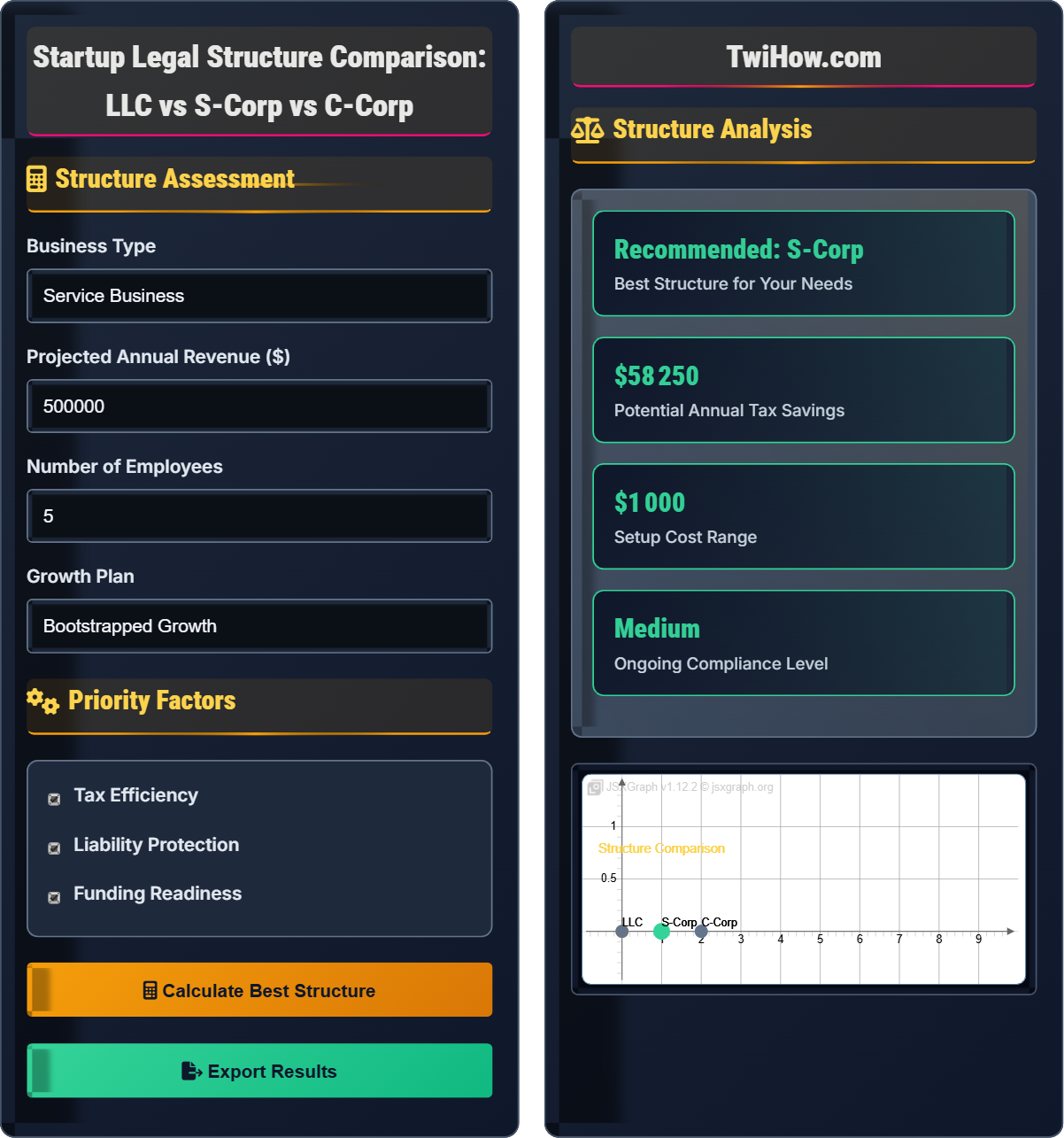
Structure Assessment
Priority Factors
Structure Analysis
| Feature | LLC | S-Corp | C-Corp |
|---|---|---|---|
| Tax Treatment | Pass-through | Pass-through | Double taxation |
| Liability Protection | High | High | High |
| Investor Friendly | Low | Medium | High |
| Compliance | Low | Medium | High |
| Profit Distribution | Flexible | Proportional | Dividends |
Legal Structures for Startups
An LLC combines the liability protection of a corporation with the tax benefits of a partnership. It's a popular choice for small businesses and startups due to its flexibility and simplicity.
Key Features:
1. Pass-through Taxation: Profits and losses pass through to owners' personal tax returns
2. Liability Protection: Personal assets protected from business debts
3. Management Flexibility: Can be managed by members or managers
4. Operational Freedom: Fewer formalities than corporations
5. Flexible Profit Distribution: Not bound by ownership percentage
An S-Corp is a tax election that allows corporations to be treated as pass-through entities for tax purposes. It provides liability protection while avoiding double taxation.
Key Features:
• Pass-through Taxation: No corporate income tax
• Self-Employment Tax Savings: Owners can take salary plus distributions
• Shareholder Limitations: Maximum 100 shareholders, all must be US citizens
• One Class of Stock: Limited flexibility in equity structure
• Corporate Formalities: Requires board meetings, minutes, etc.
Comparing the three structures across key dimensions:
- Tax Efficiency: LLC and S-Corp avoid double taxation; C-Corp is subject to it
- Liability Protection: All three provide strong personal asset protection
- Growth Potential: C-Corp best for raising capital; LLC least flexible
- Compliance Burden: LLC has lowest requirements; C-Corp has highest
- Investor Appeal: C-Corp preferred by institutional investors
- Equity Flexibility: C-Corp allows multiple stock classes; S-Corp is most restrictive
- Early Stage: LLC for simplicity and tax efficiency
- Seeking Investment: C-Corp for investor preference
- Owner Salary: S-Corp for self-employment tax savings
- Future IPO: C-Corp is required
- International Expansion: C-Corp provides more flexibility
- Employee Equity: C-Corp handles stock options better
- Operational Flexibility: LLC offers most freedom
- Transition Capability: LLC can convert to corporation later
Structure Fundamentals
LLC, S-Corp, C-Corp, pass-through taxation, double taxation, limited liability, corporate formalities, shareholder limitations.
Optimal Structure = (Tax Efficiency × Liability Protection × Growth Flexibility) ÷ (Compliance Burden + Transition Costs)
Where Tax Efficiency = tax savings potential, Growth Flexibility = ability to scale and raise capital.
- LLC provides most operational flexibility
- S-Corp offers self-employment tax savings
- C-Corp is required for public trading
- Conversion between structures has tax implications
- State laws may vary significantly
Tax Implications
Pass-through taxation, corporate tax, self-employment tax, dividend taxation, capital gains.
- LLC Taxation: Profits flow directly to owners' tax returns
- S-Corp Taxation: Profits pass through, but salary subject to payroll tax
- C-Corp Taxation: Double taxation on profits and dividends
- Self-Employment Tax: S-Corp owners can reduce by taking salary plus distributions
- Capital Gains: Long-term gains on equity sales
- S-Corp requires reasonable salary for owner-employees
- LLC members pay self-employment tax on all profits
- C-Corp allows for more sophisticated tax planning
- State tax treatment may differ from federal
Follow this systematic approach to choose the right legal structure:
Business Structure Learning Quiz
Which business structure is subject to "double taxation" where the business pays taxes on profits and owners pay taxes again on dividends?
C-Corporations are subject to "double taxation." The corporation pays corporate income tax on its profits, and when those profits are distributed to shareholders as dividends, the shareholders must also pay personal income tax on those dividends. This results in the same income being taxed twice.
LLCs and S-Corps are pass-through entities, meaning profits and losses flow directly to the owners' personal tax returns, avoiding double taxation.
The answer is C) C-Corp.
Double taxation is a significant disadvantage of C-Corp structure and is a primary reason why many small businesses choose pass-through entities. However, C-Corps offer other advantages like unlimited growth potential and investor preference that may outweigh the tax disadvantage for certain businesses.
Double Taxation: Taxation of the same income at both corporate and personal levels
Pass-through Entity: Business structure where income flows to owners' tax returns
Corporate Income Tax: Tax paid by corporation on its profits
• C-Corps face double taxation
• LLCs and S-Corps avoid double taxation
• Tax implications significantly affect business profitability
• Consider retained earnings vs. distributed profits
• Evaluate reinvestment needs vs. owner distributions
• Compare total tax burden across structures
• Not understanding double taxation implications
• Assuming all structures have same tax treatment
• Not considering long-term tax impact
Explain how an S-Corp can provide self-employment tax savings for business owners compared to an LLC, and what requirements must be met to realize these savings.
Self-Employment Tax Comparison:
LLC Members: Pay self-employment tax (Social Security and Medicare) on all business profits. For 2023, this is 15.3% on the first $160,200 of net earnings.
S-Corp Owners: Only pay self-employment tax on their salary, not on distributions or dividends. They can take a reasonable salary plus profit distributions.
Example: For a business with $200,000 in profits:
• LLC: Owner pays ~$15,300 in self-employment tax on all profits
• S-Corp: Owner takes $100,000 salary (subject to payroll tax) and $100,000 distributions (not subject to self-employment tax), saving approximately $7,650 in self-employment tax.
Requirements:
1. Reasonable Salary: Must pay yourself a reasonable salary for services rendered
2. Payroll Compliance: Must follow all payroll tax requirements
3. Proper Documentation: Must document the salary vs. distribution distinction
Failure to pay reasonable salary can result in IRS reclassification of distributions as salary.
This tax strategy works because S-Corp owners are employees of their corporation and only pay payroll taxes on their wages, not on profit distributions. This can result in significant tax savings, especially for profitable businesses. However, it requires careful compliance with salary requirements.
Self-Employment Tax: Social Security and Medicare taxes for self-employed individuals
Reasonable Salary: Appropriate compensation for services rendered
Profit Distribution: Share of business profits beyond salary
• S-Corp owners must receive reasonable salary
• Distributions are not subject to self-employment tax
• IRS scrutinizes salary levels for S-Corp owners
• Research industry salary benchmarks
• Document salary decisions carefully
• Consult tax professional for optimal salary
• Taking unreasonably low salary to avoid payroll taxes
• Not following proper payroll procedures
• Failing to document salary rationale
TechStart Inc. is a software company founded by three entrepreneurs planning to seek Series A funding from venture capital firms. They currently operate as an LLC but are considering converting to a C-Corp. The founders expect to raise $5 million in their Series A round and eventually plan to go public. What are the advantages of converting to a C-Corp for their funding and growth plans, and what are the potential drawbacks they should consider?
Advantages of C-Corp Conversion:
1. Investor Preference: VC firms typically invest only in C-Corps due to legal and tax structures familiar to institutional investors.
2. Equity Flexibility: C-Corps can issue multiple classes of stock (preferred, common, different voting rights), essential for venture funding rounds.
3. Employee Equity: Better structure for stock option plans, restricted stock units, and other equity compensation that attracts talent.
4. Growth Scalability: Unlimited number of shareholders allowed, unlike S-Corp's 100-shareholder limit.
5. International Operations: More suitable for global expansion and foreign investment.
6. Public Offering Readiness: C-Corp is required for public trading.
Potential Drawbacks:
1. Double Taxation: Corporate profits are taxed at both corporate and personal levels when distributed.
2. Compliance Burden: More extensive governance requirements, board meetings, documentation, and reporting.
3. Conversion Costs: Legal and tax implications of converting from LLC to C-Corp.
4. Operational Complexity: More formal management structure required.
For TechStart Inc.'s specific situation with planned VC funding and public offering, the advantages of C-Corp structure clearly outweigh the disadvantages.
This scenario illustrates how business goals drive structure selection. While C-Corp has tax disadvantages, the strategic advantages for high-growth companies seeking institutional investment make it the preferred choice. The conversion timing is crucial and should occur before the funding round.
Series A Funding: First institutional round of venture capital financing
Preferred Stock: Stock with preferential rights over common stock
Stock Option Plan: Employee compensation through equity grants
• VC firms typically invest only in C-Corps
• Conversion has significant tax implications
• Convert before funding rounds to avoid complications
• Consider timing of conversion carefully
• Consult with startup attorneys and tax advisors
• Attempting to raise VC funding as LLC
• Converting after funding commitment
• Not understanding conversion tax implications
A small consulting firm currently operates as an LLC with $750,000 in annual revenue and 3 employees. The owners are considering converting to an S-Corp to save on self-employment taxes. What factors should they consider in making this decision, and what are the potential costs and benefits of the conversion?
Benefits of S-Corp Election:
1. Self-Employment Tax Savings: With $750,000 in revenue, assuming reasonable profit margins, the owners could save significant amounts on self-employment taxes by taking salary plus distributions.
2. Perpetual Existence: S-Corp provides continuity regardless of owner changes.
3. Credibility: Some clients prefer dealing with incorporated entities.
Considerations for Conversion:
1. Compliance Requirements: S-Corps require more formalities than LLCs (board meetings, minutes, resolutions).
2. Reasonable Salary Requirement: Owners must pay themselves reasonable salaries, which subjects that income to payroll taxes.
3. Shareholder Limitations: Maximum of 100 shareholders, all must be US citizens/residents.
4. Stock Restrictions: Only one class of stock allowed.
5. Conversion Costs: Legal fees, accounting setup, and administrative costs.
6. Tax Complexity: More complex tax returns and payroll requirements.
For this consulting firm, the tax savings might justify the conversion if the owners have substantial profit distributions. However, they should weigh the administrative burden against the expected tax savings.
This scenario highlights the trade-offs between different business structures. The tax benefits of S-Corp status must be weighed against increased administrative requirements. The decision should be based on quantitative analysis of tax savings versus compliance costs.
S-Corp Election: Tax status election using Form 2553
Reasonable Compensation: Appropriate salary for services rendered
Administrative Burden: Ongoing compliance and paperwork requirements
• S-Corp election must be made timely
• Reasonable salary requirement is strictly enforced
• S-Corp has specific eligibility requirements
• Calculate break-even point for conversion
• Consider projected growth in calculations
• Consult tax professional before conversion
• Not calculating actual tax savings accurately
• Underestimating compliance costs
• Failing to pay reasonable salary
Which of the following is a restriction that applies to S-Corporations but NOT to C-Corporations?
S-Corporations are restricted to having only one class of stock, which limits their flexibility in structuring equity arrangements. This is a significant restriction that does not apply to C-Corporations, which can issue multiple classes of stock with different rights and preferences.
All other options (board meetings, bylaws, registered agent) are requirements for both S-Corps and C-Corps. The one-class-of-stock restriction is unique to S-Corps and is one of the main reasons why high-growth companies seeking investment often choose C-Corp structure.
The answer is B) Limitation to one class of stock.
This restriction significantly impacts S-Corp's ability to accommodate different types of investors. C-Corps can issue preferred stock with special rights (voting, liquidation preferences, anti-dilution) that are attractive to investors, while S-Corps cannot differentiate between shares.
Class of Stock: Type of equity with specific rights and privileges
Preferred Stock: Stock with preferential rights over common stock
Anti-dilution Rights: Protection against share value dilution
• S-Corps can only have one class of stock
• C-Corps can have multiple stock classes
• Stock class restrictions affect investor appeal
• Consider investor needs when choosing structure
• Evaluate equity flexibility requirements
• Plan for future funding rounds
• Not understanding stock class limitations
• Assuming all corporate structures are identical
• Overlooking investor preference implications
FAQ
Q: Can I change my business structure later if I start with an LLC?
A: Yes, you can convert from an LLC to a corporation, but it can be complex and costly. The conversion process involves:
1. Legal Filing: Filing articles of incorporation for the new corporation
2. Asset Transfer: Transferring all LLC assets to the corporation
3. Tax Implications: Potential tax consequences depending on the conversion method
4. Liability Considerations: Ensuring continuity of liability protection
5. Operational Changes: Establishing corporate governance structure
While possible, it's generally better to choose the right structure from the beginning. If you anticipate needing to raise significant investment or go public, starting with a C-Corp may be more efficient.
Q: What are the typical costs of forming each business structure?
A: Formation costs vary by state but generally follow this pattern:
LLC: $50-$500 for filing fees, plus potential registered agent fees ($100-$300 annually). Legal assistance may cost $500-$2,000.
S-Corp: Same as C-Corp formation costs, plus the cost of filing Form 2553 with the IRS (free), but you must first form a C-Corp.
C-Corp: $100-$800 for filing fees, plus registered agent fees. Legal assistance typically $1,000-$5,000 for proper setup.
Ongoing Costs: LLCs generally have lower ongoing costs (annual reports, franchise taxes), while C-Corps have higher compliance costs (more extensive reporting, audit requirements).
These are estimates and can vary significantly by state and complexity of formation.
Q: Do I need a lawyer to form my business structure?
A: While not legally required, it's highly recommended, especially for:
• Multi-member businesses: Operating agreements and equity arrangements
• Businesses with significant assets: Proper liability protection
• Companies planning to raise investment: Proper corporate structure
• Complex ownership arrangements: Vesting schedules, exit provisions
For simple single-member LLCs, you might manage without a lawyer, but for any complex situation, professional guidance is invaluable. The cost of a few hundred dollars for legal assistance can prevent thousands in future problems or tax penalties.