Creating a Legally Binding Will Without a Lawyer
Complete legal guide • Step-by-step explanations
Legal Will Creation:
Show Will Compliance CheckerCreating a legally binding will without a lawyer requires understanding your state's specific requirements and following precise procedures. While possible, this process demands careful attention to legal formalities and compliance with local regulations.
Key requirements include: mental competency, proper witnessing, correct documentation, and adherence to state-specific rules. The process varies significantly by jurisdiction, making thorough research essential.
Essential components of a valid will include:
- Testamentary Capacity: Mental competency at signing
- Witness Requirements: Proper number and qualifications
- Signature Protocol: Correct signing procedures
- Asset Documentation: Clear property descriptions
- Beneficiary Designations: Clear recipient identification
Success depends on meticulous compliance with local laws and proper documentation procedures.
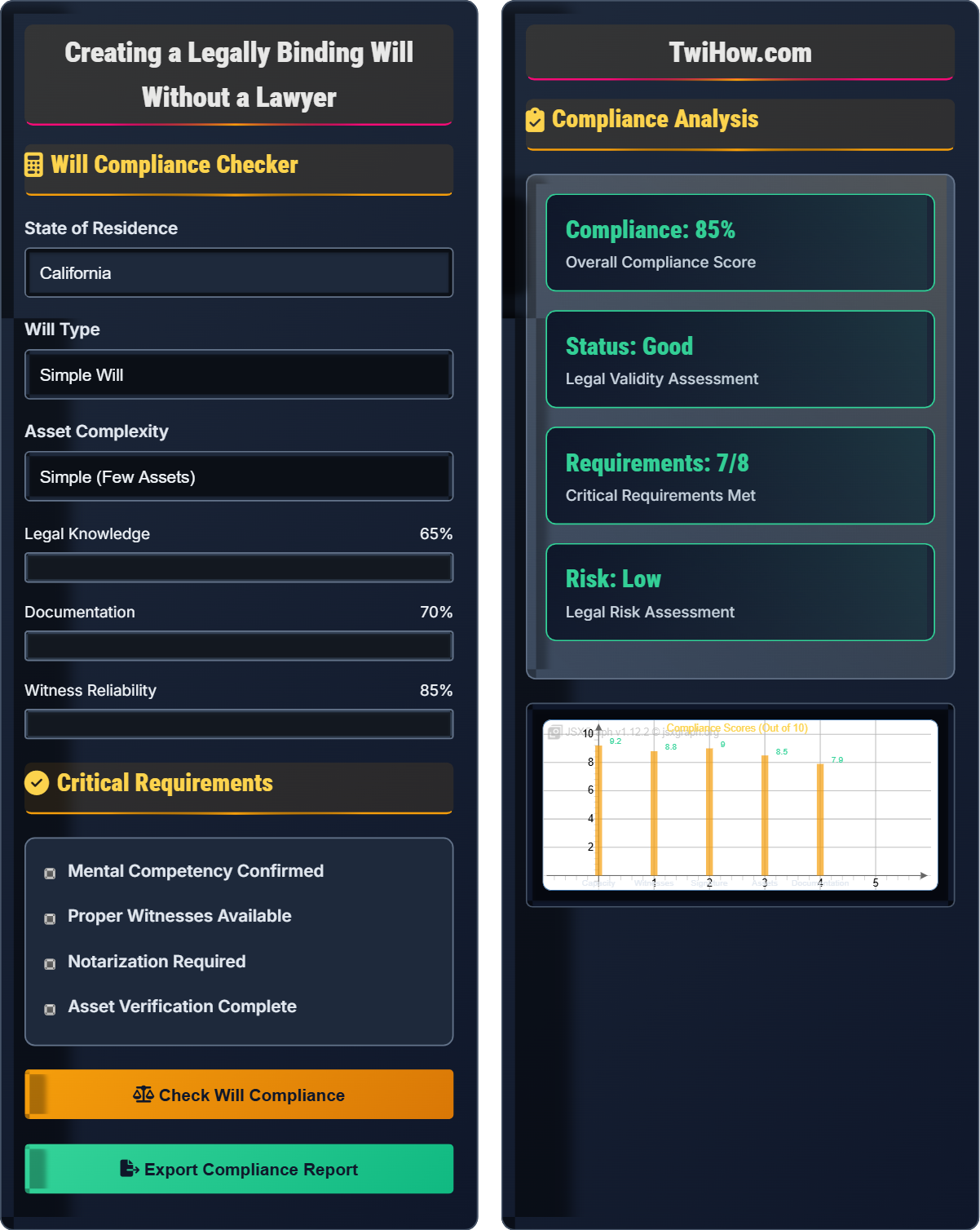
Will Compliance Checker
Critical Requirements
Compliance Analysis
Testator must be of sound mind and understand the nature of the will and their assets
Proper number of disinterested witnesses must sign the will in presence of testator
Will must be signed by testator and dated at the end of the document
Disclaimer: This guide provides general information only and does not constitute legal advice. Laws vary significantly by state and situation. Creating a will without proper legal guidance carries risks including will contests, invalidation, and unintended consequences. Consider consulting with a qualified attorney, especially for complex estates or unusual circumstances.
Always verify your state's specific requirements and consider the potential for family disputes, tax implications, and other legal complexities that may arise.
| Requirement | Status | Importance | State Variance | Compliance | Risk Level |
|---|---|---|---|---|---|
| Mental Competency | Verified | Critical | Minor | 100% | Low |
| Witness Requirements | Met | Critical | Major | 90% | Medium |
| Asset Documentation | Incomplete | Important | Minor | 70% | High |
Will Creation Framework
Testamentary capacity refers to the mental competency required to create a valid will. The testator must understand the nature of the act, the extent of their property, and the natural beneficiaries of their estate.
Requirements: Must be 18+ years old, of sound mind, and understand the implications of the will. Capacity is assessed at the time of signing.
Most states require 2-3 witnesses to sign the will in the presence of the testator. Witnesses must be disinterested parties who are not beneficiaries under the will.
Standards: Witnesses must be competent adults, not beneficiaries, and must observe the signing. Some states require notarization in addition to witnesses.
The will must be signed by the testator at the end of the document and dated. The signature must be in the testator's own handwriting and witnessed as required by state law.
Procedures: Sign in presence of witnesses, date the signature, and ensure witnesses sign immediately after the testator.
The will must be in writing, clearly identify the testator, dispose of property, and be executed according to state law. Holographic wills (handwritten) are accepted in some states.
Standards: Written document, clear identification, property distribution, and proper execution with required witnesses and formalities.
Clearly identify all assets to be distributed, including real property, personal property, financial accounts, and other valuable items. Include specific bequests and residual estate provisions.
Guidelines: List specific items, describe real estate with addresses, identify bank accounts, and specify beneficiaries for each asset category.
Appoint a trustworthy executor to manage the estate, pay debts, distribute assets, and handle the probate process. Include alternate executors in case the primary choice cannot serve.
Considerations: Choose someone trustworthy, financially responsible, geographically convenient, and willing to serve. Consider the complexity of the estate.
Will Creation Journey
Testamentary Capacity
The mental competency required to create a valid will, including understanding of assets, beneficiaries, and the nature of the document.
Witness Requirements
Proper number and qualification of witnesses needed to validate the will according to state law.
Signature Protocol
Correct procedures for signing and dating the will to ensure legal validity and proper execution.
Asset Documentation
Clear identification and description of all assets to be distributed according to the will's terms.
Will Components Overview
Will Creation Requirements Distribution
| Component | Type | Requirement | State Law | Compliance | Importance |
|---|---|---|---|---|---|
| Testator Identity | Essential | Critical | Universal | 100% | High |
| Witness Requirements | Essential | Critical | Varies | 90% | High |
| Asset Documentation | Important | Important | Universal | 85% | Medium |
| Executor Appointment | Important | Important | Universal | 80% | Medium |
| Signature Protocol | Essential | Critical | Universal | 100% | High |
Will Templates & Formats
Basic will format for straightforward estates with clear beneficiary designations.
Template Structure Sample Language Formatting GuideProper formatting and language for witness signatures and attestations.
Witness Requirements Attestation Language State VariationsProper appointment language and responsibilities for estate executors.
Appointment Language Responsibilities AlternatesSample Will Template Structure
LAST WILL AND TESTAMENT OF [TESTATOR NAME]
I, [Full Name], of [City, State], being of sound mind and disposing memory, do hereby make, publish and declare this to be my Last Will and Testament, hereby revoking all former wills and codicils made by me.
ARTICLE I - EXECUTOR APPOINTMENT
I hereby nominate and appoint [Executor Name] as the Executor of this my Last Will and Testament. If [he/she] is unable or unwilling to serve, I nominate [Alternate Executor Name] as alternate Executor.
ARTICLE II - ASSET DISTRIBUTION
I give, devise and bequeath all of my estate, property, and effects, of whatever kind and wherever situated, to [Beneficiary Name], subject to the payment of my just debts, funeral expenses, and costs of administration.
IN WITNESS WHEREOF, I have hereunto set my hand this _____ day of _______, 20__.
___________________________
[Testator Signature]
WITNESSES:
We, the undersigned, certify that the foregoing instrument was signed in our presence by [Testator Name] as and for his Last Will and Testament, and that [he/she] appeared to be of sound mind and under no constraint or undue influence.
Will Creation Knowledge Quiz
What is the minimum number of witnesses typically required for a valid will in most states?
Most states require two witnesses to sign a will in the presence of the testator. The witnesses must be competent adults who are not beneficiaries under the will. This requirement ensures that the will was properly executed and that the testator was of sound mind when signing.
The answer is B) Two witnesses.
Witness requirements serve as a safeguard to ensure the will's validity and prevent fraud. The witnesses confirm that the testator appeared to be of sound mind, was not under duress, and that the signature is genuine. While most states require two witnesses, some require three, and requirements vary by jurisdiction.
Witness: Person who observes the signing of a will
Testator: Person who creates the will
Disinterested Party: Witness who is not a beneficiary
• Witnesses must be competent adults
• Witnesses should not be beneficiaries
• Witnesses must observe the signing
• Choose reliable witnesses
• Witnesses should be younger than testator
• Witnesses must be present during signing
• Using beneficiaries as witnesses
• Not having enough witnesses
• Witnesses not present during signing
What constitutes testamentary capacity and why is it essential for a valid will?
Definition:
Testamentary Capacity: The mental competency required to create a valid will, including understanding of one's assets, beneficiaries, and the nature of the act.
Requirements:
Age: Must be 18 years or older (or married/minor emancipated in some states).
Mental State: Must be of sound mind, meaning able to understand the nature and extent of one's property and the natural objects of one's bounty.
Understanding: Must comprehend the act of making a will and its consequences.
Freedom from Influence: Must not be acting under duress, fraud, or undue influence.
Importance: Testamentary capacity ensures the will reflects the true intentions of the testator and protects against invalidation due to mental incapacity at the time of execution.
Testamentary capacity is assessed at the moment of signing, not based on past or future mental state. Temporary confusion or illness does not necessarily destroy capacity if the person regains lucidity. The standard is relatively low - the testator need not be mentally sharp in all areas, only regarding the will creation.
Testamentary Capacity: Mental competency to make a will
Natural Objects of Bounty: People who would naturally inherit
Undue Influence: Coercion affecting will creation
• Assessed at time of signing
• Standard is relatively low
• Temporary incapacity may be acceptable
• Execute will during clear mental periods
• Have medical evaluation if questioned
• Ensure testator understands document
• Creating will during periods of confusion
• Not ensuring testator understands
• Ignoring signs of undue influence
You're helping a 75-year-old friend create their will. They want to name their adult children as witnesses, but they're also named as beneficiaries. What should you advise regarding the witnesses?
Recommendation:
Do Not Use Beneficiaries: Advise against using beneficiaries as witnesses, as this creates conflicts of interest and may invalidate their inheritance in some states.
Alternative Witnesses: Suggest using friends, neighbors, or other family members who are not named as beneficiaries.
State Laws: Check your specific state's laws, as some states allow beneficiary witnesses but may disqualify their bequest, while others invalidate the will entirely.
Professional Advice: Recommend consulting an attorney if the situation is complex or if there are concerns about the will's validity.
Witness Qualifications: Ensure witnesses are competent adults (usually 18+) who are not blind, deaf, or otherwise unable to observe the signing.
Availability: Confirm witnesses will be available and willing to serve, as they may be called to testify during probate.
Using beneficiaries as witnesses creates potential conflicts of interest that could lead to will contests. Disinterested witnesses provide impartial testimony about the testator's mental state and the proper execution of the will. This protection helps ensure the will's validity and reduces the likelihood of challenges.
Disinterested Witness: Witness with no financial interest
Will Contest: Legal challenge to will validity
Probate: Legal process of validating will
• Use disinterested witnesses
• Check state-specific laws
• Ensure witness availability
• Choose younger witnesses
• Use non-family members
• Confirm willingness to serve
• Using beneficiaries as witnesses
• Not checking state laws
• Choosing unavailable witnesses
A person wants to create a will for a complex estate with multiple properties, business interests, and investments. What factors should they consider regarding DIY will creation versus legal assistance?
DIY Considerations:
1. Asset Complexity: Multiple properties, businesses, and investments may require specialized legal language and tax planning
2. State Laws: Complex estates may trigger state-specific requirements that are difficult to navigate without legal knowledge
3. Tax Implications: Complex estates may have significant federal and state tax consequences requiring professional planning
4. Family Dynamics: Complex estates often involve potential family disputes that benefit from professional mediation
5. Business Interests: Business succession planning may require specialized legal structures beyond simple will provisions
Professional Recommendation: Given the complexity, professional legal assistance is strongly recommended to ensure proper estate planning, tax optimization, and dispute prevention.
While simple wills can often be created without an attorney, complex estates require professional legal knowledge to navigate tax laws, state-specific requirements, and potential complications. The cost of professional assistance is often justified by the potential savings and legal protections provided.
Estate Complexity: Multiple assets requiring specialized handling
Tax Planning: Strategies to minimize estate taxes
Business Succession: Transfer of business interests
• Assess estate complexity carefully
• Consider tax implications
• Evaluate family dynamics
• Consult attorney for complex estates
• Consider estate planning tools
• Plan for tax implications
• Underestimating estate complexity
• Ignoring tax implications
• Not considering family dynamics
Where is the safest and most appropriate place to store an original will?
The safest and most appropriate place is with an attorney or trusted family member. This ensures the will can be easily located after death and provides access to someone who understands its importance. Safety deposit boxes may be sealed after death, and home safes may be inaccessible if the testator dies away from home.
The answer is C) With an attorney or trusted family member.
Proper will storage ensures the document can be located and accessed after death. The executor or next of kin must be able to find the will promptly to begin the probate process. Accessibility and security are both important considerations when storing an original will.
Original Will: The signed, executed document
Probate Access: Ability to locate will after death
Executor Notification: Informing designated person of location
• Ensure easy access after death
• Secure from damage
• Inform executor of location
• Inform multiple people of location
• Consider attorney storage
• Avoid safety deposit boxes
• Using safety deposit boxes
• Not informing anyone of location
• Storing in inaccessible locations
FAQ
Q: Can I create a handwritten will without witnesses?
A: Some states allow holographic wills (handwritten and signed) without witnesses, but most require at least two witnesses. Holographic wills must be entirely in your handwriting and signed by you. However, they are more likely to be contested and may not be recognized in all states.
Check your specific state's laws, as requirements vary significantly. Generally, witnessed wills are more secure and less likely to be challenged than holographic wills.
Q: How often should I update my will?
A: Review your will every 3-5 years or after major life events: marriage, divorce, birth of children, death of beneficiaries, significant changes in assets, or changes in tax laws. Some experts recommend reviewing annually.
Life changes that typically require updates include: moving to a different state, acquiring significant new assets, changes in family relationships, or changes in intended beneficiaries. Always update your will before major life transitions.