How to Create a Living Trust and Is It Necessary?
Complete estate planning guide • Step-by-step instructions
Living Trust Overview:
Trust CalculatorA living trust is a legal document that allows you to place your assets under the management of a trustee for the benefit of yourself and others. Unlike a will, a living trust takes effect while you're alive and can help avoid probate, maintain privacy, and provide seamless asset management during incapacity.
Key benefits include:
- Probate Avoidance: Assets transfer without court involvement
- Privacy Protection: Terms remain confidential unlike wills
- Incident Management: Continues functioning during incapacity
- Tax Benefits: Potential estate tax savings for larger estates
Whether you need a living trust depends on your assets, family situation, and state laws. While beneficial for many, it may not be necessary for everyone.
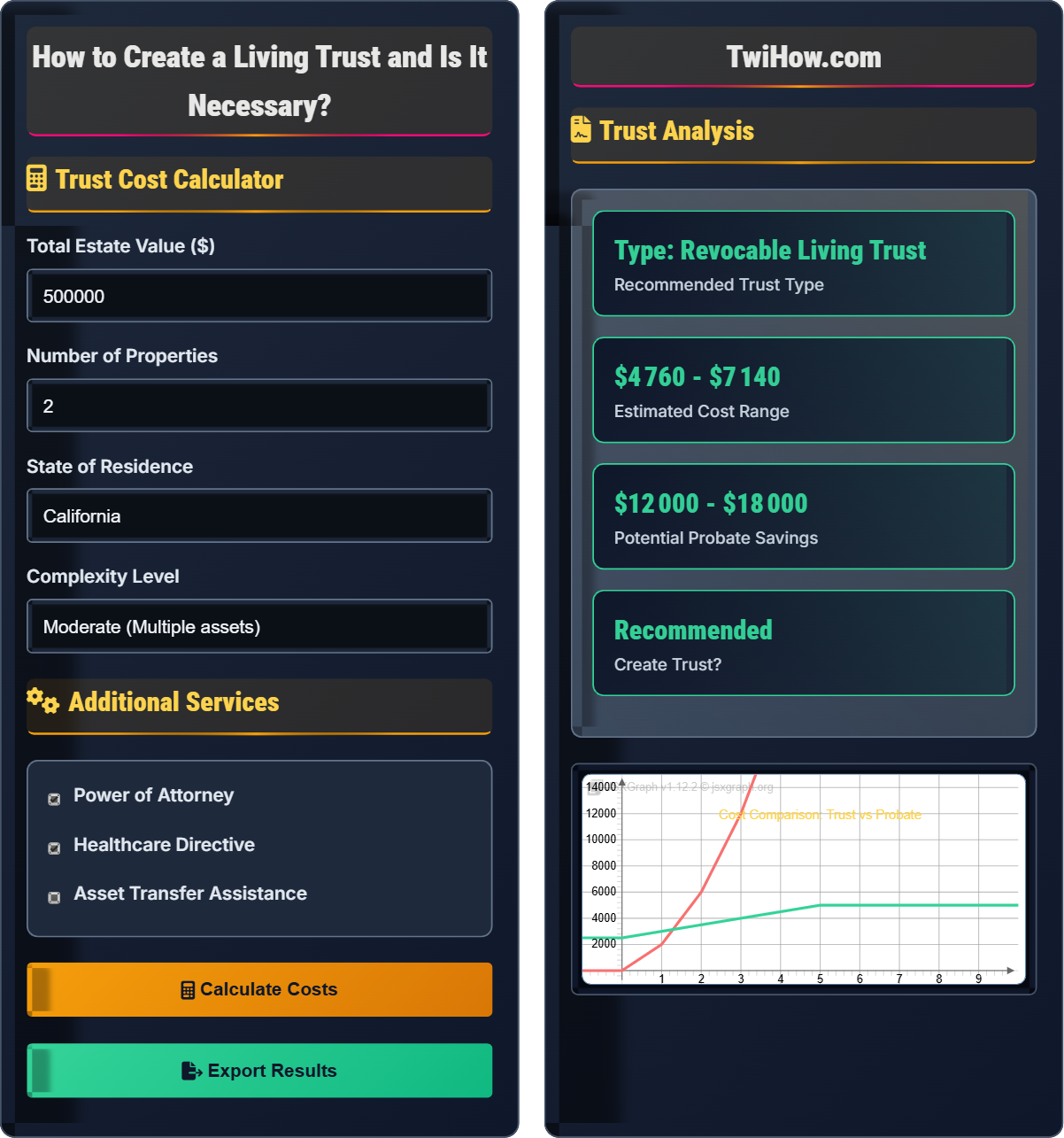
Trust Cost Calculator
Additional Services
Trust Analysis
| Factor | Score | Impact | Recommendation |
|---|---|---|---|
| Estate Size | High | +$20,000 | Strong |
| Property Count | Medium | +$10,000 | Moderate |
| State Laws | High | +$15,000 | Strong |
| Family Complexity | Medium | +$8,000 | Moderate |
Understanding Living Trusts
A living trust (also called an inter vivos trust) is a legal entity created during your lifetime that holds ownership of your assets. You transfer your property to the trust, which is managed by a trustee for the benefit of beneficiaries. You can serve as both the trustee and beneficiary during your lifetime.
There are two main types of living trusts:
- Revocable Living Trust: Can be changed or revoked during your lifetime
- Irrevocable Living Trust: Cannot be changed once established
The person who creates the trust and transfers assets into it.
The person or institution responsible for managing the trust assets according to the trust terms.
The person(s) who receive benefits from the trust assets.
The person designated to manage the trust if the original trustee becomes unable to serve.
Determine whether a revocable or irrevocable trust best meets your needs based on your goals for asset protection, tax benefits, and flexibility.
Choose a primary trustee (often yourself) and successor trustees who will manage the trust if you become incapacitated or pass away.
Work with an attorney to create a comprehensive trust agreement that specifies terms, beneficiaries, distribution guidelines, and trustee powers.
Transfer ownership of your assets (real estate, bank accounts, investments) to the trust by changing titles and beneficiary designations.
Keep the trust updated with new assets and review periodically to ensure it continues to meet your goals.
Assets in the trust transfer directly to beneficiaries without going through probate court.
Trust terms remain private, unlike wills which become public record during probate.
Successor trustees can manage assets if you become unable to do so.
Beneficiaries receive assets more quickly compared to probate proceedings.
You may benefit from a living trust if you:
- Own real estate in multiple states
- Have significant assets subject to probate
- Want to maintain privacy about your estate
- Are concerned about potential incapacity
- Have a blended family or complex beneficiary situation
- Live in a state with expensive or lengthy probate proceedings
Trust vs Will Comparison
- Avoids probate court proceedings
- Maintains complete privacy
- Provides seamless management during incapacity
- Allows immediate asset distribution
- Can be structured for tax benefits
- Better control over asset distribution timing
- Higher initial setup costs
- Requires ongoing maintenance
- More complex to fund properly
- No creditor protection for revocable trusts
- May require additional legal documents
- Doesn't protect against all taxes
Creating a living trust involves various costs depending on complexity and location. Here's a breakdown of typical expenses:
Decision Making Framework
Trust Simulation Scenarios
John owns a home in California worth $800,000 and a vacation property in Nevada worth $400,000. He has $300,000 in investment accounts and wants to ensure smooth transfer to his children.
With Trust: Assets transfer directly to beneficiaries without probate in either state, saving significant time and money while maintaining privacy.
Sarah, age 65, has two adult children and significant assets. She's concerned about what would happen if she became unable to manage her affairs due to illness.
With Trust: Her successor trustee immediately assumes control of assets according to predetermined instructions, avoiding court intervention and maintaining privacy.
Michael is a successful business owner who wants to keep his estate details private and ensure his assets go directly to his children without public scrutiny.
With Trust: All estate details remain private, with only beneficiaries knowing the contents and distribution plans.
Living Trust Learning Quiz
What is the key difference between a revocable and irrevocable living trust?
The primary difference between revocable and irrevocable living trusts is the ability to modify them. A revocable living trust can be amended, modified, or revoked by the grantor during their lifetime, providing maximum flexibility. An irrevocable living trust, once established, cannot be changed without the consent of the beneficiaries or special circumstances.
The answer is B) Revocable trusts can be changed; irrevocable cannot.
Understanding the difference between revocable and irrevocable trusts is fundamental to estate planning. Revocable trusts offer flexibility during your lifetime but don't provide asset protection from creditors or tax benefits. Irrevocable trusts offer stronger asset protection and potential tax advantages but require giving up control over the assets.
Revocable Trust: A trust that can be modified or terminated by the grantor
Irrevocable Trust: A trust that cannot be changed once established
Grantor: The person who creates and funds the trust
• Revocable trusts maintain flexibility during lifetime
• Irrevocable trusts provide asset protection
• Both avoid probate if properly funded
• Most people start with revocable trusts for flexibility
• Consider irrevocable trusts for asset protection
• Consult an attorney for complex situations
• Assuming all trusts are the same type
• Not understanding the trade-offs
• Choosing type without considering goals
Explain the process of funding a living trust and why it's critical for the trust to be effective. What happens if assets are not properly transferred to the trust?
Funding Process: Funding a living trust involves transferring ownership of assets from your individual name to the name of the trust. This includes:
• Real estate: Recording new deeds with the trust as owner
• Bank accounts: Changing account titles to the trust name
• Investment accounts: Transferring ownership to the trust
• Personal property: Updating titles and registrations
Critical Importance: Assets not titled in the trust name must still go through probate, defeating the purpose of having a trust.
Consequences of Improper Funding: Assets outside the trust will require probate, potentially negating the time and cost savings of the trust.
Funding is often the most overlooked aspect of trust creation. Many people create a trust but fail to transfer their assets into it, rendering the trust ineffective. The trust only controls assets that are officially owned by the trust. This is why ongoing maintenance and periodic reviews are essential.
Funding: The process of transferring assets to the trust
Proper Funding: Ensuring all intended assets are titled in trust name
Probate Assets: Assets that must go through court proceedings
• Trust only controls assets in its name
• Ongoing funding is required for new assets
• Some assets don't need to be funded (retirement accounts)
• Create an asset inventory before funding
• Work with financial institutions for account transfers
• Update beneficiary designations appropriately
• Creating trust but not funding it
• Forgetting to update new asset titles
• Not understanding which assets to fund
Robert has an estate valued at $750,000 in California, including a house worth $600,000 and investment accounts totaling $150,000. He's considering creating a living trust. Calculate the potential costs and savings, and determine if a trust is financially beneficial for Robert.
Trust Creation Costs: $2,000 - $4,000 for a revocable living trust in California
Probate Costs (without trust): California law allows attorneys' fees of 4% of the first $100,000 + 3% of next $100,000 + 2% of next $500,000 = $18,000 + filing fees of $1,000-$2,000 = Total $19,000-$20,000
Net Savings: $19,000 - $20,000 (probate costs) - $2,000 - $4,000 (trust costs) = $13,000 - $18,000 in savings
Additional Benefits: Privacy, faster distribution, and incapacity planning.
Conclusion: For Robert, creating a living trust is financially beneficial with potential savings of $13,000-$18,000 plus non-monetary benefits.
Cost-benefit analysis is crucial when deciding on estate planning tools. In states with high probate costs like California, the financial benefits of a living trust often justify the initial expense. The break-even point varies by state, but for estates over $200,000 in expensive probate states, trusts are typically cost-effective.
Probate Costs: Court fees and attorney fees for estate administration
Break-even Point: Estate value where trust benefits equal costsFee Structure: State-specific calculations for probate costs
• Higher estate values increase probate costs
• State laws significantly affect costs
• Non-financial benefits also matter
• Research your state's probate fee structure
• Consider estate growth over time
• Factor in non-financial benefits
• Ignoring state-specific probate costs
• Only considering upfront costs
• Not accounting for estate appreciation
Susan created a revocable living trust and named her daughter as successor trustee. Susan becomes incapacitated and the trust contains real estate, bank accounts, and investment portfolios. Describe the trustee's responsibilities and the administrative process.
Immediate Actions: Daughter must verify her authority as successor trustee by presenting the trust document to financial institutions.
Administrative Responsibilities:
1. Manage day-to-day finances and pay bills
2. Maintain real estate and insurance coverage
3. Continue investment management
4. Keep detailed records of all transactions
5. File any required tax returns
Process: Unlike probate, no court supervision is required. Daughter acts under the trust's authority to manage assets for Susan's benefit during incapacity.
Upon Death: Distribute assets according to trust terms without probate.
Trust administration during incapacity demonstrates the practical advantage of living trusts. The successor trustee can immediately step in without court approval, ensuring continuity of financial management. This contrasts sharply with guardianship proceedings which are public, expensive, and time-consuming.
Successor Trustee: Person designated to manage trust upon incapacity or death
Trust Administration: Managing trust assets according to trust terms
Capacity: Legal ability to make decisions
• Trustee must follow trust terms exactly
• Fiduciary duty to act in beneficiaries' best interests
• No court supervision required
• Prepare trustee with education and documentation
• Maintain organized records
• Consult professionals when needed
• Not preparing successor trustee adequately
• Mixing personal and trust funds
• Failing to keep proper records
Which of the following is a limitation of a revocable living trust?
A revocable living trust does not provide protection from creditors because the grantor retains control over the assets. Since the trust can be revoked or modified at any time, creditors can still access the assets to satisfy debts. This is in contrast to irrevocable trusts, which generally do provide creditor protection because the grantor has given up control.
The answer is B) Does not provide creditor protection.
One of the most important limitations of revocable trusts is the lack of creditor protection. Because the grantor maintains control, the IRS and creditors treat the assets as belonging to the grantor. For asset protection, irrevocable trusts or other strategies are needed. This is a crucial distinction that many people don't understand when choosing between trust types.
Creditor Protection: Legal shield preventing creditors from accessing assets
Control Retention: Maintaining authority over trust assets
Asset Protection: Strategies to safeguard wealth
• Revocable trusts offer no creditor protection
• Control equals ownership for legal purposes
• Irrevocable trusts may provide protection
• Understand the trade-offs between control and protection
• Consider umbrella insurance for liability protection
• Consult an attorney for complex asset protection needs
• Assuming revocable trusts protect from creditors
• Not understanding the control-protection trade-off
• Using wrong tool for asset protection goals
Frequently Asked Questions
Expert Q&A
Q: I'm 45 years old with a modest estate ($300,000). Do I really need a living trust, or would a will suffice?
A: For a $300,000 estate, the decision depends on your state's probate laws and your personal preferences:
Consider a trust if:
• You live in a state with expensive or lengthy probate (like California, New York, or Florida)
• You own real estate in multiple states
• Privacy is important to you
• You want to plan for potential incapacity
Wills may suffice if:
• You live in a state with simplified probate procedures
• You have no privacy concerns
• You're comfortable with the probate process
Many attorneys recommend trusts for estates over $200,000 in expensive probate states, as the cost savings often justify the initial expense.
Q: What happens to my retirement accounts and life insurance policies if I create a living trust?
A: Retirement accounts (401k, IRA) and life insurance policies typically should NOT be transferred to a living trust because:
1. Tax Consequences: Retirement accounts have special tax treatment that could be lost if transferred to a trust
2. Beneficiary Designations: These accounts already have direct beneficiary designations that bypass probate
3. Required Minimum Distributions: Trusts may not be eligible for favorable RMD rules
Instead, keep these accounts in your individual name but update beneficiary designations to reflect your estate plan. You can name your trust as a contingent beneficiary if desired. Always consult with a tax professional before making changes to retirement accounts.