How to Establish Legal Guardianship for a Minor
Complete legal guide • Step-by-step process
Guardianship Overview:
Show Process SimulatorLegal guardianship is a court-ordered relationship where an adult (guardian) is given legal authority to care for a minor child. This arrangement grants the guardian responsibility for the child's welfare, education, medical care, and other important decisions until the child reaches adulthood or the guardianship is terminated by court order.
Establishing legal guardianship involves several key steps: filing a petition with the appropriate court, providing required documentation, attending hearings, and receiving court approval. The process varies by jurisdiction but generally follows a standard procedure focused on the best interests of the child.
Key considerations for guardianship:
- Child's Best Interest: Courts prioritize the welfare of the minor above all else
- Parental Rights: Existing parental rights may be terminated or modified
- Legal Authority: Guardian assumes significant legal and financial responsibilities
- Court Oversight: Ongoing reporting and accountability requirements
Guardianship provides stability and legal protection for children when parents are unable to fulfill their responsibilities due to death, illness, incarceration, or other circumstances.
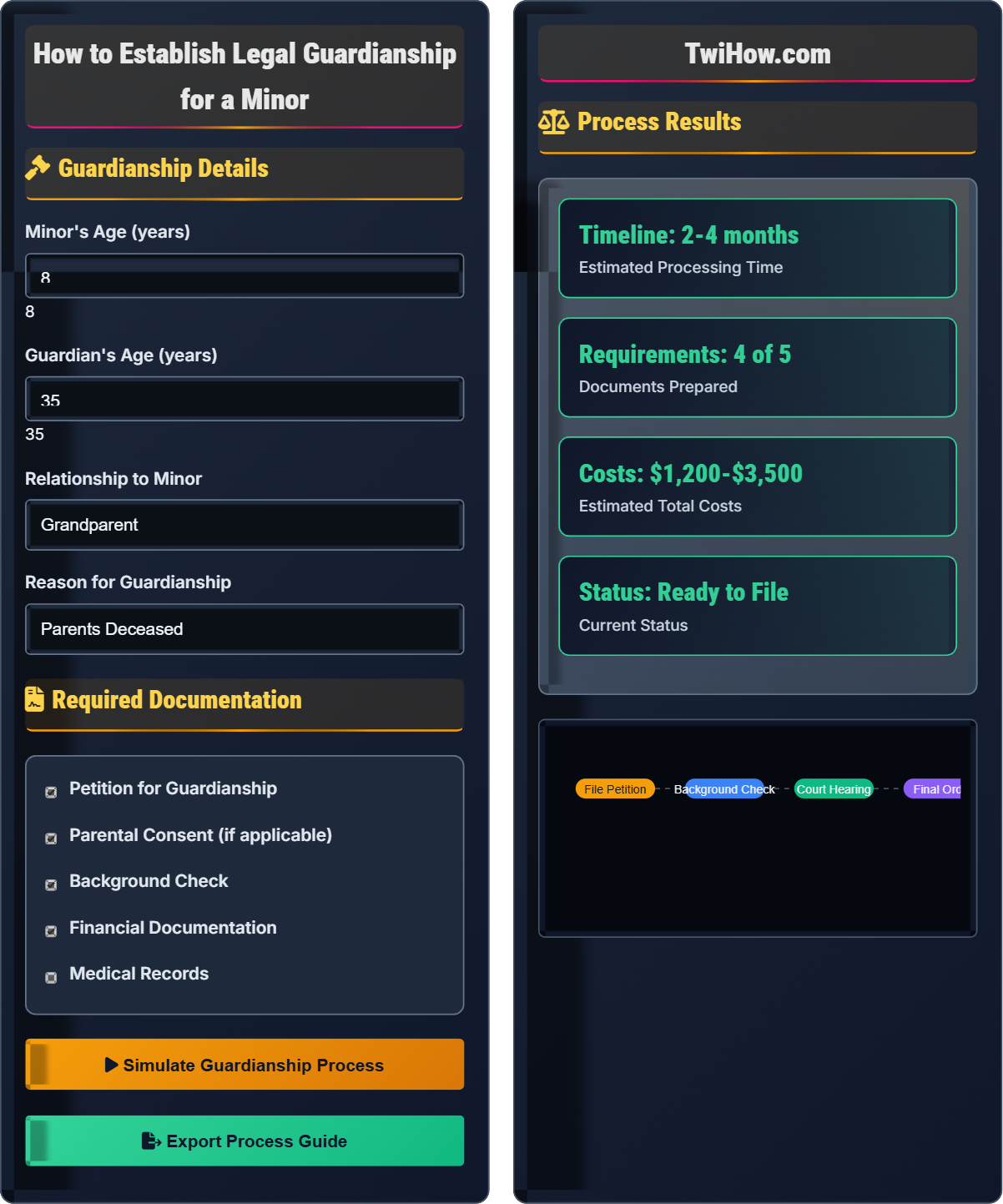
Guardianship Details
Required Documentation
Process Results
| Step | Action | Timeline | Status |
|---|---|---|---|
| 1 | File Petition | Week 1 | Ready |
| 2 | Background Check | Week 2-3 | Pending |
| 3 | Court Hearing | Month 1-2 | Scheduled |
| 4 | Home Study | Month 2-3 | Pending |
| 5 | Final Order | Month 3-6 | Pending |
Required Documents Checklist
- Petition for Guardianship
- Birth Certificate (minor)
- Background Check Results
- Financial Statements
- Proof of Residence
- Medical Records
- Parental Consent (if applicable)
- Guardian's Statement
How Legal Guardianship Works
Legal guardianship is a court-ordered relationship where an adult (the guardian) is granted legal authority to care for a minor child (the ward). The guardian assumes responsibility for the child's welfare, education, medical care, and other important decisions until the child reaches adulthood or the guardianship is terminated by court order.
It's important to distinguish legal guardianship from other arrangements:
Where:
- Adoption: Permanently transfers parental rights and creates new family relationship
- Foster Care: Temporary placement through government agency
- Temporary Custody: Short-term arrangement without full legal authority
- Legal Guardianship: Court-ordered permanent arrangement with full legal authority
As a legal guardian, you assume significant responsibilities:
- Physical Care: Providing food, shelter, clothing, and safety
- Medical Decisions: Authorizing healthcare and medical treatments
- Educational Choices: Making decisions about schooling and activities
- Financial Management: Managing the child's assets and expenses
- Legal Representation: Acting as legal representative in matters affecting the child
- Court Reporting: Filing required reports and updates with the court
- Full Guardianship: Complete legal authority over all aspects of the child's life
- Limited Guardianship: Authority restricted to specific areas (medical, educational, etc.)
- Temporary Guardianship: Short-term arrangement for specific period
- Standby Guardianship: Takes effect upon occurrence of specific event
- Successor Guardianship: Takes effect when current guardian can no longer serve
Guardianship Essentials
Legal authority, court oversight, child welfare, guardian responsibilities, court orders.
Guardianship Success = (Eligibility + Documentation + Court Approval) × Child's Best Interest
Where Eligibility = Age, Character, Financial Stability; Documentation = Required Papers; Court Approval = Hearing Outcome.
- Court must find arrangement serves child's best interest
- Guardian must be financially stable
- Background checks are mandatory
- Parental rights may be terminated
Requirements
Age 18+, financial stability, clean background, parental consent (when applicable), court approval.
- Be at least 18 years old
- Reside in the state where petition is filed
- Pass criminal background check
- Demonstrate financial stability
- Complete required training (if applicable)
- Child's wishes (depending on age)
- Existing family relationships
- Guardian's health and stability
- Long-term care plans
Guardianship Learning Quiz
Which of the following is NOT a typical requirement for becoming a legal guardian?
While having a college degree may be beneficial, it is not a legal requirement for becoming a guardian. The typical requirements include being at least 18 years old, passing background checks, demonstrating financial stability, and proving the ability to care for the child. Courts focus on the person's character, stability, and ability to provide for the child's needs rather than educational credentials.
The answer is B) Having a college degree.
Legal guardianship requirements are designed to ensure the child's safety and well-being. Courts look for individuals who can provide a stable, safe, and nurturing environment. The focus is on practical qualifications that demonstrate the ability to care for a child, not academic achievements. The key factors include age (to ensure legal capacity), character (through background checks), and financial stability (to ensure the child's needs can be met).
Legal Guardian: Adult granted legal authority to care for a minor
Ward: Minor under the care of a legal guardian
Background Check: Investigation into criminal history and character
• Guardian must be at least 18 years old
• Background checks are mandatory
• Focus on demonstrating stability and capability
• Prepare comprehensive financial documentation
• Ensure all background check requirements are met
• Assuming education level affects eligibility
• Underestimating documentation requirements
• Failing to plan for long-term care
Explain the key responsibilities of a legal guardian and describe the differences between full and limited guardianship.
Key Guardian Responsibilities:
1. Physical Care: Providing food, shelter, clothing, and ensuring the child's safety and well-being.
2. Medical Decisions: Authorizing medical care, treatments, and making healthcare decisions on behalf of the child.
3. Educational Choices: Making decisions about schooling, extracurricular activities, and educational opportunities.
4. Financial Management: Managing the child's assets, income, and expenses in the child's best interest.
5. Legal Representation: Acting as the legal representative in matters affecting the child.
6. Court Reporting: Filing required reports and updates with the court as mandated.
Full vs. Limited Guardianship:
Full Guardianship: Grants the guardian complete legal authority over all aspects of the child's life, including medical, educational, and financial decisions.
Limited Guardianship: Restricts the guardian's authority to specific areas, such as medical care only or educational decisions only, while parents retain authority in other areas.
Legal guardianship carries significant responsibilities that mirror many parental duties. The scope of these responsibilities depends on the type of guardianship ordered by the court. Full guardianship provides comprehensive authority, while limited guardianship allows for targeted decision-making authority. Courts make these determinations based on the child's best interests and the specific circumstances that necessitate guardianship.
Full Guardianship: Complete legal authority over all aspects of the child's life
Limited Guardianship: Authority restricted to specific areas of decision-making
Best Interest Standard: Legal principle prioritizing child's welfare in all decisions
• Guardian must act in child's best interest
• Financial management must benefit the child
• Court reporting requirements must be met
• Keep detailed records of all decisions and expenses
• Maintain regular communication with court officials
• Seek legal counsel for complex decisions
• Mixing personal finances with child's finances
• Failing to maintain required records
• Making decisions without considering court requirements
Sarah's sister and brother-in-law died in a car accident, leaving behind their 10-year-old daughter Emma. Sarah, who lives in another state, wants to become Emma's legal guardian. The child's paternal grandparents live nearby and also want custody. Sarah has a stable job, good income, and a safe home, but she would need to relocate Emma to another state. The grandparents have modest means but have been caring for Emma since the accident. Describe the guardianship process Sarah would need to follow and analyze the factors the court would likely consider.
Guardianship Process for Sarah:
1. Jurisdiction Determination: File petition in the state where Emma currently resides (the grandparents' state), as courts in the child's home state typically have jurisdiction.
2. Documentation: Prepare petition, financial statements, background checks, character references, and proof of ability to care for Emma.
3. Court Proceedings: Attend hearings where both parties present their cases. The court will evaluate all interested parties.
4. Home Study: Both Sarah and the grandparents may undergo home studies by social workers.
Court Factors:
• Child's Best Interest: Primary consideration in all decisions
• Existing Relationship: Emma's attachment to grandparents vs. relationship with aunt
• Stability: Financial and emotional stability of both parties
• Child's Wishes: At 10 years old, Emma's preferences may be considered
• Geographic Continuity: Impact of relocating Emma to a new state
• Relatives' Rights: Preference often given to relatives over non-relatives
Guardianship disputes involving multiple parties require courts to carefully balance competing interests while maintaining focus on the child's welfare. The "best interest" standard guides all decisions, considering factors like existing relationships, stability, and the child's expressed preferences. Geographic considerations are particularly important as they affect continuity of care, school relationships, and community ties.
Jurisdiction: Legal authority of a court to hear a case
Home Study: Comprehensive evaluation of a potential guardian's living situationBest Interest Standard: Legal principle prioritizing child's welfare above all else
• Courts prioritize child's best interest
• Jurisdiction determined by child's residence
• All interested parties have opportunity to present case
• Prepare comprehensive documentation of stability
• Demonstrate commitment to child's continuity of care
• Consider compromise arrangements that address geographic concerns
• Filing in incorrect jurisdiction
• Underestimating importance of existing relationships
• Failing to address geographic displacement concerns
A court is considering a guardianship petition for 14-year-old Michael, whose parents are incarcerated. The potential guardians include his 22-year-old brother (recent college graduate, stable job), his 55-year-old aunt (retired teacher, modest income), and a foster family (experienced caregivers). The teenager expresses a preference to stay with his brother. Analyze the pros and cons of each option and explain how the court should weigh the various factors.
Brother's Option:
Pros: Strong emotional bond, teenager's expressed preference, young adult energy, recent family connection
Cons: Limited life experience, potential career instability, possible burden of responsibility
Aunt's Option:
Pros: Life experience, stability, teaching background suggests nurturing skills, established income
Cons: Age may limit physical activity participation, potentially shorter long-term relationship
Foster Family Option:
Pros: Professional experience with children, established support systems, proven track record
Cons: Less emotional connection, potential for multiple placements
Court Considerations:
At 14 years old, Michael's preference carries significant weight, but the court must also consider long-term stability, the guardian's ability to provide consistent care, and the child's overall development needs. The court should evaluate each candidate's ability to provide a stable, nurturing environment while considering the teenager's maturity and expressed wishes.
Court decisions in guardianship cases involve balancing multiple factors, with the child's best interest as the paramount concern. As children mature, their preferences gain greater weight in court decisions. However, practical considerations like stability, experience, and ability to provide long-term care remain crucial. Courts must consider both immediate needs and long-term development when making these important decisions.
Best Interest Standard: Legal principle prioritizing child's welfare above all else
Mature Minor Doctrine: Principle giving weight to older children's preferences
Continuity of Care: Maintaining stability in child's living situation
• Child's best interest is paramount
• Older children's preferences carry weight
• Long-term stability must be ensured
• Consider both emotional and practical factors
• Evaluate long-term sustainability of arrangements
• Assess support systems available to each candidate
• Overlooking child's expressed preferences
• Ignoring long-term stability concerns
• Focusing solely on one factor
Under what circumstances can a legal guardianship be terminated?
All of the listed circumstances can lead to termination of legal guardianship. Guardianship naturally terminates when the child reaches the age of majority (typically 18). It can also be terminated if the guardian becomes incapacitated or unable to fulfill their duties, or by court order for various reasons such as neglect, abuse, or if the arrangement is no longer in the child's best interest. The court maintains ongoing jurisdiction over guardianship arrangements and can modify or terminate them as circumstances change.
The answer is D) All of the above.
Legal guardianship is not a permanent arrangement and can be modified or terminated based on changing circumstances. The court's continuing jurisdiction ensures that the child's best interests are protected even after the guardianship is established. This flexibility allows for adjustments when the original reasons for guardianship no longer exist or when the arrangement is no longer serving the child's welfare.
Termination: Legal end of guardianship relationship
Age of Majority: Age when person becomes legally independent (usually 18)
Incivility: Guardian's inability to fulfill responsibilities
• Guardianship ends at age of majority
• Court can terminate for cause
• Guardian incapacity triggers review
• Understand termination procedures and triggers
• Maintain ongoing court compliance
• Plan for transition as child approaches majority
• Assuming guardianship is permanent
• Neglecting ongoing court requirements
• Failing to plan for transition to independence
FAQ
Q: How long does the guardianship process typically take, and what are the main steps involved?
A: The guardianship process typically takes 3-6 months, though it can vary significantly based on the complexity of the case and court schedules. The main steps include:
1. Petition Preparation: Complete and file the guardianship petition with the appropriate court
2. Documentation: Gather required documents including background checks, financial statements, and medical records
3. Notice: Provide notice to all interested parties including parents and other relatives
4. Hearing: Attend court hearing where evidence is presented and testimony given
5. Home Study: Undergo evaluation by court-appointed social worker
6. Court Order: Receive final court order establishing guardianship
The timeline can be affected by factors such as contested petitions, missing documentation, or court scheduling delays.
Q: What's the difference between guardianship and adoption, and when would someone choose one over the other?
A: Guardianship and adoption are fundamentally different legal arrangements:
Guardianship: Creates a temporary or long-term legal relationship where the guardian cares for the child but parental rights are not permanently terminated. Parents may retain some rights and obligations, and the arrangement can be modified or terminated by court order.
Adoption: Permanently transfers all parental rights and responsibilities to the adoptive parents. The biological parent-child relationship is legally severed, and the adopted child becomes the legal child of the adoptive parents with all associated rights and responsibilities.
Someone might choose guardianship over adoption when: maintaining contact with biological family is desired, parents may regain capacity in the future, or when the arrangement is intended to be temporary. Adoption is chosen when permanency and complete legal relationship are desired.