How to Handle a Traffic Ticket Without Hiring a Lawyer
Complete legal guide • Step-by-step process
Traffic Ticket Overview:
Show Defense SimulatorHandling a traffic ticket without a lawyer is entirely possible and often successful with proper preparation and understanding of the process. Most traffic violations can be contested or resolved through self-representation in traffic court. The key is knowing your rights, understanding the legal procedures, and preparing a strong defense strategy.
The process typically involves reviewing the citation details, gathering evidence, researching applicable laws, and presenting your case in court. Many jurisdictions offer leniency programs for first-time offenders or allow for plea bargaining.
Key considerations for handling a traffic ticket:
- Right to Contest: You have the right to challenge any traffic citation
- Evidence Gathering: Collect all relevant documentation and witnesses
- Legal Research: Understand the specific violation and applicable defenses
- Court Procedure: Know the rules and expectations for your hearing
Successful self-representation requires careful preparation, attention to detail, and respectful demeanor in court.
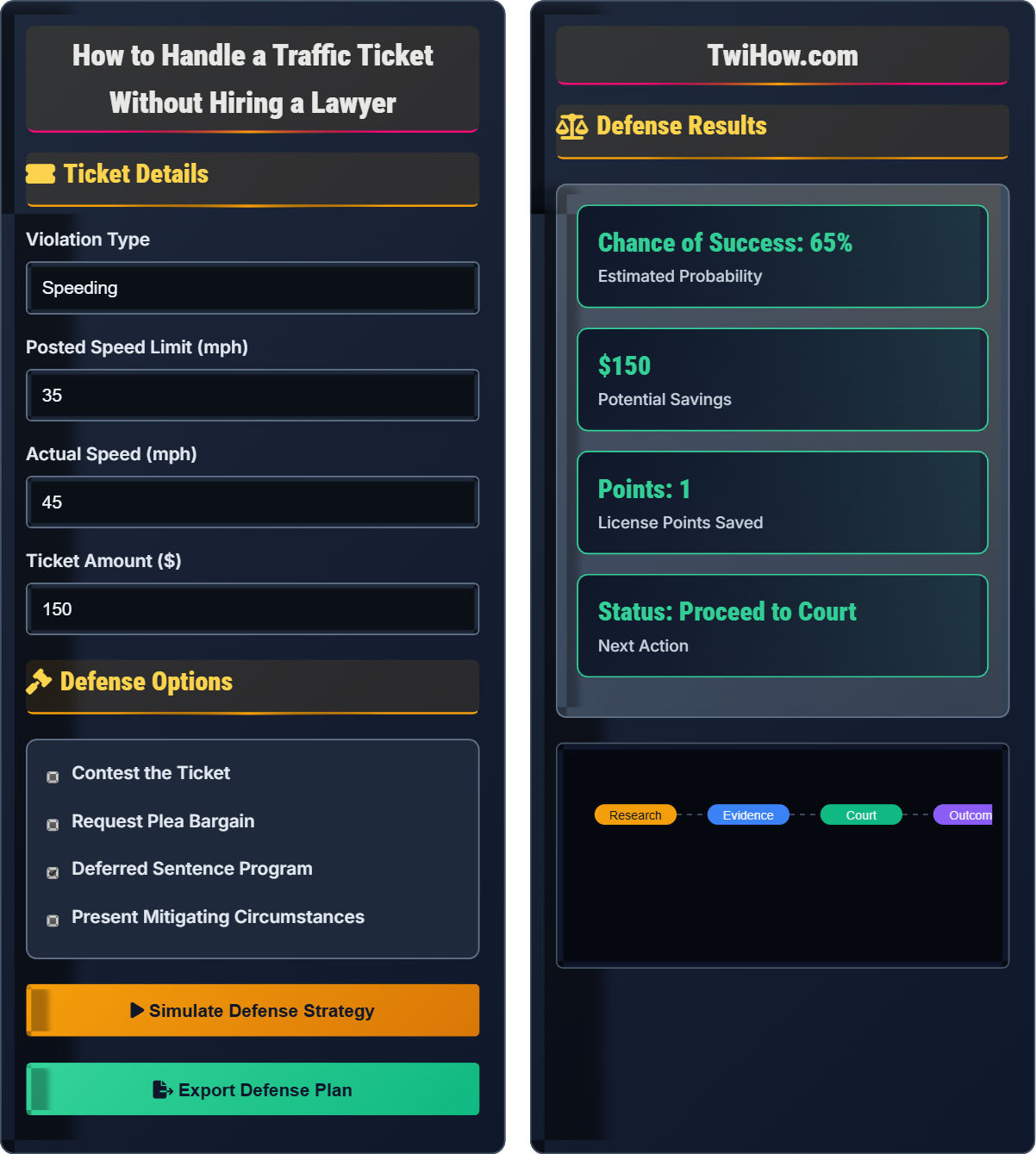
Ticket Details
Defense Options
Defense Results
| Step | Action | Priority | Status |
|---|---|---|---|
| 1 | Review Citation | High | Completed |
| 2 | Research Defenses | High | Pending |
| 3 | Gather Evidence | Medium | Pending |
| 4 | Court Appearance | High | Scheduled |
| 5 | Follow Up | Low | Pending |
Evidence Checklist
- Original citation
- Photo of location/speed limit sign
- Calibration records (if applicable)
- Witness statements
- GPS data or dashcam footage
- Vehicle maintenance records
- Medical documentation (if applicable)
- Previous driving record
How to Handle Traffic Tickets Successfully
Traffic citations are legal documents that accuse you of violating traffic laws. When you receive a ticket, you have options: pay the fine (admit guilt), contest the ticket in court, or request a deferred sentence program. Each option has consequences for your driving record, insurance rates, and future driving privileges.
Successful traffic ticket defense involves multiple factors:
Where:
- Preparation: Research, organization, and understanding of the law
- Evidence Quality: Credible documentation and witness testimony
- Court Presentation: Respectful demeanor and clear argumentation
Effective defenses for traffic violations include:
- Speeding: Challenging radar calibration, speedometer accuracy, or citing emergency circumstances
- Stop Signs: Proving the sign was obscured, missing, or incorrectly posted
- Red Lights: Demonstrating malfunctioning signals or camera errors
- Parking: Showing unclear signage or temporary emergency situations
- Equipment Issues: Proving vehicle malfunction or required equipment was present
- Mistaken Identity: Proving you weren't driving or were misidentified
- Defensive Driving Course: Often reduces points and sometimes dismisses tickets
- Deferred Sentence: Allows dismissal if you avoid violations for a specified period
- Plea Bargaining: Negotiating reduced charges or penalties
- Payment Plans: Spreading out fine payments over time
- Community Service: Substituting service for fines in some cases
Ticket Handling Essentials
Traffic citation, court appearance, defensive driving, plea bargain, deferred sentence, points system.
Defense Success = (Evidence + Preparation + Presentation) × Court Discretion
Where Evidence = Credible Documentation; Preparation = Legal Research; Presentation = Professional Demeanor.
- You have the right to contest any ticket
- Court deadlines are strictly enforced
- Respectful behavior influences outcomes
- Documentation is crucial for success
Court Preparation
Research laws, gather evidence, organize documentation, practice presentation, arrive early, dress appropriately.
- Read the citation carefully
- Research applicable laws
- Gather all evidence
- Practice your argument
- Arrive early and dress professionally
- Bring all documentation
- Address the judge respectfully
- Speak clearly and confidently
- Be honest and concise
- Listen carefully to instructions
Traffic Ticket Defense Quiz
Which of the following is NOT typically a viable defense strategy for a speeding ticket?
Claiming ignorance of the speed limit is not a valid defense in traffic court. Drivers are legally responsible for knowing and obeying posted speed limits. However, challenges based on equipment accuracy (radar calibration, speedometer malfunction), emergency circumstances, and other factual defenses are legitimate strategies that courts consider.
The answer is B) Claiming you didn't know the speed limit.
Traffic laws are considered "strict liability" offenses in many cases, meaning that the violation itself constitutes the offense regardless of intent. Drivers have a legal duty to know and comply with traffic regulations. Effective defenses focus on factual disputes (equipment accuracy, visibility of signs) or legal exceptions (emergencies, official directions) rather than subjective states like knowledge or intent.
Strict Liability: Legal responsibility without regard to intent
Speed Limit: Maximum legal speed allowed on a road segment
Valid Defense: Legally acceptable justification for violation
• Drivers must know posted speed limits
• Equipment accuracy can be challenged
• Emergency circumstances may provide defense
• Focus on factual rather than subjective defenses
• Document equipment malfunctions
• Research radar calibration procedures
• Claiming ignorance of the law
• Failing to research equipment accuracy
• Not documenting emergencies
Describe the typical traffic court procedure and explain what you should do during each stage to maximize your chances of success.
Traffic Court Procedure Stages:
1. Arraignment: Enter your plea (guilty, not guilty, or no contest). If contesting, request a trial date.
2. Pre-Trial Conference: Discuss potential plea bargains or procedural matters with the prosecutor.
3. Trial Preparation: Organize evidence, witnesses, and legal arguments.
4. Trial: Present your case, cross-examine witnesses, and argue your defense.
5. Verdict: Judge renders decision on guilt or innocence.
6. Sentencing: Penalties are determined if found guilty.
Maximizing Success at Each Stage:
• Before Court: Thoroughly research the law and gather evidence
• During Court: Dress professionally, be respectful, speak clearly
• Presenting Evidence: Organize materials chronologically and logically
• Cross-Examination: Ask focused questions that support your defense
• Closing Argument: Summarize key points concisely
Traffic court procedures follow formal legal processes similar to other court proceedings. Success depends on understanding the structure and adapting your strategy accordingly. Each stage presents opportunities to strengthen your case or negotiate favorable outcomes. Professional presentation and thorough preparation are essential at every stage of the process.
Arraignment: Court appearance where plea is entered
Pre-Trial Conference: Meeting to discuss case resolution
Verdict: Court's determination of guilt or innocence
• Court deadlines are strictly enforced
• Professional demeanor influences outcomes
• Proper evidence presentation is crucial
• Arrive early and dress professionally
• Bring all documentation organized
• Practice your presentation beforehand
• Arriving late to court
• Failing to bring necessary documentation
• Speaking disrespectfully to the judge
You received a speeding ticket for going 55 mph in a 35 mph zone. The officer wrote down 60 mph on the citation, but your GPS showed 52 mph at the time. You were rushing to the hospital because your child had a fever. The speed limit sign was partially obscured by tree branches. Describe your defense strategy and the evidence you would present.
Defense Strategy:
1. Challenge Accuracy: Point out the discrepancy between the officer's reported speed (60 mph) and GPS data (52 mph).
2. Challenge Visibility: Document the obscured speed limit sign with photos showing tree branches blocking the view.
3. Present Mitigating Circumstances: Provide medical documentation showing your child's illness and hospital visit.
Evidence to Present:
• GPS data showing your actual speed (52 mph vs. cited 60 mph)
• Photos of the speed limit sign showing obstruction
• Medical records documenting your child's condition
• Hospital admission records with timestamps
• Witness testimony from family members about the emergency
• Previous clean driving record documentation
Court Approach: Acknowledge that you were exceeding the speed limit but argue that the circumstances justify leniency and that the citation contains inaccuracies.
Effective traffic defense combines factual challenges with mitigating circumstances. The discrepancy between the officer's report and GPS data provides objective evidence of potential inaccuracy. The obscured sign demonstrates that the speed limit wasn't clearly visible. The emergency situation doesn't excuse the violation but may influence the judge's sentencing decision. Combining multiple defense strategies increases the likelihood of success.
GPS Evidence: Electronic data showing vehicle speed/location
Mitigating Circumstances: Factors that may reduce penalties
Speed Limit Visibility: Clarity of posted speed limit signs
• Factual evidence is more persuasive than arguments
• Emergency circumstances may influence sentencing
• Speed limit signs must be clearly visible
• Document everything immediately after the incident
• Take photos from multiple angles
• Keep all medical documentation
• Failing to document evidence promptly
• Not keeping accurate records
• Waiting too long to gather evidence
You're a 22-year-old driver with a clean record facing a $200 speeding ticket. If convicted, your insurance premium will increase by $800 annually for the next 3 years. The ticket includes 3 points on your license. You have a choice: pay the ticket now, contest it in court (with estimated 40% chance of success), or request a defensive driving course (available in your state for ticket dismissal). Analyze the costs and benefits of each option and recommend the best strategy.
Option Analysis:
Pay Now: Immediate cost $200, points added, insurance increase $800×3=$2,400, total cost $2,600.
Contest in Court: Cost of time and effort, 40% chance of saving $2,400, 60% chance of paying $200 plus costs, expected value = (0.4×$2,400) - (0.6×$200) = $960 - $120 = $840 savings.
Defensive Driving Course: Course cost approximately $50, insurance reduction possible, points may not be assessed, total cost approximately $250.
Recommendation: Defensive driving course is the best option. It provides guaranteed benefits: no points on license, potential insurance discount, minimal cost, and avoids court appearance. The $50 course cost is far less than the potential $2,400 in increased premiums.
Additional Considerations: Check if your insurance company offers accident forgiveness programs or if this is your first violation, as some insurers don't increase rates for first-time minor infractions.
Traffic ticket decisions should consider both immediate and long-term costs. Insurance rate increases often exceed the ticket fine significantly, especially for younger drivers. Defensive driving courses offer a "win-win" solution by avoiding points while demonstrating responsibility. The decision tree analysis shows that even a 40% chance of success isn't worth the risk compared to guaranteed benefits from a defensive driving course.
Expected Value: Average outcome considering probabilities
Insurance Points: Factors affecting premium rates
Defensive Driving Course: Educational program for ticket dismissal
• Consider total cost including insurance
• Defensive driving courses often worth it
• Insurance rates vary by violation type
• Contact your insurance company immediately
• Ask about first-offense programs
• Compare total costs of all options
• Focusing only on ticket amount
• Ignoring insurance consequences
• Missing defensive driving course deadlines
What is the most important deadline to consider when deciding whether to contest a traffic ticket?
The deadline for requesting a court date is the most critical because it determines whether you can contest the ticket at all. If you miss this deadline, you'll typically lose the right to challenge the citation and may face additional penalties. Most jurisdictions require you to request a court date within a specific timeframe (often 10-30 days) after receiving the ticket.
The answer is B) Deadline for requesting a court date.
Procedural deadlines in legal matters are typically non-negotiable and failure to meet them results in forfeiture of rights. The deadline for requesting a court appearance is usually the first and most important deadline because it preserves all other options. Once this deadline passes, your choices become significantly limited, often leaving payment as the only option.
Deadline: Time limit for taking legal action
Procedural Right: Legal requirement for court procedures
Forfeiture: Loss of legal rights by inaction
• Court appearance deadlines are strict
• Missing deadlines forfeits rights
• Read all deadlines on citation carefully
• Mark deadlines on calendar immediately
• Call court if deadline approaches
• Request extensions if needed
• Missing court request deadlines
• Ignoring citation deadlines
• Procrastinating on legal matters
FAQ
Q: How much does it typically cost to hire a lawyer for a traffic ticket, and is it worth it compared to handling it myself?
A: Traffic ticket lawyers typically charge $150-$500 per case, with some offering flat fees. For minor infractions like speeding, this may not be cost-effective compared to handling it yourself, especially if you qualify for defensive driving courses that can dismiss the ticket.
However, lawyers are valuable for serious violations, commercial driving violations, or when you face license suspension. They understand procedural rules, can negotiate better plea deals, and have relationships with prosecutors.
For simple tickets, self-representation is often sufficient and much more economical. Consider hiring a lawyer only for complex situations or when the stakes are high (license suspension, major fines, commercial license).
Q: What's the difference between a deferred sentence and a suspended sentence for traffic violations?
A: A deferred sentence means the court postpones entering a conviction. If you comply with certain conditions (like avoiding violations for a set period), the case is dismissed and no conviction appears on your record.
A suspended sentence means the court enters a conviction but suspends the penalty. You're technically convicted but don't face immediate punishment, provided you meet certain conditions.
For traffic violations, deferred sentences are more favorable as they result in no conviction on your record, while suspended sentences mean you have a conviction that may affect insurance rates and future violations.