How to Handle Identity Theft Legally and Report It
Complete legal guide • Step-by-step process
Identity Theft Overview:
Show Recovery AssistantIdentity theft occurs when someone uses your personal information without permission to commit fraud or other crimes. This can include stealing your Social Security number, credit card information, bank accounts, or other identifying details. The legal process for handling identity theft involves immediate reporting, documentation, and following specific procedures to clear your name and restore your credit.
Recovery from identity theft can take months or even years, but following the proper legal steps can significantly reduce the damage and speed up the process. The key is to act quickly and systematically through the proper channels.
Essential steps include:
- Immediate Reporting: Contact credit bureaus and financial institutions
- Official Complaints: File reports with FTC and local police
- Documentation: Keep records of all communications and fraudulent activities
- Credit Monitoring: Watch for additional fraudulent activity
Understanding your legal rights and the proper procedures can help you recover more quickly and protect yourself from future incidents.
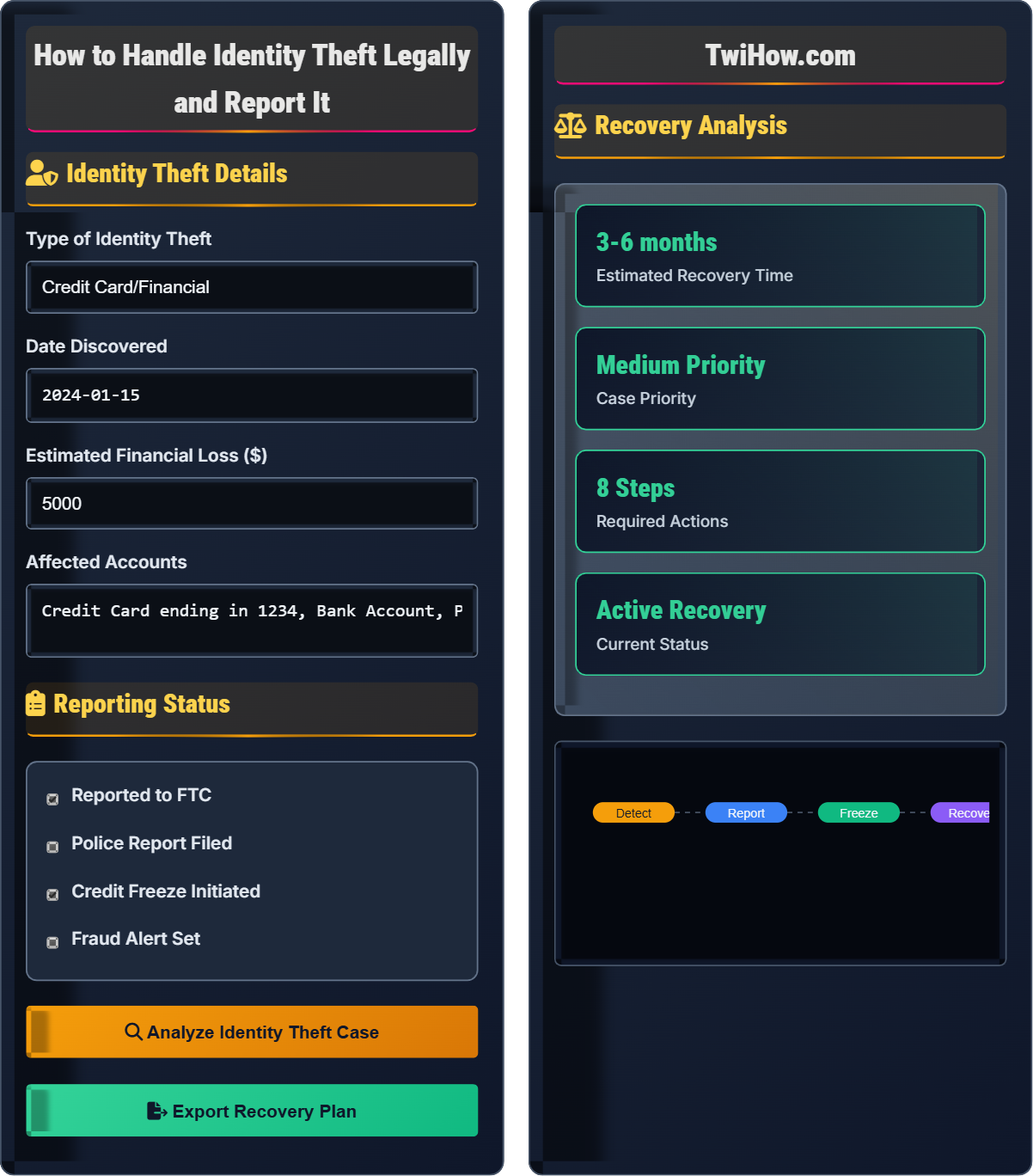
Identity Theft Details
Reporting Status
Recovery Analysis
| Action | Priority | Due Date | Status |
|---|---|---|---|
| Report to FTC | High | Immediate | Complete |
| File Police Report | High | Within 24 hours | Pending |
| Notify Credit Bureaus | High | Immediate | Complete |
| Close Fraudulent Accounts | High | Within 48 hours | In Progress |
| Dispute Fraudulent Charges | High | Within 1 week | Pending |
| Set Up Credit Monitoring | Medium | Within 1 week | Pending |
| Update Passwords | Medium | Immediate | Complete |
| Monitor Credit | Low | Ongoing | Active |
Recovery Timeline
- Days 1-3: Report to FTC, police, credit bureaus
- Days 4-7: Close fraudulent accounts, dispute charges
- Weeks 2-4: Replace cards/documents, set up monitoring
- Months 2-6: Monitor credit, resolve disputes
- Months 6-12: Restore credit, finalize recovery
Understanding Identity Theft and Legal Recovery
Identity theft occurs when someone wrongfully obtains and uses another person's personal information in a way that involves fraud or deception, typically for economic gain. This can include using your Social Security number, credit card information, bank accounts, or other identifying details without permission.
The legal recovery process follows a systematic approach:
Where:
- Immediate Action: Quick reporting and freezing of accounts
- Proper Documentation: Comprehensive records of fraud
- Systematic Resolution: Following legal procedures with institutions
Different types of identity theft require different response strategies:
- Financial Identity Theft: Unauthorized use of financial accounts or creation of new accounts
- Tax Identity Theft: Filing fraudulent tax returns using your SSN
- Medical Identity Theft: Using your information to obtain medical services
- Criminal Identity Theft: Providing your information when arrested
- Social Security Identity Theft: Using your SSN for employment or benefits
- Child Identity Theft: Using a child's SSN for credit applications
- Fair Credit Reporting Act (FCRA): Rights to dispute fraudulent information
- Fair and Accurate Credit Transactions Act (FACTA): Identity theft protections
- Gramm-Leach-Bliley Act: Financial institution privacy protections
- Driver's Privacy Protection Act: Protection of personal information from motor vehicle records
- Right to Debt Validation: Ability to verify fraudulent debts
- Liability Limits: Maximum liability for unauthorized credit card use
Identity Theft Essentials
Identity theft, fraud, FTC complaint, credit freeze, fraud alert, police report, recovery plan.
Recovery Success = (Quick Reporting + Proper Documentation + Systematic Resolution) × Persistence
Where Quick Reporting = Immediate action after discovery; Proper Documentation = Comprehensive records; Systematic Resolution = Following legal procedures; Persistence = Continued monitoring.
- Act immediately after discovery
- Document everything
- Follow up consistently
- Know your legal rights
Legal Rights
Right to dispute, right to debt validation, right to privacy, right to credit reports, right to legal recourse.
- Fair Credit Reporting Act (FCRA)
- Fair and Accurate Credit Transactions Act (FACTA)
- Gramm-Leach-Bliley Act
- Driver's Privacy Protection Act
- State identity theft laws
- Consumer Financial Protection Act
- Liability limits vary by account type
- Reporting deadlines are important
- Documentation is crucial for disputes
- Monitoring is ongoing responsibility
Identity Theft Recovery Quiz
What is the primary purpose of filing a complaint with the FTC about identity theft?
Filing a complaint with the FTC at IdentityTheft.gov provides you with an official identity theft report and a personalized recovery plan. The FTC complaint serves as documentation that you can use with creditors and other institutions to dispute fraudulent charges. While the FTC helps coordinate law enforcement efforts, it does not provide immediate compensation or arrest criminals directly.
The answer is B) To get a recovery plan and official identity theft report.
The FTC complaint is a crucial first step in the recovery process because it creates an official record of the identity theft. This record can be used to prove to creditors, banks, and other institutions that you are a victim and should not be held liable for fraudulent charges. The recovery plan provides a systematic approach to resolving the theft.
FTC: Federal Trade Commission
Identity Theft Report: Official document proving identity theft
Recovery Plan: Step-by-step guide for resolving theft
• File complaint immediately after discovery
• Use IdentityTheft.gov for official report
• Keep copy of confirmation number
• Print the FTC report for documentation
• Use the recovery plan as a checklist
• Update the report as needed
• Delaying the FTC report filing
• Not understanding the report's purpose
• Failing to use the recovery plan
Explain the difference between a credit freeze and a fraud alert, and when you should use each one.
Credit Freeze:
• Completely blocks access to your credit report
• Prevents new accounts from being opened in your name
• Requires PIN or password to lift
• May have fees (free for identity theft victims)
• Provides maximum protection against new account fraud
Fraud Alert:
• Adds a warning to your credit report
• Requires creditors to verify your identity before opening new accounts
• Lasts for 1 year (extendable)
• Free to all consumers
• Less restrictive than a freeze
When to Use Each:
Credit Freeze: When you want maximum protection, such as after identity theft, or if you're not planning to open new credit accounts.
Fraud Alert: When you want moderate protection but still plan to apply for credit, or as an initial response before deciding on a freeze.
Recommendation: For confirmed identity theft victims, a credit freeze is generally preferred due to its stronger protection.
Both credit freezes and fraud alerts serve to protect against new account fraud, but they operate differently. A freeze is more restrictive and provides stronger protection, while a fraud alert allows for easier access to credit while requiring additional verification. Understanding the difference helps victims choose the appropriate protection level based on their situation and future credit needs.
Credit Freeze: Complete block on credit report access
Fraud Alert: Warning added to credit report
Credit Report: Record of credit history
• Both protect against new account fraud
• Freeze provides stronger protection
• Alert is easier to manage
• Place on all three credit bureaus
• Keep PIN/password secure
• Lift temporarily for legitimate credit applications
• Only placing on one credit bureau
• Losing freeze PIN/password
• Not understanding the difference
You discover that someone has opened a credit card account in your name and charged $3,000 worth of merchandise. You've never applied for this card and don't recognize the purchases. The credit card company is demanding payment and threatening to send your account to collections. What immediate steps should you take to protect yourself legally?
Immediate Steps:
1. Contact the Credit Card Company: Immediately call the fraud department to report the unauthorized account. Request written confirmation of the fraud report.
2. File FTC Complaint: Go to IdentityTheft.gov to file an official complaint and get an identity theft report.
3. Place Credit Freeze: Contact all three credit bureaus (Equifax, Experian, TransUnion) to place a credit freeze to prevent additional accounts.
4. File Police Report: File a report with your local police department for official documentation.
5. Send Written Dispute: Send a written dispute letter to the credit card company referencing the Fair Credit Reporting Act, including copies of your FTC identity theft report and police report.
6. Monitor Your Credit: Regularly check your credit reports for additional fraudulent activity.
Legal Protection: Under the Fair Credit Billing Act, you have zero liability for unauthorized charges. The burden is on the creditor to prove the charges were authorized.
This scenario demonstrates the importance of acting quickly and systematically. The key is to create official documentation that proves you are a victim of identity theft. The FTC report and police report serve as legal proof that can be used to dispute charges and prevent liability. The credit freeze prevents additional fraud while the case is being resolved.
Fraud Department: Specialized unit for handling fraud reports
Zero Liability: No responsibility for unauthorized charges
Fair Credit Billing Act: Consumer protection law
• Act immediately when discovering fraud
• Document everything in writing
• Know your zero liability rights
• Keep all correspondence
• Follow up in writing
• Know your rights under FCBA
• Paying fraudulent charges
• Not disputing charges in writing
• Failing to create official documentation
You receive a bill for medical services you never received, and your insurance company indicates that claims have been filed under your insurance information. You suspect medical identity theft. What specific steps should you take that differ from regular identity theft?
Medical Identity Theft Specific Steps:
1. Contact Your Health Insurance Company: Report the fraudulent claims and request investigation. Ask for copies of the fraudulent claims.
2. Contact Healthcare Providers: Contact the hospitals, clinics, or doctors' offices where the fraudulent services occurred. Request corrections to your medical records.
3. Get Your Medical Records: Request a copy of your medical records from all providers to check for other fraudulent entries.
4. File FTC Complaint: Report to IdentityTheft.gov, noting it's medical identity theft.
5. File Police Report: File a report with your local police department.
6. Dispute with Credit Bureaus: If medical debts appear on your credit report, dispute them and provide documentation of identity theft.
7. Monitor Your Medical Records: Regularly check your medical records and Explanation of Benefits (EOB) statements.
Additional Considerations: Medical identity theft can be particularly dangerous as it can affect your medical care if incorrect information enters your medical records. Prioritize correcting medical records to ensure accurate treatment information.
Medical identity theft requires additional steps because it can affect your health and safety. Incorrect medical information in your records could lead to inappropriate treatment or medication interactions. Unlike financial identity theft, medical identity theft has immediate health implications, making it crucial to correct medical records as quickly as possible.
Medical Identity Theft: Using medical information for fraud
Explanation of Benefits: Insurance statement of covered services
Medical Records: Documentation of healthcare received
• Correct medical records immediately
• Monitor for health implications
• Document all fraudulent medical services
• Keep copies of all medical records
• Request corrections in writing
• Verify your medical information regularly
• Not correcting medical records promptly
• Failing to check all medical providers
• Ignoring health implications of fraud
What is the maximum liability for unauthorized credit card charges under federal law?
Under the Fair Credit Billing Act, your liability for unauthorized credit card charges is limited to $50. If you report the loss before the card is used, you have no liability. If you report it after unauthorized charges are made but before the credit card company's billing statement is sent, your liability is limited to $50. This law protects consumers from excessive liability for fraudulent charges.
The answer is A) $50.
The Fair Credit Billing Act provides important consumer protections by limiting liability for unauthorized charges. This protection encourages people to report lost or stolen cards promptly without fear of unlimited liability. However, debit card fraud has different protections with different liability limits, so it's important to understand the distinction between credit and debit card protections.
Fair Credit Billing Act: Federal law limiting credit card liability
Unauthorized Charges: Purchases made without cardholder permission
Credit Card: Revolving credit account with liability protections
• Credit card liability is limited to $50
• Report immediately for no liability
• Debit card protections differ
• Report lost/stolen cards immediately
• Monitor statements regularly
• Know the difference between credit and debit protections
• Confusing credit and debit card protections
• Not reporting fraud promptly
• Assuming unlimited liability
FAQ
Q: Do I have to pay for the credit freeze or fraud alert?
A: As of September 2018, credit freezes are free for all consumers due to the Economic Growth, Regulatory Relief, and Consumer Protection Act. Fraud alerts are also free for everyone. Previously, credit freezes had fees that varied by state and credit bureau, but they are now free nationwide.
For identity theft victims, both credit freezes and fraud alerts have been free for many years, but the law now extends this benefit to all consumers. You can place, lift, or remove credit freezes at no cost through all three major credit bureaus.
Be cautious of websites or services that charge fees for credit freezes, as these are likely scams or unnecessary third-party services.
Q: How long does it take to recover from identity theft?
A: Recovery time varies significantly depending on the type and extent of the identity theft:
Credit Card Identity Theft: 3-6 months with prompt reporting
Bank Account Takeover: 2-4 months with quick action
SSN/Tax Identity Theft: 6-18 months or longer
Medical Identity Theft: 6-12 months with ongoing monitoring
Child Identity Theft: Several years if not detected early
The key factors affecting recovery time are: how quickly you discover the theft, how promptly you report it, the complexity of the fraud, and how thoroughly you follow up on all required steps. Some cases can be resolved in weeks, while others take years to fully resolve.
On average, most identity theft cases take 6-12 months to fully resolve, with victims spending 100+ hours on recovery activities.