How to Handle Legal Issues Related to Social Media Content
Complete guide • Legal protections • Essential steps
Social Media Legal Protection:
Legal Risk AssessmentWhen creating and sharing content on social media, understanding legal requirements protects you from costly mistakes. Key areas include copyright, defamation, privacy, terms of service, and platform-specific policies. This guide covers essential legal considerations for responsible social media use.
Legal considerations include:
- Copyright Compliance: Using content legally and respecting intellectual property
- Defamation Protection: Avoiding false statements that harm reputation
- Privacy Rights: Protecting personal information and consent
- Terms of Service: Following platform rules and agreements
Always understand your rights and responsibilities as both a content creator and consumer on social platforms.
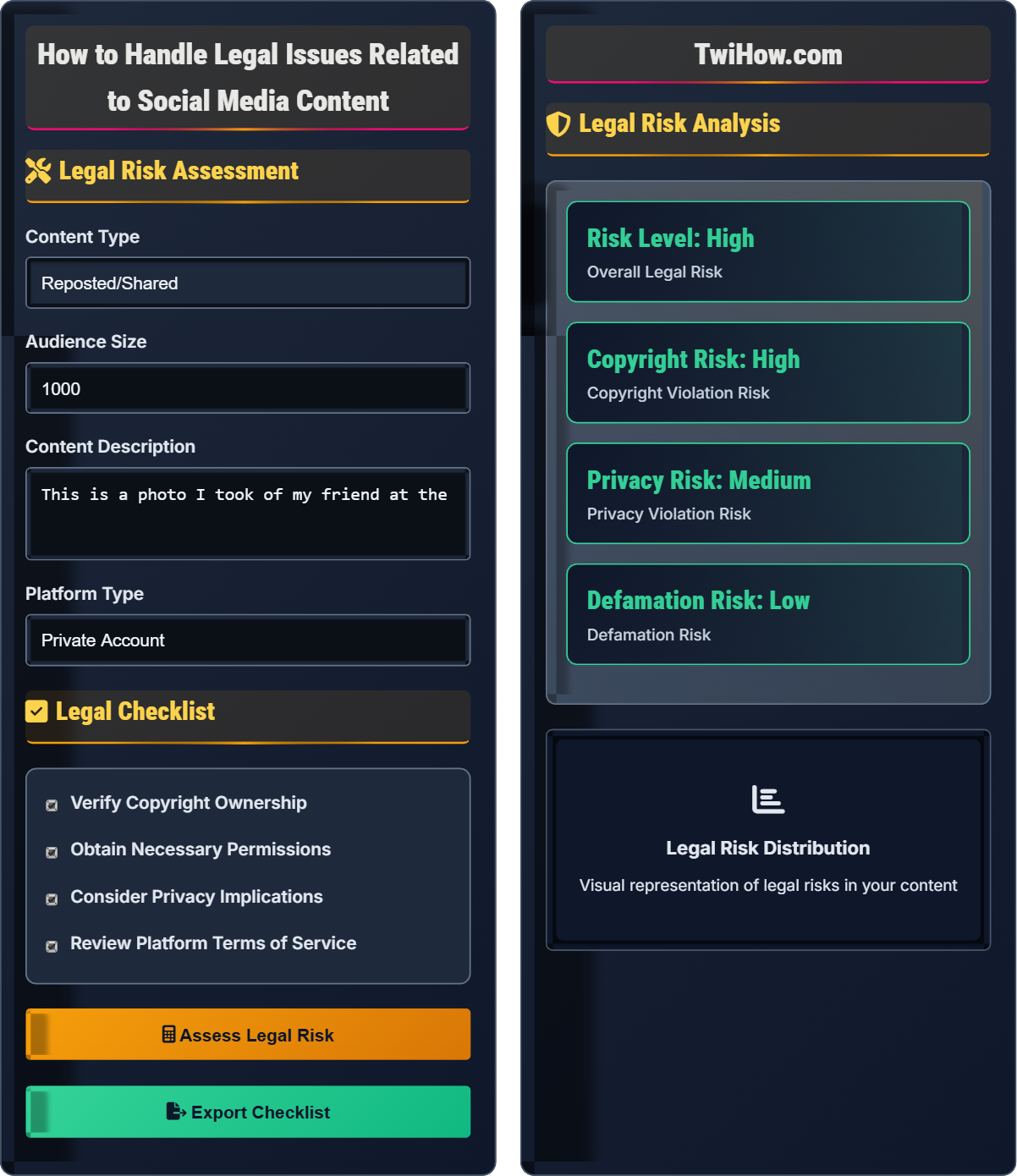
Legal Risk Assessment
Legal Checklist
Legal Risk Analysis
Legal Risk Distribution
Visual representation of legal risks in your content
| Item | Status | Action Required |
|---|---|---|
| Copyright Verification | ✓ Done | None |
| Permission Required | ⚠ Pending | Get consent |
| Privacy Review | ⚠ Pending | Assess exposure |
| Terms of Service | ✓ Done | None |
Legal Protections Available
- Fair Use: Limited use of copyrighted material
- First Amendment: Freedom of expression protection
- DMCA Safe Harbor: Protection for service providers
- Consent Rights: Control over personal images
Legal Requirements for Social Media Content
Understanding copyright is crucial for social media content creation. Key aspects include:
- Original Content: You own copyright to your original work
- Third-Party Content: Requires permission or falls under fair use
- Derivative Works: Modifications of existing content require permission
- Creative Commons: Licensed content with specific permissions
Always attribute sources and understand licensing terms when using third-party content.
Protecting privacy involves understanding various rights and regulations:
Key considerations include:
- Right to publicity for public figures
- Children's Online Privacy Protection Act (COPPA)
- GDPR compliance for European users
- Biometric privacy laws in some states
Understanding the balance between free speech and defamation:
- Opinion vs. Fact: Opinions are generally protected
- Public vs. Private Figures: Different standards apply
- Actual Malice Standard: Public figures must prove knowing falsehood
- Retraction Rights: Some states allow retractions to limit damages
- Copyright Infringement: Unauthorized use of protected content
- Right of Publicity: Unauthorized commercial use of likeness
- Harassment Claims: Repeated unwanted contact or threats
- Terms of Service Violations: Breaching platform agreements
Copyright and Intellectual Property
Copyright protection automatically applies to original works fixed in tangible form.
Purpose, nature, amount, and effect on market value determine fair use.
Four factors: transformative use, published work, portion used, market impact.
- Always assume content is copyrighted until proven otherwise
- Permission is required for commercial use of copyrighted material
- Fair use is determined case-by-case by courts
Privacy and Personal Rights
Individuals have rights to control commercial use of their name, image, and likeness.
- Consent for photographing individuals
- Location privacy settings
- Data collection transparency
- Minors' special protections
- Public spaces have different privacy expectations
- Minors require parental consent for commercial use
- Private property allows more control over photography
- Workplace policies may restrict employee content sharing
Social Media Legal Knowledge Quiz
When posting content on social media, which of the following statements about copyright is TRUE?
Copyright protection automatically applies to original works that are fixed in a tangible medium, including content posted online. This means that creators own copyright to their original posts, but they also must respect others' copyrights when sharing content.
The answer is C) Copyright protection applies to original works posted online.
Copyright law doesn't change simply because content is posted online. The same principles that apply to traditional media also apply to digital content. Understanding this helps users navigate their rights and responsibilities when creating and sharing content on social platforms.
Copyright: Legal protection for original creative works
Public Domain: Works not protected by copyright
Tangible Medium: Fixed form of expression
• Assume content is copyrighted until proven otherwise
• Original content you create is yours to share
• Third-party content requires permission or fair use
• Use Creative Commons licensed content appropriately
• Attribute sources when required
• Understand fair use limitations
• Assuming online content is freely usable
• Not obtaining permission for third-party content
• Misunderstanding fair use scope
Explain the concept of "right of publicity" and how it applies to social media content. What are the key differences between using someone's image for personal versus commercial purposes?
Right of Publicity: This is the right of individuals to control the commercial use of their name, image, likeness, or other indicia of identity. On social media, this means you cannot use someone's image for commercial purposes without their permission.
Personal vs. Commercial Use: Personal use (like tagging friends in vacation photos) is generally protected under freedom of expression. Commercial use (like using someone's image to promote products) typically requires explicit permission.
Key Differences: Commercial use involves profit motive and often requires compensation. Personal use is for non-commercial sharing. Some states have stronger right of publicity laws than others.
The right of publicity balances individual privacy with freedom of expression. Understanding this distinction helps users navigate when they need permission versus when they can share content freely. The commercial aspect is the key differentiator.
Right of Publicity: Control over commercial use of one's identity
Commercial Use: Profit-motivated exploitation of identity
Personal Use: Non-commercial sharing and expression
• Commercial use typically requires consent
• Personal use has broader protections
• Laws vary by state/jurisdiction
• Get explicit consent for commercial use
• Consider whether content could be seen as commercial
• Respect requests to remove content
• Not distinguishing between personal and commercial use
• Assuming all social sharing is protected
• Ignoring state-specific laws
You're a local business owner who discovers a customer posted a review claiming your restaurant served food that caused food poisoning, but you know this isn't true. The post has gone viral and is damaging your business. Explain the elements of defamation and what steps you should take to address this situation. How would your approach differ if the poster was a public figure versus a private citizen?
Elements of Defamation: False statement, published to third parties, damages reputation, fault (negligence or worse).
Steps to Take: Document the post, assess damages, send a cease and desist letter, request removal from platform, consult with an attorney, consider counter-publication of truth.
Public vs. Private Figure: Private citizens need only prove negligence. Public figures must prove "actual malice" (knowledge of falsity or reckless disregard for truth). This affects burden of proof significantly.
Recommended Action: Focus on factual correction and platform reporting. Document evidence of food safety compliance and health inspections.
Defamation law protects against false statements that harm reputation while balancing free speech rights. The standard differs based on the plaintiff's status, recognizing that public figures have greater access to counter speech.
Defamation: False statements that harm reputation
Actual Malice: Knowledge of falsity or reckless disregard
Public Figure: Person with public prominence or involvement
• Truth is an absolute defense to defamation
• Opinions are generally protected
• Standards differ for public vs. private figures
• Document everything immediately
• Focus on factual corrections
• Use platform reporting tools
• Responding emotionally to false claims
• Not documenting evidence properly
• Ignoring the situation hoping it goes away
You're a content creator planning to monetize your social media presence. You want to cross-post content across multiple platforms to maximize reach. Analyze the potential conflicts between different platforms' terms of service and explain how to structure your content strategy to comply with all requirements. What legal risks should you consider?
Platform Terms Conflicts: Some platforms require exclusive content, others allow cross-posting. Some claim broad licenses, others have limited rights.
Content Strategy: Create platform-specific content variations, understand each platform's license terms, ensure originality of your content, maintain consistent messaging while respecting platform differences.
Legal Risks: Breach of terms of service, copyright infringement claims, trademark violations, privacy violations, advertising guideline violations.
Best Practices: Read all terms carefully, create original content, respect platform-specific requirements, maintain good faith compliance.
Platform terms of service are legally binding contracts that govern content use and distribution. Understanding these agreements is crucial for compliant content creation and monetization strategies.
Terms of Service: Legal agreement between user and platform
Exclusive License: Rights granted to one party only
Cross-Posting: Sharing identical content across platforms
• Terms of service are legally binding
• Violations can result in account termination
• Platforms may change terms with notice
• Keep terms of service updated
• Create content that fits multiple platforms
• Maintain original content for exclusivity
• Not reading terms of service thoroughly
• Assuming all platforms have same requirements
• Ignoring platform-specific content rules
Which of the following scenarios would MOST likely qualify as fair use when posting on social media?
Fair use considers four factors: purpose (transformative criticism/commentary), nature of work, amount used, and market effect. Brief quotation with commentary for criticism is most likely to qualify as fair use, as it's transformative and serves an educational/publishing purpose.
The answer is C) Briefly quoting a news article with commentary for criticism.
Fair use is a complex doctrine that allows limited use of copyrighted material without permission for purposes like criticism, comment, news reporting, teaching, and research. Transformative use is a key factor in fair use determinations.
Fair Use: Limited use of copyrighted material without permission
Transformative Use: Adding new meaning or purpose
Market Effect: Impact on original work's commercial value
• Fair use is determined case-by-case
• Transformative use strengthens fair use claims
• Commercial use weakens fair use claims
• Use minimal amount necessary
• Add transformative commentary
• Consider market impact
• Assuming any educational use is fair
• Not considering market effect
• Using excessive portions of original work
FAQ
Q: Can I use copyrighted music in my social media videos if I give credit to the artist?
A: Simply giving credit does not constitute permission to use copyrighted music. You need either explicit permission from the copyright holder, a license from a music library, or your use must qualify as fair use (which is rare for background music).
Most social platforms have their own music libraries with pre-cleared tracks for use. Alternatively, you can use Creative Commons licensed music or royalty-free music that explicitly permits your intended use.
Many creators think attribution is sufficient, but copyright law requires permission for reproduction and distribution of musical works.
Q: What should I do if someone posts a photo of me without my permission on social media?
A: Your rights depend on context:
1. Public Space: Photos taken in public generally don't require consent
2. Private Property: You may have stronger privacy claims
3. Commercial Use: Unauthorized commercial use may violate right of publicity
Steps to take: Politely request removal, report to platform, check platform privacy policies, consider legal action if commercial use or harassment is involved. Some states have specific revenge porn laws and image appropriation statutes.