How to Handle Legal Issues with Online Purchases and Returns?
Complete guide • Consumer rights • Legal protections
Online Shopping Legal Guide:
Return Rights CalculatorWhen making online purchases, understanding your legal rights protects you from fraudulent practices and ensures fair treatment. This guide covers return policies, consumer protections, dispute resolution, and essential legal rights for online shoppers.
Key rights include:
- Right to Information: Clear pricing, terms, and conditions
- Return Rights: Cooling-off periods and return policies
- Payment Protection: Chargebacks and dispute resolution
- Privacy Rights: Data protection and security
Knowing these rights helps you shop safely and resolve issues effectively.
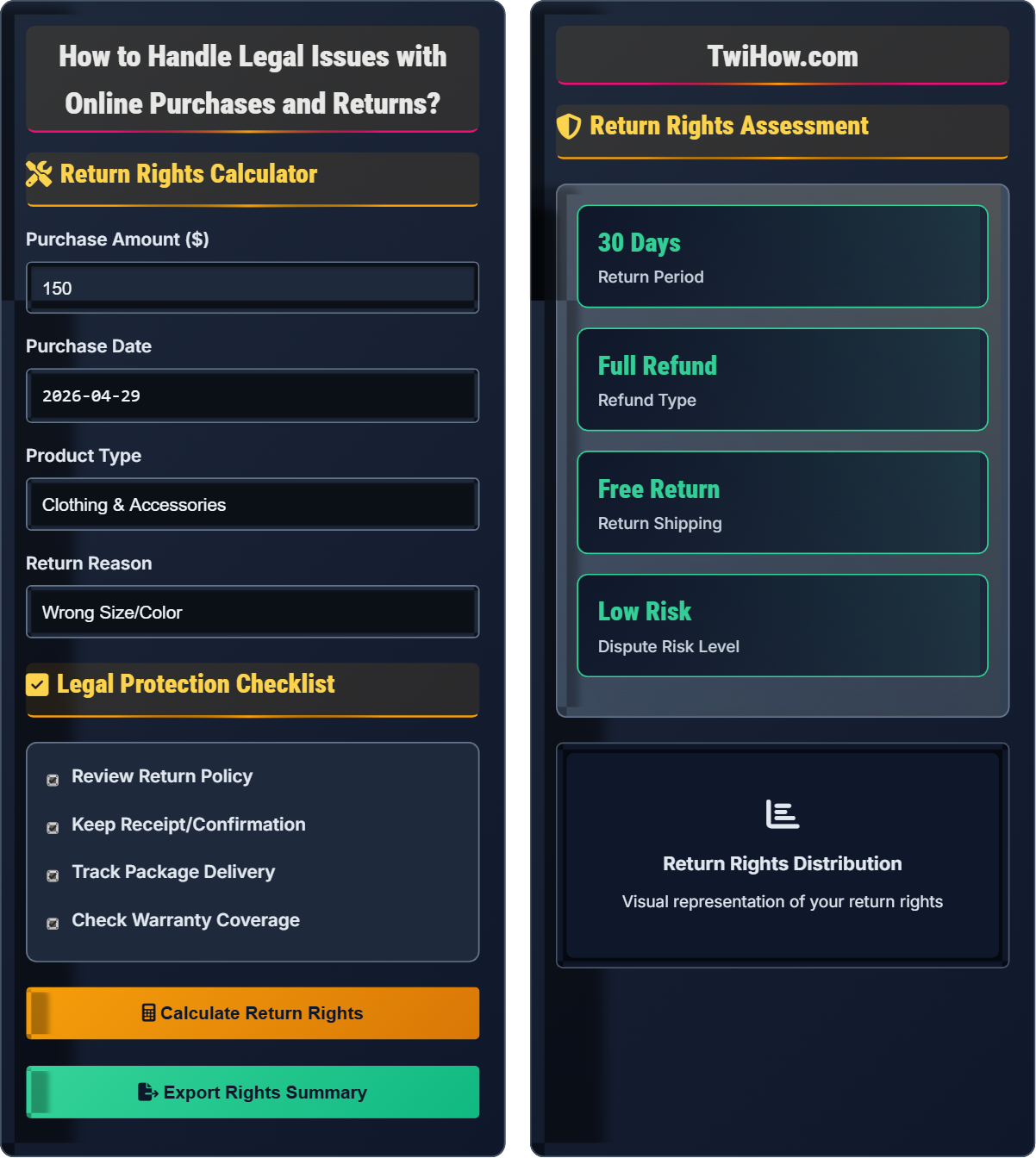
Return Rights Calculator
Legal Protection Checklist
Return Rights Assessment
Return Rights Distribution
Visual representation of your return rights
| Right | Eligibility | Details |
|---|---|---|
| Full Refund | ✓ Eligible | Within return period |
| Free Return Shipping | ✓ Eligible | Defective item |
| Exchange Option | ✓ Available | Same or different size |
| Warranty Coverage | ⚠ Limited | 30-day period |
Return Process Steps
- Initiate return request online
- Print return label if required
- Pack item securely
- Ship back within deadline
- Wait for processing
Online Shopping Legal Rights
Key consumer protection laws apply to online purchases:
- Truth in Advertising: Accurate product descriptions and pricing
- Right to Information: Clear terms and conditions
- Privacy Protection: Secure handling of personal data
- Fair Billing: Accurate charges and billing practices
These protections apply regardless of purchase amount or vendor size.
Legal requirements for return policies:
Key requirements:
- Clear return timeframes (typically 30 days)
- Unopened product requirements
- Receipt/confirmation requirements
- Restocking fee limitations
Special rules apply to digital products:
- Cooling-off Period: 14-day right to cancel for digital goods
- Download Limitations: May lose access after return
- License vs. Ownership: Understanding what you actually purchase
- Platform Restrictions: Store-specific policies apply
- Hidden Fees: Unexpected shipping or handling charges
- Restocking Fees: Excessive fees beyond legal limits
- Return Policy Changes: Retroactive policy modifications
- Counterfeit Goods: Receiving fake or unauthorized products
Return Policy Types
Money-back guarantees, exchange-only policies, and restocking fee structures.
Understanding legal requirements versus retailer policies.
Legal protections may override restrictive policies.
- Return policies must be clearly disclosed before purchase
- Restocking fees cannot exceed actual costs
- Defective products have different return rules
Payment and Dispute Resolution
Chargeback rights, fraud protection, and dispute resolution procedures.
- Contact merchant first
- File chargeback with credit card
- Consumer protection agency complaint
- Legal action if necessary
- Chargeback rights typically within 60-120 days
- Documentation is crucial for disputes
- Consumer protection laws vary by state
- International purchases have additional complexities
Online Shopping Rights Quiz
According to federal law, what is the standard cooling-off period for online purchases?
There is no federal standard for return periods on general online purchases. Retailers can set their own policies, though some states have consumer protection laws. However, there is a 14-day cooling-off period specifically for digital goods under certain circumstances.
The answer is C) No federal standard, varies by retailer.
Unlike door-to-door sales which have federal cooling-off periods, online retail purchases are primarily governed by the retailer's own policies. This is why it's crucial to read return policies before purchasing. However, some states have enacted their own consumer protection laws.
Restocking Fee: Charge for returning merchandise
Cooling-off Period: Time to cancel without penalty
Consumer Protection: Laws safeguarding buyers
• Return policies must be disclosed before purchase
• Digital goods have specific cooling-off rules
• State laws may provide additional protections
• Always read return policies before buying
• Save all purchase confirmations
• Check state consumer protection laws
• Assuming all retailers have same return periods
• Not saving purchase confirmations
• Missing return deadlines
Explain the difference between digital and physical product return rights. What are the special considerations for software, music, and other digital downloads?
Digital Products: Generally have a 14-day cooling-off period under federal law, allowing returns even after download. However, this may not apply if the consumer explicitly agreed to waive the cooling-off period after being informed.
Physical Products: Return rights depend on retailer policies, typically 30 days for unopened items.
Special Considerations: Digital products may lose access after return, license agreements may restrict returns, and platform-specific rules apply. Some digital marketplaces have stricter policies than federal law requires.
Best Practice: Download digital content only after confirming you want to keep it, as returns may result in losing access.
Digital products present unique challenges because they can be consumed immediately after purchase. The law recognizes this by providing specific cooling-off periods, but consumers should understand that returning digital items often means losing access to them permanently.
License Agreement: Terms governing digital product use
Access Revocation: Loss of digital content after returnConsumption Model: Digital goods accessed rather than owned
• Digital goods have 14-day cooling-off period
• Access may be revoked after return
• License terms may override general rules
• Read license agreements before downloading
• Test software within trial period
• Understand access revocation consequences
• Assuming digital purchases are always returnable
• Not understanding license restrictions
• Downloading before deciding to keep
You purchased an expensive designer handbag online that arrived looking authentic but feels different from the original you own. Upon closer inspection, you realize it's a counterfeit product. The retailer refuses to issue a refund, claiming you opened the package. Analyze your legal rights in this situation and explain what steps you should take to recover your money.
Legal Rights: You have strong legal protections against counterfeit goods. Selling counterfeit products violates trademark laws and consumer protection statutes. The retailer's claim about package opening is irrelevant to the fundamental issue of receiving a fake product.
Legal Protections: You can demand full refund under consumer protection laws, fraud statutes, and anti-counterfeiting regulations. The retailer cannot avoid responsibility by citing return policies when selling fake goods.
Steps to Take: Document everything (photos, purchase records), contact your credit card company for chargeback, file complaints with consumer protection agencies, and consider legal action if necessary.
Additional Actions: Report to trademark holders and consumer protection agencies.
Selling counterfeit goods is illegal regardless of return policies. Consumers have strong protections against fraudulent merchandise. The retailer cannot hide behind technical return policy violations when the fundamental issue is receiving fake products.
Counterfeit Goods: Fake products mimicking genuine brands
Trademark Violation: Unauthorized use of brand identifiers
Consumer Fraud: Deceptive business practices
• Counterfeit goods sales violate multiple laws
• Return policies don't protect fraudulent sellers
• Strong consumer protections apply
• Research sellers before purchasing
• Compare prices to authenticity
• Document everything immediately
• Accepting return policy as final word
• Not documenting counterfeit discovery
• Failing to report to authorities
You purchased electronics from an overseas seller through an online marketplace. The product arrived damaged, but the seller claims their country's laws don't allow returns. The marketplace says they're only facilitating the transaction. Analyze your rights and explain how to navigate this complex international purchase situation.
International Considerations: Different countries have varying consumer protection laws. However, many international transactions are governed by the platform's terms of service.
Platform Responsibility: Major marketplaces often have dispute resolution processes and buyer protection programs that apply regardless of seller location.
Steps to Take: Initiate dispute through the platform, document damage with photos, check platform's international buyer protection, contact your credit card company for chargeback, and consider filing complaints with consumer protection agencies.
Additional Options: Small Claims Court may have jurisdiction depending on the purchase amount and circumstances.
International purchases add complexity but don't eliminate consumer rights. Platforms often provide protections that override seller claims about local laws. Understanding the governing terms between you, the platform, and the seller is crucial for international transactions.
International Purchase: Transaction across national borders
Platform Liability: Marketplace responsibility for transactions
Dispute Resolution: Process for resolving conflicts
• Platform terms may override seller claims
• International buyer protection available
• Credit card protections apply to foreign purchases
• Check platform's international protections
• Understand currency and shipping risks
• Document everything for cross-border disputes
• Assuming international purchases have no protections
• Not checking platform buyer protection
• Failing to document damage immediately
What is the legal limit on restocking fees that retailers can charge for returned items?
Restocking fees must generally reflect the actual costs incurred by the retailer for processing the return. While there's no specific federal percentage limit, fees that exceed actual costs may be considered unfair or deceptive practices under consumer protection laws.
The answer is C) Must reflect actual costs incurred.
Restocking fees exist to compensate retailers for the costs of processing returns, but they cannot be used as a profit center. The fee should approximate the actual expenses of restocking, not serve as punishment for returning items. Some states have specific limits on restocking fees.
Restocking Fee: Charge for processing returned merchandise
Actual Costs: Real expenses for return processing
Unfair Practice: Deceptive or misleading business act
• Fees must reflect actual costs
• Cannot be punitive
• State laws may impose additional limits
• Question excessive restocking fees
• Compare fees to purchase amount
• Research state-specific protections
• Accepting excessive restocking fees
• Not questioning fee justification
• Assuming all fees are legal
FAQ
Q: Can a retailer refuse to accept returns if I don't have the original packaging?
A: It depends on the retailer's return policy. Many retailers require original packaging, especially for electronics and fragile items. However, some states have laws requiring refunds for defective products regardless of packaging.
For defective items, retailers generally must accept returns even without original packaging. For change-of-mind returns, packaging requirements are typically enforceable if clearly disclosed before purchase.
Always check the specific return policy before purchasing, and document any defects that require return without original packaging.
Q: What should I do if a retailer stops responding to my return request?
A: If a retailer stops responding:
1. Document everything: Keep records of all communications and purchase details
2. Contact credit card company: Initiate chargeback process
3. File complaints: With Better Business Bureau, state attorney general, FTC
4. Leave reviews: On relevant platforms to warn other consumers
5. Consider legal action: For larger amounts, small claims court may be appropriate
Many retailers will respond once they see potential negative consequences for ignoring valid return requests.