How to Handle Legal Matters When Moving to a New Country
Complete guide • Immigration • Legal requirements
International Move Legal Guide:
Visa Requirements ToolMoving to a new country involves numerous legal requirements including visas, residency permits, tax obligations, and document authentication. This guide covers essential legal steps, documentation, and compliance requirements to ensure a smooth international transition.
Key legal matters include:
- Visa Applications: Work, study, or residence permits
- Tax Obligations: Residency status and dual taxation
- Document Authentication: Apostilles and translations
- Legal Residency: Registration and compliance requirements
Proper preparation and understanding of legal requirements prevent delays and complications during your move.
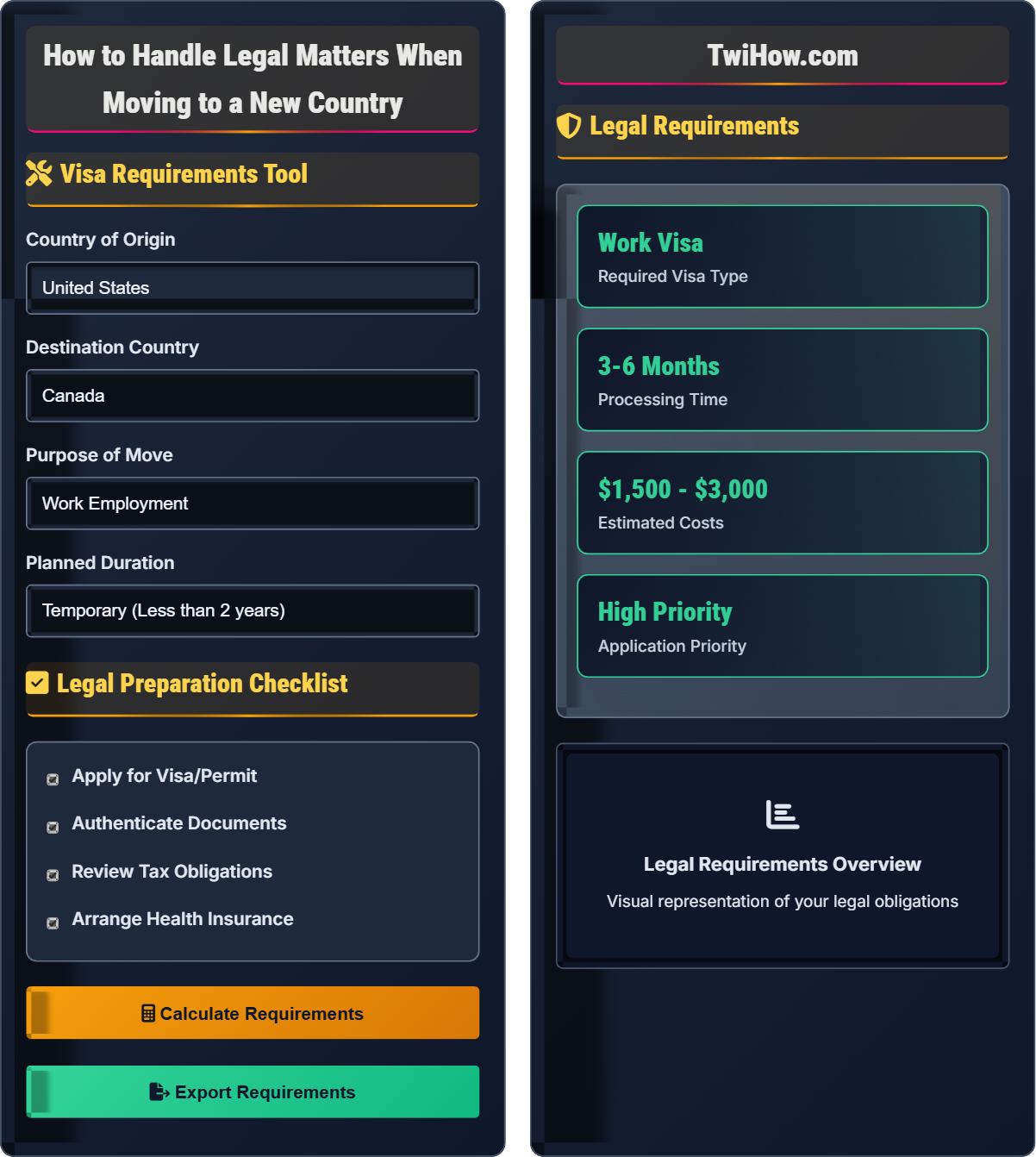
Visa Requirements Tool
Legal Preparation Checklist
Legal Requirements
Legal Requirements Overview
Visual representation of your legal obligations
| Requirement | Urgency | Notes |
|---|---|---|
| Passport Validity | High | Must be valid for 6+ months |
| Visa Application | High | Submit 3-6 months ahead |
| Medical Exam | Medium | Required for some countries |
| Police Clearance | High | From last 5 years of residence |
Timeline Recommendations
- Start 6-12 months before planned move
- Submit visa application 3-6 months ahead
- Complete medical exams early
- Arrange tax obligations before departure
Legal Requirements for International Moves
Visa requirements vary significantly by country and purpose of stay:
- Work Visas: Employment contract, skills assessment, labor certification
- Student Visas: University acceptance, financial proof, language proficiency
- Family Visas: Relationship proof, sponsor's financial status
- Investor Visas: Capital investment, business plan
Research specific requirements well in advance as processing times vary from weeks to years.
Understanding tax implications is crucial for international moves:
Key considerations:
- Tax residency rules in both countries
- Foreign Earned Income Exclusion
- Reporting foreign bank accounts
- Double taxation avoidance treaties
Documents may require authentication for international use:
- Apostille: Certification for Hague Convention countries
- Authentication: For non-Hague Convention countries
- Translation: Official translation if required
- Notarization: Additional certification by notary
- Insufficient Documentation: Missing required documents
- Missed Deadlines: Late application submission
- Tax Non-compliance: Not understanding reporting requirements
- Expired Documents: Passport or documents expiring during stay
Visa and Permit Types
Work, study, family, tourist, and investment visas with varying requirements.
Online application, document submission, interview, and biometrics.
Processing times vary significantly by country and visa type.
- Apply well in advance of intended travel date
- Meet all requirements before application
- Provide truthful information only
Tax and Financial Obligations
Physical presence tests, economic ties, and permanent home criteria.
- Understand tax treaty benefits
- Plan for Foreign Earned Income Exclusion
- Report foreign bank accounts
- Consider tax-efficient investments
- Bank account reporting requirements
- Foreign asset disclosure
- Exchange rate considerations
- Retirement account transfers
International Move Legal Knowledge Quiz
What is the primary difference between a work visa and a working holiday visa?
All the statements are correct. Working holiday visas are typically designed for young adults (usually 18-30 or 35), don't require employer sponsorship, and are only available to citizens of countries that have reciprocal agreements with the destination country.
The answer is D) All of the above.
Working holiday visas serve a different purpose than traditional work visas. They're designed to promote cultural exchange and allow young people to travel and work temporarily. Understanding these distinctions is crucial for choosing the right visa category.
Working Holiday Visa: Temporary work/travel visa for young adults
Employer Sponsorship: Company petitioning for worker visa
Reciprocal Agreement: Mutual visa arrangement between countries
• Age restrictions apply to working holiday visas
• Limited duration (usually 1-2 years)
• Restrictions on employer types
• Check nationality eligibility
• Verify age requirements
• Understand work restrictions
• Assuming all countries offer working holiday visas
• Not understanding age limits
• Confusing with traditional work visas
Explain the concept of tax residency and how it affects international movers. What are the implications of being a tax resident in multiple countries simultaneously?
Tax Residency: Legal status determining which country has the right to tax your worldwide income. Determined by physical presence tests, economic ties, or having a permanent home in a country.
Dual Tax Residency: Occurs when you meet residency tests in two countries simultaneously. Can result in being taxed on the same income by both countries.
Mitigation: Most countries have Double Taxation Avoidance Agreements (DTAAs) that provide tie-breaker rules to determine primary tax residence and prevent double taxation.
Planning: Carefully manage physical presence and economic ties to avoid unintended dual residency.
Tax residency rules can be complex and vary significantly between countries. The physical presence test is the most common, but economic ties and permanent home tests also matter. Understanding these rules helps prevent unexpected tax obligations.
Tax Residency: Status determining tax obligations
Physical Presence Test: Days spent in country threshold
DTAA: Double Taxation Avoidance Agreement
• Physical presence often triggers tax residency
• Economic ties can establish residency
• DTAA rules determine primary residence
• Track days spent in each country
• Understand local tax laws
• Consult tax professionals
• Not understanding residency triggers
• Overlooking economic ties
• Failing to plan for tax obligations
You're moving from the United States to Germany for work. Your university degree certificate needs to be authenticated for the German embassy. Explain the process you need to follow, including what an apostille is, whether you need one for Germany, and what other steps might be required.
Apostille: A simplified form of document authentication for countries that are part of the Hague Convention. It certifies the authenticity of the signature and seal on a document.
Germany Situation: Germany is a member of the Hague Convention, so an apostille is sufficient for document authentication.
Process: Obtain apostille from the Secretary of State in the state where the document was issued, then potentially arrange for official translation to German if required by German authorities.
Additional Steps: Some German institutions may require additional authentication or specific translation certifications.
The Hague Convention simplifies document authentication between member countries. Understanding whether your destination country is a member affects the authentication process. Always verify specific requirements with the destination country's embassy.
Apostille: Simplified document authentication for Hague members
Hague Convention: International treaty for document authentication
Authentication: Process of verifying document validity
• Check if destination country is Hague member
• Authenticate documents early in process
• Verify specific requirements with embassy
• Start document authentication early
• Make multiple copies of authenticated documents
• Consider expedited services if needed
• Not verifying authentication requirements
• Waiting too late to authenticate documents
• Forgetting about translation requirements
You're relocating to Australia for a 3-year work assignment. Australian immigration requires health insurance for your visa. Compare the requirements for private health insurance versus joining Australia's Medicare system. What are the implications of each choice for you and your family?
Private Health Insurance: Required for most temporary visas. Covers hospital stays, medical procedures, and some medications. Often includes dental and optical coverage.
Medicare: Australia's universal healthcare system. Available to permanent residents and citizens. Provides subsidized healthcare but may have waiting periods.
Implications: Temporary residents typically need private insurance as Medicare may have waiting periods for new residents. Permanent residents can access Medicare after meeting residency requirements.
Recommendation: For a 3-year assignment, private insurance is likely required initially, with potential transition to Medicare if converting to permanent residency.
Healthcare systems vary significantly between countries. Some have universal healthcare, others require private insurance. Understanding these differences is crucial for maintaining coverage during your international move.
Medicare: Australia's universal healthcare system
Private Insurance: Commercial health coverage
Waiting Period: Time before benefits begin
• Healthcare requirements vary by visa type
• Universal systems often exclude temporary residents
• Private insurance may be required for visa approval
• Research healthcare requirements early
• Understand coverage differences
• Plan for family members' needs
• Assuming universal healthcare applies to temporary residents
• Not understanding visa-specific requirements
• Forgetting to budget for healthcare costs
What is the most important consideration when managing your finances during an international move?
Understanding tax reporting requirements for foreign accounts is crucial. Many countries require reporting of foreign bank accounts, investments, and other financial assets. Failure to comply can result in significant penalties.
The answer is B) Understanding tax reporting requirements for foreign accounts.
Tax reporting requirements often extend beyond income tax to include asset disclosure. Countries like the US require reporting of foreign financial accounts (FBAR), while others have similar requirements. This is often overlooked but can have serious consequences.
FBAR: Foreign Bank Account Report (US requirement)
Asset Disclosure: Reporting foreign investments
Tax Reporting: Obligation to report financial activities
• Many countries require foreign asset reporting
• Penalties can be severe for non-compliance
• Requirements may apply to all family members
• Consult tax professionals early
• Understand reporting thresholds
• Keep detailed financial records
• Not understanding reporting requirements
• Failing to file required forms
• Underestimating complexity of international tax
FAQ
Q: Do I need to inform my home country's tax authority that I'm moving abroad?
A: Yes, in many cases you must notify tax authorities of your move. For example:
• United States: Must file Form 8854 if expatriating
• United Kingdom: Complete P85 form to establish non-resident status
• Canada: File departure tax return
These notifications help establish your tax status and may affect your obligations. Some countries consider you a resident until you formally notify them of your departure.
Consult a tax professional familiar with your home country's requirements before leaving.
Q: What documents should I prioritize authenticating before moving internationally?
A: Prioritize documents that will be used for:
1. Visa Applications: Educational certificates, employment letters, police clearances
2. Employment: Academic credentials, professional licenses, work experience letters
3. Education: Transcripts, diplomas, standardized test scores
4. Marriage/Family: Marriage certificates, birth certificates for children
Start with educational documents and police clearances, as these often take the longest to process. Make multiple authenticated copies of each document.