How to Legally Challenge a Government Agency Decision
Complete guide • Administrative law • Appeal process
Government Agency Appeals:
Appeal Pathway PlannerWhen government agencies make decisions that affect your rights, benefits, or legal status, you have the right to challenge these decisions through established legal procedures. This guide covers administrative appeals, judicial review, due process rights, and essential steps for challenging government decisions effectively.
Key appeal options include:
- Administrative Appeal: Internal review within the agency
- Administrative Hearing: Formal proceeding with independent judge
- Judicial Review: Court challenge to agency decision
- Legislative Action: Petitioning lawmakers for intervention
Understanding these pathways helps protect your rights and ensures proper governmental accountability.
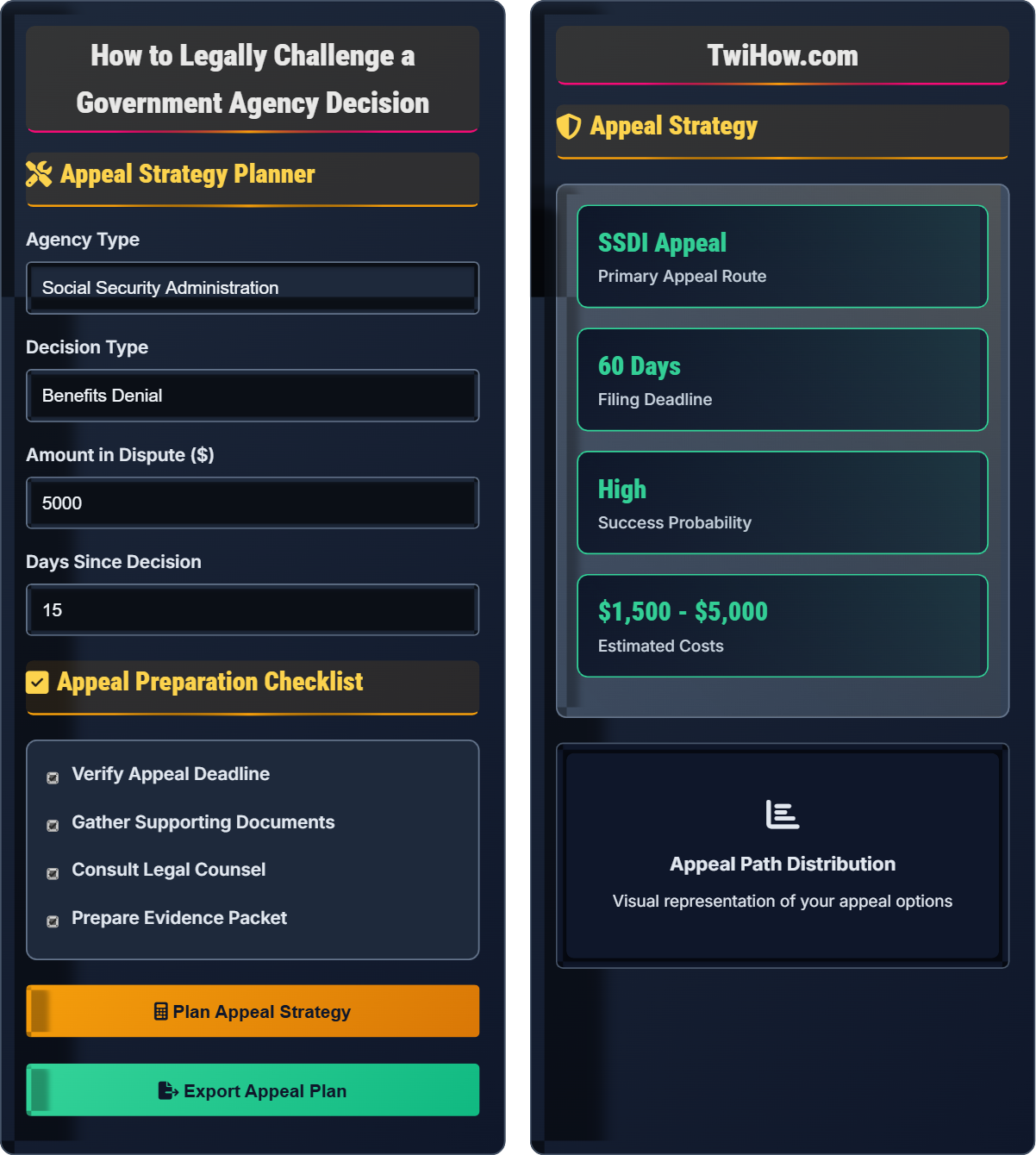
Appeal Strategy Planner
Appeal Preparation Checklist
Appeal Strategy
Appeal Path Distribution
Visual representation of your appeal options
| Step | Priority | Details |
|---|---|---|
| Review Decision Letter | High | Identify specific reasons for denial |
| Gather Documentation | High | Collect all supporting evidence |
| File Appeal Notice | Urgent | Meet filing deadline |
| Prepare Case | Medium | Build your argument with evidence |
| Attend Hearing | High | Present your case |
Appeal Timeline
- Day 0: Receive adverse decision
- Days 1-5: Review decision and deadlines
- Days 6-10: File appeal notice
- Days 11-30: Prepare documentation
- Days 30-90: Hearing scheduled
- Days 90-120: Decision rendered
Government Agency Appeal Process
The Administrative Procedure Act (APA) establishes the legal framework for challenging government decisions:
- Due Process: Right to notice and hearing
- Procedural Safeguards: Fair hearing procedures
- Record Requirements: Decision must be based on evidence
- Reasoned Decision: Agency must explain its reasoning
Most federal agencies must follow APA procedures when making decisions.
Essential documents for your appeal:
- Copy of original adverse decision
- Supporting evidence and documentation
- Medical records (if applicable)
- Employment records (if applicable)
- Financial statements (if applicable)
- Expert opinions or evaluations
- Statute of Limitations: Missing appeal deadlines
- Standing Issues: Not having legal right to challenge
- Exhaustion: Not using all administrative remedies
- Procedural Errors: Improper filing or documentation
Types of Government Appeals
Internal agency review process for challenging decisions.
Typically: Initial decision → Reconsideration → Hearing → Review Board → Court.
Each level has specific procedures and deadlines.
- Exhaust all administrative remedies before court
- Meet strict filing deadlines
- Follow agency-specific procedures
Due Process Rights
Right to notice, hearing, and impartial decision-maker.
- Notice of charges or decision
- Opportunity to respond
- Impartial decision-maker
- Right to legal representation
- Procedural due process applies to government actions
- Substantive due process challenges underlying law
- Right to counsel varies by proceeding type
- Right to appeal exists in most cases
Government Agency Appeals Quiz
What is the typical deadline for filing an appeal of a government agency decision?
Appeal deadlines vary significantly depending on the agency and type of decision. Some agencies allow 30 days, others 60 days, and some have different deadlines for different types of decisions. It's crucial to check the specific deadline in the decision letter.
The answer is C) Varies by agency and type of decision.
Each government agency has its own procedural rules for appeals, which are typically found in the Code of Federal Regulations (CFR) or state administrative codes. Missing deadlines usually means losing the right to appeal.
Statute of Limitations: Time limit to file legal action
Administrative Deadline: Agency-specific filing time
Final Decision: Conclusion of agency process
• Always check the deadline in the decision letter
• Extensions are rarely granted
• Mark deadlines on calendar immediately
• Start preparing appeal before deadline
• File early when possible
• Assuming standard 30-day deadline
• Not reading decision letter carefully
• Waiting until the last day to file
Explain the exhaustion requirement in government agency appeals. Why must you use all administrative remedies before going to court, and what are the exceptions to this rule?
Exhaustion Requirement: The legal principle that requires parties to use all available administrative remedies before seeking judicial review.
Reasons for Requirement: Allows agency to correct its own errors, develops full administrative record for court review, promotes efficient use of judicial resources, and respects agency expertise.
Exceptions: Constitutional challenges, irreparable harm, futility of administrative process, inadequate administrative remedy, or clear agency error of law.
Consequences of Non-Exhaustion: Courts will typically dismiss cases without exhaustion, meaning you lose your right to judicial review.
The exhaustion doctrine balances efficiency and fairness. It ensures agencies have the chance to correct errors while providing judicial oversight when administrative remedies are inadequate.
Exhaustion: Using all administrative options first
Administrative Remedies: Agency-specific appeal options
Judicial Review: Court examination of agency decision
• Exhaustion is usually mandatory
• Filing deadlines apply at each level
• Administrative record is crucial
• Document all administrative efforts
• Preserve issues for judicial review
• Consult attorney if exceptions apply
• Going directly to court without exhausting
• Missing intermediate appeal deadlines
• Not preserving arguments for court
You received a denial letter from the Social Security Administration for disability benefits. The letter states you have 60 days to file an appeal. You believe you have strong medical evidence to support your case but have never appealed a government decision before. Outline the steps you should take and explain what documentation you'll need to prepare for the most effective appeal.
Immediate Steps: 1) Mark the 60-day deadline on your calendar. 2) Read the denial letter carefully to understand specific reasons for denial. 3) Contact an attorney specializing in Social Security appeals.
Documentation Needed: All medical records from treating physicians, work history, daily activity reports, medication lists, functional capacity evaluations, and any new medical evidence that addresses the specific reasons for denial.
Appeal Process: Request reconsideration first, then request a hearing before an Administrative Law Judge if denied again. The key is addressing the specific reasons the agency gave for denial.
Timeline: Start preparing immediately, file appeal within 10-15 days of decision to allow time for gathering documentation.
SSDI appeals have specific procedural requirements and deadlines. The key to success is addressing the specific reasons for denial with targeted medical evidence.
Reconsideration: First level of appeal
ALJ: Administrative Law Judge
Functional Capacity: Ability to perform work
• Strict 60-day deadline
• Must address specific reasons for denial
• Medical evidence is crucial
• Gather medical evidence immediately
• Consider hiring SSDI specialist attorney
• Document daily limitations
• Missing the 60-day deadline
• Not addressing specific denial reasons
• Failing to provide adequate medical evidence
Your company's environmental permit was denied by the EPA. The agency cited insufficient pollution control measures and potential environmental impact. The denial will cost your company millions in lost revenue. Analyze the legal options available and explain which appeal strategy would likely be most effective given the technical nature of the decision.
Appeal Options: 1) Request reconsideration from EPA, 2) Appeal to Environmental Appeals Board (EAB), 3) File lawsuit in federal court.
Most Effective Strategy: Start with administrative appeal to EAB, which has technical expertise in environmental matters. Prepare detailed technical documentation addressing each concern raised by the EPA.
Key Elements: Comprehensive technical analysis, expert reports on pollution controls, environmental impact studies, and demonstration that proposed measures meet regulatory standards.
Considerations: The technical nature favors administrative review where experts can evaluate the scientific basis for the decision before court review.
Technical decisions often benefit from administrative review by experts before court review. The EAB has specialized knowledge that can be advantageous for complex environmental cases.
EAB: Environmental Appeals Board
Technical Evidence: Scientific and engineering data
Environmental Impact: Effect on natural resources
• Technical expertise important for environmental cases
• Administrative review often precedes court review
• Burden of proof may shift in technical cases
• Engage technical experts early
• Address specific technical concerns
• Consider settlement discussions
• Going directly to court without administrative review
• Not addressing technical deficiencies
• Underestimating the need for expert testimony
When is legal representation most beneficial in challenging a government agency decision?
Legal representation is most beneficial in complex cases or when substantial amounts are at stake. Administrative procedures can be complex with strict requirements, and attorneys familiar with the process can significantly improve chances of success.
The answer is B) For complex cases or when substantial amounts are at stake.
While you can represent yourself in administrative appeals, attorneys provide valuable expertise in procedural requirements, evidence presentation, and legal argumentation that can make a significant difference in outcomes.
Pro Se: Representing yourself
Administrative Law: Legal rules for agencies
Procedural Requirements: Required steps and deadlines
• Right to legal representation varies by proceeding
• Complex procedures favor legal representation
• Some agencies provide free legal aid
• Consider attorney consultation even if self-representing
• Many attorneys work on contingency for government appeals
• Legal aid may be available for certain cases
• Underestimating complexity of administrative procedures
• Not understanding procedural requirements
• Failing to present evidence effectively
FAQ
Q: Can I continue receiving benefits while appealing a government decision to terminate them?
A: It depends on the type of benefit and the specific program. Many programs offer "continuation of benefits" during the appeal process if you file within the required timeframe and meet other conditions.
For example, Social Security disability benefits may continue during reconsideration and ALJ hearings if you request continuation. Unemployment benefits often continue during appeals. However, some programs like SNAP (food stamps) may not provide continued benefits during appeals.
Always request continuation when filing your appeal, and check the specific rules for your benefit program.
Q: What happens if I miss the deadline to appeal a government agency decision?
A: Missing the deadline usually means losing your right to appeal through the administrative process. The agency decision typically becomes final and binding.
However, some agencies may grant extensions for "good cause," such as serious illness, natural disaster, or other circumstances beyond your control. You must demonstrate that the delay was not due to your neglect.
If the deadline is missed without good cause, you may still have limited options such as filing a new application (if applicable) or pursuing other legal remedies, but these are often more difficult and less successful.