How to Legally Separate Assets from a Business Partner
Complete guide • Partnership dissolution • Asset division
Business Partnership Separation:
Asset Division CalculatorWhen separating from a business partner, proper legal procedures protect your assets and ensure fair division. This guide covers partnership dissolution, asset evaluation, legal structures, and essential steps for protecting your interests during the separation process.
Key considerations include:
- Partnership Agreement: Following agreed-upon terms and procedures
- Asset Valuation: Determining fair market value of business assets
- Legal Structure: LLC, corporation, or general partnership differences
- Financial Obligations: Debt responsibilities and liabilities
Proper planning and legal guidance help ensure a smooth and equitable separation process.
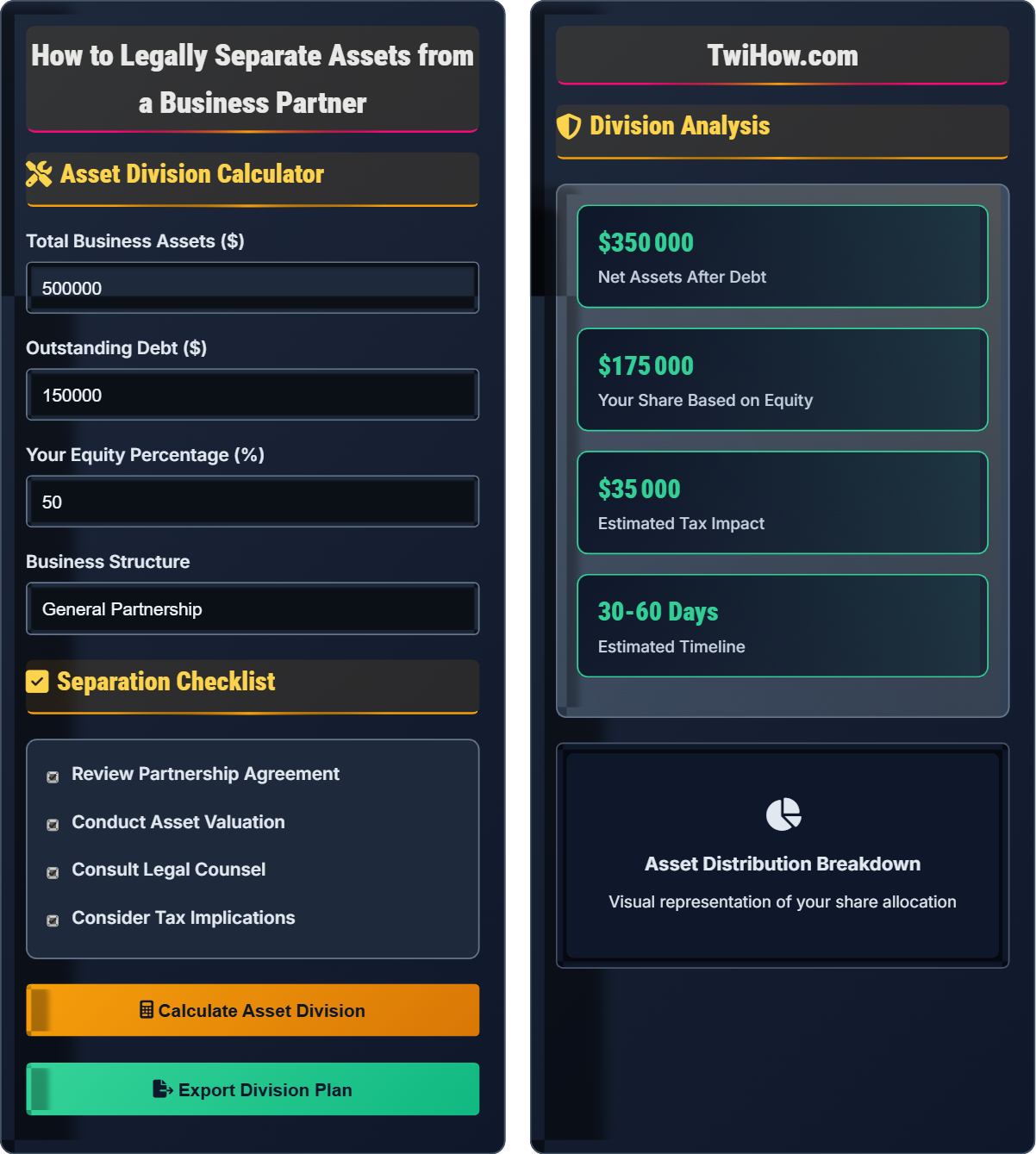
Asset Division Calculator
Separation Checklist
Division Analysis
Asset Distribution Breakdown
Visual representation of your share allocation
| Asset Category | Your Share | Partner's Share |
|---|---|---|
| Cash & Bank Accounts | $25,000 | $25,000 |
| Equipment & Inventory | $75,000 | $75,000 |
| Real Estate | $50,000 | $50,000 |
| Intellectual Property | $25,000 | $25,000 |
Separation Process Steps
- Formal notification of intent to separate
- Professional asset valuation
- Negotiate division terms
- Execute legal documents
- Transfer ownership officially
Business Partnership Separation Overview
Start with your existing partnership agreement which should outline separation procedures:
- Dissolution Process: Specific steps and timelines
- Asset Valuation: Method for determining business value
- Buy-Sell Provisions: Right of first refusal clauses
- Dispute Resolution: Mediation or arbitration procedures
Follow the agreement's terms precisely to avoid legal complications.
Accurate asset valuation is crucial for fair division:
Key valuation components:
- Cash and liquid assets
- Inventory and equipment
- Real estate and property
- Intellectual property and goodwill
Separation procedures vary by business structure:
- General Partnership: Direct asset division based on equity
- LLC: Follow operating agreement provisions
- Corporation: Stock buyback or dividend distribution
- S-Corp: Similar to corporation with tax benefits
- Improper Documentation: Inadequate legal paperwork
- Tax Consequences: Unexpected tax liabilities
- Debt Responsibility: Unclear liability for business debts
- Intellectual Property: Disputes over IP ownership
Asset Valuation Methods
Asset-based, income-based, and market-based valuation methods.
Business value equals sum of assets minus liabilities.
Consider market conditions and future earning potential.
- Professional valuation required for fair division
- Both parties should agree on valuator
- Valuation date affects final division
Tax and Financial Considerations
Capital gains, ordinary income, and potential tax advantages.
- Installment sale to spread tax burden
- Section 754 election for partnerships
- Charitable remainder trusts for large estates
- Like-kind exchanges for real estate
- Debt assumption responsibility
- Working capital requirements
- Continuing business operations
- Non-compete agreements
Business Separation Knowledge Quiz
What is the first and most important step when beginning the process of separating assets from a business partner?
The partnership agreement is the foundational document that governs the relationship between partners. It typically contains specific provisions for dissolution, asset division, and dispute resolution procedures. Starting with the agreement ensures you follow the agreed-upon process and understand your rights and obligations.
The answer is B) Review the existing partnership agreement.
Partnership agreements are contractual documents that define the business relationship. They often contain crucial information about separation procedures, which take precedence over default state laws. Understanding these terms helps avoid disputes and ensures compliance with the original agreement.
Partnership Agreement: Contract governing business partnership terms
Dissolution: Formal ending of partnership relationship
Operating Agreement: Management document for LLCs
• Agreements take precedence over default state laws
• Follow procedures exactly as outlined
• Document all steps of the process
• Locate original signed agreement
• Check for amendment provisions
• Understand dispute resolution clauses
• Ignoring partnership agreement terms
• Not following formal procedures
• Failing to document the process
Explain the importance of professional asset valuation in business partnership separation. What methods do valuators typically use, and why is it important for both parties to agree on the valuator?
Importance of Professional Valuation: Fair asset division requires accurate determination of business value. Professional valuators bring objectivity and expertise to what can be an emotionally charged process.
Valuation Methods: Asset-based (book value approach), income-based (discounted cash flow), and market-based (comparable company analysis). Each method may yield different values depending on business characteristics.
Agreement on Valuator: Having both parties agree on the professional ensures credibility of results. If one party objects to the valuator, they may challenge the results, creating delays and additional costs.
Asset valuation is often the most contentious aspect of business separation. Professional valuation provides objective standards that both parties can rely on. The choice of valuator can significantly impact the outcome, making mutual agreement crucial for acceptance of results.
Business Valuation: Process of determining fair market value
Discounted Cash Flow: Income-based valuation method
Fair Market Value: Price in open market between willing parties
• Valuation date affects final division
• Both parties should agree on valuator
• Use certified valuation professionals
• Research credentials of potential valuators
• Agree on scope of valuation upfront
• Consider timing of valuation date
• Using informal estimates instead of professional valuation
• One party selecting valuator without consent
• Not agreeing on valuation methodology
You and your partner own a business with $300,000 in total assets and $120,000 in outstanding debt. Your partnership agreement states equal ownership (50/50), but you contributed more capital initially. The business has been profitable, but your partner now wants to exit. How should the debt be handled during asset separation, and what factors should you consider regarding your respective contributions?
Net Asset Calculation: Total assets ($300,000) minus debt ($120,000) = net assets of $180,000. With equal ownership, each partner would receive $90,000 in assets.
Debt Responsibility: Typically, both partners remain liable for business debt unless creditors agree to release one party. The debt obligation continues until paid off or refinanced.
Capital Contributions: Past contributions may be documented in capital accounts, but the partnership agreement usually controls distribution. Consider negotiating adjustments based on initial contributions if the agreement allows flexibility.
Recommended Action: Pay down debt before separation if possible, or negotiate debt assumption as part of the separation agreement.
Debt responsibility is often overlooked in separation planning. Partners typically remain jointly liable for business debt unless creditors agree otherwise. This can significantly impact the actual value of distributed assets and future financial obligations.
Joint Liability: Both parties responsible for debt
Capital Account: Record of partner's investmentDebt Assumption: Taking responsibility for debt
• Partners typically remain jointly liable for business debt
• Creditors must agree to release parties from liability
• Net assets determine actual distribution value
• Pay down debt before separation if possible
• Negotiate debt assumption as part of agreement
• Consider refinancing options
• Forgetting about ongoing debt obligations
• Not addressing creditor consent for releases
• Calculating distributions based on gross assets
Your business partner wants to sell their 40% share back to the company. The business is valued at $500,000, but you only have $50,000 in available cash. Your partnership agreement doesn't specify a buyout procedure. Analyze different financing options for the buyout and explain the advantages and disadvantages of each approach.
Buyout Amount: 40% of $500,000 = $200,000 total buyout.
Financing Options:
1. Installment Payments: Spread payments over time (advantages: manageable cash flow, disadvantages: interest costs, ongoing relationship)
2. Bank Loan: Secure loan to finance buyout (advantages: immediate completion, disadvantages: debt obligation, interest costs)
3. Asset Liquidation: Sell business assets to fund buyout (advantages: immediate funding, disadvantages: impacts operations)
4. Partner Financing: Seller finances part of payment (advantages: flexible terms, disadvantages: ongoing obligation)
Each option has different tax implications and operational impacts.
Buyout financing is a critical consideration that affects both parties' financial positions. The chosen method impacts cash flow, debt levels, and ongoing business operations. Careful analysis of options helps find the most viable solution for both parties.
Buyout: Purchase of partner's interest
Installment Payment: Payment over time
Asset Liquidation: Selling assets for cash
• Document all financing terms
• Consider tax implications of each option
• Ensure business can support payment obligations
• Negotiate favorable terms with departing partner
• Consider business's ability to generate cash flow
• Evaluate impact on operations and growth
• Underestimating impact on business cash flow
• Not considering tax consequences
• Failing to document payment terms
When receiving assets from a business partnership separation, which of the following tax treatments typically applies?
Under IRS regulations, distributions from partnerships are generally tax-free to the extent of the partner's adjusted basis in the partnership. Only amounts received in excess of basis are taxable as capital gains. This treatment helps avoid double taxation since partnership income was already taxed to the partner.
The answer is B) Generally tax-free to the extent of basis.
Partnership tax rules are designed to prevent double taxation. Partners are taxed on their share of partnership income annually, so distributions aren't taxed again up to their basis. Understanding basis calculations is crucial for proper tax planning during separation.
Adjusted Basis: Partner's investment adjusted for income/losses
Double Taxation: Taxing same income twice
Capital Gains: Tax on appreciation above basis
• Distributions tax-free up to basis amount
• Excess amounts are capital gains
• Basis adjusts annually for income/loss
• Track basis adjustments annually
• Consult tax professionals for complex situations
• Consider timing of distributions
• Assuming all distributions are taxable
• Not tracking basis properly
• Forgetting about built-in gains
FAQ
Q: What happens to business debts when partners separate? Do I still owe money if my partner leaves?
A: In most cases, business debts remain the joint responsibility of all partners until paid off or the creditors agree to release one partner from liability. This is true even after separation.
The partnership continues to be liable for existing debts. When a partner leaves, they may still be personally liable for obligations incurred during their partnership tenure unless the creditor agrees to release them.
During separation negotiations, partners often address debt responsibility in their separation agreement, potentially requiring the remaining partner to refinance or assume specific debts to release the departing partner.
Q: Can I force my partner to sell their share of the business if they don't want to?
A: Generally, you cannot force a partner to sell their share unless:
1. Partnership Agreement: Contains specific buy-sell provisions or forced sale clauses
2. Court Order: In extreme cases involving deadlock or misconduct
3. Buyout Rights: If you have contractual rights to purchase shares
Without these provisions, you may need to dissolve the entire partnership if the relationship becomes untenable. Many partnership agreements include deadlock provisions to address this situation before it arises.