How to Navigate Legal Issues When Buying a Used Car
Complete guide • Legal protections • Essential steps
Used Car Legal Protection:
Legal Checklist ToolWhen buying a used car, understanding legal requirements protects you from costly mistakes. Key areas include title verification, warranty rights, disclosure requirements, and protection under lemon laws. This guide covers essential legal considerations to ensure a safe purchase.
Legal considerations include:
- Title Verification: Ensuring clear ownership and no liens
- Disclosure Requirements: Seller obligations to reveal defects
- Warranty Rights: Understanding coverage options
- Lemon Laws: Protection for defective vehicles
Always verify the seller's identity, obtain proper documentation, and research the vehicle's history before completing the transaction.
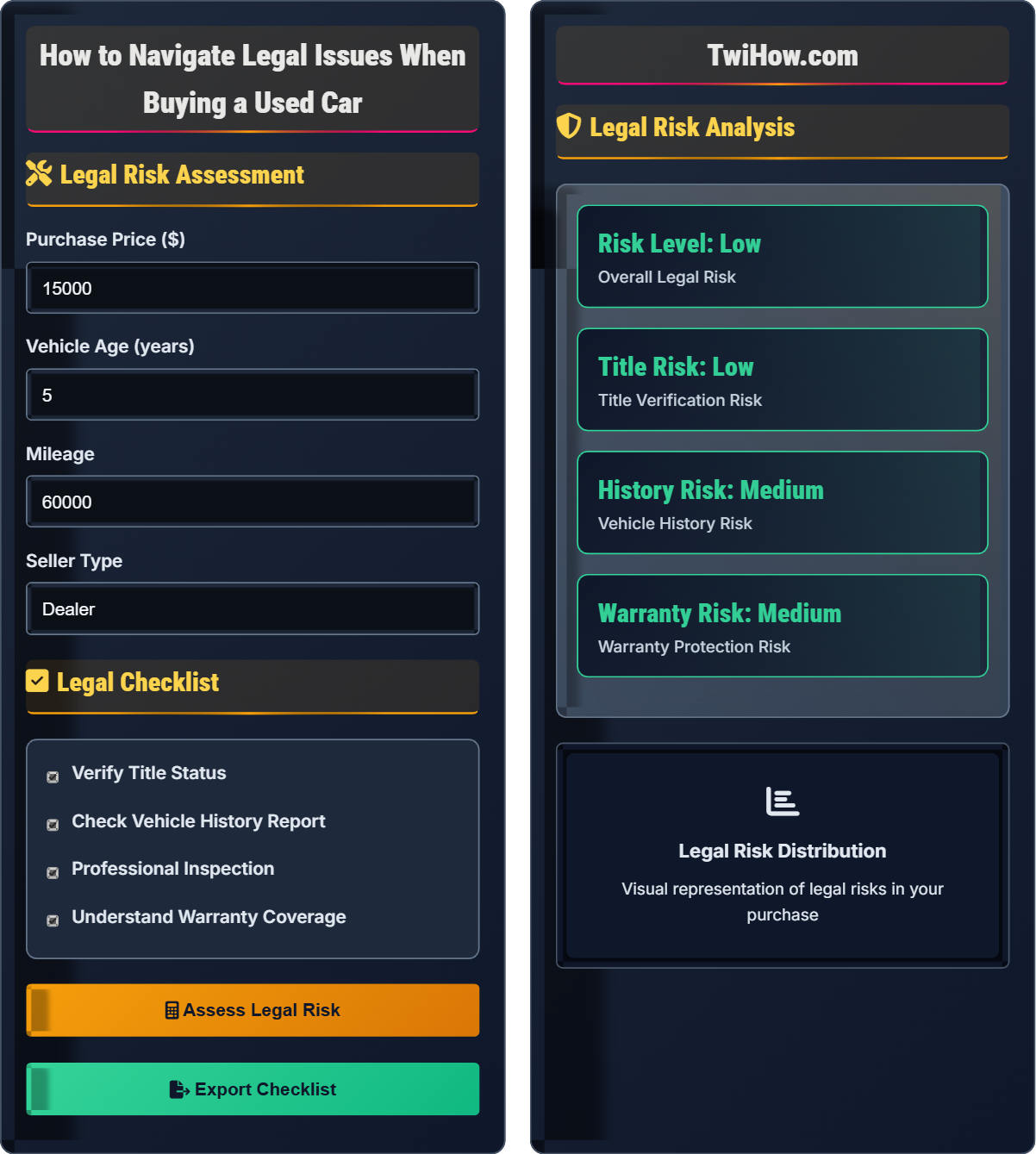
Legal Risk Assessment
Legal Checklist
Legal Risk Analysis
Legal Risk Distribution
Visual representation of legal risks in your purchase
| Item | Status | Action Required |
|---|---|---|
| Title Verification | ✓ Done | None |
| Vehicle History | ⚠ Pending | Order report |
| Professional Inspection | ⚠ Pending | Schedule inspection |
| Warranty Review | ✓ Done | None |
Legal Protections Available
- Implied Warranty: Vehicle is fit for normal use
- Express Warranty: Specific manufacturer promises
- Lemon Law: Protection for recurring defects
- Fraud Protection: Recourse for misrepresentation
Legal Requirements for Used Car Purchases
Verifying the title is crucial to ensure clear ownership. Check for:
- Clear Title: No outstanding liens or loans
- Salvage Title: Indicates significant damage history
- Flood Damage: Water damage indicators
- Odometer Rollback: Inconsistent mileage readings
Always match the title holder's name with the seller's identification.
Obtain comprehensive reports from services like Carfax or AutoCheck:
Reports typically cost $20-50 but can save thousands in repair costs. Look for:
- Accident history
- Ownership records
- Maintenance records
- Recall status
Protection varies by state but generally includes:
- Lemon Laws: Refund or replacement for recurring defects
- Implied Warranty: Vehicle fits for normal use
- Fraud Protection: Recourse for misrepresentation
- Right to Return: Limited period for returns (varies by state)
- Odometer Fraud: Tampered mileage readings
- Title Washing: Re-registering salvage titles as clean
- Flood Vehicles: Water-damaged cars sold as clean
- Missing Documents: Incomplete title transfers
Essential Legal Documents
Bill of sale, title transfer, registration, insurance, and warranty documents.
Sign title, complete transfer form, pay fees, and register with DMV.
Process varies by state but requires both buyer and seller signatures.
- Never buy without proper title documentation
- Always inspect vehicle before purchase
- Get vehicle history report before buying
Warranty & Protection Rights
Manufacturer warranty, dealer warranty, extended warranty, and implied warranty.
- Powertrain coverage
- Comprehensive coverage
- State lemon law protection
- Implied fitness guarantees
- Dealer warranties may have restrictions
- Private sales offer minimal protection
- As-is sales limit consumer rights
- Used car warranties vary significantly
Used Car Legal Knowledge Quiz
What is the most important aspect of title verification when buying a used car?
The most important aspect of title verification is ensuring that the person selling the car is legally authorized to do so. This requires matching the name on the title with the seller's government-issued identification. This prevents fraud and ensures you're dealing with the legitimate owner.
The answer is B) Matching the title holder's name with seller's ID.
Identity verification is the foundation of any secure transaction. Without confirming that the seller is the legal owner, you risk purchasing stolen property or falling victim to title fraud. This is why matching the title holder's name with the seller's ID is the most critical verification step.
Title Holder: The person legally registered as the vehicle owner
Liens: Outstanding debts secured by the vehicle
Title Fraud: Illegal alteration or forgery of title documents
• Always verify seller's identity matches title
• Check for outstanding liens on the title
• Never sign title until payment is complete
• Request original title, not copies
• Check for alterations or signs of tampering
• Verify title status with DMV if uncertain
• Accepting unsigned or incomplete titles
• Not verifying seller's identity
• Failing to check for liens
Explain the purpose of lemon laws and how they protect consumers when purchasing used cars. What steps should a consumer take if they believe they've purchased a lemon?
Purpose of Lemon Laws: Lemon laws are consumer protection statutes that require manufacturers to repurchase or replace vehicles with substantial defects that cannot be repaired after a reasonable number of attempts. While primarily focused on new vehicles, many states extend some protections to used cars.
Consumer Protection: Lemon laws provide remedies when vehicles have defects that substantially impair their use, value, or safety. They typically cover manufacturing defects but not normal wear or consumer abuse.
Steps to Take: Document all repair attempts, communicate with the manufacturer in writing, keep detailed records of problems and costs, and contact your state's consumer protection agency if repairs fail.
Lemon laws serve as a crucial consumer protection mechanism, ensuring manufacturers stand behind their products. These laws recognize that vehicles are essential purchases that must function reliably. Understanding your state's specific lemon law provisions is important before making a purchase.
Lemon: A vehicle with substantial defects affecting use, value, or safety
Substantial Defect: Problems that significantly impair vehicle operation
Reasonable Attempts: Number of repair tries before lemon law applies
• Lemon laws vary significantly by state
• Documentation is crucial for claims
• Time limits apply to lemon law claims
• Research your state's lemon law before buying
• Keep detailed service records
• Document all communication with dealers
• Not knowing state-specific lemon law provisions
• Failing to document repair attempts properly
• Missing deadlines for lemon law claims
You're considering buying a 10-year-old sedan with 35,000 miles on the odometer, but the seller claims it's a low-mileage collector's car. The vehicle appears well-maintained but shows signs of regular use inside. Calculate the average annual mileage and describe how you would verify if the odometer reading is accurate. What legal protections exist for odometer fraud?
Annual Mileage Calculation: 35,000 miles ÷ 10 years = 3,500 miles per year, which is significantly below the national average of 12,000-15,000 miles per year.
Verification Methods: Check maintenance records for mileage stamps, examine tire wear relative to mileage, inspect brake pad wear, look for inconsistent wear patterns inside the cabin, and request a comprehensive vehicle history report.
Legal Protections: The federal Truth in Mileage Act prohibits odometer tampering. Dealers must disclose true mileage, and buyers can seek damages if fraud is proven. Penalties include actual damages plus up to $10,000 in statutory damages.
Recommended Action: Have the vehicle inspected by a mechanic familiar with odometer fraud and consider requesting a vehicle history report showing maintenance milestones.
Odometer fraud is one of the most common forms of used car fraud. The discrepancy between claimed low mileage and actual usage patterns often reveals tampering. Understanding how to verify mileage and knowing your legal protections helps prevent costly mistakes.
Odometer Fraud: Illegally altering a vehicle's mileage reading
Truth in Mileage Act: Federal law preventing odometer tampering
Rollback: Reducing displayed mileage through manipulation
• Average annual mileage is 12,000-15,000 miles
• Sellers must disclose true mileage
• Odometer fraud carries severe penalties
• Compare mileage to age of vehicle
• Check maintenance records for consistency
• Examine wear patterns inside cabin
• Accepting unusually low mileage claims without verification
• Not checking maintenance records
• Ignoring physical signs of wear
A seller offers you a 5-year-old SUV with a "rebuilt" title at 40% below market value. The seller claims the car was professionally restored after minor flood damage. Explain the legal implications of a rebuilt title, the risks involved, and what questions you should ask. How would you calculate whether the savings justify the increased risk?
Rebuilt Title Implications: The vehicle was declared a total loss by an insurance company, then repaired and re-registered. This indicates significant past damage that may affect safety, reliability, and resale value.
Legal Considerations: Rebuilt titles must be disclosed to future buyers. Insurance companies may charge higher premiums or refuse coverage. Some states have restrictions on rebuilt title vehicles.
Questions to Ask: What type of damage occurred? What repairs were made? Are there structural concerns? Has the vehicle passed state inspection for rebuilt vehicles? What documentation exists of the rebuild process?
Risk Calculation: Compare the price savings to potential future repair costs, insurance premiums, and resale value depreciation. Factor in peace of mind and safety concerns.
Salvage and rebuilt titles indicate vehicles that have experienced significant damage. While professionally restored vehicles can be safe, the history creates ongoing concerns about structural integrity, electrical systems, and long-term reliability. Understanding these risks helps make informed decisions.
Salvage Title: Vehicle declared total loss by insurance
Rebuilt Title: Restored salvage vehicle legally re-registered
Total Loss: Repair costs exceed vehicle value
• Salvage titles must be disclosed to buyers
• Insurance may be difficult to obtain
• Resale value is significantly reduced
• Get independent inspection of repairs
• Research insurance availability
• Factor in higher maintenance costs
• Underestimating long-term maintenance costs
• Not researching insurance implications
• Ignoring potential structural issues
Which of the following statements about warranties on used car purchases is TRUE?
Even in private party sales, there are implied warranties that the vehicle is fit for normal use. However, these are limited compared to dealer warranties. Private sales often come with fewer explicit protections, but sellers cannot knowingly sell defective vehicles without disclosure.
The answer is B) Implied warranties provide some protection in private sales.
Implied warranties exist regardless of the seller type, though they are more limited in private sales. These warranties guarantee that the vehicle is fit for ordinary use and will perform as expected. Understanding these protections helps set realistic expectations for used car purchases.
Implied Warranty: Unstated guarantee of fitness for use
Express Warranty: Stated promises about product performance"As-Is" Sale: Purchase without express warranties
• Private sales have limited warranty protection
• Implied warranties still apply in most cases
• "As-is" sales limit but don't eliminate rights
• Ask about any available warranty coverage
• Get warranty terms in writing
• Understand what's excluded from coverage
• Assuming no warranty protection exists
• Not understanding "as-is" sale limitations
• Overlooking implied warranty protections
FAQ
Q: What's the difference between a salvage title and a rebuilt title, and how do they affect my legal rights as a buyer?
A: A salvage title is assigned when an insurance company declares a vehicle a total loss due to damage (accidents, floods, theft recovery, etc.). The vehicle cannot be driven legally until it's rebuilt and inspected.
A rebuilt title is given to a previously salvaged vehicle that has been repaired and passed state inspection. The vehicle can be registered and driven legally.
Legally, both titles must be disclosed to buyers. Salvage/rebuilt vehicles have reduced value and may face insurance challenges. You retain rights to accurate disclosure, but warranty protections are typically limited. Some states offer specific protections for rebuilt vehicles.
Q: If I buy a used car from a dealer and discover major undisclosed problems, what are my legal remedies?
A: Dealers have significant disclosure obligations and warranties. Your legal remedies may include:
1. Dealership Warranty: Most dealers offer some warranty coverage
2. Implied Warranties: Vehicle should be fit for normal use
3. Fraud Claims: For intentional misrepresentation
4. State Lemon Laws: May apply depending on defect severity
5. Consumer Protection Acts: Additional state remedies
Document everything, contact the dealer first, and consider filing complaints with state agencies. Keep all receipts and communication records.