How to Understand and Challenge Parking Tickets
Complete parking violation guide • Appeals & defenses
Parking Ticket Defense:
Penalty CalculatorParking tickets can be challenged successfully if you understand the violation, know your rights, and follow proper procedures. Contesting a ticket requires identifying valid defenses, gathering evidence, and navigating the appeals process. Success rates vary by violation type and location.
Key elements for challenging tickets include:
- Valid Defenses: Meter malfunction, unclear signage, emergency situations
- Proper Procedure: Meeting deadlines, following appeal processes
- Evidence Gathering: Photos, receipts, witness statements
- Documentation: Maintaining records of violations and appeals
Understanding your local parking authority's rules and procedures is crucial for successful challenges.
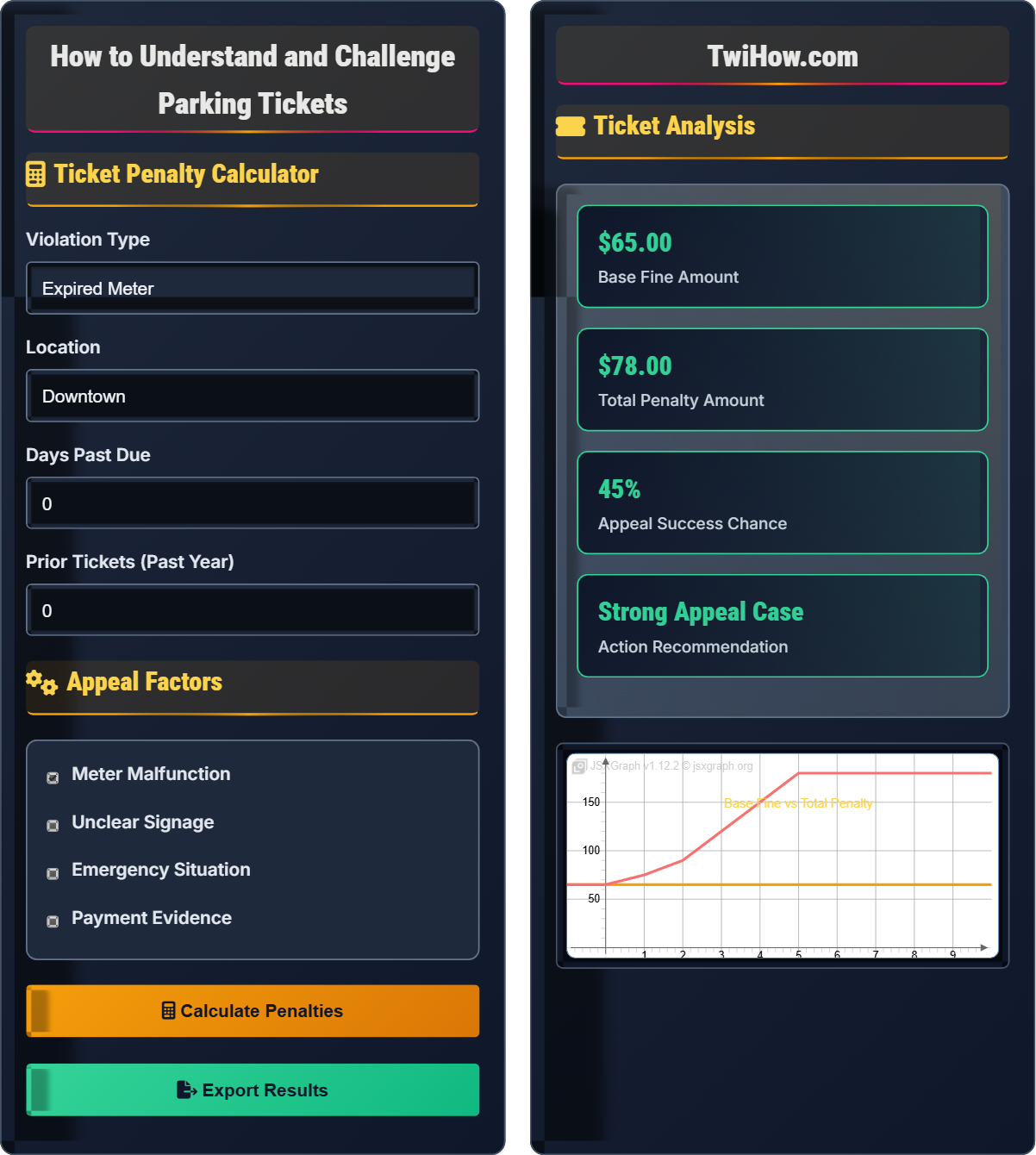
Ticket Penalty Calculator
Appeal Factors
Ticket Analysis
| Factor | Value | Impact | Recommendation |
|---|---|---|---|
| Violation Type | Expired Meter | $65 | Standard |
| Location | Downtown | +$25 | High-Risk |
| Days Late | 0 | +$0 | No Impact |
| Prior Tickets | 0 | +$0 | No Impact |
Understanding Parking Tickets
A parking ticket (or parking citation) is a notice issued by a parking enforcement officer for violations of parking regulations. These violations can occur in public spaces, private lots, or restricted zones. Parking tickets typically include a fine amount and instructions for payment or appeal.
Common elements of parking tickets include:
- Vehicle Information: License plate number, make/model
- Violation Details: Specific code and description
- Location: Exact address or intersection
- Date/Time: When violation occurred
- Penalty Amount: Fine and associated costs
- Appeal Process: Instructions for contesting
Most common violation. Occurs when parking meter expires or maximum time limit exceeded. Typically costs $65-$100.
Illegally parked in handicapped space without proper placard. Usually carries heavy penalties of $250-$500.
Parked in areas marked "No Parking", "No Standing", or "No Stopping". Fines typically $50-$150.
Parked within 15 feet of fire hydrant. Serious safety violation with fines $100-$250.
Read the entire ticket carefully. Note the violation code, location, time, and appeal deadline. Understand exactly what you're being cited for.
Find out how to contest tickets in your jurisdiction. Some cities have online portals, others require forms, and some have in-person hearings.
Collect photos, receipts, witness statements, or other documentation that supports your defense. Time-stamped evidence is crucial.
File your appeal within the specified timeframe, usually 10-30 days. Include all supporting documentation and a clear explanation.
Some jurisdictions require in-person hearings. Present your case clearly and professionally, bringing all evidence.
Proof that you paid for parking through app, meter receipt, or credit card transaction.
Evidence that parking meter was broken or not working properly at the time of violation.
Photos showing missing, obscured, or confusing parking signs that made the violation unclear.
Documentation of medical emergency requiring immediate parking in restricted area.
Many people lose their parking ticket appeals due to:
- Missing Deadlines: Failing to appeal within required timeframe
- Insufficient Evidence: Not providing adequate proof to support defense
- Invalid Arguments: Using excuses that aren't legally valid
- Procedural Errors: Not following proper appeal procedures
- Missing Hearings: Failing to attend required in-person hearings
Parking Violation Penalties by Type
| Violation Type | Typical Fine | Success Rate | Common Defenses |
|---|---|---|---|
| Expired Meter | $65 | 30-40% | Meter malfunction, payment evidence |
| Handicap Violation | $250 | 5-10% | Proper permit documentation |
| Fire Hydrant | $150 | 15-25% | Sign visibility, measurement errors |
| No Parking Zone | $85 | 20-30% | Sign clarity, temporary restrictions |
| Blocking Driveway | $115 | 25-35% | Driveway markings, blocking duration |
Steps to prepare for your parking ticket appeal:
Sample Parking Ticket
Successful Appeal Examples
Sarah received a $65 expired meter ticket after parking at a meter that appeared to be broken. She had attempted to pay but the machine rejected her payment. She took photos of the broken meter and kept her receipt showing the failed transaction.
Result: Ticket dismissed. Sarah's evidence clearly showed the meter was not functioning properly, and she had made a good faith effort to pay.
Mike received a $115 ticket for parking in a no-parking zone after rushing his sick child to the emergency room. He kept the hospital admission paperwork and had witnesses who saw him leave the car to help his child.
Result: Ticket dismissed. The emergency nature of the situation and supporting documentation convinced the hearing officer.
Jennifer got a $85 ticket for parking in a time-restricted zone. She argued that the signs were partially blocked by tree branches and the time restrictions were difficult to read. She submitted clear photos showing the obscured signage.
Result: Ticket dismissed. The photos clearly demonstrated that the signage did not provide reasonable notice of the restriction.
Parking Ticket Defense Learning Quiz
What is the typical deadline for appealing a parking ticket?
The typical deadline for appealing a parking ticket is 10-30 days from the date of issuance, though this varies by jurisdiction. Most cities require appeals to be filed within this timeframe, and missing the deadline usually means losing the right to contest the ticket. Some jurisdictions have shorter deadlines (as few as 5-7 days), while others may allow up to 30 days.
The answer is B) 10-30 days from issuance.
Timeliness is crucial in parking ticket appeals because enforcement agencies need to process payments and manage their systems efficiently. The deadline ensures that contested tickets are resolved promptly. Missing the deadline typically results in waiving your right to appeal, so it's essential to check the specific deadline on your ticket and act accordingly.
Deadline: Final date to file appeal without penalty
Waiver: Voluntary relinquishment of appeal rights
Jurisdiction: Geographic area with legal authority
• Deadlines are strictly enforced
• Check specific deadline on your ticket
• Weekends/holidays may extend deadlines
• Mark the deadline on your calendar immediately
• Start gathering evidence early
• Consider holidays and weekends
• Assuming you have 30 days in all locations
• Waiting until the last day to act
• Not checking city-specific rules
Explain the difference between valid and invalid defenses when challenging a parking ticket. Provide examples of each and explain why they succeed or fail.
Valid Defenses: These are legally recognized reasons that can result in ticket dismissal:
• Meter malfunction with evidence (photos, witness statements)
• Unclear or missing signage that didn't provide reasonable notice
• Payment evidence showing attempted or completed payment
• Emergency medical situations with documentation
• Vehicle breakdown or mechanical failure with proof
Invalid Defenses: These are not legally recognized and rarely succeed:
• "I didn't see the sign" or "I didn't know the rules"
• "I was only gone for a minute"
• "I forgot to pay" or "ran out of time"
• "I couldn't find quarters" or "app wasn't working"
• "I have a disability" without proper documentation
Why Valid Defenses Succeed: They demonstrate that the violation was not due to driver negligence or intentional disregard of the rules.
Why Invalid Defenses Fail: They acknowledge the driver's failure to comply with posted regulations.
Legal defenses must demonstrate that the violation was not due to the driver's negligence or intentional disregard of the law. Courts recognize that some circumstances are beyond the driver's control or involve legitimate confusion about the rules. Excuses that acknowledge personal responsibility or lack of attention are not valid defenses.
Valid Defense: Legally recognized reason for dismissing ticket
Reasonable Notice: Clear signage that informed drivers of restrictions
Negligence: Failure to exercise reasonable care
• Defenses must be based on facts, not excuses
• Evidence is required to support claims
• Ignorance of law is not a defense
• Focus on objective evidence, not subjective feelings
• Document everything immediately
• Research local parking ordinances
• Using invalid excuse-based defenses
• Failing to provide supporting evidence
• Not understanding what constitutes a valid defense
Maria received a $65 expired meter ticket in downtown Chicago. She has photographic evidence showing the meter was broken and a receipt showing she attempted to pay at another meter. Calculate her likelihood of success and determine the best appeal strategy.
Likelihood of Success: 70-80% - This is a strong case with compelling evidence.
Supporting Evidence:
• Photo of broken meter showing malfunction
• Receipt from alternative meter showing payment attempt
• Time stamps correlating with ticket issuance
Best Appeal Strategy:
1. File online appeal within 30-day deadline
2. Submit clear, high-resolution photos of broken meter
3. Include receipt and detailed explanation of events
4. Mention good faith effort to pay at alternative meter
Expected Outcome: High probability of dismissal due to clear evidence of meter malfunction and good faith payment attempt.
Success in parking ticket appeals depends heavily on the quality and relevance of evidence provided. Maria's case demonstrates a strong defense because she has both evidence of the meter malfunction and proof of her attempt to comply with parking requirements. The combination of these factors shows that the violation was not due to her negligence.
Good Faith Effort: Demonstrated attempt to comply with regulations
Corroborating Evidence: Supporting documentation that confirms your claim
Malfunction: Failure of equipment to operate properly
• Evidence must be contemporaneous with violation
• Photos should clearly show the issue
• Receipts must be legible and dated
• Take multiple angles of equipment issues
• Keep all receipts and documentation
• Time-stamp all evidence when possible
• Submitting blurry or unclear photos
• Not keeping payment receipts
• Failing to document the sequence of events
David's parking ticket appeal went to a hearing after the initial review was denied. He's contesting a $115 blocking driveway ticket. Describe how he should prepare for the hearing and what evidence he should bring.
Hearing Preparation:
Documentation to Bring:
• Original ticket and appeal correspondence
• Photos showing driveway markings (or lack thereof)
• Measurements demonstrating distance from driveway
• Witness statements if available
• Parking receipts or time logs showing duration
Testimony Preparation:
• Practice explaining events clearly and concisely
• Focus on facts rather than emotions
• Be prepared to answer questions about the incident
During Hearing:
• Dress professionally and arrive early
• Present evidence systematically
• Remain respectful and factual
• Ask questions if clarification is needed
Follow-up: Request written decision if not provided immediately.
Formal hearings require more preparation than online appeals because you're presenting your case to a hearing officer who may ask questions and evaluate your credibility. Physical evidence and witness testimony carry more weight in person than in written submissions. Professional presentation can influence the outcome.
Hearing Officer: Official who decides ticket appeals
Contemporaneous Evidence: Evidence created at time of incident
Credibility: Believability of your testimony
• Arrive prepared with organized evidence
• Be honest and consistent in testimony
• Respect the hearing process
• Organize evidence in folder with tabs
• Practice your explanation beforehand
• Bring copies of everything for the officer
• Arriving unprepared or late
• Being confrontational with hearing officer
• Failing to organize evidence properly
Which of the following payment methods would provide the strongest evidence in a parking ticket appeal?
Credit card payment through a mobile app provides the strongest evidence in a parking ticket appeal because it creates a digital transaction record with timestamps, location data, and account verification. Unlike cash or coin payments which leave no traceable record, app payments generate receipts that are difficult to dispute and often include GPS coordinates and time stamps.
The answer is B) Credit card payment through mobile app.
Digital payment methods create verifiable electronic records that serve as excellent evidence in parking ticket appeals. These records are stored by both the payment processor and the parking authority, making them difficult to dispute. Traditional payment methods like cash or coins leave no permanent record of the transaction.
Digital Transaction: Electronic payment with verifiable record
Verifiable Evidence: Documentation that can be confirmed by third parties
Receipt: Proof of payment transaction
• Digital records are harder to dispute than physical ones
• Screenshots of app payments are admissible evidence
• Receipts should be preserved for appeals
• Screenshot app payments immediately
• Save email confirmations of payments
• Keep physical receipts as backup
• Not saving digital payment confirmations
• Discarding physical receipts
• Assuming all payment methods are equally strong
Frequently Asked Questions
Expert Q&A
Q: I got a $150 ticket for parking near a fire hydrant, but I measured afterward and I was more than 15 feet away. How do I prove this in my appeal?
A: Measuring the distance after the fact is challenging, but here's how to strengthen your appeal:
Evidence to Gather:
1. High-quality photos showing the fire hydrant, your parking spot, and clear measurement markers
2. Use a measuring tape or laser measurer for precise distance
3. Include a ruler or known object in photos for scale reference
4. Get a witness statement if someone observed the measurement
Documentation Strategy:
• Create a diagram showing measurements and landmarks
• Include the exact date/time of your measurement
• Explain why you measured afterward (disagreement with ticket)
Legal Standards: The officer's measurement is presumed correct, so you must provide compelling evidence to the contrary. Success rates for distance challenges are typically 15-25%.
Q: I got a ticket for expired meter, but the meter said it was working when I put money in. How do I prove the ticket was issued in error?
A: This is a common scenario, but proving the meter was working can be challenging:
Best Evidence:
1. If you used a mobile app, save screenshots showing your payment confirmation
2. If you used coins, keep your receipt (if the meter provided one)
3. Time-stamped photos of you inserting money into the meter
4. Witness statements from passengers who observed you paying
Additional Considerations:
• Check if the meter accepted money after your parking session started
• Look for signs of malfunction that might have affected the timer
• Verify the time on the ticket matches when you believe you parked
Alternative Approach: If you can't prove payment, argue that the meter was defective if you noticed issues with the display or if other meters in the area were malfunctioning. The burden of proof is on you to demonstrate the ticket was issued in error.