How to Understand Your Rights During a Customs or Border Search?
Complete guide • Travel rights • Legal protections
Customs & Border Rights:
Rights Assessment ToolUnderstanding your rights during customs and border searches is crucial for travelers. While border agents have broad authority, you still have certain protections. This guide covers your rights, what to expect during searches, and how to protect yourself during the process.
Key rights include:
- Right to Remain Silent: You don't have to answer questions
- Documentary Rights: Required documentation and procedures
- Search Limitations: Restrictions on invasive searches
- Appeal Rights: Options if you disagree with decisions
Knowing these rights helps ensure proper treatment while maintaining security protocols.
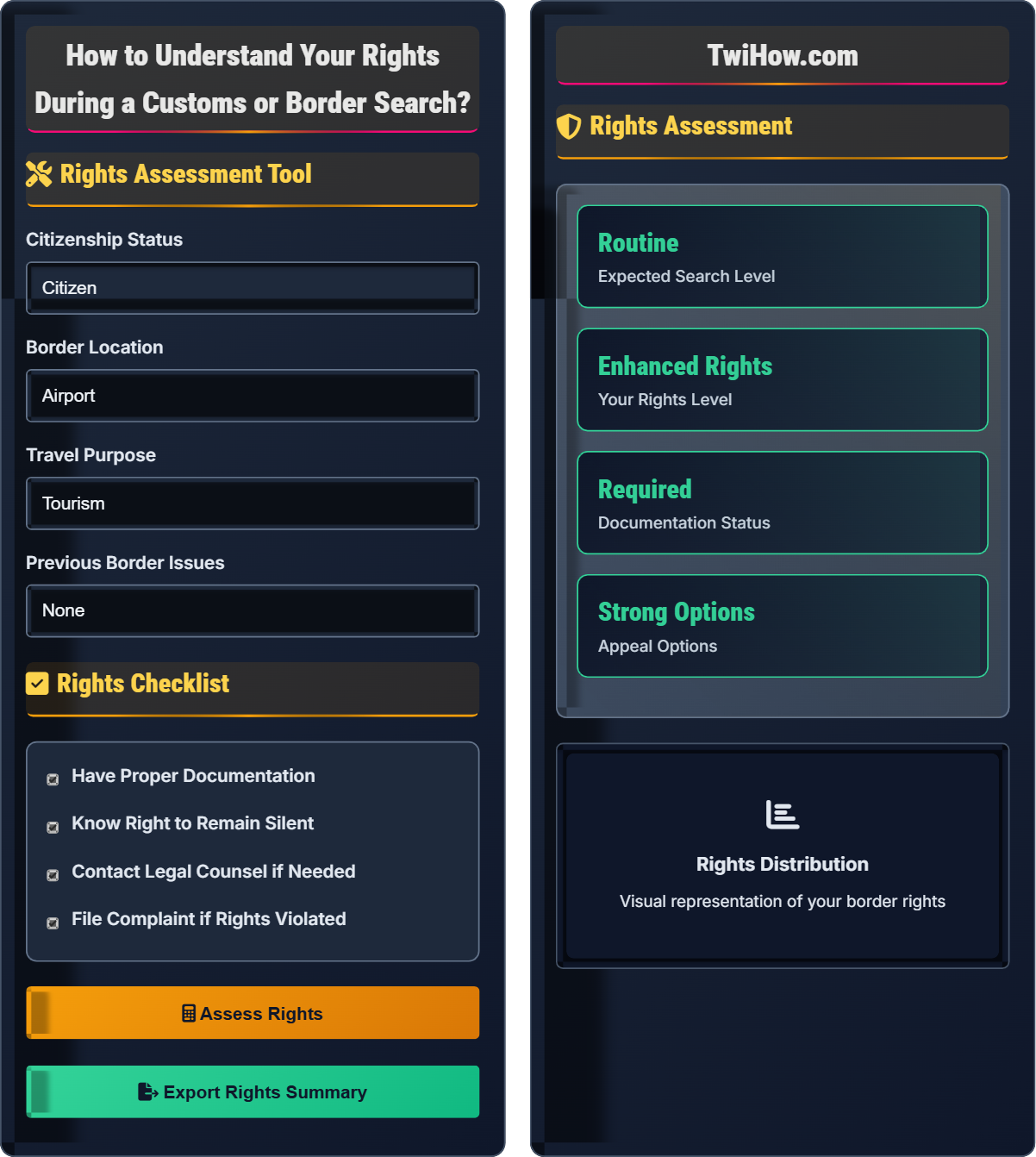
Rights Assessment Tool
Rights Checklist
Rights Assessment
Rights Distribution
Visual representation of your border rights
| Right | Availability | Notes |
|---|---|---|
| Right to Remain Silent | ✓ Available | Except for basic identity |
| Legal Representation | ✓ Available | May be delayed |
| Document Review | ✓ Available | For admissibility |
| Appeal Process | ✓ Available | Varies by status |
Standard Procedure
- Present required documentation
- Answer basic questions about identity
- Submit to routine search
- Exercise rights respectfully
- Request supervisor if needed
Customs and Border Rights Overview
Required documentation varies by citizenship and purpose:
- Citizens: Valid passport or equivalent
- Residents: Green card and passport
- Visitors: Visa, passport, and supporting documents
- Students: I-20, passport, visa, and enrollment docs
Always carry original documents, not copies.
Border agents have varying levels of search authority:
Authority levels:
- Routine inspection (basic)
- Secondary inspection (detailed)
- Intensive inspection (extensive)
- Arrest authority (law enforcement)
Recent court rulings have established some protections:
- Warrant Required: For intensive searches of devices
- Reasonable Suspicion: May be required for some searches
- Scope Limitations: Should be related to admissibility
- Encryption: Passwords not required to be disclosed
- Excessive Detention: Unreasonable delays without cause
- Discrimination: Based on race, religion, or nationality
- Property Seizure: Without proper justification
- Intimidation: Threatening behavior or false accusations
Citizenship-Based Rights
Citizens have stronger constitutional protections than non-citizens.
Fourth Amendment protections apply differently at borders.
Non-citizens have fewer rights regarding entry denial.
- Citizens cannot be denied entry to their country
- Non-citizens have limited entry rights
- Fourth Amendment applies differently at borders
Search Procedures
Routine, secondary, and intensive search procedures with different requirements.
- Initial inspection at primary checkpoint
- Secondary inspection if needed
- Intensive search if justified
- Supervisor consultation if disputed
- Routine searches require no suspicion
- Intensive searches may require reasonable suspicion
- Detention time is limited
- Property seizures require justification
Customs Rights Knowledge Quiz
Can you refuse to answer questions during a border search?
You have the right to remain silent during border searches, but you must answer basic questions about your identity, citizenship, and admissibility. Border agents can require you to identify yourself and provide basic information about your trip.
The answer is B) Yes, except for basic identity questions.
The right to remain silent at borders is more limited than in criminal investigations. While you don't have to answer detailed questions about your trip, purpose, or plans, you must provide basic identifying information required for admissibility determination.
Right to Silence: Protection against self-incrimination
Admissibility: Determination of legal entry
Basic Identity: Name, citizenship, purpose of visit
• You must provide basic identifying information
• You can refuse detailed questioning
• Agents can make admissibility decisions
• Answer basic identity questions
• Politely decline detailed questions
• Request legal counsel if needed
• Refusing to provide basic identity
• Being combative with agents
• Assuming complete silence is allowed
Explain the current legal landscape regarding electronic device searches at borders. What are your rights when agents want to search your phone, laptop, or other devices?
Current Authority: Border agents have broad authority to search electronic devices, but recent court decisions have imposed some limitations. Routine searches may not require suspicion, but intensive searches of devices may require reasonable suspicion.
Legal Protections: The Fourth Amendment still applies, but with reduced protections at borders. Courts have recognized that digital searches are more invasive than physical searches due to the vast amount of personal information stored.
Practical Rights: You can request that searches be conducted in your presence, you can note concerns about privacy, and you can file complaints if searches seem excessive. However, you cannot refuse a lawful search.
Best Practices: Encrypt sensitive data, avoid storing sensitive information on devices you're carrying, and be prepared for potential searches.
Electronic device searches represent a tension between security needs and privacy rights. Courts continue to evolve their interpretation of Fourth Amendment protections in the digital age, particularly at borders where traditional protections are reduced.
Electronic Device Search: Examination of digital contents
Reasonable Suspicion: Specific articulable facts
Fourth Amendment: Protection against unreasonable searches
• Border searches have reduced protections
• Digital searches are more invasive
• Courts are evolving on this issue
• Encrypt sensitive data
• Use cloud storage for sensitive files
• Be aware of jurisdictional differences
• Assuming complete privacy protection
• Storing sensitive data locally
• Refusing lawful searches
You're a U.S. citizen returning from a trip abroad. The customs agent asks you detailed questions about your activities, demands to search your luggage extensively, and seems to be detaining you for an extended period without explanation. Meanwhile, a visitor next to you is allowed to pass through quickly. Analyze your rights compared to the visitor's rights in this situation and explain what actions you can take.
U.S. Citizen Rights: You cannot be denied entry to your country, and you have constitutional protections under the Fifth and Fourteenth Amendments. While border searches are allowed, they must be reasonable.
Visitor Rights: Visitors have limited rights regarding entry and can be denied entry for any reason not prohibited by law. They have fewer constitutional protections at the border.
Actions You Can Take: Request to speak to a supervisor, ask for an explanation of the delay, document the interaction, and file complaints afterward. You cannot be refused entry as a citizen, but you can be detained pending inspection.
Key Difference: Citizens have a constitutional right to enter their country, while visitors do not have an inherent right to enter.
The distinction between citizens and non-citizens at borders is fundamental to immigration law. While both may be subject to searches, citizens have constitutional protections that non-citizens do not, particularly regarding entry rights.
Citizenship Rights: Constitutional protections for citizens
Entry Rights: Legal right to enter country
Admissibility: Determination of legal entry
• Citizens cannot be denied entry to their country
• Non-citizens have limited entry rights
• Both subject to search authority
• Assert your citizenship rights
• Request supervisor consultation
• Document any violations
• Confusing citizen and non-citizen rights
• Not asserting constitutional protections
• Failing to document interactions
While going through customs, you notice that people of a particular nationality are being singled out for extended questioning and searches while others are passing through quickly. You're concerned about potential discriminatory practices. Explain what constitutes illegal discrimination at borders, what evidence would support such claims, and what steps you can take to report it.
Illegal Discrimination: Treatment based solely on race, religion, national origin, or other protected characteristics without individualized suspicion. Profiling based on these factors alone is prohibited.
Lawful Secondary Screening: Targeting based on credible intelligence, watchlist inclusion, or specific behavioral indicators that are not based on protected characteristics.
Evidence to Document: Dates, times, officers involved, specific treatment differences, witness information, and any discriminatory statements made by officials.
Reporting Steps: File complaints with CBP, DHS Office of Civil Rights and Civil Liberties, ACLU, or other civil rights organizations. Consider legal representation if experiencing violations.
Important Distinction: Security-based targeting based on intelligence is different from discriminatory profiling.
Border security and civil rights intersect in complex ways. While security measures are necessary, they must not violate constitutional protections against discrimination. Distinguishing between legitimate security measures and discriminatory practices is crucial.
Profiling: Targeting based on characteristics
Individualized Suspicion: Specific reasons for targeting
Civil Rights: Constitutional protections
• Profiling based on protected characteristics is illegal
• Security measures must have legitimate basis
• Documentation is crucial for complaints
• Observe patterns of treatment
• Document specific incidents
• Report to appropriate agencies
• Confusing security measures with discrimination
• Not documenting incidents properly
• Failing to report violations
Under what circumstances can customs agents seize your personal property during a border search?
Customs agents can seize property when there's probable cause to believe it's contraband, evidence of a crime, or subject to forfeiture. This includes illegal substances, undeclared goods exceeding duty-free limits, prohibited items, and items believed to be involved in criminal activity.
The answer is C) When there's probable cause to believe it's illegal.
While border searches have reduced privacy protections, property seizures still require some level of justification. Probable cause is the standard for seizing property, which is lower than the warrant requirement but still requires reasonable grounds.
Probable Cause: Reasonable belief of illegality
Contraband: Illegal goods
Forfeiture: Government seizure of property
• Seizures require probable cause
• Agents must justify the seizure
• You have rights regarding seized property
• Declare all required items
• Understand duty-free limits
• Know your rights if property is seized
• Assuming no property can be seized
• Not declaring required items
• Failing to understand seizure procedures
FAQ
Q: Can I refuse to unlock my phone if customs asks for my password?
A: This is a complex area of law that's still evolving. Currently, border agents have broad authority to search electronic devices, and refusing to provide passwords may lead to:
• Extended detention
• Device seizure
• Denial of entry (for non-citizens)
• Further investigation
Courts have generally held that the Fifth Amendment's protection against self-incrimination doesn't apply to providing passwords, as it's considered providing access rather than testimonial evidence. However, some circuits have begun to recognize stronger protections for digital searches.
Best practice: Be cooperative while noting privacy concerns.
Q: How long can customs detain me for questioning?
A: The length of detention depends on the type of inspection:
• Routine inspection: Should be brief (minutes)
• Secondary inspection: Typically 30 minutes to 2 hours
• Extended questioning: Several hours if necessary
• Intensive inspection: Potentially longer with supervision
Detention must be reasonably related to the purpose of inspection. Unreasonable delays without justification may violate constitutional rights. Citizens cannot be indefinitely detained, while non-citizens may face longer detention periods related to admissibility determinations.
If detention seems excessive, request to speak with a supervisor.