What Are My Privacy Rights Under Current Data Protection Laws?
Complete privacy guide • Step-by-step explanations
Privacy Rights Overview:
Show Privacy Rights AnalyzerYour privacy rights under data protection laws include control over your personal information, transparency about data collection and use, and security protections. Major regulations like GDPR, CCPA, and other privacy laws grant you rights to access, correct, delete, and port your personal data. You also have rights to object to processing, restrict processing, and withdraw consent.
These rights empower you to make informed decisions about your data and hold organizations accountable for their data practices. Understanding your rights helps you protect your digital identity and personal information.
Key privacy rights include:
- Right to Access: Know what personal data is collected and processed
- Right to Correction: Rectify inaccurate or incomplete data
- Right to Deletion: Request removal of personal data
- Right to Portability: Transfer data to other services
These rights vary by jurisdiction but form the foundation of modern data protection frameworks worldwide.
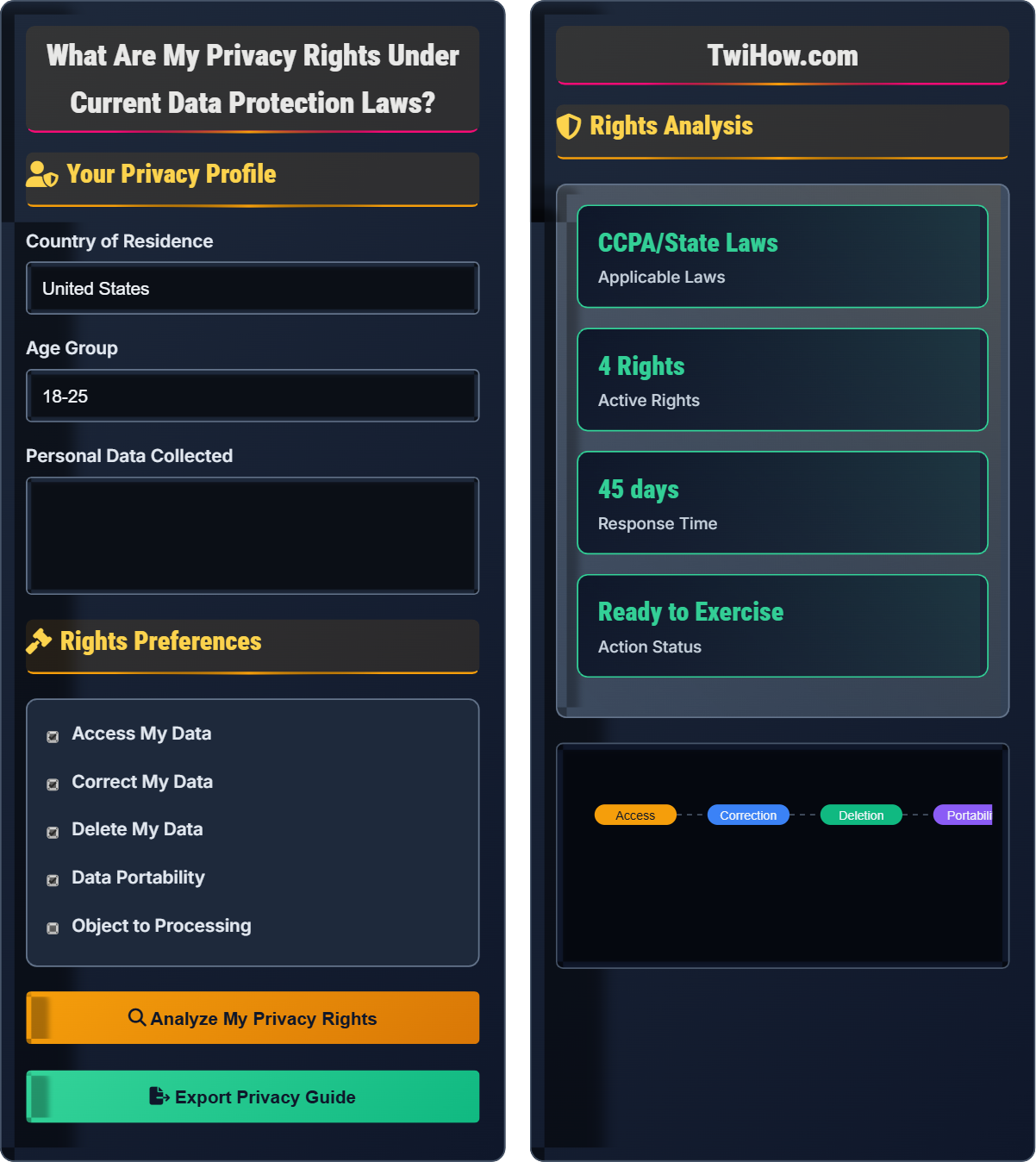
Your Privacy Profile
Rights Preferences
Rights Analysis
| Right | Description | Availability | Response Time |
|---|---|---|---|
| Access | View your personal data | Available | 30 days |
| Correction | Update inaccurate data | Available | 30 days |
| Deletion | Remove personal data | Available | 30 days |
| Portability | Transfer data elsewhere | Available | 30 days |
| Restriction | Limit data processing | Available | Immediate |
Recommended Actions
- Submit privacy request to data controllers
- Verify your identity for requests
- Track request status
- Appeal if necessary
- File complaints with authorities
Understanding Your Privacy Rights
Privacy rights are legal protections that give you control over your personal information. These rights are enshrined in data protection laws like the General Data Protection Regulation (GDPR), California Consumer Privacy Act (CCPA), and similar legislation worldwide. They ensure that organizations collecting your data do so transparently, securely, and with your consent.
Modern privacy rights follow a comprehensive framework:
Where:
- Transparency: Organizations must disclose data practices
- Control: Individuals have rights over their data
- Security: Adequate protection of personal information
- Accountability: Organizations responsible for compliance
Different regions have varying privacy protection frameworks:
- GDPR (EU): Comprehensive rights with strict enforcement
- CCPA (California): Consumer rights focused on transparency
- PIPEDA (Canada): Personal Information Protection and Electronic Documents Act
- APPI (Japan): Act on the Protection of Personal Information
- LGPD (Brazil): Lei Geral de Proteção de Dados
- VCDPA (Virginia): Virginia Consumer Data Protection Act
- Identify Data Controllers: Find organizations holding your data
- Submit Requests: Make formal requests using designated channels
- Verify Identity: Provide proof of identity as required
- Track Progress: Monitor request status and follow up
- Appeal Decisions: Challenge denials through proper channels
- File Complaints: Report violations to supervisory authorities
Privacy Rights Essentials
Personal data, data controller, data processor, consent, transparency, accountability, data minimization.
Privacy Protection = (Consent + Transparency + Control) × Accountability
Where Consent = Voluntary Permission; Transparency = Clear Disclosure; Control = Individual Rights; Accountability = Organizational Responsibility.
- Organizations must obtain explicit consent
- Data must be processed lawfully and fairly
- Individuals have rights over their personal data
- Organizations must implement security measures
Regional Variations
GDPR (Europe), CCPA (California), PIPEDA (Canada), APPI (Japan), LGPD (Brazil), VCDPA (Virginia).
- GDPR: Most comprehensive rights
- CCPA: Focus on transparency and opt-out
- PIPEDA: Canadian federal law
- APPI: Japan's data protection law
- LGPD: Brazil's GDPR-inspired law
- VCDPA: Virginia's consumer rights law
- Regional laws apply to residents
- Global companies must comply with multiple laws
- Some laws have extra-territorial reach
- Penalties vary by jurisdiction
Privacy Rights Learning Quiz
Under GDPR, how long does a data controller have to respond to a data subject access request?
Under the General Data Protection Regulation (GDPR), data controllers must respond to data subject access requests within 30 days of receiving the request. This timeframe can be extended by an additional 30 days if the request is complex or numerous, but the controller must inform the data subject of the extension within the initial 30-day period and provide reasons for the delay.
The answer is C) 30 days.
The 30-day response period under GDPR is designed to balance the data subject's right to timely access with the controller's need for reasonable time to locate and compile the requested information. This timeframe is stricter than many previous data protection laws, emphasizing the importance of data accessibility and transparency. The extension provision acknowledges that complex requests may require additional time while maintaining accountability through notification requirements.
Data Subject: Individual whose personal data is processed
Data Controller: Organization determining purposes and means of processing
Access Request: Formal request to view personal data held by an organization
• Initial response time is 30 days
• Extension possible for 30 more days
• Must notify subject of extension
• Keep records of your request dates
• Follow up if no response by deadline
• Contact supervisory authority if ignored
• Confusing GDPR with other regional laws
• Assuming longer response periods
• Not tracking request submission dates
Explain the right to erasure (right to be forgotten) under GDPR, including when it applies, when it doesn't apply, and the process for exercising this right.
Right to Erasure: The right to erasure allows data subjects to request the deletion of their personal data under certain conditions. This right is not absolute and has specific exceptions.
When It Applies:
• The personal data is no longer necessary for the original purpose
• The data subject withdraws consent and there is no other legal basis
• The data subject objects to processing and there are no overriding legitimate grounds
• The personal data has been unlawfully processed
• The personal data must be erased to comply with legal obligations
• The personal data was collected in relation to the offer of information society services to a child
When It Doesn't Apply:
• Processing is necessary for freedom of expression and information
• Processing is necessary for compliance with legal obligations
• Processing is necessary for archiving purposes in the public interest
• Processing is necessary for scientific/historical research purposes
• Processing is necessary for the establishment, exercise, or defense of legal claims
Process for Exercising: Submit a clear request to the data controller specifying the data to be deleted and the grounds for the request. The controller must respond within 30 days, confirming deletion or explaining why the request was denied.
The right to erasure represents a significant shift toward individual control over personal data. However, it's balanced against other important interests such as freedom of expression, legal compliance, and legitimate business interests. The conditional nature of this right reflects the complex balance between individual privacy and broader societal needs. Understanding these conditions helps individuals make informed decisions about when to exercise this right.
Right to Erasure: Right to request deletion of personal data
Data Controller: Entity determining processing purposes and means
Legitimate Interests: Justifiable reasons for data processing
• Not an absolute right
• Balances against other interests
• Must specify grounds for request
• Clearly state the reason for deletion request
• Reference specific GDPR article if possible
• Keep records of your request
• Assuming the right is absolute
• Not understanding exceptions
• Failing to specify grounds clearly
You've been using a fitness tracking app for 3 years and want to switch to a competitor's service. The app has collected detailed health data, workout logs, sleep patterns, and dietary information. You want to transfer this data to the new service. What are your rights under GDPR regarding data portability, and what format should the data be provided in?
Right to Data Portability: Under Article 20 of GDPR, you have the right to receive your personal data that you provided to a controller in a structured, commonly used, and machine-readable format, and to transmit that data to another controller without hindrance from the controller to whom the personal data has been provided.
Scope of Right:
• Data you provided directly (fitness metrics, workout logs)
• Data derived from your activity (sleep patterns, dietary analysis)
• Data processed based on your consent or contract
Required Format: The data must be provided in a structured, commonly used, and machine-readable format. This typically means JSON, XML, CSV, or other standard formats that can be easily imported into other systems.
Process: Submit a data portability request to the fitness app specifying that you want to transfer data to another service. The app must provide the data in the required format within 30 days. The app should also facilitate the transfer to the extent technically feasible.
Limitations: The right applies only to data processed based on consent or contract, and where processing is carried out by automated means.
The right to data portability promotes competition and user choice by enabling easy switching between services. It encourages interoperability and prevents vendor lock-in. However, it only applies to data that the user provided or that resulted from their activity, not data inferred about them by the controller. The technical feasibility requirement acknowledges that perfect portability may not always be achievable but requires controllers to make reasonable efforts to facilitate transfers.
Data Portability: Right to transfer data between services
Structured Format: Organized, standardized data format
Machine-Readable: Format that can be processed by computers
• Applies to user-provided data
• Must be in machine-readable format
• Response within 30 days
• Specify the destination service clearly
• Request standard formats like JSON or CSV
• Verify data integrity after transfer
• Requesting data not covered by portability
• Accepting proprietary formats
• Not verifying transferred data
You signed up for a newsletter and agreed to receive marketing emails. Later, you decided to withdraw your consent but the company claims they have other legal bases for processing your email address and continue sending marketing communications. According to GDPR, what are your rights in this situation, and how should you proceed?
Consent Withdrawal Rights: Under GDPR Article 7(3), you have the right to withdraw consent at any time. Withdrawal must be as easy as giving consent, and the company must inform you of this right before you give consent.
Company's Response: If the company claims other legal bases for processing, they must demonstrate that they have legitimate grounds other than consent. These could include:
• Contractual necessity (fulfilling purchase agreements)
• Legal obligation (tax records)
• Legitimate interests (provided they override your rights)
Your Rights:
• Right to object to processing based on legitimate interests
• Right to request restriction of processing
• Right to file complaints with supervisory authorities
Recommended Action: Formally withdraw consent in writing, request specific information about alternative legal bases, object to processing based on legitimate interests if applicable, and consider filing complaints if the company continues unwanted communications without valid legal grounds.
Important Note: Even if other legal bases exist, you may still have rights to object to direct marketing communications specifically.
The ability to withdraw consent is fundamental to GDPR's emphasis on individual control. However, withdrawal of consent doesn't necessarily stop all processing if other legal bases exist. This creates a complex interplay between different legal grounds and individual rights. The key is understanding that consent withdrawal is absolute, but other legal bases may still permit processing under specific conditions, subject to other rights like objection.
Legal Basis: Lawful ground for processing personal data
Legitimate Interests: Justifiable business reasons for processing
Direct Marketing: Promotional communications
• Consent withdrawal must be easy
• Other legal bases may exist
• Right to object to marketing
• Document your consent withdrawal
• Request specific legal basis information
• Object to marketing specifically
• Assuming withdrawal stops all processing
• Not requesting alternative legal basis
• Failing to object to marketing separately
Under GDPR, how soon must a data controller notify the supervisory authority of a personal data breach?
Under GDPR Article 33, a data controller must notify the competent supervisory authority of a personal data breach without undue delay and, where feasible, not later than 72 hours after becoming aware of it, unless the breach is unlikely to result in a risk to the rights and freedoms of natural persons. If the notification cannot be made within 72 hours, the controller must provide reasons for the delay.
The answer is C) Within 72 hours.
The 72-hour notification requirement strikes a balance between prompt reporting and allowing organizations reasonable time to assess the breach. The "without undue delay" language emphasizes urgency, while the 72-hour deadline provides a concrete timeframe. The exception for low-risk breaches acknowledges that not all incidents require immediate regulatory notification. This timeline ensures that supervisory authorities can respond quickly to significant breaches while allowing organizations time for proper assessment.
Data Breach: Security incident leading to unauthorized access/disclosure
Supervisory Authority: Government body overseeing data protection
Undue Delay: Unreasonable delay in taking action
• Notify within 72 hours
• Exception for low-risk breaches
• Provide reasons if delayed
• Maintain breach response procedures
• Document breach discovery time
• Assess risk level immediately
• Confusing 72-hour deadline with other timelines
• Not assessing risk level properly
• Failing to document breach timeline
FAQ
Q: Do privacy rights like GDPR apply to me if I'm not in Europe?
A: Yes, GDPR can apply to you even if you're not in Europe! The GDPR has extra-territorial scope, meaning it applies to organizations outside the EU that process personal data of EU residents. So if you're an EU resident using services from companies worldwide, those companies must comply with GDPR regarding your data.
Additionally, many countries have their own privacy laws (like CCPA in California, PIPEDA in Canada) that provide similar rights. The specific rights and protections depend on your location and the location of the data controller.
Always check which privacy laws apply based on where you live and where the organization is located.
Q: What's the difference between the right to erasure and the right to be forgotten?
A: The right to erasure and the right to be forgotten are actually the same thing! "Right to erasure" is the technical term used in the GDPR, while "right to be forgotten" is the more colloquial term that became popular after the landmark European Court of Justice case.
The right allows individuals to request deletion of their personal data under certain conditions. The "forgotten" aspect refers to the idea that the data should be completely removed from systems, as if it never existed.
Both terms refer to the same legal concept: the right to have your personal data deleted by a data controller under specific circumstances.