What Are My Rights If My Employer Monitors My Personal Devices?
Complete guide • Employee privacy rights • Legal protections
Employee Device Monitoring Rights:
Rights Assessment ToolWhen employers require or encourage the use of personal devices for work, understanding your privacy rights becomes crucial. This guide covers legal protections, monitoring limitations, consent requirements, and essential steps to protect your personal information while maintaining professional obligations.
Key considerations include:
- BYOD Policies: Bring Your Own Device terms and conditions
- Privacy Laws: State and federal protections for employees
- Monitoring Limits: What employers can and cannot track
- Personal Data: Protection of non-work-related information
Knowing your rights helps balance workplace productivity with personal privacy protection.
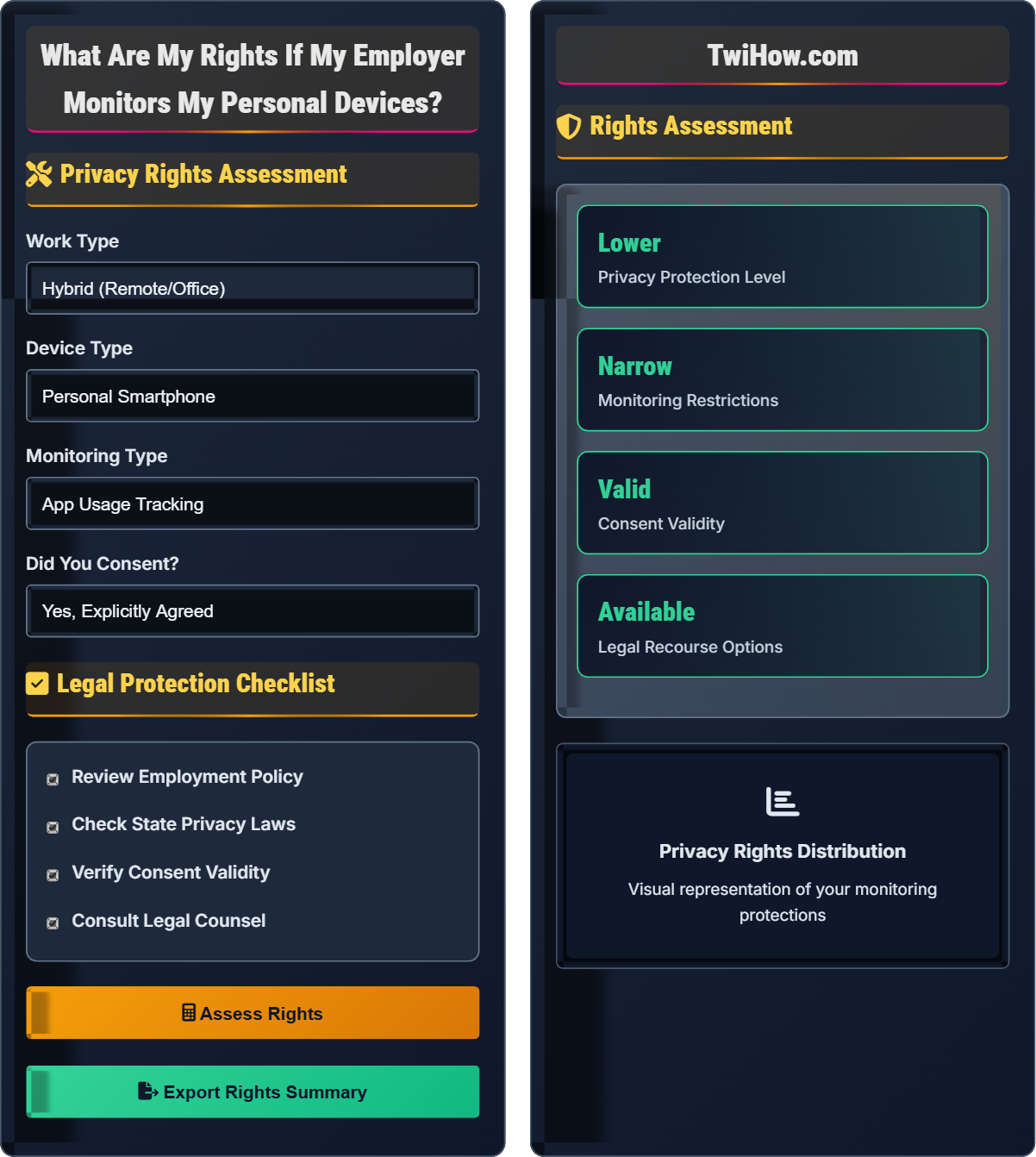
Privacy Rights Assessment
Legal Protection Checklist
Rights Assessment
Privacy Rights Distribution
Visual representation of your monitoring protections
| Right | Status | Details |
|---|---|---|
| Notice of Monitoring | ✓ Required | Must be informed of monitoring |
| Reasonable Privacy | ⚠ Limited | Depends on consent and policies |
| Personal Data Protection | ✓ Protected | Non-work data should be secure |
| Limitation on Monitoring | ⚠ Conditional | Based on consent scope |
Available Protections
- State privacy laws (varies by jurisdiction)
- Contractual protections in employment agreements
- Consent limitations and scope restrictions
- Personal data segregation requirements
Employee Privacy Rights Overview
Employee privacy rights are governed by multiple legal frameworks:
- Federal Laws: Stored Communications Act, Electronic Communications Privacy Act
- State Laws: California Consumer Privacy Act, Illinois Biometric Privacy Act
- Common Law: Invasion of privacy torts
- Employment Contracts: Specific privacy provisions
These laws balance employer business interests with employee privacy expectations.
Bring Your Own Device policies must meet specific legal requirements:
Key requirements:
- Clear notice of monitoring scope
- Employee consent for specific monitoring
- Reasonable business justification
- Data segregation between personal and work
Legal limitations on employer monitoring include:
- Personal Communications: Generally protected from monitoring
- Off-Duty Activities: Limited monitoring during non-work hours
- Biometric Data: Special restrictions in some states
- Location Tracking: Must be job-related and necessary
- Excessive Monitoring: Beyond what's necessary for business
- Lack of Notice: Not informing employees of monitoring
- Personal Data Access: Accessing non-work personal information
- Unauthorized Consent: Obtaining consent through coercion
State Privacy Laws
Privacy laws vary significantly by state with different protections.
Notice requirements, consent procedures, and monitoring restrictions.
Some states provide stronger protections than federal law.
- California provides extensive privacy protections
- Illinois has strict biometric data laws
- Several states require specific monitoring notices
Consent and Legal Protections
Clear, specific, and voluntary consent for monitoring activities.
- Clear notice of monitoring scope
- Specific consent for each monitoring type
- Opportunity to withdraw consent
- Separation from employment terms
- Consent must be freely given
- Employees can withdraw consent
- Employers cannot retaliate
- Monitoring must be job-related
Employee Privacy Rights Quiz
Under most state and federal laws, what constitutes valid consent for employer monitoring of personal devices?
Valid consent requires clear, specific notice of what monitoring will occur and explicit consent for those specific activities. General consent or implicit consent through continued employment is typically insufficient for comprehensive monitoring of personal devices.
The answer is B) Clear notice and explicit consent for specific monitoring.
Consent for monitoring personal devices must be specific and informed. Employers cannot rely on general employment agreements or continued employment as consent for comprehensive personal device monitoring. The consent must clearly specify what will be monitored.
Explicit Consent: Clear, specific permission
Implicit Consent: Assumed through behavior
Informed Consent: Permission with full knowledge
• Consent must be specific to monitoring type
• Notice must be clear and understandable
• Employees can withdraw consent in some cases
• Read consent agreements carefully
• Ask for clarification on monitoring scope
• Document consent terms
• Assuming general consent covers all monitoring
• Not understanding scope of consent
• Signing consent without reading terms
Can employers legally track the location of employees' personal devices during work hours? What about after hours or on weekends? What are the legal limitations?
During Work Hours: Location monitoring may be permitted if there's a legitimate business necessity, such as field work, delivery services, or safety concerns. The monitoring must be job-related and necessary for business operations.
After Hours: Generally more restricted. Employers typically cannot monitor personal location during off-duty time unless specifically consented to and justified by business necessity.
Legal Limitations: Must have clear notice, specific consent, legitimate business purpose, and proportionality. Some states like California have stricter protections for location data.
Best Practice: Employers should limit monitoring to work-related activities and provide clear policies about when monitoring occurs.
Location monitoring raises significant privacy concerns because it tracks personal movements. Courts and legislatures have recognized that location data is highly sensitive. Business necessity must be clearly demonstrated for such monitoring to be permissible.
Business Necessity: Essential for business operations
Location Data: Geographic positioning information
Off-Duty Time: Non-work hours and days
• Location monitoring requires strong justification
• Off-duty monitoring is highly restricted
• Consent must be specific to location tracking
• Understand when monitoring is active
• Question monitoring outside work context
• Review location tracking settings
• Not realizing location is being tracked
• Accepting constant monitoring without justification
• Not checking app permissions regularly
Your employer installed monitoring software on your personal phone that can access all apps, including your personal banking app, health records, and private messaging. The software claims to only monitor work-related activities but you're concerned it's accessing personal data. Analyze your legal rights and what actions you should take to protect your privacy.
Legal Rights: You have rights to privacy of personal information even on devices used for work. Employers cannot access personal communications or sensitive personal data without specific consent and justification.
Problems Identified: Access to banking, health records, and private messaging exceeds reasonable monitoring scope. Even if software claims to be selective, the capability to access personal data is problematic.
Recommended Actions: Document the monitoring capabilities, review your consent agreement, contact HR about privacy concerns, consider removing the software if possible, and consult with an employment attorney if necessary.
Legal Violations: This may violate state privacy laws, ECPA, and reasonable expectation of privacy.
Monitoring software that can access personal applications crosses legal boundaries. Even if intended to be selective, the mere capability to access highly personal information like banking and health records is problematic and may violate privacy laws.
Reasonable Expectation: Privacy protection standard
Personal Data: Non-work related information
Monitoring Capability: Technical ability to access data
• Personal financial data is protected
• Health information has special protections
• Monitoring must be limited to work purposes
• Review app permissions regularly
• Question broad monitoring capabilities
• Document any privacy concerns
• Not reviewing app permissions after installation
• Accepting broad monitoring without question
• Not documenting privacy concerns
Your employer wants to implement fingerprint scanning on your personal device for work app access. The biometric data will be stored on company servers. You live in Illinois, which has strict biometric privacy laws. Analyze the legal requirements and your rights regarding this request.
Illinois Biometric Information Privacy Act (BIPA): Requires written consent, specific retention schedule, and prohibits selling biometric data. Employers must provide a written release form with specific information.
Requirements: Written consent, specific retention policy, disclosure of purpose and length of collection, prohibition on selling data, secure storage requirements.
Your Rights: Right to refuse consent, right to have data destroyed after employment ends, right to be informed of storage and use policies.
Employer Obligations: Must comply with BIPA requirements or face significant penalties including statutory damages.
Illinois has some of the strongest biometric privacy laws in the country. BIPA provides specific protections for biometric data that exceed federal requirements. Other states are following Illinois with similar legislation.
BIPA: Illinois Biometric Information Privacy Act
Biometric Data: Unique biological identifiers
Statutory Damages: Predefined legal penalties
• Written consent required for biometric data
• Specific retention policies mandated
• Significant penalties for violations
• Understand your state's biometric laws
• Question necessity of biometric collection
• Review data storage policies
• Not understanding state-specific biometric protections
• Assuming all biometric collection is legal
• Not reviewing consent agreements carefully
What is the general legal standard for employer monitoring of personal communications on work devices?
Personal communications are generally protected from employer monitoring, especially private messages, emails with family/friends, and other non-work related communications. However, the level of protection may vary based on consent, company policies, and state laws.
The answer is B) Personal communications are generally protected.
While employers have rights to monitor work-related communications, personal communications maintain privacy protections. The key distinction is whether communications are work-related or personal in nature, though the boundary can sometimes be unclear.
Personal Communications: Non-work related messages
Work-Related: Business purpose communications
Reasonable Expectation: Privacy protection standard
• Personal communications have privacy protections
• Work-related communications may be monitored
• Consent affects the scope of monitoring
• Use separate devices for personal communications
• Be aware of monitoring capabilities
• Understand your company's communication policy
• Assuming all communications are monitored
• Not understanding privacy protections
• Using work devices for sensitive personal communications
FAQ
Q: Can my employer require me to install monitoring software on my personal phone if I want to work remotely?
A: Employers can generally make remote work conditional on installing monitoring software, but there are important limitations:
• The monitoring must be job-related and necessary
• You must provide informed consent
• The monitoring must comply with state privacy laws
• Personal data should be segregated from work data
• The scope must be proportional to business needs
Some states like California have specific requirements for personal device monitoring that may limit what employers can require.
Q: What can I do if I discover my employer is monitoring my personal device beyond what I consented to?
A: If monitoring exceeds your consent, take these steps:
1. Document the excessive monitoring (screenshots, logs, dates)
2. Review your consent agreement and company policies
3. Contact HR to express concerns in writing
4. Consult with an employment attorney
5. File complaints with relevant agencies if necessary
6. Consider whether to continue using the device for work
Excessive monitoring may violate privacy laws and your consent agreement, potentially giving you legal recourse.