What Are My Rights If My Flight Is Cancelled or Delayed?
Complete guide • Passenger rights • Compensation
Flight Passenger Rights:
Compensation CalculatorWhen flights are cancelled or delayed, passengers have specific rights depending on the circumstances and jurisdiction. Understanding these rights helps ensure you receive appropriate compensation and assistance. This guide covers EU261, DOT regulations, and international passenger protections.
Key rights include:
- Refunds: Full ticket refund for cancelled flights
- Compensation: Monetary payments for qualifying delays/cancellations
- Assistance: Meals, accommodation, and communications during delays
- Rebooking: Alternative transportation options
Know your rights to maximize compensation and ensure proper treatment during flight disruptions.
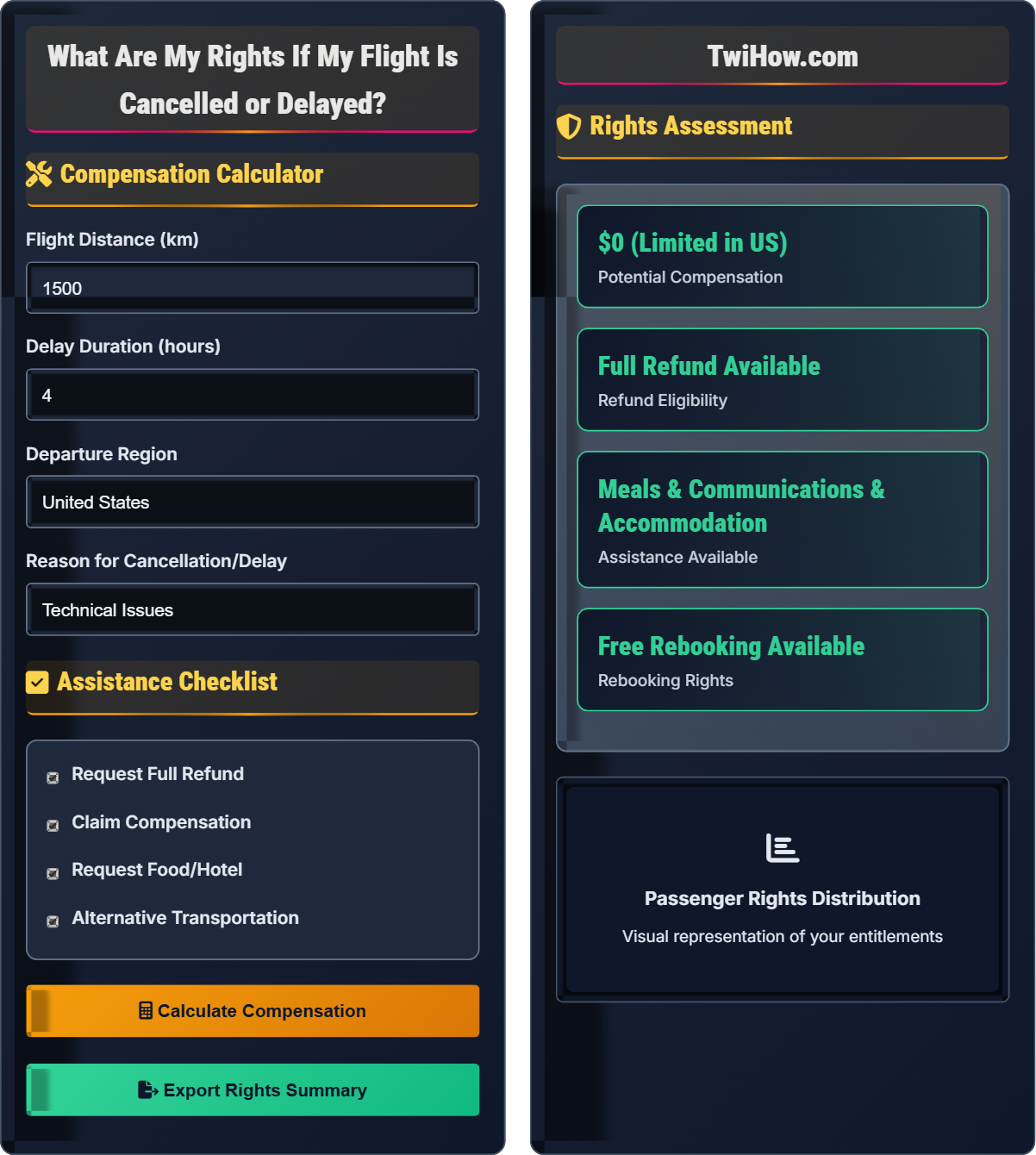
Compensation Calculator
Assistance Checklist
Rights Assessment
Passenger Rights Distribution
Visual representation of your entitlements
| Right | Eligibility | Amount/Details |
|---|---|---|
| Refund | ✓ Eligible | Full ticket price |
| Compensation | ⚠ Depends on region | $200-$600 |
| Food/Drinks | ✓ Eligible | Every 2 hours |
| Accommodation | ⚠ Overnight | If overnight delay |
Immediate Actions to Take
- Document everything (photos, receipts, flight info)
- Ask for written confirmation of delay/cancellation
- Request meal vouchers and hotel if applicable
- Contact airline customer service for rebooking
- Keep all boarding passes and tickets
Flight Passenger Rights Overview
EU261 provides compensation for cancelled or delayed flights within the EU or departing from the EU:
- Short Haul (≤1,500 km): €250 for delays ≥2 hours
- Medium Haul (1,500-3,500 km): €400 for delays ≥3 hours
- Long Haul (>3,500 km): €600 for delays ≥4 hours
- Cancelled Flights: Same compensation as delays if not notified 14 days in advance
Exceptions apply for extraordinary circumstances like weather, strikes, or security risks.
US regulations are less generous but still provide protections:
Key US protections:
- Full refund for cancelled flights
- No compensation for delays (except oversales)
- Maximum 3-hour tarmac delays (domestic)
- Reasonable care for extended delays
Additional protections under Montreal Convention:
- Baggage Liability: Up to $1,700 per passenger
- Delay Compensation: Reasonable expenses during delays
- Documentation: Proof of baggage value and delay duration
- Time Limits: Claims must be filed within specified periods
- Extraordinary Circumstances: Weather, strikes, political unrest
- Pre-notification: Cancellations notified 14+ days in advance
- Alternative Transport: Offered flights within specified timeframes
- Reasonable Care: Airlines taking appropriate measures
EU vs US Passenger Rights
Strong compensation rights for delays and cancellations within EU jurisdiction.
Fixed amounts based on distance and delay duration.
Requires extraordinary circumstances exception to apply.
- EU261 applies to all flights departing EU or arriving in EU from EU carrier
- US regulations focus on refunds and reasonable care, not compensation
- Montreal Convention provides international baggage protection
Assistance and Rebooking Rights
Meals, drinks, accommodation, and communication during extended delays.
- 2+ hours delay: Meals and drinks
- 4+ hours delay: Communication (phone, email)
- Overnight delay: Hotel accommodation
- Rebooking: Next available flight
- Assistance must be provided free of charge
- Rebooking must be arranged promptly
- Refunds must be processed within 7 days
- Compensation claims have specific time limits
Flight Rights Knowledge Quiz
Under EU Regulation 261, what compensation amount would a passenger receive for a 2,000 km flight delayed by 4 hours?
For medium-haul flights (1,500-3,500 km) with delays of 3+ hours, EU261 provides €400 compensation. The 2,000 km distance falls into the medium-haul category, and the 4-hour delay exceeds the 3-hour threshold.
The answer is C) €400.
EU261 compensation is based on flight distance categories. Understanding these thresholds is crucial for determining your rights. The compensation increases with flight distance and delay duration, but requires that the delay meets minimum thresholds.
EU261: European regulation providing passenger compensation
Medium Haul: Flights between 1,500 and 3,500 km
Extraordinary Circumstances: Events outside airline control
• Short haul: ≤1,500 km, ≥2 hours delay = €250
• Medium haul: 1,500-3,500 km, ≥3 hours delay = €400
• Long haul: >3,500 km, ≥4 hours delay = €600
• Remember the distance thresholds
• Note the minimum delay requirements
• Check for extraordinary circumstances exceptions
• Confusing distance categories
• Not meeting minimum delay requirements
• Forgetting extraordinary circumstances exceptions
Compare and contrast passenger rights under US DOT regulations versus EU Regulation 261. What are the key differences in compensation, assistance, and enforcement?
US DOT Regulations: Focus on refunds and reasonable care. No compensation for delays except oversales. Airlines must provide refunds for cancelled flights. Tarmac delays limited to 3 hours for domestic flights.
EU261: Provides monetary compensation for qualifying delays and cancellations. Requires airlines to provide care (food, accommodation) during long delays. Compensation ranges from €250-€600 depending on flight distance.
Key Differences: EU provides monetary compensation while US does not. EU has automatic compensation rights while US focuses on refunds and care. EU regulations are more passenger-friendly in terms of financial compensation.
Understanding jurisdiction is crucial for knowing your rights. The departure location often determines which regulations apply. EU regulations are generally more protective of passenger interests regarding compensation, while US regulations focus on refunds and basic care.
DOT: US Department of Transportation
EU261: European passenger rights regulation
Reasonable Care: Basic assistance during delays
• EU applies to flights departing EU or arriving in EU from EU carrier
• US focuses on refunds rather than compensation
• Both require assistance during extended delays
• Check departure location for applicable regulations
• Document everything regardless of jurisdiction
• Know both sets of rights when traveling internationally
• Assuming all countries have EU261-like protections
• Not understanding jurisdiction differences
• Failing to document rights violations
You're flying from London to New York (5,500 km) on an EU airline. The flight is cancelled due to severe thunderstorms in New York. The airline offers a full refund but no compensation. Analyze the situation: Are you entitled to compensation under EU261? What other rights do you have? What should you do to maximize your compensation?
Compensation Eligibility: Weather conditions are considered extraordinary circumstances under EU261, so compensation is not required. However, you are still entitled to a full refund.
Other Rights: You may be entitled to re-routing at the earliest opportunity or later date at your convenience. If you choose to wait, the airline must provide care (meals, accommodation).
Maximizing Rights: Accept the refund, but also request re-routing or alternative arrangements. Document the cancellation and keep receipts for any expenses incurred. Consider travel insurance for additional protection.
Extraordinary circumstances are a significant exception to EU261 compensation. Weather, strikes, political unrest, and security risks typically fall under this category. However, airlines must still provide refunds and reasonable alternatives.
Extraordinary Circumstances: Events outside airline control
Re-routing: Alternative transportation arrangements
Care: Meals, accommodation, and communication
• Extraordinary circumstances exempt airlines from compensation
• Refunds are still required regardless of cause
• Re-routing options remain available
• Document the reason for cancellation
• Request written confirmation of extraordinary circumstances
• Explore re-routing options
• Accepting no alternatives after cancellation
• Not documenting the reason for cancellation
• Forgetting about re-routing rights
You're traveling from Frankfurt to Tokyo with a 2-hour layover in Amsterdam. The first leg from Frankfurt is delayed by 3 hours due to technical issues, causing you to miss your connecting flight. The airline says this is not their responsibility since the delay occurred on a different flight segment. Analyze your rights under EU261 and explain what compensation and assistance you may be entitled to.
EU261 Application: EU261 applies to all flights departing from an EU airport, regardless of the specific segment. Since your journey started in Frankfurt (EU), the regulation applies to your entire itinerary.
Entitlements: You may be entitled to compensation for the delayed segment (Frankfurt-Amsterdam) since it was delayed by 3+ hours and was operated by an EU airline. You're also entitled to assistance during the delay and re-routing to your final destination.
Key Considerations: The airline may argue that the delay didn't affect your final destination arrival time significantly, but you still have rights to compensation for the delayed segment itself.
EU261 applies to the entire journey if the flight departs from an EU airport. Airlines are responsible for all segments of a booked itinerary, not just the delayed segment. Understanding this helps maximize compensation for multi-segment journeys.
Itinerary: Entire booked journey
Connecting Flights: Segments of single booking
Re-routing: Alternative path to destination
• EU261 applies to entire itinerary from EU departure
• Airlines responsible for all booked segments
• Compensation possible for each delayed segment
• Claim compensation for each affected segment
• Document the entire journey disruption
• Request re-routing to minimize further delays
• Accepting airline's segmented responsibility argument
• Not claiming compensation for all affected segments
• Failing to document the full journey disruption
Under the Montreal Convention, what is the maximum liability for lost or damaged checked baggage?
Under the Montreal Convention, airlines are liable for lost, damaged, or delayed baggage up to approximately $1,700 per passenger (based on Special Drawing Rights). This international convention applies to most international flights.
The answer is C) $1,700 per passenger.
The Montreal Convention provides international standards for baggage liability. This is separate from flight delay/cancellation rights and applies globally. Passengers should document baggage issues immediately and file claims within required timeframes.
Montreal Convention: International aviation treaty
SDR: Special Drawing Rights (currency unit)
Liability: Financial responsibility for damages
• Claims must be filed within 7 days for damage
• Claims must be filed within 21 days for delay
• Claims must be filed within 2 years for loss
• Document baggage issues immediately
• Keep baggage tags and receipts
• File claims within required timeframes
• Missing claim filing deadlines
• Not documenting baggage issues properly
• Confusing domestic vs international baggage rules
FAQ
Q: How long do I have to claim compensation under EU261?
A: The time limit for claiming EU261 compensation varies by country but is typically between 2-6 years from the date of the flight. Some countries like Germany and France have 3-year limitations, while others like Italy have 2 years.
However, airlines often try to apply shorter internal deadlines (often 2-6 months). It's best to file claims as soon as possible to avoid any issues. The European Consumer Centre can provide guidance for specific countries.
Always document your flight disruption immediately and file claims promptly to preserve your rights.
Q: Can I claim compensation if I accepted a voucher instead of a refund for my cancelled flight?
A: Yes, accepting a voucher for a cancelled flight does not waive your right to compensation under EU261. The refund and compensation are separate rights.
However, EU Regulation 261/2004 Article 8 states that compensation may be reduced by 50% if the airline offers re-routing that arrives at your destination within certain timeframes (2 hours for short-haul, 4 hours for medium-haul, 6 hours for long-haul).
You can accept the voucher for the ticket value while still pursuing compensation for the cancellation. Always get written confirmation of your acceptance and reservation of rights.