Landlord Repair Rights: What You Can Do When Landlords Refuse
Complete tenant rights guide • Step-by-step explanations
Tenant Rights:
Show Repair Rights AnalyzerWhen landlords refuse to make necessary repairs, tenants have specific legal rights and remedies available. These rights protect your health, safety, and right to a habitable living environment. Understanding your rights empowers you to take appropriate action.
Landlords are legally required to maintain rental properties in habitable condition. When they fail to do so, tenants can pursue various remedies including rent withholding, repair and deduct, or legal action. The specific rights and procedures vary by state and locality.
Key rights include:
- Right to Habitable Housing: Safe and livable conditions
- Right to Notice: Proper notification before entry
- Right to Privacy: Reasonable notice requirements
- Right to Repairs: Maintenance of essential systems
- Right to Remedies: Legal options when landlord fails
Success depends on understanding local laws and following proper procedures.
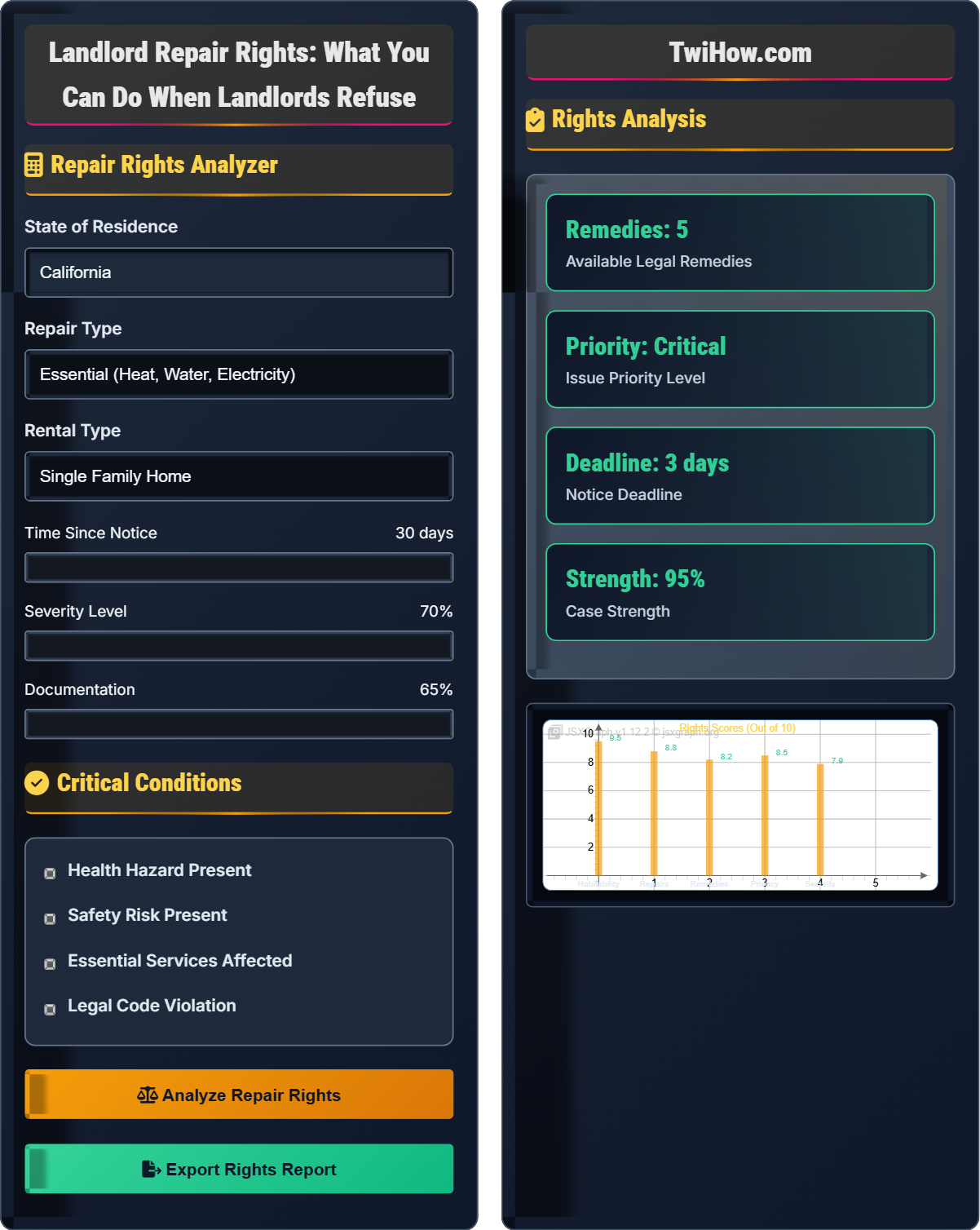
Repair Rights Analyzer
Critical Conditions
Rights Analysis
Pay for repairs yourself and deduct costs from rent, following state-specific procedures and limits
Withhold rent in escrow while repairs are pending, following proper legal procedures
Terminate lease due to uninhabitable conditions and potential constructive eviction
Disclaimer: This guide provides general information only and does not constitute legal advice. Tenant rights laws vary significantly by state, county, and city. Procedures and requirements differ substantially across jurisdictions.
Before taking any action that affects your tenancy or rent payments, consult with a qualified attorney or tenant rights organization. Improper actions could result in eviction, legal liability, or loss of rights. Always verify local laws and procedures before proceeding.
| Remedy | Availability | State Laws | Requirements | Restrictions | Legal Risk |
|---|---|---|---|---|---|
| Repair & Deduct | Varies | State Specific | Notice Required | Cost Limits | Medium |
| Rent Withholding | Limited | Court Required | Proper Procedure | Eviction Risk | High |
| Move Out | Conditional | Habitability Test | Severe Issues | Proof Required | High |
Tenant Rights Framework
Tenants have the right to live in premises that are safe, clean, and habitable. Landlords must maintain essential services including heat, water, electricity, plumbing, and structural integrity.
Standards: Functional heating, running water, electrical systems, safe locks, and absence of health hazards like mold or pest infestations.
Landlords must maintain rental properties in habitable condition and make necessary repairs within a reasonable time after receiving proper notice.
Requirements: Written notice to landlord, reasonable time for repairs, and proper documentation of the issue and communication.
When landlords fail to make repairs, tenants have legal remedies including rent withholding, repair and deduct, and termination of tenancy.
Options: Vary by state but generally include rent escrow, paying for repairs and deducting costs, or leaving without penalty under certain conditions.
Tenants can pursue legal action against landlords for failing to maintain habitable conditions or refusing to make repairs.
Processes: Small claims court, housing court, or civil litigation depending on damages and circumstances.
Landlords must provide reasonable notice before entering the rental unit except in emergencies.
Standards: Usually 24-48 hours notice, specific reasons for entry, and entry during reasonable hours.
Landlords must follow specific procedures for security deposits including timely return and itemized deductions.
Requirements: Return within 30-60 days, detailed receipts, and proper documentation of damages.
Tenant Rights Journey
Right to Habitable Housing
The fundamental right to live in premises that are safe, clean, and suitable for habitation, including essential services and structural integrity.
Right to Repairs
The right to have landlords maintain rental properties and make necessary repairs within a reasonable time after proper notice.
Right to Remedies
The right to pursue legal remedies when landlords fail to fulfill their maintenance obligations and make repairs.
Right to Privacy
The right to reasonable notice before landlord entry and protection from unauthorized access to the rental unit.
Repair Issue Categories
Tenant Rights and Remedies Distribution
| Issue | Priority | Landlord Duty | Tenant Rights | Legal Remedies | Documentation |
|---|---|---|---|---|---|
| Heating | Critical | Required | Immediate | Full | High |
| Water | Critical | Required | Immediate | Full | High |
| Plumbing | High | Required | Reasonable | Partial | Medium |
| Electrical | High | Required | Reasonable | Partial | Medium |
| Leaks | Medium | Required | Reasonable | Limited | Medium |
| Locks | Medium | Required | Reasonable | Limited | Low |
Legal Remedies & Templates
Properly formatted notice templates for demanding repairs from your landlord.
Repair Notice Final Notice Legal DemandDocumentation and procedures for various legal remedies available to tenants.
Repair & Deduct Rent Withholding Move OutInformation about filing complaints with housing authorities and code enforcement.
Code Violations Inspection Requests Housing AuthoritySample Final Notice Template
FINAL NOTICE TO LANDLORD
Date: [DATE]
To: [LANDLORD NAME]
Property Address: [PROPERTY ADDRESS]
Re: Failure to Make Necessary Repairs
This letter serves as a final notice regarding the ongoing failure to make necessary repairs to the above-referenced rental property. On [DATE], I provided written notice of the following issues:
[DESCRIBE REPAIR ISSUES]
Despite the passage of [TIME PERIOD] since my initial notice, these essential repairs remain unaddressed, rendering the premises uninhabitable and in violation of state and local housing codes.
You are hereby given [DEADLINE] days from receipt of this notice to complete the necessary repairs. If these repairs are not completed within the specified time, I will be forced to exercise my legal rights under [STATE LAW] to ensure habitable living conditions.
This notice is given in accordance with [RELEVANT STATUTE] and applicable state and local laws.
Sincerely,
[TENANT NAME]
[DATE]
Tenant Rights Knowledge Quiz
What is the landlord's legal obligation regarding essential services like heat, water, and electricity?
Landlords are legally obligated to maintain essential services in habitable condition under the implied warranty of habitability. This is a fundamental right that exists regardless of lease terms and is required by state and local housing codes.
The answer is B) Maintain them in habitable condition as part of implied warranty.
The implied warranty of habitability is a legal doctrine that requires landlords to maintain rental properties in a condition suitable for living. This includes essential services regardless of who pays the bills. It's an automatic legal right that cannot be waived by lease agreements.
Implied Warranty: Automatic legal guarantee
Habitability: Suitable for living conditions
Essential Services: Heat, water, electricity, plumbing
• Warranty exists automatically
• Cannot be waived in lease
• Applies to essential services
• Research your state's habitability laws
• Document essential service issues
• Give proper notice to landlord
• Believing lease waivers are valid
• Not documenting issues
• Failing to give notice
What are the requirements and limitations for using the "repair and deduct" remedy?
Requirements:
Written Notice: Must provide written notice to landlord of the repair issue and request for repairs.
Reasonable Time: Allow landlord reasonable time to complete repairs (varies by state).
Cost Threshold: Repair costs typically must be below a certain threshold (often $300-500).
Emergency Exceptions: Some states allow immediate action for health/safety emergencies.
Proper Documentation: Must keep receipts and proof of costs incurred.
Limitations:
Amount Limits: Deduction typically limited to repair costs and often cannot exceed one month's rent.
Not Available: Not permitted in all states, and may be restricted in certain circumstances.
Procedural Requirements: Must follow specific state procedures exactly to avoid legal consequences.
Repair and deduct is a powerful but risky remedy that varies significantly by state. It requires strict adherence to procedural requirements. Improper use can result in eviction or legal liability. Always verify your state's specific requirements before using this remedy.
Repair and Deduct: Pay for repairs, deduct from rent
Procedural Requirements: Specific legal steps
Reasonable Time: Appropriate timeframe for repairs
• Follow state-specific procedures
• Keep detailed documentation
• Verify availability in your state
• Research state laws carefully
• Keep all receipts
• Consider legal advice
• Not following exact procedures
• Deducting too much rent
• Not documenting properly
Your apartment's heating system failed during winter, and your landlord hasn't responded to your repair requests for 10 days. The temperature inside has dropped to 55°F. What immediate actions should you take?
Immediate Actions:
Document Everything: Take photos of the broken system and record indoor temperatures daily.
Contact Authorities: Call your local health department or housing authority to report uninhabitable conditions.
Seek Temporary Shelter: If conditions are dangerous, consider staying elsewhere while maintaining possession of the apartment.
Send Formal Notice: Send a certified letter to landlord demanding immediate repair with a short deadline (24-48 hours).
File Complaint: File a complaint with housing authorities or code enforcement if available.
Consider Legal Action: Consult with a tenant rights attorney about potential constructive eviction or rent withholding options.
Protect Health: Take steps to protect yourself from cold-related health risks while maintaining your legal rights.
Emergency situations like heating failures require immediate action. The cold temperature constitutes a serious health hazard and violation of habitability standards. Multiple approaches should be used simultaneously to ensure the issue is addressed quickly and to protect your legal rights.
Constructive Eviction: Landlord's failure forcing tenant to leave
Health Hazard: Conditions threatening health and safety
Habitability Standard: Minimum living conditions required
• Document health risks
• Contact authorities
• Protect your health
• Take temperature readings
• Contact health department
• Consider temporary relocation
• Waiting too long for response
• Not documenting health risks
• Leaving without protecting rights
Your lease contains a clause stating the landlord has no responsibility for maintenance or repairs. Can this clause override your legal rights?
Legal Analysis:
1. Implied Warranty: The implied warranty of habitability is a legal doctrine that exists automatically and cannot be waived by lease agreements.
2. State Laws: Most states have housing codes that establish minimum habitability standards that override private agreements.
3. Public Policy: Courts generally will not enforce clauses that violate public policy regarding health and safety.
4. Enforceability: Such clauses are typically unenforceable if they attempt to waive essential habitability rights.
5. Legal Action: You can still pursue legal remedies despite such clauses, as they conflict with statutory rights.
6. Documentation: The clause may indicate the landlord's intention to avoid responsibilities, which could be relevant in legal proceedings.
Lease agreements cannot waive fundamental legal rights established by state and local housing laws. The implied warranty of habitability is a legal doctrine that exists independently of lease terms. Courts will not enforce agreements that attempt to waive essential safety and health protections.
Implied Warranty: Automatic legal guarantee
Public Policy: Fundamental legal principles
Statutory Rights: Rights established by law
• Legal rights override lease clauses
• Cannot waive habitability rights
• Housing codes prevail
• Research your state's housing laws
• Don't accept waiver clauses
• Document landlord's intentions
• Accepting invalid waivers
• Not knowing statutory rights
• Believing lease terms override laws
What is the safest way to withhold rent due to repair issues?
The safest way is to pay rent to court or an escrow account. This demonstrates good faith effort to pay rent while the dispute is resolved, protecting against eviction for non-payment while preserving your right to claim rent reduction due to uninhabitable conditions.
The answer is B) Pay rent to court or escrow account.
Rent withholding without proper procedure is risky and often results in eviction. Court-ordered escrow accounts allow tenants to continue paying rent while disputes are resolved, protecting both parties' interests. This approach shows good faith and preserves legal remedies.
Rent Escrow: Rent held in court account during disputes
Good Faith: Honest intention to comply with obligations
Eviction Protection: Preventing non-payment evictions
• Never stop paying rent abruptly
• Use proper legal procedures
• Show good faith effort
• Consult attorney before withholding
• Use court escrow when available
• Document all actions
• Stopping rent payments abruptly
• Not using proper procedures
• Failing to show good faith
FAQ
Q: Can my landlord evict me for complaining about repair issues?
A: No, landlords cannot legally evict tenants for exercising their legal rights to habitable housing. This is considered retaliation and is prohibited by law in most states. However, landlords may try to evict under other pretenses. Document all communications and consider legal assistance if you face retaliation.
Retaliation protections typically last 6-12 months after making a complaint. If you receive an eviction notice shortly after reporting repairs, this may constitute illegal retaliation. Consult with a tenant rights attorney immediately.
Q: How long should I wait for repairs before taking action?
A: Reasonable time varies by issue type: 24-48 hours for emergencies (heat, water, safety), 7-14 days for essential services, and 30 days for non-emergency repairs. However, always check your local laws as they may specify different timeframes.
After giving reasonable notice and time, document the landlord's failure to act. Continue following up in writing and consider legal remedies if repairs remain unaddressed. The key is providing adequate notice while documenting the landlord's non-response.