Legal Considerations for Starting a Side Business
Complete legal guide • Structure & compliance
Side Business Legal Requirements:
Risk CalculatorStarting a side business requires careful attention to legal requirements including business structure selection, tax obligations, licensing, contracts, and employment law. Proper legal foundation protects your personal assets, ensures compliance, and positions your business for growth.
Key legal considerations include:
- Business Structure: Choose between sole proprietorship, LLC, partnership, or corporation
- Licensing & Permits: Obtain required local, state, and federal licenses
- Tax Obligations: Understand income tax, sales tax, and employment tax requirements
- Contracts & Agreements: Draft proper client and vendor agreements
Addressing these considerations early prevents costly legal issues and ensures compliance with all applicable laws.
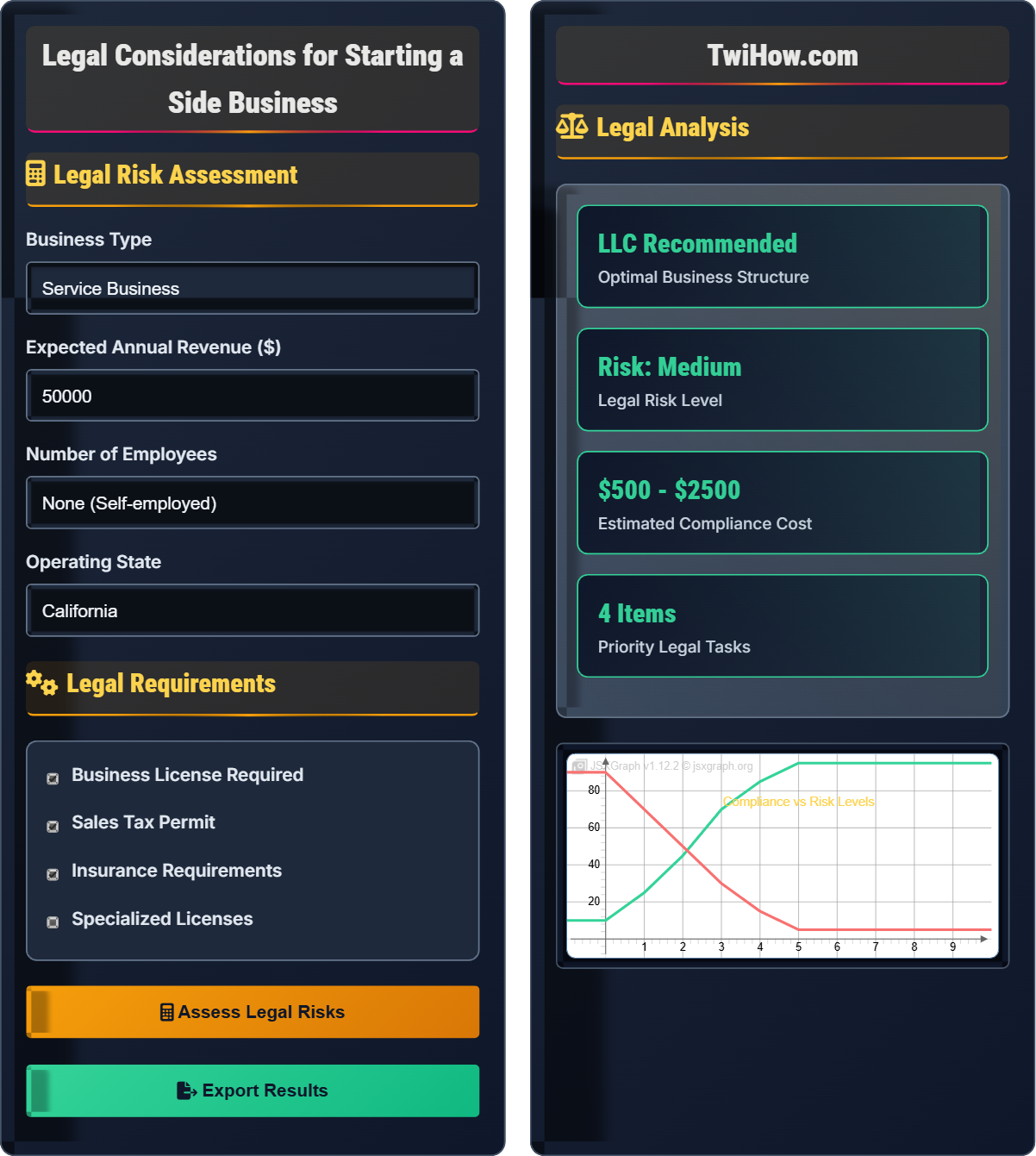
Legal Risk Assessment
Legal Requirements
Legal Analysis
| Requirement | Priority | Cost | Action Needed |
|---|---|---|---|
| Business Registration | High | $100 - $500 | Immediate |
| Licensing | High | $200 - $1,000 | Within 30 days |
| Tax Registration | High | $0 - $100 | Immediate |
| Insurance | Medium | $500 - $2,000 | Within 60 days |
Understanding Side Business Legal Requirements
Starting a side business requires establishing proper legal foundations to protect personal assets, ensure compliance, and position for growth. The legal requirements vary based on business type, size, and location, but certain fundamentals apply universally.
Essential legal considerations include:
- Business Structure: Determines liability protection and tax obligations
- Licensing & Permits: Required by local, state, and federal authorities
- Tax Obligations: Income tax, sales tax, and employment tax requirements
- Contracts & Agreements: Client contracts, vendor agreements, and employment documents
- Intellectual Property: Trademarks, copyrights, and patent protection
- Insurance: Liability, property, and professional coverage
Simplest structure with no legal separation between owner and business. Easy to set up but offers no liability protection. Profits and losses reported on personal tax return.
Two or more owners sharing profits and liabilities. General partners have unlimited liability; limited partnerships offer some protection. Requires partnership agreement.
Combines liability protection of corporations with tax benefits of partnerships. Flexible management structure and operational freedom. Recommended for most side businesses.
Separate legal entity with strongest liability protection. More complex to manage with strict compliance requirements. Suitable for larger operations.
Select the optimal business entity based on liability protection, tax implications, and operational flexibility. Consider factors like expected revenue, number of owners, and risk tolerance.
File necessary paperwork with state authorities, obtain an EIN from the IRS, and register your business name. Consider trademark protection if using a unique brand name.
Research and secure all necessary local, state, and federal licenses. Requirements vary by business type and location. Some businesses require specialized permits.
Register for state and local taxes, understand sales tax obligations, and establish proper accounting systems. Consider quarterly estimated tax payments.
Assess liability risks and obtain appropriate coverage including general liability, professional liability, and property insurance as needed.
Develop standardized contracts for clients, vendors, and employees to define terms, limit liability, and establish dispute resolution procedures.
Protect trademarks, copyrights, and trade secrets. Understand ownership of work created for clients versus your own IP.
If hiring employees or contractors, comply with wage and hour laws, tax withholding, and workplace safety regulations.
Understand self-employment tax, quarterly estimated payments, and deductible business expenses. Maintain accurate financial records.
Many side business owners encounter legal issues due to:
- Commingling Funds: Using personal accounts for business transactions
- Inadequate Insurance: Not protecting against potential liabilities
- Poor Record Keeping: Failing to maintain proper financial records
- Ignoring Compliance: Overlooking licensing or tax requirements
- Weak Contracts: Operating without proper legal agreements
Business Structure Comparison
| Structure | Liability Protection | Tax Treatment | Setup Complexity | Cost |
|---|---|---|---|---|
| Sole Proprietorship | No protection | Pass-through to personal tax | Simple | $0-$100 |
| Partnership | Limited for LPs | Pass-through to partners | Moderate | $100-$500 |
| LLC | Strong protection | Flexible options | Moderate | $100-$800 |
| Corporation | Strong protection | Double taxation | Complex | $500-$2,000 |
Essential legal requirements for your side business:
Legal Requirements Timeline
Real-World Scenarios
Sarah, a marketing professional, starts a consulting business while keeping her full-time job. She provides strategic marketing advice to small businesses and earns approximately $40,000 annually from consulting.
Key Requirements: Business license, EIN, quarterly tax payments, and contract templates for clients.
Mike creates an online store selling handmade crafts. He expects to generate $80,000 in annual revenue and plans to hire part-time help during busy seasons.
Key Requirements: Business license, sales tax registration, seller's permit, and liability insurance.
Jennifer offers home repair services as a side business. She expects to earn $30,000 annually and plans to expand to a full-time operation eventually.
Key Requirements: Trade license, business insurance, bonding, and proper contracts for customers.
Legal Considerations Learning Quiz
Which business structure offers the best liability protection while maintaining tax flexibility for a side business?
The Limited Liability Company (LLC) offers the best combination of liability protection and tax flexibility for most side businesses. LLCs provide personal asset protection while allowing pass-through taxation (avoiding double taxation). They offer operational flexibility with fewer formalities than corporations.
The answer is B) Limited Liability Company (LLC).
For side businesses, LLCs are often ideal because they separate personal and business assets while maintaining tax simplicity. Unlike corporations, LLCs don't require extensive record-keeping or formal meetings. They offer the liability protection of a corporation with the tax benefits of a partnership.
LLC: Limited Liability Company - hybrid business structure
Liability Protection: Shield from personal responsibility for business debts
Pass-through Taxation: Business income taxed at owner's rate
• LLCs protect personal assets from business creditors
• Tax flexibility allows various treatment options
• Operational flexibility compared to corporations
• Maintain separate business and personal accounts
• File annual reports to maintain good standing
• Consider single-member LLC for solo operations
• Choosing structure based on simplicity alone
• Not considering long-term growth plans
• Ignoring state-specific requirements
Explain the tax obligations for a side business earning $35,000 annually as a sole proprietor. Include self-employment tax, estimated payments, and deductible expenses.
Self-Employment Tax: At $35,000 net income, the self-employment tax is approximately $2,678 (15.3% of net earnings up to the Social Security cap).
Income Tax: Depends on total income including other sources, but roughly $3,500-$7,000 for middle-income brackets.
Estimated Payments: Quarterly payments of approximately $1,500-$2,000 to avoid penalties.
Deductible Expenses: Business equipment, supplies, mileage, home office, professional services, insurance, and other ordinary and necessary business expenses.
Reporting: Schedule C attached to Form 1040, plus Schedule SE for self-employment tax.
Side business owners must understand that self-employment tax applies to net business income, in addition to regular income tax. This is often a surprise to new entrepreneurs. Estimated tax payments are required to avoid penalties, and proper record-keeping is essential for maximizing deductions.
Self-Employment Tax: Social Security and Medicare taxes for business owners
Net Income: Revenue minus business expenses
Estimated Taxes: Quarterly payments to IRS
• Self-employment tax applies to net income over $400
• Estimated payments due quarterly
• Penalties apply for underpayment
• Set aside 25-30% of profits for taxes
• Track expenses throughout the year
• Consider working with a tax professional
• Forgetting about self-employment tax
• Not making estimated payments
• Poor record-keeping for deductions
David starts a graphic design side business and begins accepting projects from local businesses. Calculate the potential liability exposure if he delivers work that infringes on a trademark, and determine what contract provisions would protect him.
Potential Exposure: David could face legal action for trademark infringement, with damages potentially reaching $100,000-$500,000 or more depending on the infringement severity and client losses.
Protective Contract Provisions:
• Indemnification clause requiring client to protect David from third-party claims
• Limitation of liability clause capping damages
• Client warranties regarding materials provided
• Dispute resolution procedures
• Intellectual property ownership clauses
Additional Protection: Professional liability insurance could cover legal costs and damages up to policy limits.
Service providers face significant liability risks when delivering work that incorporates client materials or operates in regulated areas. Standard contracts with protective clauses are essential. The indemnification provision is particularly important as it shifts liability back to the party that provided problematic materials.
Indemnification: Promise to compensate for losses
Limitation of Liability: Caps on damages in contract
Professional Liability Insurance: Coverage for service errors
• Contracts should address IP ownership
• Limitation clauses may not cover intentional acts
• Insurance provides additional protection layer
• Use standard contract templates
• Customize for each project type
• Have legal review for high-value contracts
• Working without written contracts
• Accepting client's standard terms
• Not addressing IP ownership
Jessica's side business grows to the point where she hires two part-time contractors and one full-time employee. Describe the employment law requirements she must now comply with and the differences between contractors and employees.
Employee Requirements:
• Payroll tax withholding and remittance
• Workers' compensation insurance
• Unemployment insurance contributions
• Wage and hour law compliance (minimum wage, overtime)
• Equal employment opportunity compliance
• Workplace safety compliance
Contractor Differences:
• No tax withholding required
• No benefits or payroll taxes
• Must meet IRS criteria for independent contractor status
• Responsible for their own taxes
Classification Risks: Misclassification can result in significant penalties and back taxes.
Employment law compliance increases significantly when hiring employees versus contractors. The distinction between employees and contractors is determined by the degree of control the business has over the worker. The IRS and state agencies scrutinize classifications to ensure workers receive proper protections and benefits.
Employee: Worker subject to employer control
Contractor: Independent worker with operational control
Payroll Taxes: Social Security, Medicare, unemployment
• Proper classification is critical
• Employees get benefits and protections
• Contractors handle their own taxes
• Use IRS Form SS-8 for classification questions
• Document contractor independence
• Consider PEO for compliance assistance
• Misclassifying employees as contractors
• Not understanding wage and hour laws
• Forgetting state-specific requirements
Which type of insurance is typically most important for a side business providing professional services?
Professional liability insurance (also called errors and omissions insurance) is typically most important for service-based side businesses. It protects against claims of inadequate work, negligence, or failure to deliver promised results. This type of insurance covers legal costs and settlements related to professional services.
The answer is B) Professional Liability Insurance.
For service businesses, professional liability insurance addresses the primary risk: allegations of poor work or professional mistakes. While general liability covers physical damage, professional liability covers intangible service failures. The coverage is essential for consultants, designers, and other service providers who could face claims of inadequate performance.
Professional Liability: Coverage for service-related claims
Errors and Omissions: Alternative name for professional liability
General Liability: Coverage for physical harm/damage
• Professional liability covers service failures
• Coverage amounts should match business value
• Claims-made policies require continuous coverage
• Match coverage to potential exposure
• Consider tail coverage for claims-made policies
• Bundle with other business insurance
• Confusing general and professional liability
• Underestimating professional risk
• Not maintaining continuous coverage
Frequently Asked Questions
Expert Q&A
Q: I'm a marketing manager considering starting a consulting business on the side. What legal structures and protections do I need to consider?
A: For a marketing consulting business, I recommend forming an LLC for liability protection while maintaining tax flexibility:
Legal Structure: Single-member LLC provides asset protection without complex tax filings. You'll need an EIN and may need a business license depending on your location.
Key Protections:
1. Professional liability insurance to cover claims of inadequate marketing results
2. Comprehensive client contracts with limitation of liability clauses
3. Intellectual property agreements defining work ownership
Employment Considerations: Ensure your consulting doesn't violate your current employer's policies regarding outside work or competing activities. Review your employment agreement for non-compete or confidentiality clauses.
Initial Costs: Expect $1,000-$3,000 for setup including LLC formation, licensing, insurance, and legal documents.
Q: I want to start selling custom graphics online as a side business. What intellectual property considerations should I be aware of?
A: As a graphic designer, intellectual property is central to your business:
Copyright Protection: Your original designs are automatically copyrighted, but consider registering key works for enhanced protection. Include copyright notices on your work.
Client Agreements: Clearly specify IP ownership transfers. Typically, clients receive licenses to use designs while you retain underlying copyright unless explicitly transferred.
Third-Party Materials: Ensure any fonts, stock images, or other elements you use are properly licensed for commercial use. Don't assume free resources are truly free for commercial applications.
Brand Protection: Consider trademark protection for your business name and logo. Conduct searches to ensure you're not infringing on existing trademarks.
Work-for-Hire Issues: Understand when client work constitutes "work for hire" where the client owns the copyright from creation. This only applies if there's a written agreement specifying work-for-hire status.
Defensive Measures: Maintain records of your creative process to prove original authorship if disputes arise.