What Are the Legal Requirements for Creating a Valid Prenuptial Agreement?
Complete guide • Marriage contracts • Legal protections
Prenuptial Agreement Requirements:
Validity CheckerPrenuptial agreements require specific legal elements to be valid and enforceable. This guide covers essential requirements including full financial disclosure, voluntary execution, and legal representation. Understanding these requirements helps ensure your prenup will hold up in court.
Key legal requirements include:
- Full Financial Disclosure: Complete listing of assets and debts
- Voluntary Execution: No coercion or duress
- Legal Representation: Independent counsel for each party
- Reasonable Terms: Not unconscionable to either party
Proper preparation and legal guidance help ensure your prenuptial agreement is valid and enforceable.
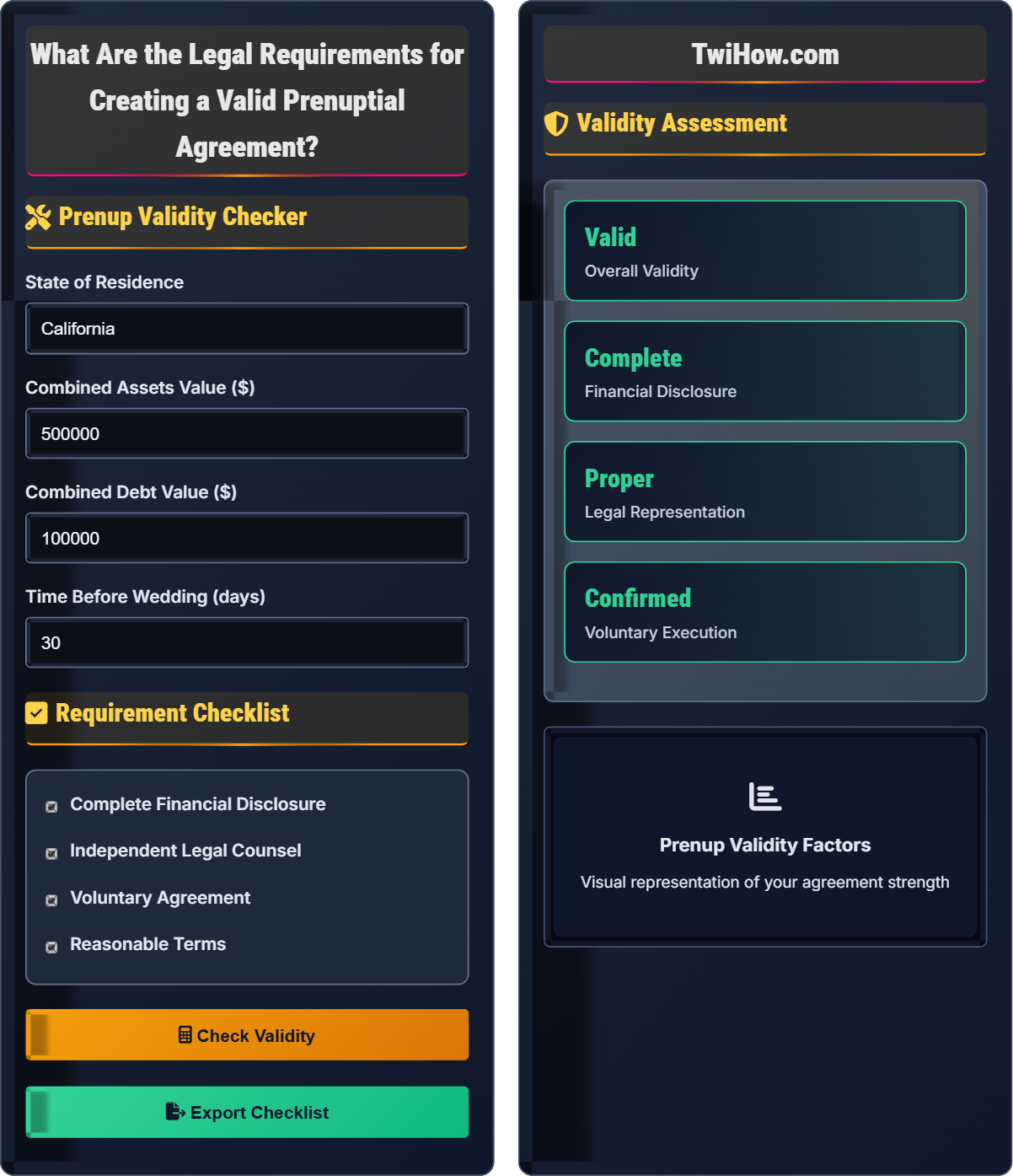
Prenup Validity Checker
Requirement Checklist
Validity Assessment
Prenup Validity Factors
Visual representation of your agreement strength
| Requirement | Status | Notes |
|---|---|---|
| Financial Disclosure | ✓ Complete | All assets listed |
| Legal Representation | ✓ Complete | Independent counsel |
| Voluntary Execution | ✓ Complete | No coercion |
| Reasonable Terms | ✓ Complete | Fair to both parties |
Strengths & Areas for Improvement
- Strengths: Complete financial disclosure, independent counsel
- Areas to Watch: Ensure adequate time before signing
- Recommendation: Consider additional provisions for future changes
Prenuptial Agreement Requirements
Complete financial disclosure is fundamental to prenup validity:
- Asset Lists: Real estate, investments, business interests
- Debt Disclosures: Mortgages, loans, credit card debt
- Income Sources: Employment, business, investment income
- Future Assets: Expected inheritances, gifts, bonuses
Failure to fully disclose can render the entire agreement invalid.
Agreements must be entered into freely and without pressure:
Key considerations:
- Signing well before wedding date
- No threats or ultimatums
- Independent legal advice for both parties
- Opportunity to review and negotiate terms
Some clauses cannot be included in prenups:
- Child Custody: Courts decide based on child's best interest
- Child Support: Cannot waive legal obligations
- Illegal Activities: Any provisions violating law
- Unconscionable Terms: Grossly unfair to one party
- Inadequate Disclosure: Omitting significant assets
- Timing Issues: Signing too close to wedding
- Coercion: Presenting agreement as ultimatum
- Unfair Terms: Grossly one-sided provisions
Financial Disclosure Requirements
Real estate, investments, retirement accounts, business interests, personal property.
Sworn financial statements, supporting documentation, and ongoing updates.
Both parties must provide accurate and complete information.
- Full disclosure is required in most states
- Deception can void the entire agreement
- Updates may be required if circumstances change
Legal Representation Standards
Each party must have separate legal representation to ensure fairness.
- Each party retains separate attorney
- Attorneys review agreement terms
- Negotiations conducted separately
- Final review before signing
- Conflict of interest if one attorney represents both
- Independent counsel protects both parties' interests
- Waiver of separate representation must be explicit
- Some states require separate representation
Prenuptial Agreement Knowledge Quiz
What is the minimum requirement for financial disclosure in a prenuptial agreement?
Most states require complete and accurate disclosure of all assets and debts for a prenuptial agreement to be valid. Partial disclosure or estimates are insufficient and can render the agreement invalid.
The answer is B) Complete and accurate listing of all assets and debts.
Full financial disclosure is essential because it ensures both parties enter the agreement with complete knowledge of each other's financial situation. This transparency is necessary for the agreement to be considered voluntary and informed.
Financial Disclosure: Complete listing of assets and debts
Voluntary Agreement: Made with full knowledge and without coercion
Material Asset: Any significant financial interest
• Full disclosure is required for validity
• Omissions can void the entire agreement
• Both parties must provide complete information
• Gather all financial documents before starting
• Use sworn financial statements
• Include supporting documentation
• Omitting assets or debts
• Providing estimates instead of exact values
• Failing to update disclosures
Explain the concept of "voluntary execution" in prenuptial agreements. What factors do courts consider when determining if an agreement was executed voluntarily?
Voluntary Execution: The agreement must be entered into freely without coercion, duress, or undue influence. Both parties must have adequate time to consider the terms and seek independent counsel.
Court Considerations: Courts examine timing (signing close to wedding date suggests coercion), adequacy of legal representation, sophistication of parties, and whether terms were explained properly.
Indicators of Voluntariness: Early presentation of agreement, independent legal counsel, adequate negotiation time, and fair terms that benefit both parties.
Red Flags: Last-minute presentation, inadequate time for review, unequal bargaining power, or grossly unfair terms.
Voluntary execution ensures that both parties genuinely consent to the terms. Courts scrutinize agreements that appear to be signed under pressure, as this undermines the fundamental principle that both parties freely agreed to the terms.
Voluntary Execution: Agreement entered without coercion
Duress: Threats or pressure forcing agreement
Undue Influence: Excessive persuasion or manipulation
• Adequate time before signing is crucial
• Independent counsel protects both parties
• Fair terms support voluntary nature
• Present agreement early in engagement
• Allow adequate time for review
• Encourage independent legal counsel
• Presenting agreement shortly before wedding
• Pressuring partner to sign quickly
• Not allowing independent counsel
One partner's attorney prepares a prenuptial agreement and presents it to both parties. The other partner feels pressured to sign without hiring their own lawyer. The agreement heavily favors the first partner. Analyze the potential legal problems with this scenario and explain why independent legal representation is important.
Legal Problems: This scenario violates the principle of independent representation. When one attorney represents both parties' interests, conflicts of interest arise, and the agreement may be deemed invalid.
Conflict of Interest: The attorney cannot provide zealous advocacy for both parties simultaneously, as their interests are fundamentally opposed.
Voluntariness Issues: The pressure to sign without independent counsel suggests the agreement may not be truly voluntary.
Enforceability: Courts may find the agreement invalid due to lack of independent representation and potentially unfair terms.
Recommendation: Each party should retain separate counsel to ensure their individual interests are protected.
Independent representation ensures that both parties have advocates working in their individual best interests. This protects against unfair terms and ensures that both parties understand the implications of the agreement.
Conflict of Interest: Competing duties to clients
Zealous Advocacy: Vigorous representation of client's interests
Independent Counsel: Separate legal representation
• Attorneys cannot represent conflicting interests
• Both parties benefit from independent counsel
• Some states require separate representation
• Each party should hire their own attorney
• Attorneys can coordinate but represent only one party
• Consider cost-sharing for efficiency
• Assuming one attorney can represent both
• Pressuring partner to waive representation
• Not understanding representation importance
A prenuptial agreement includes clauses waiving child custody rights, limiting spousal support to $100 per month indefinitely, and requiring the lower-income spouse to work 60 hours per week during marriage. Analyze which provisions are likely unenforceable and explain why courts would reject them.
Child Custody Waiver: Unenforceable because courts must decide custody based on the child's best interest, regardless of parental agreements.
Extremely Low Support: Likely unconscionable and unenforceable as it may leave one spouse unable to meet basic needs.
Work Requirement: Unenforceable as it attempts to control personal autonomy and lifestyle choices.
Enforceable Elements: Property division, debt allocation, and business succession planning would likely be upheld if properly structured.
Principle: Courts will not enforce provisions that violate public policy or harm vulnerable parties.
Courts balance individual autonomy with public policy considerations. While parties can agree to many terms, certain fundamental rights and societal interests cannot be waived through contract.
Public Policy: Fundamental societal interests
Unconscionable: Grossly unfair or oppressive
Best Interest: Child welfare standard
• Courts decide child custody based on best interest
• Child support cannot be waived
• Provisions must be reasonable and fair
• Focus on property and financial arrangements
• Avoid provisions about children's welfare
• Ensure fairness in all terms
• Including child custody provisions
• Attempting to waive child support
• Creating extremely one-sided terms
What is the recommended timeframe for presenting a prenuptial agreement to ensure it's considered voluntary?
Most legal experts recommend presenting prenuptial agreements at least 3-6 months before the wedding. This provides adequate time for review, negotiation, and consultation with independent counsel, demonstrating the voluntary nature of the agreement.
The answer is B) At least 3-6 months before the wedding.
The timing of presenting a prenup is crucial for demonstrating voluntariness. Agreements presented too close to the wedding date suggest coercion, as the party may feel forced to sign to proceed with the ceremony.
Voluntariness: Agreement made without coercion
Coercion: Pressure or force compelling agreement
Adequate Time: Sufficient period for consideration
• Earlier presentation supports voluntary nature
• Adequate time allows for review and negotiation
• Last-minute presentation suggests coercion
• Discuss prenups early in engagement period
• Allow time for negotiation
• Plan for potential delays in process
• Presenting agreement too close to wedding
• Not allowing adequate review time
• Rushing the negotiation process
FAQ
Q: Can we update our prenuptial agreement after getting married?
A: Yes, you can modify a prenuptial agreement after marriage through a postnuptial agreement. Both parties must consent to the changes, and the modification must meet the same requirements as the original agreement:
• Full financial disclosure
• Independent legal counsel for both parties
• Voluntary execution without coercion
• Reasonable terms
Common reasons for modifications include changes in financial circumstances, birth of children, career changes, or acquisition of significant assets. Some prenups include built-in review and modification procedures.
Q: What happens if my spouse doesn't fully disclose their assets in our prenup?
A: Failure to provide complete financial disclosure is grounds for invalidating a prenuptial agreement. Courts take this requirement seriously because:
1. Voluntariness: You cannot make an informed decision without complete information
2. Contract Validity: Fraudulent concealment can void the entire agreement
3. Legal Standards: Most states require full disclosure for enforceability
If discovered after marriage, the non-disclosing spouse may face legal consequences, and the agreement may be set aside entirely. Always verify financial statements and consider hiring a forensic accountant for complex situations.