What Are the Legal Requirements for Homeschooling in My Area?
Complete legal guide • Step-by-step process
Homeschooling Overview:
Show Requirements AnalyzerHomeschooling laws vary significantly by state and locality in the United States. While parents have the constitutional right to direct their children's education, states regulate the manner in which education is provided. Requirements range from minimal oversight to extensive regulation, including curriculum standards, testing requirements, and record-keeping obligations.
The legal framework for homeschooling is primarily governed by state laws, which differ considerably in their requirements. Some states require extensive documentation and standardized testing, while others have minimal regulations. Understanding your specific state's requirements is crucial for legal compliance.
Key areas of regulation include:
- Registration: Notification requirements to state/local authorities
- Curriculum: Required subjects and educational standards
- Testing: Assessment and evaluation requirements
- Records: Documentation and reporting obligations
Parents must research and comply with their specific state's requirements to ensure legal homeschooling status.
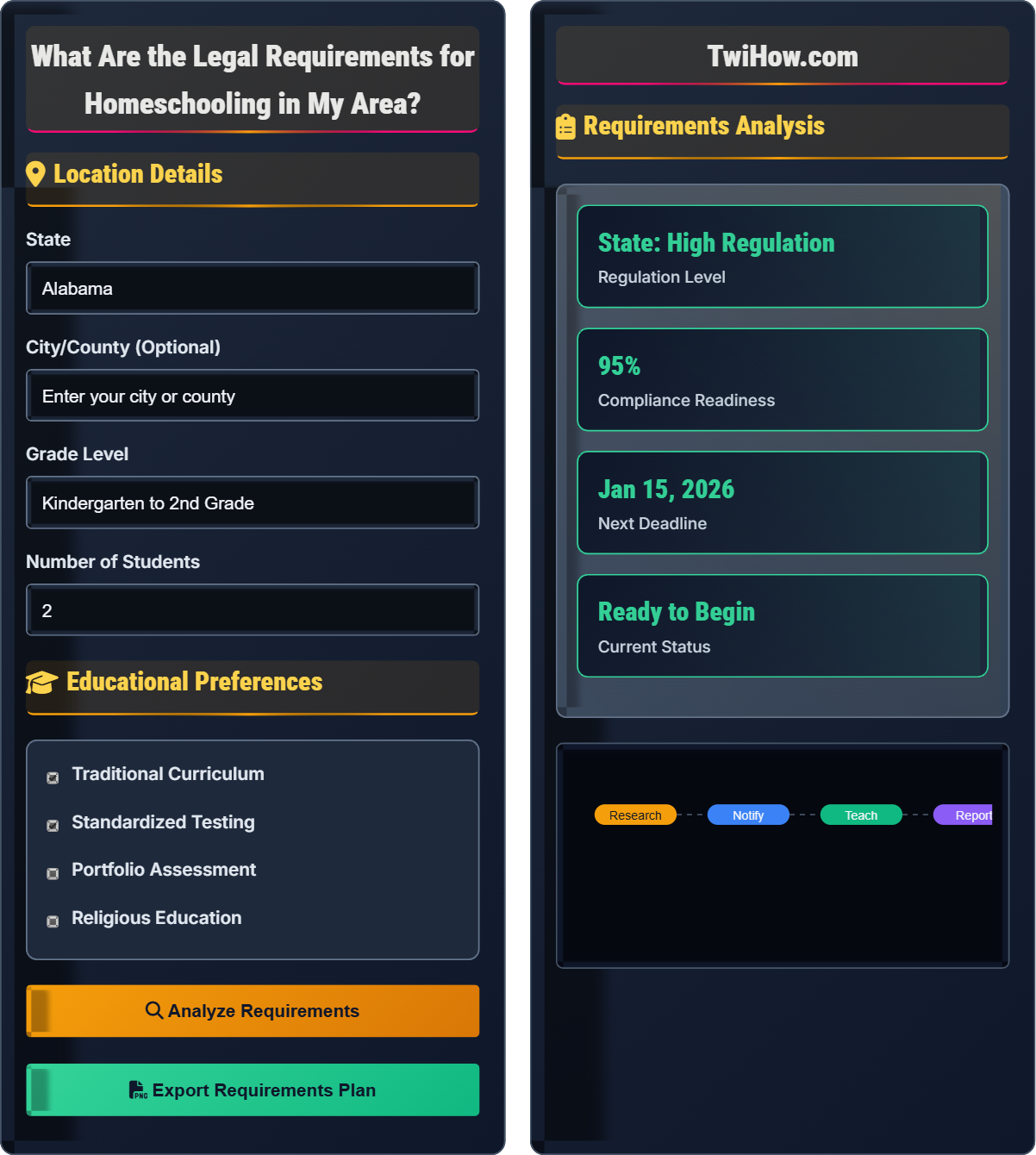
Location Details
Educational Preferences
Requirements Analysis
| Requirement | Description | Due Date | Status |
|---|---|---|---|
| Registration | Notify state of intent to homeschool | Aug 15 | Pending |
| Curriculum | Submit planned curriculum | Sep 1 | Pending |
| Testing | Annual standardized testing | Jun 1 | Due |
| Attendance | Meet minimum days/hours | Year-round | Ongoing |
| Records | Maintain educational records | Ongoing | Complete |
Annual Timeline
- August: Register intent to homeschool
- September: Begin school year, submit curriculum
- December: Mid-year progress report
- June: Annual testing and final report
- July: Plan for next year
Understanding Homeschooling Legal Requirements
Homeschooling is the practice of educating children at home rather than in traditional public or private schools. Parents or guardians take responsibility for their children's education, including curriculum selection, instruction, and assessment. While parents have constitutional rights to direct their children's education, states regulate the manner in which education is provided to ensure educational adequacy.
The legal framework for homeschooling follows this formula:
Where:
- Constitutional Rights: Parental rights to direct education
- State Regulations: Specific requirements for homeschooling
- Compulsory Attendance: Mandatory education laws
States regulate homeschooling in different ways, typically falling into these categories:
- Minimal Regulation: Alaska, Idaho, Michigan, New Hampshire, Wyoming (little to no requirements)
- Moderate Regulation: Colorado, Illinois, Indiana, Ohio, Texas (notification and record-keeping)
- High Regulation: California, Connecticut, Massachusetts, New York, Pennsylvania (extensive requirements)
- Unique Requirements: Hawaii, New Jersey, Rhode Island (specific testing or oversight)
- Notification: Inform state/local authorities of intent to homeschool
- Curriculum: Provide evidence of planned educational program
- Testing: Annual standardized testing or evaluation
- Attendance: Meet minimum days/hours of instruction
- Records: Maintain educational records and transcripts
- Qualifications: Parental educational requirements (varies by state)
- Subjects: Required core subjects (language arts, math, science, social studies)
Homeschooling Essentials
Homeschooling, compulsory attendance, educational adequacy, parental rights, state regulations, curriculum standards.
Compliance Success = (Knowledge of Laws + Proper Documentation + Consistent Records) × Active Engagement
Where Knowledge of Laws = Understanding state requirements; Proper Documentation = Required forms and notices; Consistent Records = Educational tracking; Active Engagement = Regular instruction and assessment.
- State laws override federal guidelines
- Children must receive adequate education
- Records must be maintained
- Required notifications must be filed
Compliance Checklist
State notification, curriculum planning, testing compliance, record keeping, attendance tracking.
- File intent to homeschool
- Submit curriculum plan
- Begin instruction
- Maintain records
- Administer assessments
- File annual report
- State laws change frequently
- Local districts may have additional requirements
- Record keeping is crucial for compliance
- Testing requirements vary by grade level
Homeschooling Legal Requirements Quiz
Which constitutional principle provides the legal foundation for homeschooling in the United States?
The legal foundation for homeschooling comes from parental rights to direct their children's education, which has been recognized by the Supreme Court. In Pierce v. Society of Sisters (1925), the Court established that parents have the right to direct their children's education, which includes the right to choose alternative educational methods like homeschooling.
The answer is B) Parental rights to direct education.
The constitutional foundation for homeschooling stems from the fundamental right of parents to direct the upbringing and education of their children. This right is deeply rooted in American tradition and has been recognized by the Supreme Court. However, this right is not absolute, and states retain authority to ensure educational adequacy through reasonable regulations.
Parental Rights: Constitutional authority of parents to direct child education
Compulsory Attendance: State requirement for children to receive education
Educational Adequacy: Minimum educational standards required
• Parental rights are fundamental
• States can regulate for adequacy
• Rights are not absolute
• Know your constitutional rights
• Understand state-specific regulations
• Balance rights with state requirements
• Assuming no state regulations apply
• Confusing federal and state laws
• Not understanding the balance between rights and regulations
Explain the testing requirements for homeschooling across different states and why these requirements exist.
Testing Requirements by State Category:
Minimal Regulation States: Alaska, Idaho, Michigan, New Hampshire, and Wyoming have little to no required testing. Parents may choose to assess their children's progress as they see fit.
Moderate Regulation States: Colorado, Illinois, Indiana, and Ohio typically require annual standardized testing or evaluation by a certified teacher.
High Regulation States: Connecticut, Massachusetts, New York, and Pennsylvania often require specific standardized tests, evaluation by certified teachers, or portfolio reviews.
Why Testing Requirements Exist:
• Educational Adequacy: Ensures children are receiving an appropriate education
• Progress Monitoring: Tracks student academic growth
• State Oversight: Provides accountability for public education
• Special Needs: Identifies children who may need additional support
• Academic Standards: Ensures curriculum meets educational benchmarks
Common Testing Options: Standardized achievement tests, nationally normed tests, evaluation by certified teachers, portfolio reviews, or alternative assessments.
Testing requirements represent the balance between parental rights and state interests in ensuring educational adequacy. States with minimal requirements trust parents to provide quality education, while states with extensive requirements seek more oversight. The variety reflects different philosophical approaches to education regulation and parental autonomy.
Standardized Testing: Uniform tests administered to measure academic achievement
Educational Adequacy: Minimum educational standards required by law
Portfolio Review: Assessment of student work samples and progress
• Requirements vary significantly by state
• Results may need to be reported
• Research your state's specific testing requirements
• Plan testing schedule in advance
• Keep records of all test results
• Not understanding state-specific requirements
• Missing testing deadlines
• Failing to keep proper records
You're moving from California (high regulation) to Texas (moderate regulation) with your homeschooled 8th-grade son. In California, you were required to file quarterly reports, submit to annual standardized testing, and have your curriculum approved by a credentialed teacher. What changes do you need to make to comply with Texas homeschooling laws?
California Requirements (Previous):
• Quarterly reports to state
• Annual standardized testing
• Curriculum approval by credentialed teacher
• Extensive record keeping
Texas Requirements (New):
• No state registration or approval required
• No mandatory standardized testing
• No curriculum approval needed
• No reporting to state required
• Must teach reading, spelling, grammar, mathematics, and good citizenship
Changes Needed:
• Stop filing quarterly reports with California
• You are no longer required to conduct standardized testing (though you may choose to)
• No curriculum approval needed
• No annual reports to state required
• Continue teaching required subjects
• Maintain records (recommended for documentation)
Important Note: While Texas has minimal state requirements, you should check local district policies and consider that colleges may require documentation of your homeschool program.
This scenario illustrates the dramatic differences in homeschooling regulations between states. Moving from a highly regulated state to a minimally regulated state requires understanding that requirements are state-specific. Parents must research and adapt to their new state's laws, which can be significantly different. The transition may seem liberating but still requires careful planning to ensure educational quality.
State-Specific Laws: Regulations that vary by state
Educational Adequacy: Minimum standards required by law
Curriculum Approval: State authorization of educational materials
• Always research current state laws
• Local districts may have additional rules
• Research laws before moving
• Join local homeschooling groups
• Keep educational records regardless of requirements
• Continuing old state's requirements unnecessarily
• Not researching new state's laws
• Failing to adapt to new requirements
You're starting to homeschool your 6th-grade daughter in Massachusetts, which has high regulation. The state requires detailed record keeping including daily attendance, curriculum used, and quarterly progress reports. What system should you implement to ensure compliance, and what are the potential consequences of non-compliance?
Required Record Keeping System:
• Daily Attendance Log: Track each day of instruction with date and hours
• Curriculum Documentation: List textbooks, materials, and lesson plans used
• Quarterly Progress Reports: Academic assessment and evaluation every 3 months
• Test Results: Annual standardized testing scores
• Correspondence: Keep copies of all communications with state
Implementation System:
• Digital spreadsheet for daily attendance tracking
• Portfolio system for curriculum documentation
• Calendar reminders for quarterly reports
• Dedicated folder for all homeschooling records
• Annual review and filing system
Consequences of Non-Compliance:
• Potential investigation by state education officials
• Requirement to enroll child in public school
• Possible legal action for truancy
• Loss of homeschooling privileges
• Need to restart the homeschooling process with additional oversight
Best Practices: Over-document rather than under-document, keep copies of all submissions, and maintain records for at least 3-5 years.
Record keeping requirements serve multiple purposes: accountability, assessment of educational progress, and legal protection. In high-regulation states, comprehensive records demonstrate compliance with educational standards. The system should be systematic and reliable, as these records may be requested during inspections or audits. Good record keeping also helps parents track their children's progress and make educational adjustments.
Record Keeping: Systematic documentation of educational activities
Educational Portfolio: Collection of student work and progress
Compliance Audit: Review of homeschooling records for legal compliance
• Maintain accurate records
• Document everything required
• Set up systems before starting
• Use technology to automate tracking
• Keep backup copies of records
• Inadequate record keeping systems
• Missing documentation deadlines
• Failing to document required elements
What is the typical age range for compulsory attendance laws that apply to homeschooling?
Most states require compulsory attendance from ages 6-18, though there are variations. The starting age is typically 6 or 7, and the ending age is typically 16 or 18. Homeschooling is subject to these same compulsory attendance laws, meaning parents must provide education for children within these age ranges. The specific ages vary by state, but 6-18 is the most common range.
The answer is B) Ages 6-18.
Compulsory attendance laws exist to ensure that all children receive an education, regardless of the method used. These laws apply to homeschooling just as they apply to traditional schooling. The age requirements are designed to ensure that children receive education during critical developmental years. Parents must ensure that their homeschooling program meets these age requirements and provides continuous education throughout the required period.
Compulsory Attendance: Legal requirement for children to receive education
Educational Age Range: Years during which education is mandatory
Homeschooling Compliance: Meeting legal education requirements
• Applies to all education methods
• Continuous education required
• Check your state's specific age requirements
• Plan for the entire required period
• Understand exceptions and early release options
• Assuming age requirements don't apply to homeschooling
• Not understanding state-specific age ranges
• Failing to provide continuous education
FAQ
Q: Do I need to be certified or have a teaching degree to homeschool my children?
A: In most states, parents do not need to be certified teachers or have a teaching degree to homeschool their children. Only a few states (like New York and Pennsylvania) have specific parental qualification requirements. However, some states may require parents to demonstrate competency in certain subjects or complete training programs.
The rationale behind not requiring certification is that parents have the fundamental right to direct their children's education. However, parents should ensure they can provide an adequate education and may benefit from educational training or resources.
It's important to research your specific state's requirements, as they can change and vary significantly. Consider joining local homeschooling groups for support and resources.
Q: Can homeschooled students participate in public school activities or sports?
A: Participation in public school activities varies by state and district:
States with Open Enrollment: Alaska, Arkansas, Hawaii, Iowa, Maine, Minnesota, Missouri, New Mexico, North Dakota, Oklahoma, Tennessee, Utah, Washington, and Wyoming allow homeschoolers to participate in public school activities.
States with Limited Access: Some states allow participation in specific activities like sports, while others restrict access entirely.
Typical Requirements: May include meeting academic standards, paying fees, providing insurance, or demonstrating residency in the district.
Check with your local school district for specific policies, as even in states that allow participation, individual districts may have different interpretations or requirements.