What is the Difference Between Copyright, Trademark, and Patent?
Complete IP guide • Step-by-step explanations
Intellectual Property Overview:
Show IP Comparison ToolCopyright, trademark, and patent are three distinct forms of intellectual property protection that serve different purposes. Copyright protects original creative works like books, music, and software. Trademark protects brand identifiers like names, logos, and slogans. Patent protects inventions and discoveries. Each offers unique legal protections with different durations, requirements, and enforcement mechanisms.
Understanding these differences is crucial for creators, inventors, and businesses seeking to protect their intellectual property. The choice of protection depends on the nature of the creation or invention and the desired scope of protection.
Key differences:
- Copyright: Protects creative expression and artistic works
- Trademark: Protects brand identity and commercial symbols
- Patent: Protects functional inventions and technical innovations
These protections work together to form a comprehensive intellectual property strategy for protecting different types of creative and innovative assets.
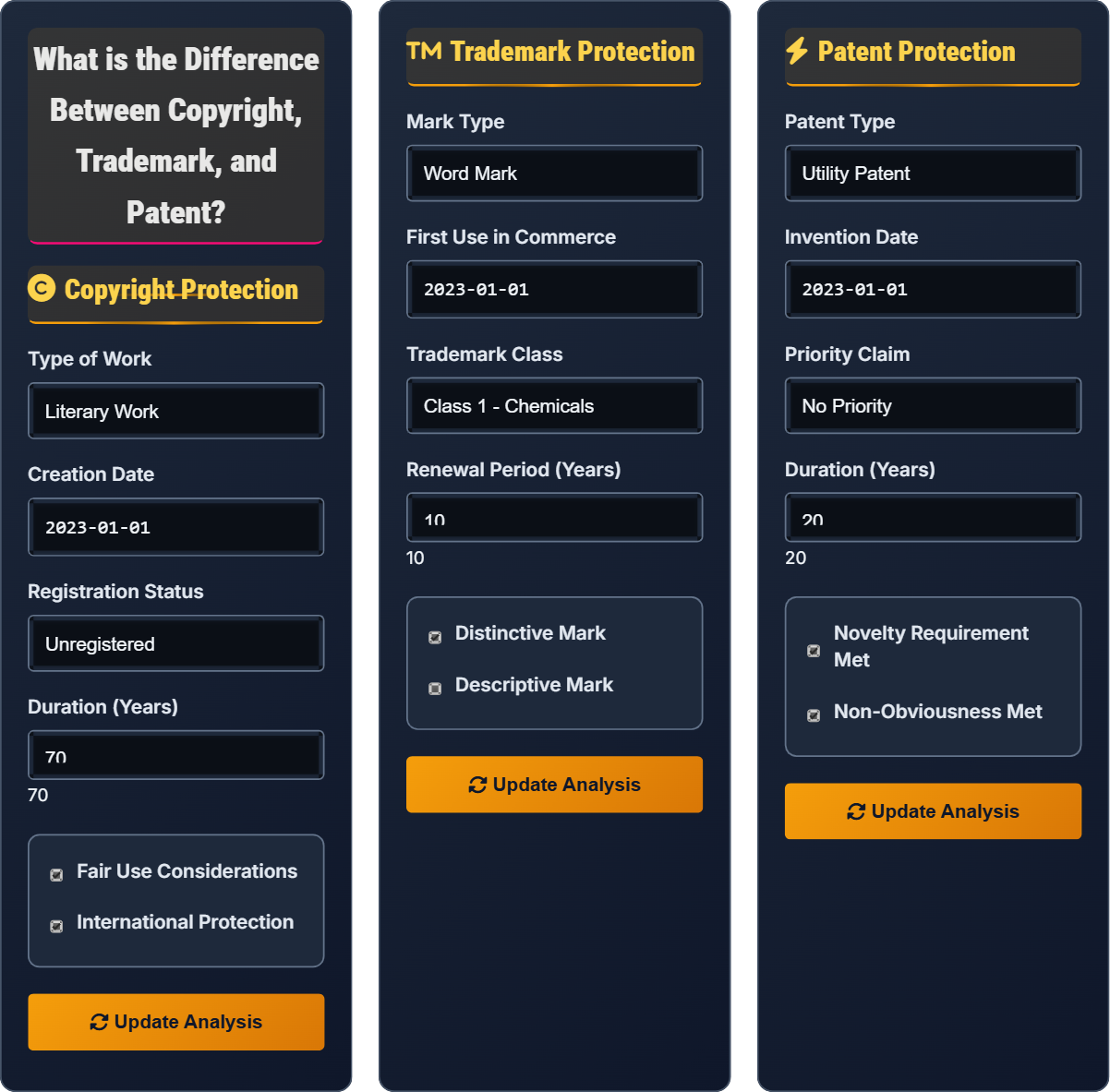
Copyright Protection
Trademark Protection
Patent Protection
Intellectual Property Comparison
| Aspect | Copyright | Trademark | Patent |
|---|---|---|---|
| Protects | Original creative works | Brand identifiers | Inventions & discoveries |
| Duration | Life + 70 years | 10 years (renewable) | 20 years |
| Automatic? | Yes (registration recommended) | No (requires registration) | No (requires registration) |
| Registration Office | Copyright Office | Patent & Trademark Office | Patent & Trademark Office |
| Requirements | Originality & fixation | Distinctiveness & use | Novelty, utility & non-obviousness |
Intellectual Property Protection Explained
Copyright is a form of intellectual property protection that covers original works of authorship fixed in a tangible medium. This includes literary works, musical compositions, dramatic works, choreographic works, pictorial and graphic works, audiovisual works, sound recordings, and architectural works.
Key characteristics of copyright protection:
- Automatic Protection: Created when work is fixed in tangible form
- Duration: Typically lasts for the author's lifetime plus 70 years
- Exclusive Rights: Reproduction, distribution, public performance, display, and derivative works
- Registration: Recommended but not required for protection
- International: Protected in Berne Convention countries
Trademarks protect words, phrases, symbols, or designs that identify and distinguish the source of goods or services. This includes brand names, logos, slogans, and trade dress that consumers associate with specific companies.
Key characteristics of trademark protection:
- Source Identifier: Distinguishes goods/services from competitors
- Duration: Potentially infinite with proper renewal and use
- Registration: Required for federal protection
- Classes: Specific categories of goods/services
- Enforcement: Prevents consumer confusion
Patents protect new and useful inventions, including processes, machines, manufactures, and compositions of matter. This includes utility patents, design patents, and plant patents that grant exclusive rights to make, use, sell, and import the invention.
Key characteristics of patent protection:
- Functional Protection: Covers how things work or are made
- Duration: 20 years for utility patents, 15 years for design patents
- Registration: Required for protection
- Disclosure: Requires public disclosure of invention details
- Exclusivity: Prevents others from making, using, selling
Effective intellectual property strategies often combine multiple forms of protection:
- Software: Copyright for code, patent for functionality, trademark for brand
- Products: Patent for invention, trademark for brand, copyright for marketing materials
- Entertainment: Copyright for content, trademark for character names, patent for novel technologies
- Branding: Trademark for names/logos, copyright for artistic elements, patent for unique packaging
IP Protection Essentials
Intellectual property, copyright, trademark, patent, originality, distinctiveness, novelty, utility, non-obviousness.
IP Protection = (Copyright + Trademark + Patent) × Registration × Enforcement
Where Copyright = Original Creative Works; Trademark = Brand Identity; Patent = Functional Inventions.
- Copyright exists automatically upon creation
- Trademarks require use in commerce
- Patents require registration and examination
- IP rights are territorial
Application Examples
iPhone (patent for technology, trademark for name/logo, copyright for iOS interface); Harry Potter (copyright for books, trademark for series name, patent for related toys).
- Software applications (multiple IP types)
- Product manufacturing (comprehensive protection)
- Entertainment franchises (cross-platform protection)
- Biotechnology innovations (complex IP strategies)
- Timing of IP filings
- International expansion planning
- Competitive landscape analysis
- Monetization opportunities
IP Protection Learning Quiz
Which form of intellectual property protection would be most appropriate for a new smartphone app that includes unique visual elements, distinctive branding, and innovative functionality?
A smartphone app would benefit from multiple forms of intellectual property protection. Copyright would protect the code and visual interface, trademark would protect the app name and logo, and patent would protect any innovative technical functionality. This comprehensive approach ensures maximum protection for all aspects of the app.
The answer is D) Combination of all three.
Modern products and services often require multiple forms of intellectual property protection. Software applications are a prime example of this, as they contain various protectable elements: the code itself (copyright), the visual interface (copyright/design patent), the brand name (trademark), and innovative functionality (patent). Understanding when to use multiple IP types is crucial for comprehensive protection strategies.
Intellectual Property: Legal rights over creations of the mind
Comprehensive Protection: Using multiple IP types for maximum coverage
Multi-Layer Strategy: Combining different IP protections
• Different IP types protect different aspects
• Multiple protections can coexist
• Comprehensive strategies offer best protection
• Analyze all aspects of your creation
• Consider which IP type fits each element
• Combine protections for comprehensive coverage
• Assuming one IP type covers everything
• Overlooking complementary protections
• Failing to consider all product aspects
Compare the duration and renewal requirements for copyright, trademark, and patent protection. Explain why these differences exist.
Copyright Duration: Life of the author plus 70 years for individual works, or 95 years from publication or 120 years from creation (whichever is shorter) for works made for hire. No renewal required for automatic protection, though registration can be renewed.
Trademark Duration: Initially 10 years from registration, renewable indefinitely every 10 years as long as the mark continues to be used in commerce. Requires proof of continued use and renewal fees.
Patent Duration: 20 years from filing date for utility patents, 15 years from issue date for design patents. No renewal possible; protection expires absolutely.
Reasons for Differences:
• Copyright: Long duration encourages creativity and innovation
• Trademark: Indefinite renewal reflects ongoing business value
• Patent: Limited duration balances inventor rights with public access
The different durations reflect the policy goals behind each type of intellectual property. Copyright's long duration encourages creative expression by providing extended economic incentives. Trademark's indefinite renewal recognizes that brand identity has ongoing commercial value. Patent's limited term balances rewarding innovation with ensuring eventual public access to technological advances. These differences reflect the unique economic and social functions of each protection type.
Duration: Length of IP protection
Renewal: Process to extend protection
Policy Goals: Economic and social objectives
• Copyright: Life + 70 years
• Trademark: 10 years, renewable indefinitely
• Patent: 20 years, no renewal
• Remember trademark requires active use
• Patent protection is finite
• Copyright is longest-lasting
• Confusing renewal requirements
• Misunderstanding duration differences
• Assuming all IP has same term
A tech startup has developed a revolutionary fitness tracker with a unique algorithm, distinctive design, and catchy brand name. The team wants to protect their investment before launching. Describe the optimal intellectual property strategy for this product, including what to protect first, the timing of filings, and why each type of protection is important.
Patent Strategy: File a provisional patent application immediately to secure priority date for the unique algorithm. Follow up with a non-provisional application within 12 months. This protects the core innovation and prevents competitors from copying the technology.
Trademark Strategy: Conduct a trademark search and file applications for the brand name and logo. This should be done before launch to ensure availability and prevent consumer confusion.
Design Patent Strategy: File design patent applications for the distinctive appearance of the device. This complements the utility patent by protecting the visual elements.
Copyright Strategy: Register copyright in the user interface and marketing materials. While automatic, registration provides enhanced enforcement options.
Timing Priority: 1) Patent filing (protect innovation), 2) Trademark filing (protect brand), 3) Design patent (protect appearance), 4) Copyright registration (protect creative elements).
Effective IP strategies require understanding the value of different assets and the timing of protection. Inventions are vulnerable to copying once disclosed, so patent protection should come first. Brand identity is crucial for market success, so trademark protection should precede launch. The strategy should protect the most valuable and vulnerable assets first, considering both competitive threats and business objectives.
Priority Date: Date that establishes patent rights
Provisional Application: Initial patent filing that preserves rights
IP Strategy: Coordinated approach to protection
• Patent filing before public disclosure
• Trademark before market entry
• Design protection for visual elements
• File patents before product launch
• Conduct trademark searches early
• Consider international protection
• Public disclosure before patent filing
• Delaying trademark protection
• Ignoring design elements
A company discovers that a competitor is selling a product that appears to copy their patented technology, uses a confusingly similar trademark, and incorporates copyrighted design elements. What is the appropriate legal response, and how should the company prioritize their enforcement actions?
Patent Infringement: Send cease and desist letter regarding patent infringement. File lawsuit if necessary, as patent damages can be substantial and may include enhanced damages for willful infringement.
Trademark Infringement: Demand immediate cessation of unauthorized use of similar marks. File opposition if competitor is seeking registration, or cancellation proceeding if they already have registration. Trademark infringement can cause immediate market confusion.
Copyright Infringement: Send DMCA takedown notices for online sales and copyrighted elements. File lawsuit for statutory damages and attorney fees.
Priority Order: 1) Trademark (immediate market confusion), 2) Patent (substantial damages), 3) Copyright (supporting evidence).
Strategic Considerations: Consider whether to pursue all claims simultaneously or selectively based on strength of evidence, cost-benefit analysis, and strategic objectives.
IP enforcement requires strategic thinking about which rights to assert and when. Trademark violations often cause immediate market harm through consumer confusion, making them a priority. Patent infringement can result in significant monetary damages. Copyright infringement may provide supporting evidence for other claims. The enforcement strategy should consider both legal remedies and business objectives.
Enforcement: Taking legal action to protect rights
Cease and Desist: Demand to stop infringing activity
Statutory Damages: Prescribed legal damages
• Enforce rights promptly
• Document all violations
• Consider strategic priorities
• Document all evidence immediately
• Consult with IP attorneys
• Consider settlement negotiations
• Delaying enforcement action
• Inconsistent enforcement
• Ignoring weaker claims
Which statement about international intellectual property protection is correct?
Intellectual property rights are territorial, meaning they must be obtained separately in each country where protection is desired. While international treaties like the Berne Convention facilitate copyright protection and the Madrid Protocol simplifies trademark registration, protection still requires individual country filings. Patents must be filed separately in each jurisdiction where protection is sought, though the PCT system allows for streamlined initial filing.
The answer is C) IP rights are territorial and require country-specific registration.
Despite international treaties, intellectual property remains territorial. This means that while treaties like the Paris Convention, Berne Convention, and TRIPS Agreement provide frameworks for international protection, actual rights must still be secured individually in each jurisdiction. Companies expanding internationally must consider IP filing strategies that account for territorial limitations and treaty benefits.
Territorial: Limited to specific geographic areas
Berne Convention: Treaty for copyright protection
Madrid Protocol: System for international trademarks
• IP rights are territorial
• Registration required in each country
• Treaties facilitate but don't eliminate local filing
• Research target markets early
• Use international filing systems when available
• Budget for multiple jurisdictions
• Assuming global protection from domestic filing
• Ignoring international expansion plans
• Failing to budget for foreign filings
FAQ
Q: How do I protect my software application? Should I focus on copyright, patent, or both?
A: Software protection typically requires a multi-layered approach:
Copyright: Protects the actual code, user interface, and visual elements. This is automatic upon creation but registration strengthens enforcement.
Patent: Protects the underlying algorithms, processes, and functionality. This requires filing a patent application and is particularly important for novel technical innovations.
Trademark: Protects the app name, logo, and branding elements.
For most software, start with copyright (automatic protection) and consider patent protection for truly innovative features. The combination provides comprehensive coverage for all aspects of your application.
Q: What's the difference between a design patent and copyright protection for visual elements?
A: Design patents and copyright for visual elements serve different purposes:
Design Patent: Protects the ornamental design of a functional item. It covers how something looks and is applied to manufactured items. Duration is 15 years from issue date.
Copyright: Protects artistic expression in creative works. It covers original works of authorship fixed in tangible form, including artwork, photographs, and graphic designs. Duration is life plus 70 years.
For a product with both functional and aesthetic elements, design patents may be stronger for industrial designs, while copyright may be better for purely artistic elements. Both can coexist for the same item.