What Is the Difference Between Libel and Slander Legally?
Complete guide • Defamation law • Legal distinctions
Libel vs. Slander:
Defamation Classification ToolLibel and slander are both forms of defamation - false statements that harm someone's reputation. The key difference is the medium: libel involves written or published statements, while slander involves spoken words. Understanding these distinctions is crucial for legal protection and potential remedies.
Key differences include:
- Libel: Written, published, or permanent form of defamation
- Slander: Spoken or temporary form of defamation
- Per Se: Certain statements are inherently harmful
- Presumed Damages: Automatic damage assumptions
Both require proving falsity, publication, harm to reputation, and fault.
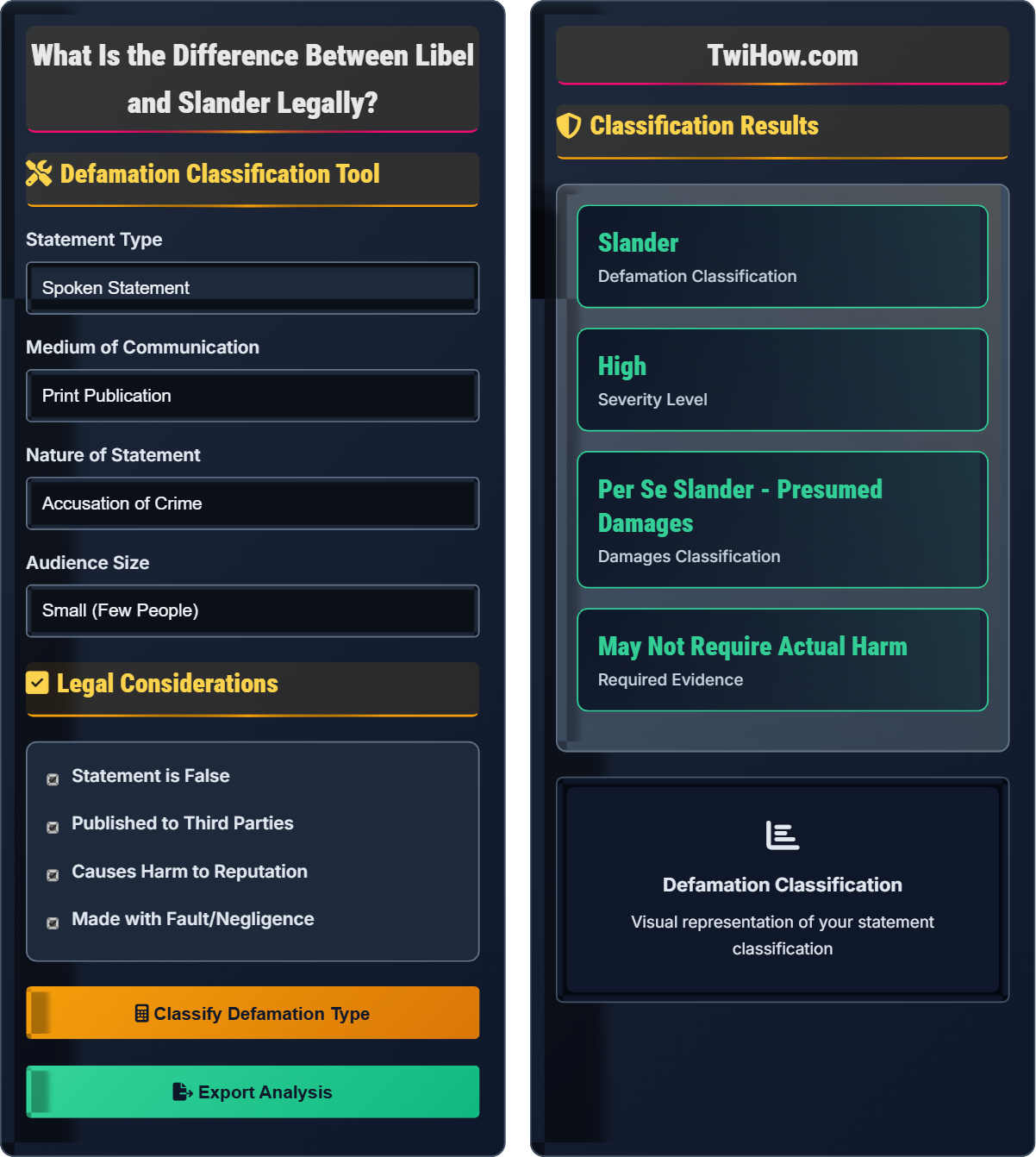
Defamation Classification Tool
Legal Considerations
Classification Results
Defamation Classification
Visual representation of your statement classification
| Aspect | Classification | Details |
|---|---|---|
| Type | Slander | Spoken statement |
| Medium | Personal Conversation | Private setting |
| Nature | Character/Integrity | Personal reputation |
| Audience | Small | Limited distribution |
Required Legal Elements
- Falsity of the statement
- Publication to third parties
- Harm to reputation
- Fault (negligence or worse)
Libel vs. Slander Overview
Libel is written defamation - false statements that are published in permanent form:
- Print Publications: Newspapers, magazines, books
- Online Content: Websites, blogs, social media posts
- Audio/Video: Recorded broadcasts, podcasts
- Permanent Form: Statements that can be seen/read repeatedly
Libel is often considered more serious because it has lasting impact and wider reach.
Slander is spoken defamation - false statements made orally:
Key characteristics:
- Spoken words or gestures
- Temporary or transitory form
- Requires proof of actual damages (in most cases)
- Harder to prove due to temporary nature
Statements that are inherently harmful and presumed to cause damages:
- Crime: Accusing someone of criminal conduct
- Disease: Attributing loathsome disease
- Business: Impugning professional capacity
- Chastity: Accusing unmarried woman of unchastity
- Truth: True statements cannot be defamatory
- Privilege: Absolute (court proceedings) or qualified (job references)
- Opinion: Subjective statements not presented as facts
- Consent: Plaintiff agreed to publication
Libel vs. Slander Distinctions
Medium permanence, burden of proof, and damages requirements.
Libel involves permanent records, slander is temporary.
Permanent form allows for easier proof and wider distribution.
- Libel requires no proof of actual damages in per se cases
- Slander typically requires proof of actual harm
- Both require proof of falsity and fault
Damages and Remedies
Actual, presumed, punitive, and nominal damages available.
- Establish defamation elements
- Calculate actual damages
- Seek injunctive relief
- Reputation restoration
- Statute of limitations varies by state
- Public figures face higher burden of proof
- Truth is absolute defense
- Retractions may limit damages
Defamation Law Knowledge Quiz
What is the fundamental difference between libel and slander?
The fundamental difference between libel and slander is the medium of communication. Libel involves written, published, or permanent forms of false statements, while slander involves spoken or temporary forms of false statements. This distinction affects the burden of proof and damages required.
The answer is B) Libel is written, slander is spoken.
The permanence of libel versus the transitory nature of slander creates different legal standards. Written statements are easier to prove and have longer-lasting impact, which is why libel cases often have different procedural requirements than slander cases.
Libel: Written or published defamation
Slander: Spoken defamation
Permanence: Lasting or enduring quality of statement
• Libel is permanent form of defamation
• Slander is temporary form of defamation
• Both require same core elements
• Remember: "Libel" has "L" like "Letter" (written)
• Slander is spoken word
• Both require falsity and publication
• Confusing seriousness with classification
• Mixing up medium with other factors
• Not understanding permanence distinction
Explain the concept of "presumed damages" in defamation law and how it applies differently to libel and slander cases. What are "per se" defamatory statements?
Presumed Damages: In certain defamation cases, courts presume that harm to reputation occurred, eliminating the need for the plaintiff to prove actual damages. This applies primarily to libel and specific types of slander.
Libel Cases: In most jurisdictions, libel per se creates presumption of damages. The permanent nature of written statements justifies this presumption.
Slander Cases: Generally requires proof of actual damages, except for per se slander categories which create presumption of harm.
Per Se Categories: Statements accusing of crime, disease, business misconduct, or unchastity are considered inherently harmful.
The presumption of damages recognizes that certain false statements are so harmful that damage to reputation is obvious. The law doesn't require victims to quantify every aspect of reputational harm, especially when the statement is inherently damaging.
Presumed Damages: Automatically assumed harm to reputation
Actual Damages: Proven economic or emotional harm
Per Se: Inherently harmful by nature
• Libel per se creates presumption of damages
• Slander requires actual damages in most cases
• Per se categories include crime, disease, business, chastity
• Remember: Permanence affects damages requirement
• Per se statements don't need damage proof
• Libel more likely to create presumed damages
• Assuming all slander cases require damage proof
• Not understanding per se categories
• Confusing actual vs. presumed damages
A blogger writes a blog post falsely accusing a local business owner of embezzling funds. The post is shared widely on social media, reaching thousands of people. Later, the same blogger makes a verbal accusation during a radio interview. Analyze both statements: classify each as libel or slander, and explain the different legal implications for the business owner seeking damages.
Blog Post: This is libel because it's a written statement published in permanent form. The wide distribution and permanent nature strengthen the case.
Radio Interview: This is slander because it's a spoken statement. However, if recorded and rebroadcast, it could become libel due to permanence.
Legal Implications: For the blog post, the business owner can seek presumed damages due to libel per se (accusation of crime). For the radio statement, actual damages must typically be proven unless it qualifies as per se slander.
Recovery: The libel case is stronger due to presumption of damages and permanent record.
Digital media blurs traditional libel/slander lines. Online content is generally considered libel due to its permanent, accessible nature. The key is whether the statement exists in a form that can be reviewed repeatedly.
Permanence: Lasting quality of statement form
Publication: Communication to third parties
Embezzlement: Theft of entrusted funds
• Digital content typically classified as libel
• Accusations of crime are per se defamatory
• Permanence affects damages requirements
• Consider permanence of digital content
• Identify per se categories
• Evaluate audience reach
• Not considering permanence of online content
• Forgetting per se categories
• Overlooking audience size impact
A newspaper publishes an article falsely claiming that a private citizen committed fraud. The same newspaper later publishes an article making the same false claim about a public official. Compare the legal standards each victim must meet to prove defamation, and explain why the standards differ.
Private Citizen: Must prove falsity, publication, and fault (usually negligence). Lower burden of proof due to lesser public interest in private lives.
Public Official: Must prove falsity, publication, fault, and actual malice (knowledge of falsity or reckless disregard for truth). Higher standard due to First Amendment protection of public discourse.
Reasoning: Public figures have voluntarily exposed themselves to increased scrutiny and have greater access to counter speech. The law balances reputation protection against free speech rights.
Impact: Public officials face significantly higher burden of proof, making defamation cases more difficult.
The actual malice standard represents the Supreme Court's attempt to balance reputation protection with First Amendment freedoms. Public figures have greater access to media and resources to counter false statements, justifying the higher legal threshold.
Actual Malice: Knowledge of falsity or reckless disregard
Public Figure: Person with public prominence
Private Person: Individual not in public eye
• Public figures must prove actual malice
• Private persons need only prove negligence
• Standards protect First Amendment rights
• Consider public status of victim
• Evaluate burden of proof differences
• Remember First Amendment balance
• Applying same standard to all plaintiffs
• Not understanding actual malice requirement
• Forgetting First Amendment considerations
Which of the following is considered an absolute defense to defamation claims?
Truth is the absolute defense to defamation. If a statement is true, it cannot be defamatory regardless of how harmful it might be to someone's reputation. This defense applies to both libel and slander cases.
The answer is B) Truth.
Truth as an absolute defense reflects the policy that society benefits from truthful speech, even when it harms someone's reputation. The law prioritizes factual accuracy over reputation protection when statements are true.
Absolute Defense: Complete protection from liability
Qualified Privilege: Conditional protection
Factual Truth: Correspondence to reality
• Truth is absolute defense to defamation
• Truth must be substantial truth
• Even damaging truths are protected
• Verify factual accuracy
• Distinguish truth from opinion
• Remember substantial truth standard
• Confusing opinion with truth defense
• Not understanding absolute vs. qualified defenses
• Overlooking substantial truth concept
FAQ
Q: Can I sue for defamation if someone spreads a false rumor about me in a small group conversation?
A: Yes, you may have a defamation claim if the statement was false, published to others (even a small group), caused harm to your reputation, and was made with fault.
However, for slander (spoken statements), you typically need to prove actual damages unless the statement falls under "per se" categories (crime, disease, business misconduct, etc.). The smaller audience may limit your damages, but doesn't necessarily defeat your claim.
Consider whether the statement was truly false, whether it reached people who knew you, and whether it caused actual harm to your reputation or relationships.
Q: What's the statute of limitations for filing a defamation lawsuit?
A: Statute of limitations for defamation varies by state but is typically 1-3 years from the date of publication. Some states have shorter periods (1 year) while others allow up to 3 years.
Special considerations include:
- Discovery rule: Period may start when you discovered the defamatory statement
- Single publication rule: One suit for all republications of same statement
- Internet publications: Some states have special rules for online content
It's crucial to consult with an attorney promptly, as missing the deadline permanently bars your claim.