Legal Process for Adopting a Child
Complete adoption guide • Steps & requirements
Adoption Legal Process:
Adoption Cost CalculatorThe legal process for adopting a child involves multiple steps including home studies, background checks, court proceedings, and finalization. The process varies by type of adoption (domestic, international, foster care) and state laws. Understanding requirements, costs, and timelines helps prepare prospective parents for this significant journey.
Key aspects of the adoption process include:
- Eligibility Requirements: Age, income, marital status, and home environment
- Home Study: Background checks, interviews, and home inspections
- Legal Proceedings: Court hearings and finalization of adoption
- Post-Placement Supervision: Required monitoring period after placement
The process typically takes 6 months to 2+ years depending on the type of adoption and circumstances.
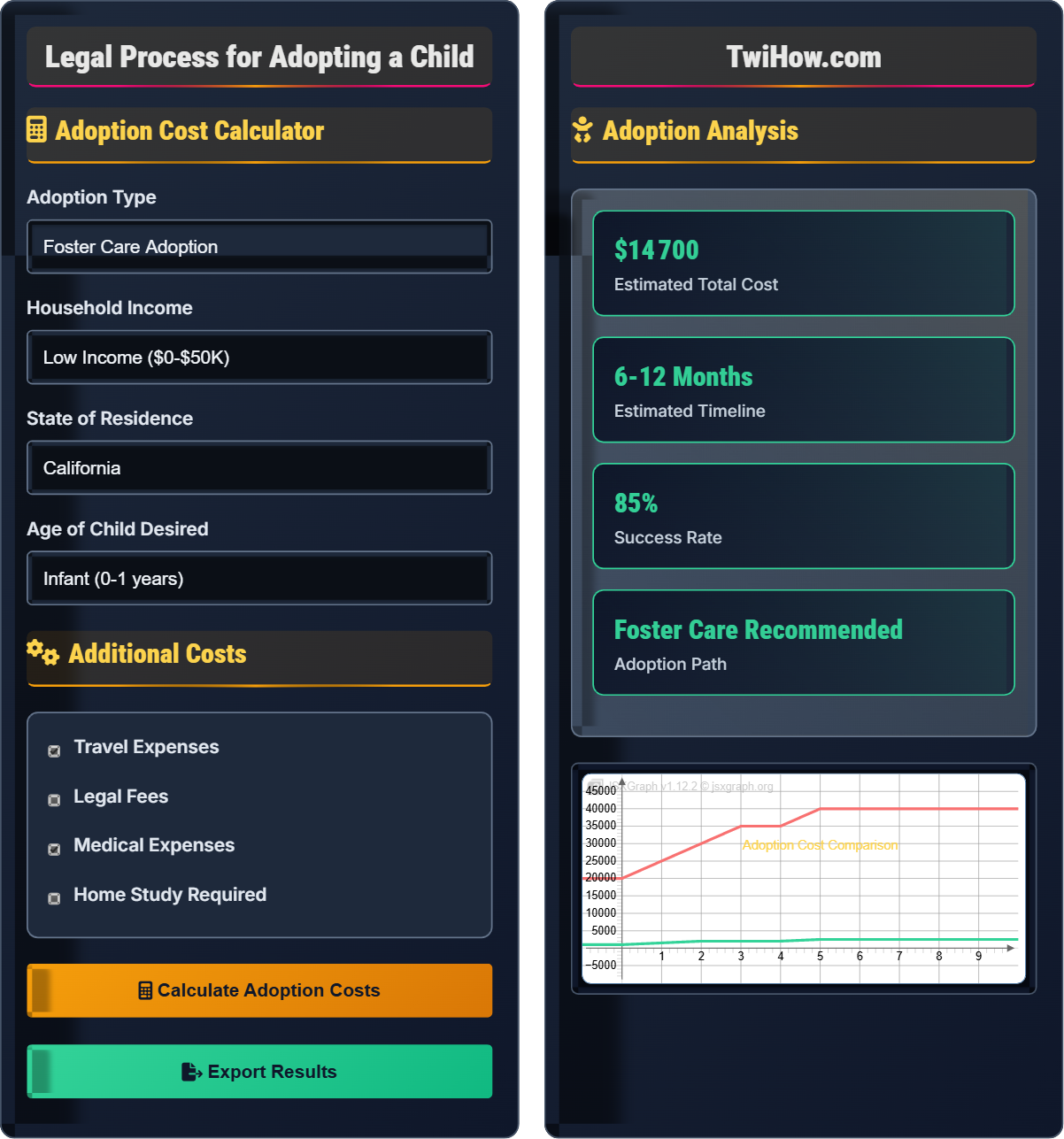
Adoption Cost Calculator
Additional Costs
Adoption Analysis
| Category | Amount | Percentage | Notes |
|---|---|---|---|
| Agency Fees | $15,000 | 60% | Includes services and placement |
| Legal Fees | $3,000 | 12% | Court proceedings and documentation |
| Home Study | $2,500 | 10% | Background checks and interviews |
| Travel | $4,500 | 18% | Based on distance and requirements |
Understanding the Adoption Process
Child adoption is a legal process that permanently transfers parental rights and responsibilities from birth parents to adoptive parents. Once finalized, adoptive parents have the same legal rights and responsibilities as biological parents. The process involves court proceedings that terminate the birth parents' rights and establish the adoptive parents' rights.
Types of adoption include:
- Domestic Adoption: Adopting a child within your country
- International Adoption: Adopting a child from another country
- Foster Care Adoption: Adopting a child in the foster care system
- Private Adoption: Working directly with birth parents or agencies
- Agency Adoption: Working with licensed adoption agencies
- Relative Adoption: Adopting a relative's child
Prospective parents must meet state-specific requirements including age, income, health, and home environment standards. Requirements vary by adoption type and agency.
A comprehensive evaluation including background checks, interviews, home visits, and documentation of financial stability and parenting readiness.
Connecting with a child based on compatibility factors and beginning the placement process with post-placement supervision.
Finalizing the adoption through court hearings where parental rights are transferred and adoption is legally recognized.
Decide on adoption type (foster care, private, international) and research agencies or attorneys. Consider costs, timeline, and requirements for each path.
Submit application forms, provide references, financial statements, and personal information. Begin background check process and medical evaluations.
Complete comprehensive home study including interviews, home visits, and documentation. This evaluates your suitability as parents and home environment.
After approval, wait for a match with a child. This waiting period can range from months to years depending on preferences and availability.
Child is placed with your family. Post-placement supervision period begins, typically lasting 6 months to a year.
Court proceedings to finalize adoption, terminating birth parents' rights and establishing your legal parenthood.
Most states require adoptive parents to be at least 21 years old. Some have higher minimums or maximum age differences.
Safe, stable living environment with adequate space. Must pass safety inspections and meet state housing standards.
Physical and mental health evaluations to ensure fitness for parenting responsibilities.
Proof of stable income and ability to support a child. No specific income minimums in most states.
Adoption can present various challenges:
- Long Wait Times: Matching can take months to years depending on preferences
- Emotional Stress: Uncertainty and attachment issues during the process
- Financial Burden: Significant costs associated with different adoption paths
- Legal Complexity: Navigating varying state and international laws
- Birth Parent Changes: Possibility of birth parents changing their minds
Adoption Types Comparison
| Type | Timeline | Cost Range | Success Rate | Considerations |
|---|---|---|---|---|
| Foster Care | 6-18 months | $0-$2,500 | 85% | Children often older; medical/behavioral histories available |
| Private Domestic | 1-3 years | $25,000-$40,000 | 70% | Birth parent involvement; higher costs; younger children |
| International | 2-4 years | $30,000-$50,000 | 65% | Travel required; complex legal procedures; cultural considerations |
| Agency | 1-2 years | $20,000-$35,000 | 75% | Professional support; structured process; matching services |
Estimated costs for different adoption paths:
Adoption Timeline
Successful Adoption Stories
The Johnsons adopted their son Marcus from foster care when he was 4 years old. The process took 10 months and cost approximately $2,000. They worked with the state social services department and completed a thorough home study.
Outcome: Successful integration into family. Marcus is now thriving in school and has formed strong bonds with his adoptive parents and siblings.
Sarah and David adopted their daughter from South Korea after a 3-year process. They spent $35,000 and made two trips to Korea. The process involved extensive paperwork, cultural preparation, and language considerations.
Outcome: Successful integration with strong support for cultural identity. Daughter is thriving academically and socially.
The Garcias worked with an adoption agency to adopt an infant. The process took 18 months and cost $32,000. They maintained contact with the birth mother throughout pregnancy and delivery.
Outcome: Positive relationship with birth mother. Child is healthy and family is thriving with ongoing communication.
Adoption Process Learning Quiz
Which type of adoption typically has the lowest costs and fastest timeline?
Foster care adoption typically has the lowest costs ($0-$2,500) and fastest timeline (6-18 months). This is because the state subsidizes most costs and the children are already in the system. The state often provides financial assistance and medical coverage for the child. Other adoption types involve more complex procedures and higher professional fees.
The answer is B) Foster Care Adoption.
Foster care adoption is often the most accessible route for families due to lower costs and faster processing. The state has already determined that the child cannot safely return to their birth family, which streamlines the legal process. However, children in foster care may have experienced trauma or have special needs requiring additional support.
Foster Care: Temporary care for children unable to live with birth families
Subsidized Adoption: State financial assistance for adoptive families
Termination of Rights: Legal process ending parental rights
• Foster care adoptions have lower costs due to state subsidies
• Timeline is typically faster than other adoption types
• Children may have special needs requiring support
• Attend foster care information sessions
• Be prepared for children's complex needs
• Understand post-adoption support services
• Assuming all foster children have similar needs
• Not preparing for potential behavioral issues
• Underestimating the importance of support services
Explain the home study process for adoption, including what it evaluates and why it's required. What documentation is typically needed?
Home Study Purpose: The home study is a comprehensive evaluation required for all adoptions to ensure the safety and suitability of the adoptive family. It serves to protect the child's best interests.
What It Evaluates:
• Physical home environment and safety
• Financial stability and employment
• Physical and mental health
• Personal and family history
• Motivation for adoption
• Parenting skills and readiness
Required Documentation:
• Medical examinations and health clearances
• Financial statements and employment verification
• Criminal background checks
• Personal references (typically 3-5)
• Marriage certificate (if applicable)
• Life history statement
Process: Typically involves 3-4 interviews with a social worker, home visits, and document review over 2-4 months.
The home study is the cornerstone of the adoption process, serving as the primary evaluation tool to ensure children are placed in safe, stable homes. It's not meant to be punitive but rather to assess the family's readiness and capacity to parent. The process helps social workers understand the family's strengths and areas where they might need support.
Home Study: Comprehensive evaluation of prospective adoptive parents
Best Interests: Standard for determining child welfare
Post-Placement Supervision: Monitoring after child placement
• Home study is required for all adoption types
• Social worker must be licensed and certified
• Process must be completed before placement
• Prepare documentation in advance
• Be honest and open during interviews
• Ask questions about the process
• Not preparing documentation early enough
• Being dishonest about personal history
• Not taking the process seriously
The Smiths are considering a private domestic adoption. They estimate agency fees of $20,000, legal fees of $5,000, home study costs of $3,000, and travel expenses of $8,000. Calculate their total estimated cost and determine what percentage each category represents of the total.
Total Estimated Cost: $20,000 + $5,000 + $3,000 + $8,000 = $36,000
Percentage Breakdown:
• Agency Fees: ($20,000 ÷ $36,000) × 100 = 55.6%
• Legal Fees: ($5,000 ÷ $36,000) × 100 = 13.9%
• Home Study: ($3,000 ÷ $36,000) × 100 = 8.3%
• Travel Expenses: ($8,000 ÷ $36,000) × 100 = 22.2%
Analysis: Agency fees represent the largest portion of costs (55.6%), followed by travel expenses (22.2%). Legal fees and home study costs are relatively smaller portions of the total.
Understanding cost breakdowns helps families plan their budgets effectively. Agency fees typically represent the largest expense because they cover services throughout the entire process including matching, counseling, and support. Travel costs can vary significantly based on the location of the child and the number of required trips.
Agency Fees: Charges for professional adoption services
Legal Fees: Costs for court proceedings and documentation
Home Study: Professional evaluation of suitability
• Costs can vary significantly by agency and location
• Some fees may be tax-deductible
• Unexpected costs may arise during process
• Budget for 10-20% additional costs beyond estimates
• Research tax credits and deductions
• Consider fundraising and financing options
• Underestimating total costs
• Not planning for unexpected expenses
• Failing to research financing options
The Johnsons have been approved for adoption and are waiting for a match. They want to understand the waiting period and how to prepare during this time. Describe the typical waiting period and suggest activities for preparation.
Typical Waiting Period:
• Foster care: 1-6 months (depending on preferences)
• Private domestic: 6 months to 2+ years
• International: 1-4 years (varies by country)
Preparation Activities:
Emotional Preparation:
• Attend support group meetings
• Read books about adoption and parenting
• Connect with other adoptive families
Practical Preparation:
• Prepare nursery or bedroom
• Research pediatricians and schools
• Plan for post-adoption support services
Financial Preparation:
• Continue saving for adoption costs
• Review insurance coverage
• Plan for potential time off work
Maintaining Perspective: Stay connected to your support network and maintain normal routines while remaining open to opportunities.
The waiting period is often the most challenging part of the adoption process. It's important for families to stay engaged and prepared while managing expectations. The length of wait depends on factors like the age of child preferred, special needs, race, and geographic location. Staying positive and productive during this time helps families remain ready when opportunities arise.
Matching: Process of connecting families with children
Open Adoption: Relationship between adoptive and birth families
Post-Placement: Period after child joins family
• Waiting periods can be unpredictable
• Families must remain flexible
• Continuing education is important
• Keep profiles updated and current
• Stay in touch with agencies regularly
• Be open to different possibilities
• Becoming discouraged during wait
• Not staying in contact with agencies
• Losing focus on preparation
What is the legal status of an adoption once it is finalized?
Once an adoption is finalized, it creates a legal parent-child relationship that is identical to a biological parent-child relationship. The adoptive parents have all the rights and responsibilities of biological parents, and the adopted child has all the rights of a biological child. The adoption is permanent and cannot be reversed except in extremely rare circumstances involving fraud or duress.
The answer is B) It creates legal parent-child relationship identical to biological relationship.
Adoption finalization is a permanent legal change that completely severs the legal relationship between the child and birth parents while creating a new legal relationship with adoptive parents. The adopted child gains all legal rights and privileges of a biological child, including inheritance rights, access to family medical history, and social security benefits. The adoptive parents assume all legal responsibilities including financial support and care.
Finalization: Court proceeding that makes adoption permanent
Severance: Termination of birth parents' legal rights
Relinquishment: Voluntary surrender of parental rights
• Finalized adoptions are permanent
• Adopted children gain full legal rights
• Birth parents' rights are permanently terminated
• Understand all legal implications before proceeding
• Work with qualified adoption attorney
• Review all documentation carefully
• Not understanding permanency of adoption
• Failing to work with qualified professionals
• Rushing through legal procedures
Frequently Asked Questions
Expert Q&A
Q: We're considering international adoption from China. What special requirements and challenges should we be aware of?
A: International adoption from China has specific requirements:
Eligibility Requirements:
• Combined household income of at least $10,000 per child already in household plus $8,000 for each adopted child
• Parents must be between 25-50 years old (age difference maximum 50 years)
• Married for at least 2 years (some exceptions for single parents)
• Good physical and mental health
Process Requirements:
• Complete home study by licensed Chinese social worker
• Submit dossier to China Center for Children's Welfare and Adoption (CCCWA)
• Wait for child referral and approval
• Travel to China for 2-3 weeks for finalization
Special Considerations:
• Focus on children with special needs or older children
• Strong emphasis on cultural preservation
• Post-adoption reporting requirements
Timeline: Typically 2-4 years including the entire process and travel.
Q: What should we know about open adoption and maintaining contact with birth parents?
A: Open adoption arrangements vary but typically involve ongoing contact between adoptive families and birth parents:
Benefits of Open Adoption:
• Child has access to complete medical and family history
• Reduced feelings of abandonment and identity confusion
• Birth parents have peace of mind about child's welfare
• Child can understand the adoption story from multiple perspectives
Arrangement Types:
• Letter and photo exchanges
• Email or phone contact
• Visits (frequency varies)
• Social media contact
Managing Relationships:
• Establish clear boundaries early
• Maintain consistent, age-appropriate communication
• Focus on the child's best interests
• Be prepared to adapt arrangements as child grows
Challenges: Potential for boundary conflicts, differing expectations, or emotional complications. Professional counseling can help navigate these relationships.