How to Legally Expunge Your Criminal Record
Complete legal guide • Step-by-step process
Criminal Record Expungement Overview:
Show Expungement AnalyzerExpungement is a legal process that allows you to clear or seal criminal records from public view. This process varies significantly by state and type of offense, but it can remove barriers to employment, housing, education, and other opportunities. The process typically involves filing a petition with the court, attending hearings, and meeting specific waiting periods and eligibility requirements.
Successful expungement can significantly improve your life prospects by removing the stigma of a criminal record. However, the process can be complex and requires careful attention to legal requirements, documentation, and procedural rules.
Key considerations for expungement include:
- Eligibility Requirements: Type of offense, time elapsed, other criminal history
- Waiting Periods: Mandatory time frames before eligibility
- Documentation: Required court records and supporting evidence
- Legal Process: Filing procedures, hearings, and court appearances
Understanding your state's specific requirements is crucial for a successful expungement petition.
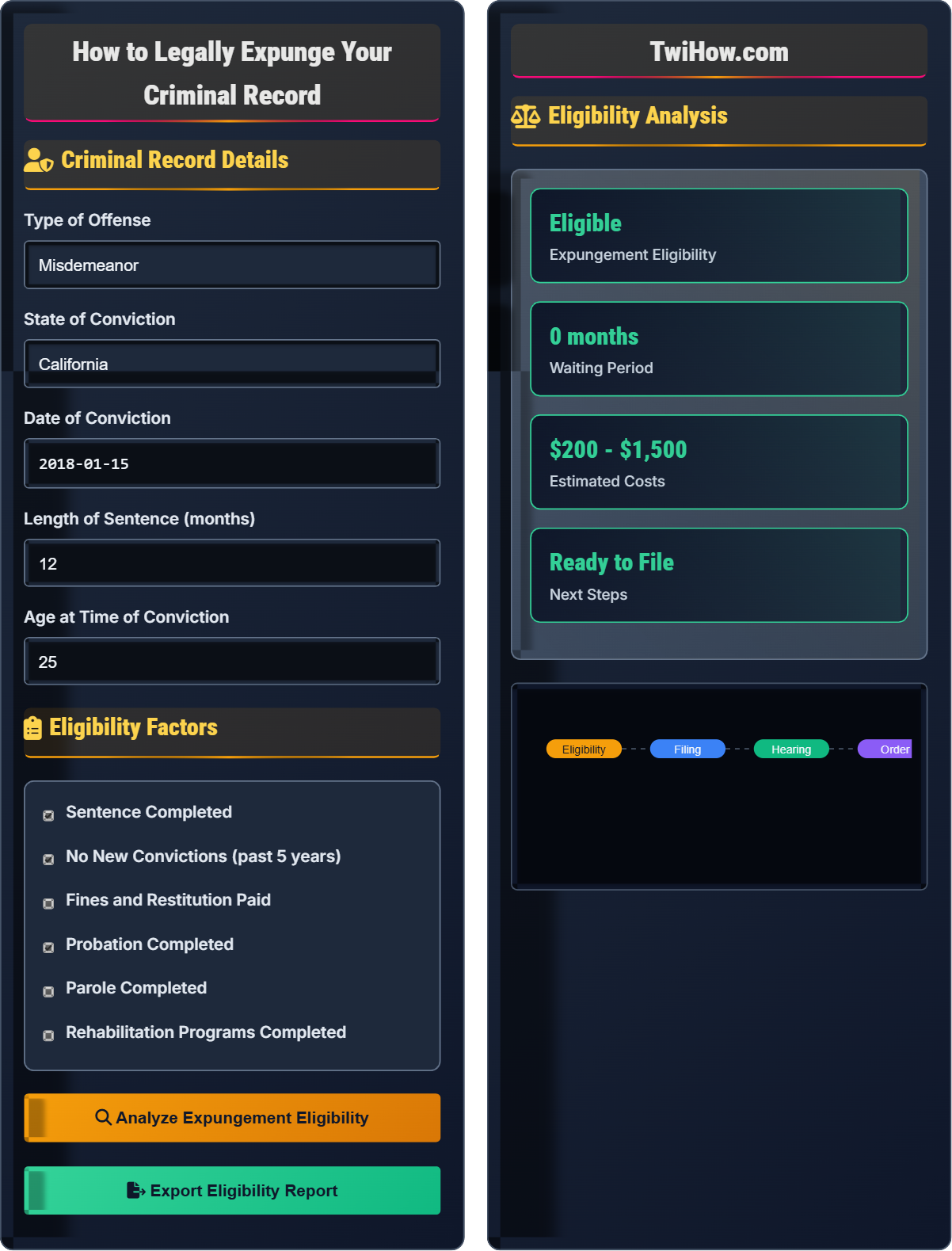
Criminal Record Details
Eligibility Factors
Eligibility Analysis
| Step | Action | Timeline | Status |
|---|---|---|---|
| 1 | Verify Eligibility | Immediate | Complete |
| 2 | Gather Court Records | 1-2 weeks | Pending |
| 3 | Complete Petition | 1 week | Pending |
| 4 | File with Court | Week 2 | Pending |
| 5 | Pay Filing Fees | Week 2 | Pending |
| 6 | Court Review | 2-6 weeks | Pending |
| 7 | Court Hearing | Month 2-3 | Scheduled |
| 8 | Final Order | After Hearing | Pending |
Required Documentation
- Original conviction documents
- Certificate of completion of sentence
- Proof of payment of fines/restitution
- Certified criminal history report
- Character references
- Employment verification
- Rehabilitation evidence
- Expungement petition form
Understanding Criminal Record Expungement
Expungement is a legal process that allows individuals to clear or seal criminal records from public view. When a record is expunged, it is typically removed from public records databases and cannot be accessed by employers, landlords, or other entities conducting background checks. The specific effects of expungement vary by state and type of offense.
Eligibility for expungement follows this formula:
Where:
- Time Elapsed: Years since conviction or completion of sentence
- Offense Type Factor: Eligibility multiplier based on offense severity
- Criminal History: Number of prior convictions (higher = less eligible)
- Compliance Factors: Completion of sentence, fines paid, etc.
Different jurisdictions offer various types of record clearing:
- Complete Expungement: Record is destroyed and cannot be accessed
- Sealing: Record is sealed but may be accessible to law enforcement
- Set-Aside: Conviction is set aside and replaced with dismissal
- Non-Disclosure: Record is sealed but may be accessed under specific circumstances
- Automatic Expungement: Processed without petition in some jurisdictions
- Employment: Removes barriers to job applications
- Housing: Improves housing application prospects
- Education: Enables college and professional licensing
- Civic Rights: Restores voting and jury service rights
- Psychological: Reduces stigma and stress
- Financial: Improves credit and loan prospects
Expungement Essentials
Expungement, record sealing, criminal conviction, eligibility requirements, petition filing, court hearing.
Eligibility = (Time Elapsed + Compliance) / (Criminal History + Offense Severity)
Where Time Elapsed = Years since conviction; Compliance = Sentence completion, fines paid; Criminal History = Prior convictions; Offense Severity = Eligibility multiplier.
- Eligibility varies by state and offense
- Waiting periods apply after conviction
- Complete sentence before applying
- Pay all fines and restitution
Legal Requirements
Certified court records, certificate of completion, payment receipts, character references, petition forms.
- Verify eligibility requirements
- Obtain certified court records
- Complete expungement petition
- File with appropriate court
- Pay filing fees
- Attend court hearing
- Follow court order instructions
- State laws vary significantly
- Some offenses are not eligible
- Professional licensing may still consider expunged records
- Law enforcement may still access sealed records
Expungement Knowledge Quiz
Which of the following is typically NOT a requirement for criminal record expungement?
While completion of sentence, payment of fines, and waiting periods are common requirements for expungement, psychological evaluations are not typically required for the expungement process. These evaluations might be required for other legal proceedings but are not a standard requirement for clearing criminal records.
The answer is C) Psychological evaluation.
Expungement requirements are designed to ensure that individuals have completed their obligations related to the original conviction before their record can be cleared. This includes serving any prison/jail time, completing probation, paying all fines and restitution, and meeting any waiting periods. Psychological evaluations are not typically part of the standard expungement process but may be required for other legal matters.
Expungement: Legal process to clear criminal records
Restitution: Compensation paid to victims
Waiting Period: Time required before eligibility
• Sentence must be completed
• Fines must be paid
• Waiting periods apply
• Research state-specific requirements
• Gather all necessary documentation
• Consider hiring an attorney for complex cases
• Not meeting waiting period requirements
• Failing to complete all sentence requirements
• Missing required documentation
Explain what happens to your record after successful expungement and which entities can still access it.
Effects of Expungement:
• Public Access: The record is removed from public databases and background checks
• Employment: Employers conducting background checks will not see the expunged record
• Housing: Landlords will not see the record in screening
• Education: College applications typically don't require disclosure
Entities That May Still Access Records:
• Law Enforcement: Police and other agencies may still access records
• Courts: Judicial system retains access for legal proceedings
• Government Agencies: Certain agencies may access for security clearances
• Licensing Boards: Professional licensing may still consider records
• Future Prosecution: May be admissible in subsequent criminal cases
Important Note: The specific effects vary by state law. Some states provide complete erasure while others seal records from public view but maintain access for certain agencies.
Expungement does not completely erase a record in all contexts. While it removes the record from public view and most background checks, certain government agencies and law enforcement may still have access. This is because these entities have legitimate interests in the information for public safety or legal proceedings. The purpose of expungement is to remove barriers to employment, housing, and other opportunities while maintaining access for appropriate governmental functions.
Record Sealing: Hiding records from public view
Background Check: Search for criminal history
Security Clearance: Authorization for sensitive positions
• Public access is removed
• Law enforcement may still access
• State laws vary significantly
• Understand your state's specific expungement laws
• Research which agencies may still access records
• Consider implications for professional licensing
• Assuming complete erasure from all records
• Not understanding law enforcement access
• Failing to research state-specific effects
You were convicted of a misdemeanor theft in 2018, served a 6-month sentence, completed 40 hours of community service, and paid $500 in restitution. It's now 2024, and you live in California. You want to apply for a nursing license that requires disclosure of all criminal history. Can you legally omit the conviction from your application after expungement?
Eligibility Analysis:
• Offense Type: Misdemeanor theft is generally eligible for expungement in California
• Time Elapsed: 6 years since conviction exceeds typical waiting periods
• Compliance: Sentence completed, community service done, restitution paid
Expungement Process: You would be eligible to petition for expungement in California, which would allow you to answer "no" to questions about conviction history on most applications.
Professional Licensing Consideration: However, professional licensing boards may have different requirements. Some licensing boards require disclosure of all arrests and convictions regardless of expungement status. You should check the specific requirements of the California Board of Registered Nursing.
Recommendation: Apply for expungement first, then contact the licensing board to determine their specific disclosure requirements. In many cases, expungement allows you to answer "no" to conviction questions, but licensing boards may have additional requirements.
This scenario illustrates the complexity of expungement effects in professional licensing contexts. While expungement generally allows you to deny the conviction for most purposes, professional licensing boards may have different requirements. It's crucial to research the specific policies of the licensing board before applying for professional credentials.
Professional Licensing: Certification for regulated professions
Licensing Board: Regulatory body for profession
Disclosure Requirements: Obligation to reveal criminal history
• Expungement allows "no" answers on most applications
• Professional licensing may have different requirements
• Always verify specific licensing board policies
• Apply for expungement before licensing applications
• Contact licensing board for specific requirements
• Consider legal consultation for complex cases
• Assuming expungement applies to all contexts
• Not researching professional licensing requirements
• Omitting required disclosures on applications
You have two misdemeanor convictions: one for shoplifting in 2017 and another for simple assault in 2019. You want to expunge both records in Texas. What is the process, and are you eligible to expunge both convictions?
Texas Expungement Rules:
In Texas, expungement is only available for certain situations:
• Acquittal or dismissal of charges
• Successful completion of deferred adjudication for certain offenses
• Certain arrests without conviction
For Convicted Cases in Texas: Texas offers "nondisclosure" through the "order of nondisclosure" which seals records from public view but may still be accessible to certain entities.
Eligibility for Nondisclosure:
• Shoplifting (2017): May be eligible for nondisclosure if it was a Class C misdemeanor and you completed deferred adjudication
• Simple Assault (2019): May be eligible for nondisclosure if it was a Class C misdemeanor
Process:
1. Determine if you completed deferred adjudication for either offense
2. Verify that the offenses qualify for nondisclosure
3. Wait the required period (typically 2-5 years after discharge)
4. File petition for order of nondisclosure
5. Attend court hearing if required
6. Implement court order
Important: Texas does not expunge convictions for most misdemeanor cases. Instead, it offers sealing through nondisclosure orders.
This scenario demonstrates the importance of understanding state-specific laws. Texas has different expungement rules than many other states, with more limited expungement eligibility but offering nondisclosure as an alternative. The key is to understand what your state offers and whether your specific situation qualifies for the available relief.
Deferred Adjudication: Guilt not formally entered
Nondisclosure: Sealing records from public view
Class C Misdemeanor: Less serious offense in Texas
• Texas has limited expungement options
• Nondisclosure is more common than expungement
• Deferred adjudication is key requirement
• Research Texas-specific laws thoroughly
• Verify if you completed deferred adjudication
• Consider hiring Texas-expert attorney
• Assuming Texas has standard expungement laws
• Not understanding deferred adjudication requirements
• Confusing expungement with nondisclosure
What is the primary difference between record sealing and expungement?
The primary difference is that expungement typically involves destroying or erasing the record entirely, while sealing hides the record from public view but maintains it for access by certain entities like law enforcement. Expunged records generally cannot be accessed by employers or landlords, while sealed records may still be accessible to specific agencies under certain circumstances.
The answer is B) Expungement destroys records, sealing hides them from public view.
Both expungement and sealing are forms of record relief, but they operate differently. Expungement aims to treat the conviction as if it never happened, while sealing acknowledges the record exists but restricts access to it. The availability of each option varies by state and offense type. Understanding the difference is crucial for setting proper expectations about the effects of the process.
Expungement: Complete removal of criminal record
Sealing: Restricting access to criminal record
Public Access: Availability to general public
• Effects vary by state law
• Law enforcement may access sealed records
• Expungement provides broader relief
• Research your state's specific options
• Understand the differences in your jurisdiction
• Set realistic expectations about outcomes
• Assuming all states offer both options
• Not understanding the differences
• Expecting complete erasure with sealing
FAQ
Q: How long does the expungement process typically take?
A: The expungement process typically takes 3-12 months depending on several factors:
Timeline Factors:
• State Requirements: Some states process expungements faster than others
• Court Backlog: Busy courts may have longer wait times
• Complexity: Multiple convictions or contested petitions take longer
• Documentation: Completeness of required documents
• Hearing Requirement: Whether a court appearance is needed
Typical Timeline:
• Preparation: 1-4 weeks to gather documents
• Filing: 1-2 weeks to submit petition
• Processing: 2-8 weeks for initial review
• Hearing: 1-4 weeks after review (if required)
• Final Order: 1-4 weeks after hearing
The process can vary significantly by jurisdiction, so it's important to check with your local court or attorney for specific timelines.
Q: Will expungement restore my right to own firearms?
A: The restoration of firearm rights after expungement depends on several factors:
Federal Law: Under federal law, certain convictions permanently prohibit firearm ownership regardless of expungement. This includes felonies punishable by more than one year in prison and certain misdemeanors.
State Law: State laws vary significantly. Some states restore firearm rights upon expungement, while others maintain the prohibition.
Conviction Type: The nature of the original conviction affects restoration of rights. Domestic violence misdemeanors, for example, often result in permanent firearm prohibitions.
Process: Even if expungement restores rights in your state, you may need to separately petition for firearm rights restoration. The process and waiting periods vary by jurisdiction.
Recommendation: Consult with a firearms attorney in your state to understand how expungement affects your specific situation.