What is the Statute of Limitations for Common Legal Claims?
Complete legal guide • Step-by-step explanations
Statute of Limitations Overview:
Show SOL AnalyzerA statute of limitations is a law that sets the maximum time period after an event within which legal proceedings may be initiated. These time limits vary by type of claim, severity of offense, and jurisdiction. The purpose is to ensure that legal claims are brought within a reasonable time frame when evidence is still fresh and memories are reliable.
Statutes of limitations typically begin running from the date of the incident, though in some cases they may begin when the injury is discovered. Some serious crimes like murder have no statute of limitations, while others like minor misdemeanors may have very short time limits.
Key considerations:
- Discovery Rule: Time may start when the injury is discovered
- Tolling: Certain circumstances may pause the clock
- Minority: Time limits may be extended for minors
- Continuous Treatment: Medical malpractice may have extended periods
Understanding these time limits is crucial for preserving your legal rights and avoiding forfeiture of claims.
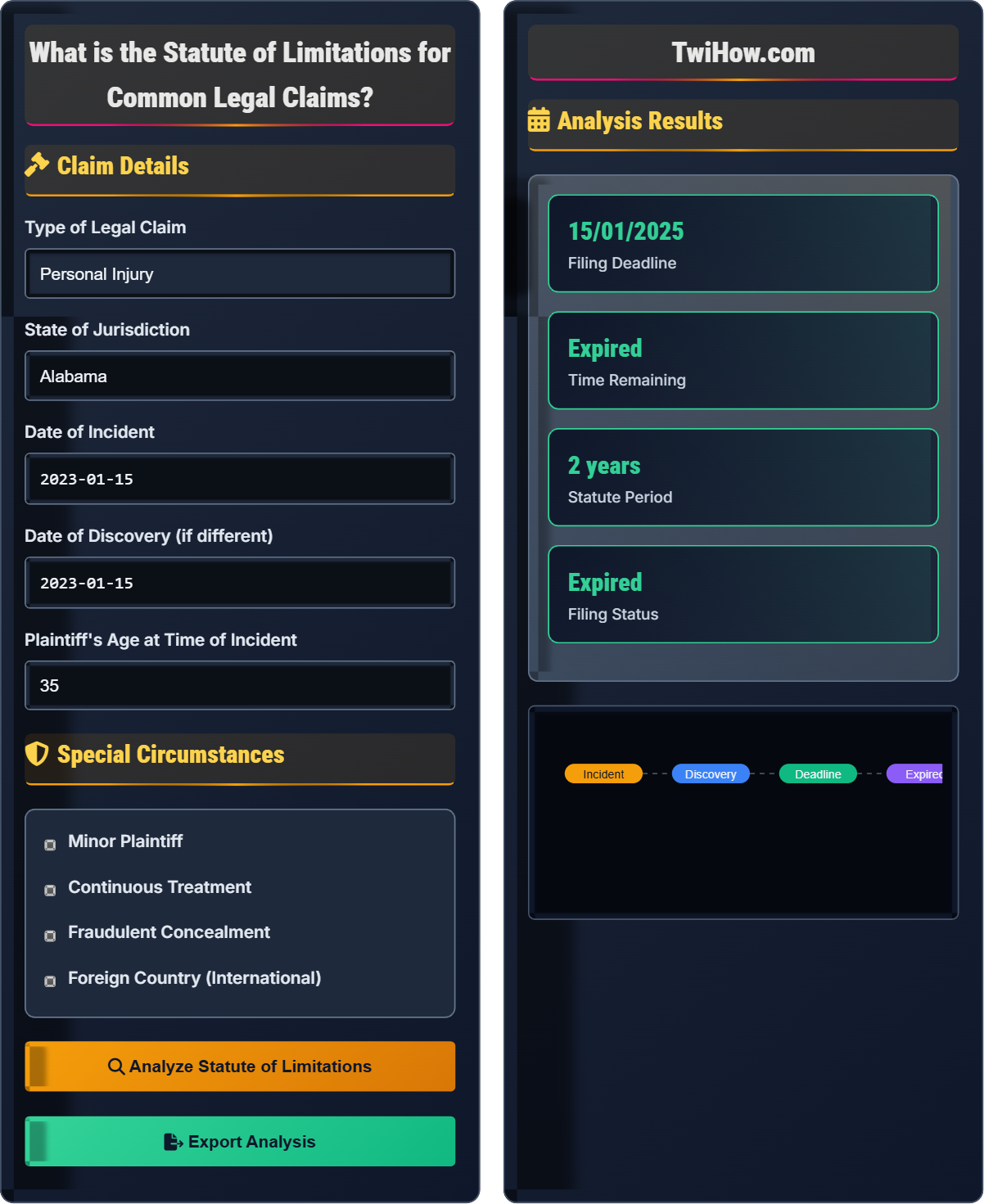
Claim Details
Special Circumstances
Analysis Results
| Claim Type | State | Limit Period | Start Date | End Date |
|---|---|---|---|---|
| Personal Injury | California | 2 years | Jan 15, 2023 | Jan 15, 2025 |
| Contract Dispute | California | 4 years | Jan 15, 2023 | Jan 15, 2027 |
| Medical Malpractice | California | 3 years | Jan 15, 2023 | Jan 15, 2026 |
| Fraud | California | 3 years | Jan 15, 2023 | Jan 15, 2026 |
Special Circumstances
- Minor Tolling: Time may not start until age of majority
- Discovery Rule: Time starts when injury is discovered
- Fraudulent Concealment: Clock may be paused
- Continuous Treatment: Extended period for medical malpractice
Understanding Statutes of Limitations
A statute of limitations is a law that sets the maximum time period after an event within which legal proceedings may be initiated. These time limits vary by type of claim, severity of offense, and jurisdiction. The purpose is to ensure that legal claims are brought within a reasonable time frame when evidence is still fresh and memories are reliable.
The calculation of statutes of limitations follows a systematic approach:
Where:
- Triggering Event: Date of incident, discovery, or other triggering event
- Statute Period: Standard time limit for the specific claim type
- Tolling Effects: Circumstances that pause or extend the time period
Criminal statutes of limitations vary significantly by severity of crime:
- Capital Crimes: No statute of limitations in most states
- Major Felonies: 5-25 years or more
- Minor Felonies: 3-7 years
- Misdemeanors: 1-3 years
- Sexual Assault: Extended or no limitation in many states
- Child Abuse: Extended or no limitation with delayed discovery
- Minor Plaintiffs: Time may not start until reaching age of majority
- Discovery Rule: Time starts when injury is discovered
- Fraudulent Concealment: Clock may be paused while fraud is concealed
- Continuous Treatment: Extended period for ongoing medical care
- Out of State: Time may be tolled while defendant is absent
- Insanity: Time may be tolled during periods of incompetence
SOL Essentials
Statute of limitations, time bar, prescription period, filing deadline, tolling, discovery rule, minority exception.
Deadline = Incident Date + Limitation Period - Tolling Periods
Where Incident Date = Triggering event; Limitation Period = Standard time limit; Tolling Periods = Pauses or extensions.
- Time limits are strictly enforced
- Discovery rule may extend deadlines
- Minor plaintiffs get extended time
- Some crimes have no limitations
Common Time Limits
Personal injury (2-3 years), contracts (3-6 years), fraud (3-6 years), medical malpractice (1-3 years).
- California: 2 years personal injury
- New York: 3 years personal injury
- Texas: 2 years personal injury
- Florida: 4 years personal injury
- Illinois: 2 years personal injury
- Washington: 3 years personal injury
- State laws vary significantly
- Discovery rule applications differ
- Minority exceptions vary
- Medical malpractice is complex
Statute of Limitations Quiz
When does the statute of limitations typically begin for a medical malpractice claim under the discovery rule?
Under the discovery rule, the statute of limitations begins when the patient discovers or reasonably should have discovered the injury. This rule is important in medical malpractice cases because injuries may not be immediately apparent. The discovery rule ensures that patients have a reasonable opportunity to pursue their claims once they become aware of the harm.
The answer is B) When the patient discovers or should have discovered the injury.
The discovery rule is a legal doctrine that postpones the start of the statute of limitations until the plaintiff discovers or reasonably should have discovered the injury. This is particularly relevant in medical malpractice, fraud, and latent defect cases where the harm may not be immediately apparent. The rule balances the defendant's interest in certainty with the plaintiff's need to discover their injuries.
Statute of Limitations: Time limit for filing legal claims
Discovery Rule: Rule starting time when injury is discovered
Medical Malpractice: Professional negligence in medical treatment
• Discovery rule varies by state
• Reasonable discovery is key
• Some states have absolute limits
• Document when you discovered the injury
• Consult attorney promptly
• Understand your state's rules
• Missing discovery-based deadlines
• Not understanding state variations
• Delaying consultation with attorney
Explain how the statute of limitations is affected when a minor is the victim of a personal injury, and what happens when the minor reaches the age of majority.
Minor Tolling: In most states, the statute of limitations is "tolled" (paused) for minors until they reach the age of majority (typically 18). This means the time period does not begin to run while the person is a minor.
Age of Majority: When the minor turns 18, the statute of limitations begins to run from that point, giving them the full statutory period to file their claim.
Example: If the personal injury statute of limitations is 2 years in a state, and a child is injured at age 10, the 2-year period does not begin until the child turns 18. The child would then have until age 20 to file the lawsuit.
Important Exceptions:
• Some states have absolute limits that cannot be tolled
• Some states have different rules for sexual abuse
• Some states have specific extensions for childhood injuries
Practical Consideration: Minors typically need a guardian to file on their behalf, so the guardian must be aware of the time limits.
The minor tolling rule recognizes that children cannot independently pursue legal claims and protects their ability to seek justice when they reach adulthood. This rule ensures that children who suffer injuries do not lose their right to compensation simply because they were too young to understand or pursue their claims. The policy behind this rule is to provide equal access to justice regardless of age at the time of injury.
Tolling: Temporarily stopping the statute clock
Minor: Person under age of majority
Age of Majority: Legal age of adulthood (usually 18)
• Time is paused during minority
• Clock starts at age of majority
• Document the minor's age at time of injury
• Calculate exact deadline after turning 18
• Consult attorney well before deadline
• Assuming standard time limits apply to minors
• Not calculating correct deadline after turning 18
• Waiting until right before deadline
You were diagnosed with mesothelioma in March 2024, which you believe was caused by asbestos exposure during construction work in 1995. The standard statute of limitations for personal injury in your state is 2 years, but there's a discovery rule. You live in California, where the statute is 1 year from discovery for asbestos-related diseases. What is your filing deadline, and what factors should you consider?
Filing Deadline: April 1, 2025 (1 year from discovery in March 2024).
Key Factors to Consider:
1. Discovery Rule: California has a specific 1-year statute for asbestos-related diseases from date of discovery, not the standard 2-year personal injury period.
2. Medical Evidence: You'll need medical documentation linking your diagnosis to asbestos exposure.
3. Exposure Documentation: Records of where and when you were exposed to asbestos.
4. Responsible Parties: Identifying which companies or entities may be liable.
5. Asbestos Trust Funds: Many asbestos companies have established trust funds for claims, which may provide faster compensation.
6. Statute Tolling: Given the long latency period of asbestos diseases, the discovery rule is crucial for preserving claims.
Urgent Action Required: Given the short 1-year period and the serious nature of the disease, immediate legal consultation is essential to preserve your claim.
This scenario demonstrates the critical importance of the discovery rule for diseases with long latency periods. Without the discovery rule, many asbestos victims would be unable to pursue claims because the standard limitations periods would have expired decades before symptoms appeared. This shows how legal doctrines can adapt to accommodate the realities of certain types of injuries.
Mesothelioma: Cancer caused by asbestos exposure
Latency Period: Time between exposure and symptom onset
Asbestos Trust Funds: Compensation funds for victims
• Discovery rule applies to latent diseases
• Time is critical for health reasons
• Document exposure history immediately
• Seek legal counsel promptly
• Explore all compensation options
• Not understanding special asbestos statutes
• Delaying legal consultation
• Failing to document exposure history
You discovered in January 2024 that your business partner defrauded you of $50,000 in 2019. Your state has a 3-year statute of limitations for fraud claims from date of discovery. However, you learned about the fraud during a routine audit, and your state has a 10-year absolute limit regardless of discovery. What is your filing deadline, and how do you calculate it?
Calculation:
• Discovery Date: January 2024
• Standard SOL: 3 years from discovery = January 2027
• Absolute Limit: 10 years from incident = January 2029
Filing Deadline: January 2027 (sooner of the two deadlines).
Legal Analysis: The discovery rule extends the standard limitations period from the date of the incident (2019) to the date of discovery (2024), giving you an additional 3 years from discovery. However, the absolute limit ensures that no claim can be brought more than 10 years after the incident, regardless of when it was discovered. The earlier of these two dates governs your filing deadline.
Key Considerations:
• The discovery rule provides a longer period than if calculated from the incident date
• The absolute limit prevents unlimited extension of the deadline
• Documentation of when you discovered the fraud is crucial
• You have until January 2027 to file your claim
This problem illustrates the interaction between the discovery rule and absolute limits. The discovery rule extends the standard limitations period to account for the fact that fraud may not be immediately apparent. However, absolute limits provide a ceiling to prevent claims from arising decades later when evidence may be unavailable. Courts must apply whichever deadline comes first.
Discovery Rule: Rule extending time from date of discovery
Absolute Limit: Maximum time regardless of discovery
Fraud: Intentional misrepresentation for gain
• Discovery rule extends standard SOL
• Absolute limits provide ceiling
• Earlier deadline governs
• Calculate both possible deadlines
• Apply the earlier deadline
• Document discovery date precisely
• Only calculating discovery-based deadline
• Ignoring absolute limits
• Failing to document discovery date
Which type of crime typically has no statute of limitations in most states?
Murder and other capital crimes typically have no statute of limitations in most states. This reflects the seriousness of these crimes and society's interest in ensuring justice regardless of when it can be achieved. Most states have eliminated statutes of limitations for first-degree murder and other capital offenses.
The answer is B) Murder.
The absence of a statute of limitations for serious crimes like murder reflects fundamental legal principles: the gravity of the offense, the public interest in justice, and the fact that such crimes cause continuing harm to society. This contrasts with civil matters where there is an interest in finality and resolution. The policy recognizes that some crimes are so serious that the passage of time should not prevent prosecution.
Capital Crime: Crime punishable by death
Statute of Limitations: Time limit for prosecution
Public Interest: Society's stake in justice
• Capital crimes often have no SOL
• Some states have exceptions
• Serious felonies have longer periods
• Research state-specific criminal SOL
• Understand exceptions for serious crimes
• Know the difference from civil SOL
• Assuming all crimes have SOL
• Confusing civil and criminal SOL
• Not understanding state variations
FAQ
Q: What happens if I try to file a lawsuit after the statute of limitations has expired?
A: If you attempt to file a lawsuit after the statute of limitations has expired, the defendant can raise the expired statute as an affirmative defense. If the court agrees, it will likely dismiss your case, usually with prejudice (meaning you cannot refile). The court will not consider the merits of your case - the time bar alone is sufficient for dismissal.
The defense of statute of limitations is typically raised in the defendant's answer to the lawsuit. The court will review the dates and apply the relevant statute. If the time has expired, the case is dismissed regardless of the strength of your claim.
There are very limited exceptions, such as if the defendant waived the defense or if there are extraordinary circumstances like fraudulent concealment that toll the statute. However, these are rare and difficult to prove.
Q: Can the statute of limitations be extended or "tolled" in any circumstances?
A: Yes, there are several circumstances where the statute of limitations can be "tolled" (paused) or extended:
Minor Plaintiffs: The statute often doesn't begin to run until the person reaches the age of majority (18 in most states).
Discovery Rule: For injuries that aren't immediately apparent (like medical malpractice), the statute begins when the injury is discovered or should have been discovered.
Fraudulent Concealment: If the defendant actively concealed their wrongdoing, the statute may be tolled until the fraud is discovered.
Continuous Treatment: For ongoing medical care, the statute may not begin until treatment ends.
Defendant Absent: If the defendant leaves the state, the statute may be tolled during their absence.
Bankruptcy: Filing bankruptcy can toll certain statutes of limitations.
Each state has different rules, so it's crucial to consult with an attorney to determine if any tolling applies to your situation.