What Legal Protections Exist for Whistleblowers?
Complete legal protection guide • Rights & safeguards
Whistleblower Protections:
Protection AssessmentWhistleblower protection laws provide safeguards for individuals who report illegal, unethical, or dangerous activities within organizations. These protections cover various sectors including government, healthcare, finance, and corporate environments, offering remedies against retaliation such as termination, demotion, or harassment.
Key protections include:
- Anti-Retaliation Measures: Protection from adverse employment actions
- Confidential Reporting: Secure channels for anonymous disclosure
- Legal Remedies: Compensation and reinstatement options
- Financial Rewards: Monetary incentives for valuable information
These protections encourage transparency and accountability while safeguarding those who speak up about wrongdoing.
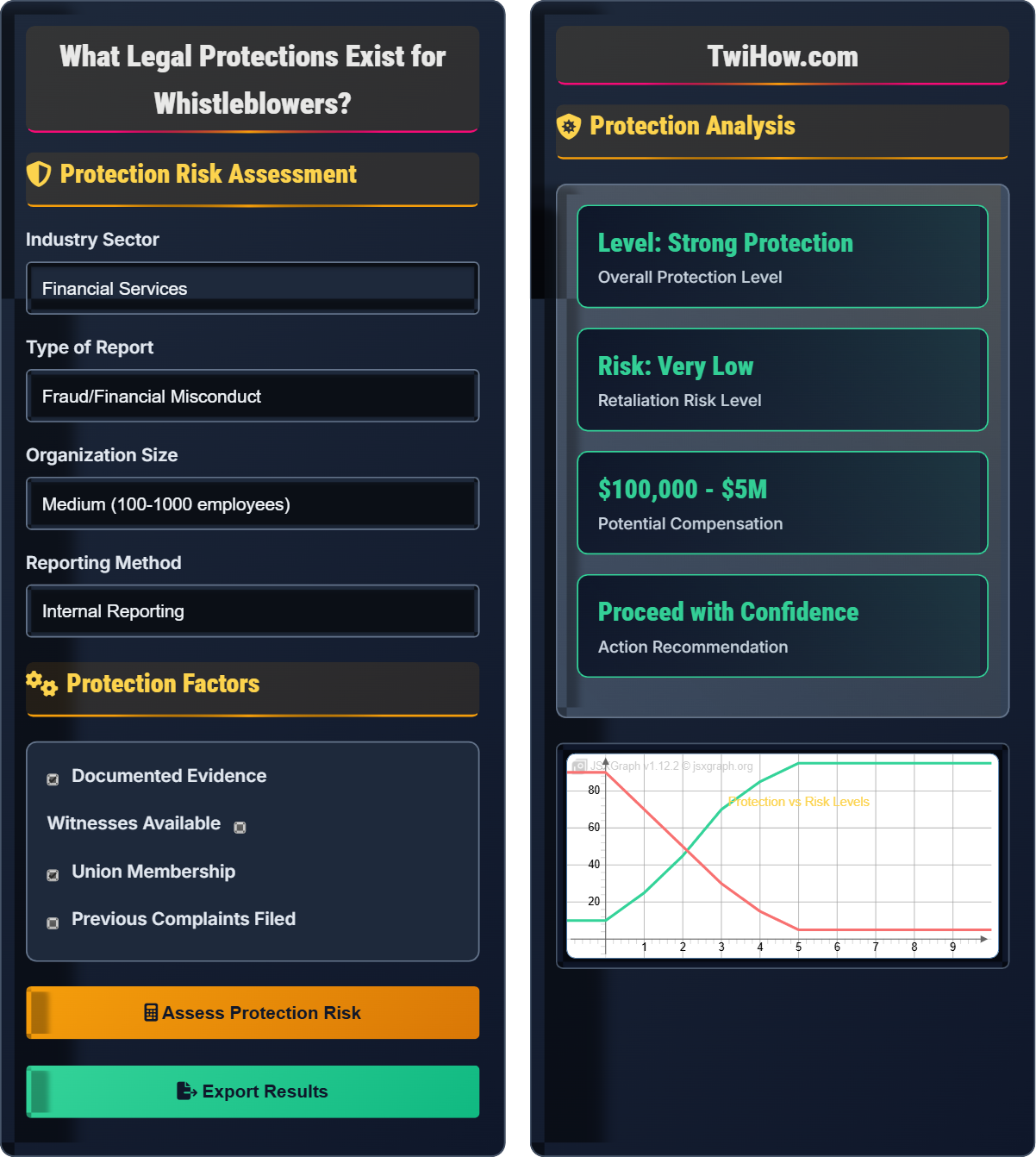
Protection Risk Assessment
Protection Factors
Protection Analysis
| Factor | Score | Impact | Recommendation |
|---|---|---|---|
| Industry Protection | High | +$50,000 | Strong |
| Report Type | High | +$100,000 | Strong |
| Documentation | Medium | +$30,000 | Moderate |
| Supporting Factors | High | +$70,000 | Strong |
Understanding Whistleblower Protections
Whistleblower protections are legal safeguards that shield individuals who report wrongdoing from retaliation by employers or other parties. These laws encourage the reporting of illegal, unethical, or dangerous activities by providing remedies for those who face adverse consequences for speaking up.
Key aspects of whistleblower protection include:
- Anti-Retaliation Provisions: Protection from termination, demotion, harassment, or other adverse employment actions
- Legal Remedies: Options for compensation, reinstatement, and other relief
- Confidentiality: Protection of identity when possible
- Financial Incentives: Awards for valuable information leading to enforcement actions
An individual who reports suspected misconduct, fraud, or violations of law by an employer, organization, or government agency.
Actions taken to report or oppose violations of law, including filing complaints, participating in investigations, or refusing to participate in illegal activities.
Adverse actions taken against an employee for engaging in protected activity, such as termination, demotion, harassment, or discrimination.
A provision allowing private individuals to sue on behalf of the government for fraud, with the possibility of receiving a percentage of recovered funds.
Protects individuals who report fraud against the government. Allows private citizens to file lawsuits on behalf of the government and potentially recover up to 30% of recovered funds.
Protects federal employees from retaliation for reporting government waste, fraud, abuse, or threats to public health and safety.
Protects employees of publicly traded companies who report corporate fraud, securities violations, or accounting irregularities.
Establishes the SEC Whistleblower Program, offering monetary awards to individuals who provide original information leading to successful enforcement actions.
Administers protections under more than 20 federal laws covering various industries including transportation, environmental protection, and workplace safety.
Protection from termination, demotion, harassment, blacklisting, and other adverse employment actions.
Back pay, front pay, compensatory damages, attorney fees, and in some cases, monetary rewards.
Right to return to original position with full seniority and benefits.
Due process rights, investigation procedures, and appeal mechanisms.
Effective whistleblower reporting involves several key steps:
- Documentation: Gather evidence and maintain detailed records
- Internal Reporting: Use company-established channels when appropriate
- External Reporting: Contact relevant government agencies or law enforcement
- Legal Counsel: Consult with experienced whistleblower attorneys
- Follow-up: Monitor investigation progress and maintain communication
Major Whistleblower Laws Comparison
| Law | Scope | Protection Period | Remedies | Award Potential |
|---|---|---|---|---|
| False Claims Act | Fraud against government | 3 years after violation | Double damages, attorney fees | 15-30% of recovery |
| Sarbanes-Oxley | Public company fraud | 180 days | Reinstatement, back pay | No specific award |
| Dodd-Frank | Securities violations | 6 years | Anti-retaliation | 10-30% of sanctions |
| Whistleblower Protection Act | Federal employees | 1 year | Reinstatement, damages | No specific award |
| OSHA Protections | Various industries | 30-180 days | Reinstatement, damages | No specific award |
Understanding the risks and protections associated with whistleblowing helps determine the safest approach for reporting misconduct:
Historical Timeline of Whistleblower Protection
Notable Whistleblower Cases
NSA contractor who disclosed classified information about global surveillance programs. While controversial, his case highlighted the tension between national security and public transparency, as well as the limitations of existing protections for intelligence community whistleblowers.
Nuclear facility worker who reported safety violations and plutonium contamination. Her mysterious death raised questions about whistleblower protection and led to increased awareness of the risks faced by those who speak out.
Enron vice president who warned company leadership about accounting irregularities. Her early internal reporting helped expose one of the largest corporate scandals in U.S. history and contributed to Sarbanes-Oxley legislation.
Whistleblower Protection Learning Quiz
Under the False Claims Act, what percentage of recovered funds can a successful whistleblower receive?
The False Claims Act provides for whistleblower rewards ranging from 15-25% if the government intervenes in the case, or 25-30% if the government does not intervene and the whistleblower substantially contributes to the case. The reward percentage depends on the government's involvement and the whistleblower's contribution.
The answer is B) 15-30%.
The False Claims Act's reward structure incentivizes individuals to come forward with information about fraud against the government. The higher percentage when the government doesn't intervene recognizes the greater risk and effort required by whistleblowers who pursue cases independently. This structure has resulted in billions of dollars recovered for taxpayers.
False Claims Act: Federal law allowing private citizens to sue on behalf of the government
Qui Tam: Latin term meaning "in the name of the king"
Relator: Term for the whistleblower in a False Claims Act case
• Rewards depend on government involvement
• Higher rewards for non-intervention cases
• Maximum of 30% for substantial contributions
• Document everything before reporting
• Consult experienced attorneys
• Understand statute of limitations
• Assuming all fraud qualifies under FCA
• Not understanding jurisdictional requirements
• Filing without sufficient evidence
Define "protected activity" under whistleblower protection laws and explain what types of conduct are covered. How does this differ from general workplace complaints?
Protected Activity: Actions taken to report or oppose violations of law, including:
• Filing complaints with regulatory agencies
• Participating in investigations or proceedings
• Refusing to participate in illegal activities
• Reporting violations internally or externally
Key Differences: Protected activities must involve violations of specific laws or regulations, not general workplace grievances. General complaints about working conditions, management style, or interpersonal conflicts are not typically protected under whistleblower laws unless they involve legal violations.
Examples of Protected: Reporting financial fraud, safety violations, environmental violations, discrimination.
Examples of Not Protected: Complaints about pay, schedule, or personal conflicts without legal violations.
Understanding the scope of protected activity is crucial because it determines whether anti-retaliation protections apply. Not all workplace complaints qualify for whistleblower protection. The activity must relate to specific legal violations, not general workplace dissatisfaction. This distinction helps focus protections on matters of public importance.
Protected Activity: Legally safeguarded reporting of violations
Retaliation: Adverse actions taken in response to protected activity
Prima Facie Case: Initial showing of protected activity and adverse action
• Must involve legal violations, not general complaints
• Timing between protected activity and adverse action matters
• Burden shifts to employer to prove legitimate reasons
• Document the legal basis for your report
• Keep records of all communications
• Seek legal counsel before reporting
• Confusing workplace grievances with legal violations
• Not understanding specific statutory requirements
• Failing to document the legal basis
Jennifer is a financial analyst at a publicly traded company. She discovers evidence of accounting fraud and reports it to the SEC. Three weeks later, she's fired for "performance issues." Calculate Jennifer's potential legal remedies under Sarbanes-Oxley and determine the timeline for filing a complaint.
Sarbanes-Oxley Protection: Jennifer is protected under SOX Section 806 for reporting securities violations.
Filing Deadline: 180 days from the date of the adverse employment action (termination).
Potential Remedies:
• Reinstatement to same or equivalent position
• Back pay with interest
• Compensatory damages
• Attorney fees and costs
Process: File complaint with OSHA within 180 days, investigation follows, potential hearing before ALJ if not resolved.
Timeline: OSHA has 210 days to issue findings; either party can request ALJ hearing within 30 days of unfavorable determination.
Sarbanes-Oxley provides robust protections for corporate whistleblowers but has strict timelines. The 180-day deadline is critical and cannot be extended. The law covers employees of publicly traded companies who report fraud, securities violations, or other violations of federal law related to fraud against shareholders.
Sarbanes-Oxley: Corporate accountability law after Enron scandal
OSHA: Occupational Safety and Health Administration
ALJ: Administrative Law Judge
• 180-day filing deadline is strict
• Must be employee of publicly traded company
• Covers various types of corporate violations
• Act quickly to meet deadlines
• Document all communications
• Preserve evidence of retaliation
• Missing the 180-day deadline
• Not understanding coverage requirements
• Failing to document retaliation
David, a compliance officer, uncovers evidence of securities fraud at his investment firm. He wants to report to the SEC under the Dodd-Frank Act. Describe the reporting process, potential rewards, and protection mechanisms available to him.
Reporting Process:
1. Submit Form TCR (Tip, Complaint, or Referral) online or by mail to SEC
2. Provide detailed information about the violation
3. Include supporting documentation
4. Optionally request anonymity through attorney
Potential Rewards: 10-30% of monetary sanctions exceeding $1 million, provided information leads to successful enforcement action.
Protection Mechanisms: Anti-retaliation provisions protecting from termination, demotion, harassment, or discrimination. Private right of action with burden-shifting provisions.
Timeline: No specific filing deadline, but prompt reporting is encouraged. 6-year statute of limitations for retaliation claims.
The SEC Whistleblower Program under Dodd-Frank revolutionized corporate accountability by offering substantial financial incentives. The program has recovered billions for investors and taxpayers. The anonymity provision is particularly important for employees who fear retaliation. The burden-shifting mechanism makes it easier for whistleblowers to prove retaliation cases.
TCR: Tip, Complaint, or Referral form
Monetary Sanctions: Fines, penalties, disgorgement ordered by courts
Original Information: Information derived from independent knowledge
• Information must be original and credible
• Sanctions must exceed $1 million for award eligibility
• No requirement to exhaust internal remedies first
• Work with experienced SEC whistleblower attorney
• Maintain detailed documentation
• Consider anonymity option if appropriate
• Reporting without legal counsel
• Not meeting original information standard
• Failing to provide sufficient detail
Which of the following is NOT a valid defense an employer can raise in a whistleblower retaliation case?
An employee's intention to quit does not constitute a valid defense to whistleblower retaliation. The law protects employees regardless of their future employment plans. Other defenses may be valid: employers can show they discovered violations independently, that the reported activity wasn't protected, or that the employee engaged in similar misconduct. However, an employee's planned departure is not a legitimate basis for adverse action related to whistleblowing.
The answer is B) The employee was planning to quit anyway.
Employers have limited defenses in whistleblower retaliation cases. The law is designed to protect employees who engage in protected activity regardless of their future employment intentions. Employers cannot use an employee's planned departure as a pretext for retaliation. The protection exists to encourage reporting of violations, not to create exceptions based on employment stability.
Pretext: False reason given to hide true motive
Legitimate Business Reason: Non-retaliatory justification
Pretextual Defense: Seemingly valid reason that masks retaliation
• Intent to quit doesn't negate protection
• Employer must prove legitimate reasons
• Timing alone may suggest retaliation
• Document all interactions after reporting
• Keep records of any negative changes
• Seek legal counsel immediately
• Assuming planned departure negates protection
• Not documenting adverse actions
• Delaying legal consultation
Frequently Asked Questions
Expert Q&A
Q: I've discovered serious financial irregularities at my company, but I'm afraid to report them due to potential retaliation. What protections are available to me?
A: You have significant legal protections, especially if you work for a publicly traded company:
Sarbanes-Oxley Act: Protects employees who report corporate fraud, securities violations, or accounting irregularities. If you're terminated, demoted, or harassed for reporting, you can file a complaint with OSHA within 180 days.
Available Remedies: Reinstatement, back pay, compensatory damages, and attorney fees if you prevail.
Best Practices:
1. Document everything related to the irregularities
2. Consult with a whistleblower attorney before reporting
3. Consider reporting internally first, then to regulators if necessary
4. Keep records of all employment-related communications
Remember, federal law prohibits retaliation for protected whistleblowing activities, and the law is on your side.
Q: I witnessed safety violations that could endanger patients at my hospital. What's the best way to report this and what protections do I have?
A: Healthcare workers have multiple protection avenues for patient safety concerns:
OSHA Protections: You're covered under the Occupational Safety and Health Act, which protects employees who report workplace safety violations. You have 30 days to file a complaint after retaliation.
State Laws: Many states have specific healthcare whistleblower protections that may offer additional safeguards.
Reporting Options:
1. Internal reporting through hospital compliance channels
2. State licensing boards
3. CMS (Centers for Medicare & Medicaid Services)
4. OSHA for workplace safety issues
Documentation Strategy: Keep detailed records of the violations, your reports, and any responses. Consider reporting to multiple agencies if the violations are severe enough to threaten patient safety. Patient safety is paramount, and the law recognizes the critical importance of protecting those who report such issues.