What Legal Steps Should I Take After a Car Accident That Wasn't My Fault?
Complete guide • Legal protections • Essential steps
Car Accident Legal Steps:
Legal Action PlannerAfter a car accident that wasn't your fault, taking immediate legal steps protects your rights and ensures proper compensation. This guide covers essential documentation, insurance procedures, legal rights, and crucial steps for preserving your case and maximizing recovery.
Key steps include:
- Documentation: Photos, witness information, police report
- Medical Care: Seek treatment for injuries
- Insurance Notification: Contact your insurer promptly
- Legal Consultation: Consider attorney representation
Proper documentation and timely action significantly impact your ability to recover damages.
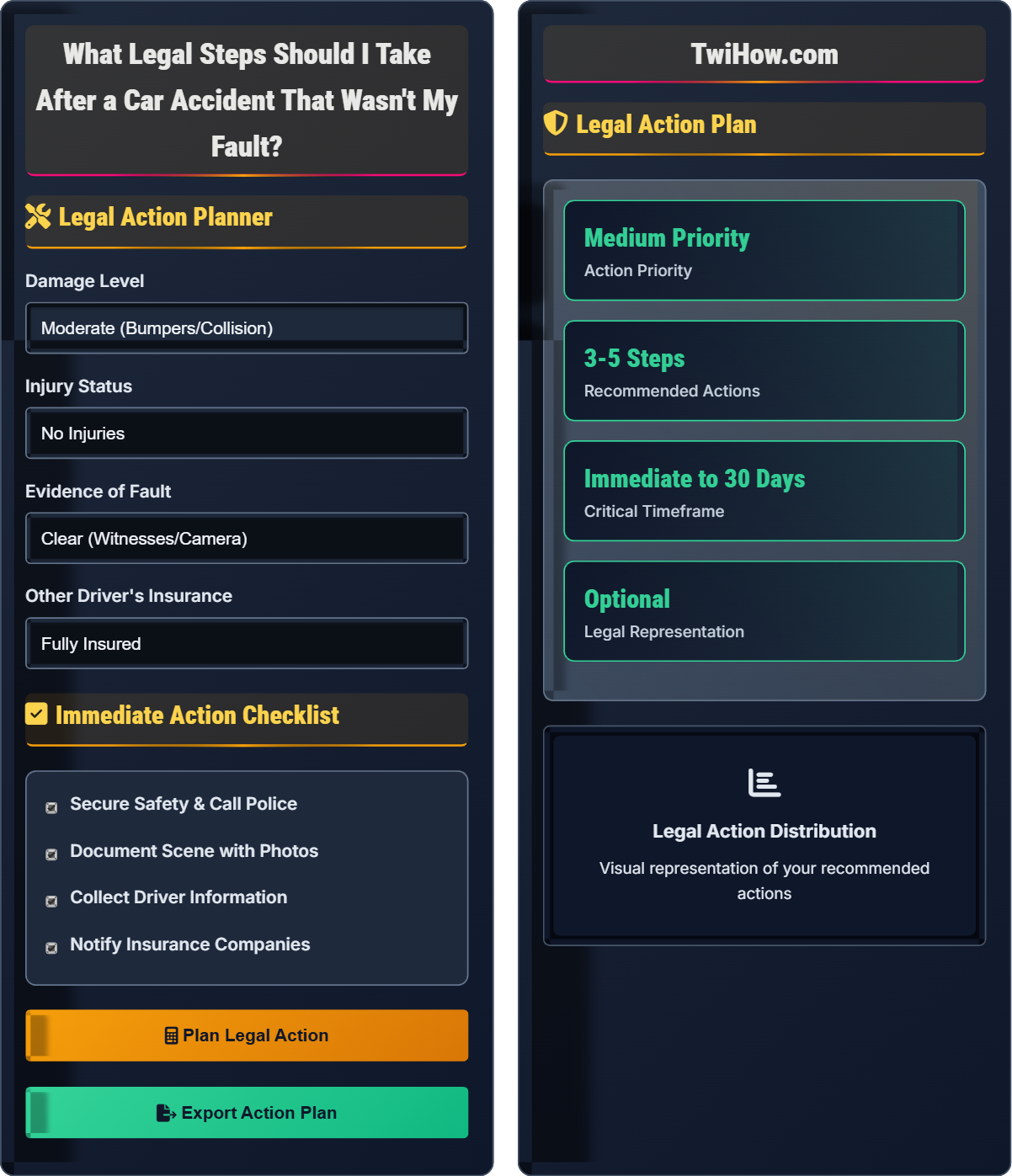
Legal Action Planner
Immediate Action Checklist
Legal Action Plan
Legal Action Distribution
Visual representation of your recommended actions
| Step | Priority | Details |
|---|---|---|
| Secure Scene & Call Police | Immediate | Ensure safety, call 911 |
| Document with Photos | Immediate | Take comprehensive photos |
| Collect Information | Immediate | Driver, insurance, witness info |
| Seek Medical Care | Within 24-48 hours | Even if no symptoms |
| Contact Attorney | Within 7 days | For serious cases |
Recommended Timeline
- 0-1 hour: Secure scene, call police, document
- 24 hours: Notify insurance, seek medical care
- 7 days: Consult attorney if needed
- 30 days: Complete insurance claims
Legal Steps After a Non-Fault Accident
Comprehensive documentation is crucial for proving your case:
- Photographs: Vehicle damage, scene, license plates
- Police Report: Officer's findings and statements
- Witness Info: Names, contact details, statements
- Medical Records: All treatment related to accident
Document everything immediately after the accident.
Understanding the claims process helps maximize your recovery:
Key considerations:
- Report to your insurance promptly
- Deal with other party's insurance cautiously
- Do not admit fault or minimize injuries
- Keep detailed records of all expenses
As a non-fault driver, you have specific rights:
- Full Compensation: For all damages caused by the other party
- Medical Care: Through personal injury protection or other party's insurance
- Property Damage: Replacement or repair costs
- Lost Wages: Income lost due to accident
- Admitting Fault: Even partial fault reduces recovery
- Minimizing Injuries: Delayed symptoms can be missed
- Accepting Quick Settlements: May undervalue your case
- Not Documenting: Lack of evidence hurts your case
Insurance Claims Process
Collision, comprehensive, PIP, uninsured motorist, and liability coverage.
Notification, investigation, evaluation, settlement, and payment.
Both your insurance and the at-fault party's insurance will be involved.
- Report accidents within policy time limits
- Cooperate with your insurance company
- Do not admit fault to insurance adjusters
Medical Care and Documentation
Even seemingly minor accidents can cause delayed injuries that worsen over time.
- Seek immediate medical attention
- Be honest about all symptoms
- Follow prescribed treatment
- Keep all medical records
- Pre-existing injury documentation
- Consistent treatment patterns
- Linking injuries to the accident
- Timeliness of seeking care
Car Accident Legal Knowledge Quiz
What is the most important immediate action to take after a car accident that wasn't your fault?
The most important immediate action is securing safety and calling police. Ensuring everyone's safety takes priority over all other actions. Once safety is confirmed, calling police creates an official record of the incident, which is crucial for insurance claims and legal proceedings.
The answer is B) Secure safety and call police.
Personal safety always comes first in any emergency situation. Before taking any other actions, you must ensure that you and others are safe from further harm. This includes moving to a safe location if possible and calling emergency services.
Personal Injury Protection (PIP): Insurance covering medical expenses regardless of fault
Police Report: Official documentation of the accident
Emergency Services: Police, fire, and medical responders
• Safety comes before all other actions
• Police reports provide official documentation
• Emergency services can provide assistance
• Turn on hazard lights immediately
• Move to safe location if possible
• Call 911 for any injuries or major damage
• Trying to move vehicles before safety is assessed
• Not calling police for minor accidents
• Failing to document scene before moving vehicles
Explain the difference between filing a claim with your insurance company versus the at-fault driver's insurance. What are the advantages and disadvantages of each approach?
Your Insurance Company: Advantages include faster processing, guaranteed coverage under your policy, and familiarity with your provider. Disadvantages include potential premium increases and needing to pay your deductible.
At-Fault Driver's Insurance: Advantages include no deductible payment and no premium increase. Disadvantages include potential resistance to paying full value, longer processing times, and potential disputes over fault.
Uninsured Motorist Coverage: If the other driver has no insurance, your uninsured motorist coverage becomes crucial.
Recommended Approach: Report to both insurers and let your attorney coordinate if needed. Your insurance company may pursue reimbursement from the at-fault party.
Insurance companies have different incentives and obligations. Your insurer has a contractual duty to you, while the at-fault driver's insurer aims to minimize payouts. Understanding both approaches helps you make informed decisions about your claim.
First-Party Claim: Filed with your own insurance
Third-Party Claim: Filed with the other party's insurance
Subrogation: Your insurer recovering from other party
• Report accidents to your insurer promptly
• Do not admit fault to any insurer
• Document all interactions
• Keep receipts for all expenses
• Don't rush to settle
• Accepting first settlement offer
• Not documenting all damages
• Admitting fault during claims process
You're involved in an accident where the other driver has no insurance. They apologize and offer to pay for repairs directly. The damage to your car is estimated at $8,000. The other driver is unemployed and lives in a modest apartment. Analyze this situation and explain what legal steps you should take instead of accepting their direct payment offer.
Legal Analysis: Accepting direct payment from an uninsured driver with limited financial resources is risky. They may promise payment but fail to follow through, leaving you responsible for the repairs.
Recommended Steps: File a claim under your uninsured motorist coverage if available. This ensures payment through your own insurance policy and protects your rights. Your insurer may later seek reimbursement from the other driver.
Alternative Options: If you don't have uninsured motorist coverage, you may need to pursue legal action against the other driver, but their financial inability to pay makes recovery unlikely.
Documentation: Still collect all information about the other driver and maintain evidence of the accident.
Uninsured accidents require careful consideration of available coverage options. Direct payment agreements with financially unstable drivers often fail, leaving victims uncompensated. Uninsured motorist coverage exists specifically for this situation.
Uninsured Motorist Coverage: Insurance covering accidents with uninsured drivers
Underinsured Motorist Coverage: Coverage when other driver's limits are insufficient
Personal Injury Protection: No-fault medical coverage
• Uninsured motorist coverage is crucial protection
• Financial status of other driver affects recovery
• Check your uninsured motorist limits
• Don't trust verbal payment promises
• Document the other driver's financial status
• Accepting payment promises from uninsured drivers
• Not having uninsured motorist coverage
• Failing to document other driver's financial status
Three days after a minor fender-bender where you weren't at fault, you begin experiencing neck pain and headaches. You initially told the police and insurance that you had no injuries. Now your doctor says you have whiplash. Explain the legal implications of this situation and what steps you should take to protect your rights.
Legal Implications: Delayed injury symptoms are common after accidents. Insurance companies sometimes dispute claims that weren't immediately reported, but delayed onset of symptoms is medically recognized.
Immediate Steps: Notify your insurance company immediately about the new symptoms. Provide medical documentation linking the injuries to the accident. Continue treatment as prescribed.
Documentation: Obtain a medical opinion connecting your current symptoms to the accident. Document the timeline of symptom development. Keep all medical records and treatment notes.
Legal Considerations: You may still be entitled to compensation, but the delay in reporting could complicate your claim. An attorney may be necessary to navigate this situation.
Whiplash and other soft tissue injuries often don't manifest immediately after an accident. Insurance companies sometimes use delayed reporting as a reason to deny claims, but medical science recognizes that symptoms can develop days or weeks after trauma.
Whiplash: Neck injury from sudden head movement
Soft Tissue Injury: Damage to muscles, ligaments, tendons
Delayed Onset: Symptoms appearing after initial accident
• Seek medical attention for any symptoms
• Report new symptoms to insurance promptly
• Link symptoms to accident through medical documentation
• See a doctor even for minor accidents
• Report all symptoms immediately
• Keep detailed records of symptoms
• Assuming no injuries at accident scene
• Not seeking immediate medical evaluation
• Failing to report delayed symptoms
What is the typical statute of limitations for filing a personal injury lawsuit after a car accident?
The statute of limitations for personal injury lawsuits typically ranges from 2-3 years from the accident date, though it varies by state. Some states have shorter periods (1 year) while others allow longer (up to 6 years). It's crucial to check your state's specific laws, as missing the deadline permanently bars your claim.
The answer is C) 2-3 years from the accident date.
Statutes of limitations exist to ensure claims are filed while evidence is fresh and witnesses are available. Missing the deadline is an absolute bar to recovery, regardless of the merits of your case. This is why prompt action after an accident is crucial.
Statute of Limitations: Time limit to file lawsuit
Personal Injury: Physical or emotional harm
Legal Deadline: Mandatory filing time
• Statute of limitations varies by state
• Missing deadline bars recovery forever
• Some exceptions may apply
• Check your state's specific laws
• Consult attorney if approaching deadline
• Don't wait until the last minute
• Assuming unlimited time to file lawsuit
• Not knowing state-specific deadlines
• Waiting too long to consult attorney
FAQ
Q: Should I give a recorded statement to the other driver's insurance company?
A: Generally, you should not give a recorded statement to the other driver's insurance company without consulting an attorney first. Insurance adjusters work for the other party and may try to minimize their company's liability.
Key considerations:
• You have no obligation to give a recorded statement
• Anything you say can be used against you
• You may inadvertently contradict yourself
• Your statements could affect your own insurance claim
You should cooperate with your own insurance company, but be cautious with the other party's insurer. It's best to refer them to your attorney.
Q: How much does it cost to hire a personal injury attorney after a car accident?
A: Most personal injury attorneys work on a contingency fee basis, meaning they only get paid if you win your case. Typical contingency fees range from 33% to 40% of your recovery.
Advantages of contingency fees:
• No upfront costs
• Attorney's interests aligned with yours
• Risk is shifted to the attorney
• More aggressive representation
You should never pay a retainer fee for a car accident case. If an attorney asks for upfront payment, consider consulting another firm. The attorney gets paid only when you receive compensation.