Police Traffic Stop Protocol: Complete Rights & Procedures Guide
Step-by-step explanations • Legal rights protection
Traffic Stop Protocol:
Show Stop Rights AnalyzerWhen stopped by police, understanding your constitutional rights and proper procedures is crucial for protecting yourself while maintaining safety. Traffic stops require balancing constitutional protections with officer safety and legal compliance.
Key constitutional protections during traffic stops include the Fourth Amendment (protection against unreasonable searches), Fifth Amendment (due process), and Fourteenth Amendment (equal protection). Officers must have reasonable suspicion or probable cause for stops.
Essential principles include:
- Right to Remain Silent: You can decline to answer questions
- Right to Legal Counsel: Available for certain situations
- Right to Refuse Searches: Unless exigent circumstances exist
- Right to Document: Recording is generally permitted
- Right to Safety: Officers must ensure safe procedures
Successful navigation requires calm demeanor, knowledge of rights, and understanding of when to assert them.
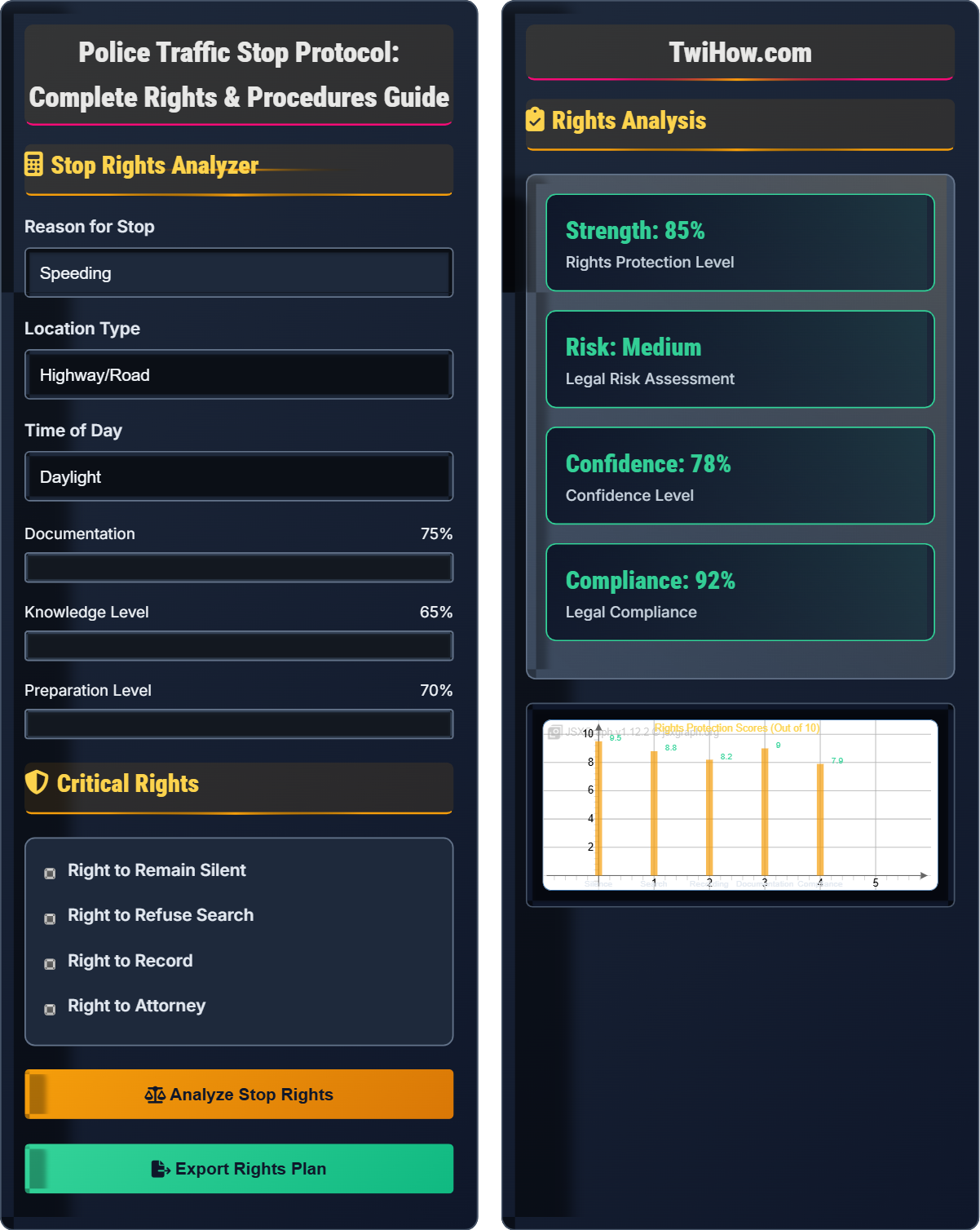
Stop Rights Analyzer
Critical Rights
Rights Analysis
Signal compliance, pull over safely, turn off engine, and keep hands visible while waiting for officer approach
Provide license, registration, and insurance when requested, but do not consent to searches
Be polite but reserved, answer basic questions, decline to answer detailed questions without attorney
Disclaimer: This guide provides general information about traffic stop rights but does not constitute legal advice. Laws vary significantly by state and situation. Your specific circumstances may require different approaches.
While you have constitutional rights during traffic stops, you must also comply with lawful orders. Resisting arrest or disobeying direct commands can result in additional charges. Always prioritize safety and de-escalation over asserting rights.
| Procedure | Right | Limitation | State Variation | Officer Authority | Penalty |
|---|---|---|---|---|---|
| Remain Silent | Yes | Basic identification | Universal | Limited | None |
| Refuse Search | Yes | Consent required | Universal | Warrant needed | None |
| Record Stop | Yes | Public view only | Most states | Limited | None |
Traffic Stop Legal Framework
During traffic stops, the Fourth Amendment protects against unreasonable searches and seizures. Officers must have reasonable suspicion for stops and probable cause for arrests. The Fifth Amendment provides protection against self-incrimination, allowing you to remain silent.
Legal standards: Reasonable suspicion (specific, articulable facts) for stops; probable cause (more likely than not) for searches; warrant required for searches absent exigent circumstances.
Drivers must provide license, registration, and proof of insurance when requested. These are legal requirements in all states. Other documents may be requested but you can decline to provide them unless ordered by a court.
Required items: Valid driver's license, vehicle registration, proof of insurance. Optional: Personal identification beyond license, financial records, employment documents.
You have the right to refuse consent to search your vehicle, person, or belongings. Officers need a warrant, probable cause, or exigent circumstances to search without consent. Consent can be withdrawn at any time.
Search exceptions: Officer safety, plain view evidence, inventory searches, border checkpoints, and exigent circumstances (immediate danger, fleeing suspect).
You have the right to remain silent about anything beyond basic identification. You can politely decline to answer questions about your destination, purpose of travel, or other details. You have the right to request an attorney.
What you must say: Name, license, registration, insurance. What you can decline: Detailed explanations, consent to searches, voluntary statements.
In most states, you have the right to record traffic stops in public view. This includes video and audio recording. Some states have specific recording laws that may limit this right. Always record safely and unobtrusively.
Legal considerations: Public spaces, no expectation of privacy, officer cannot confiscate recordings, but must not interfere with officer safety.
Officers must ensure safe stop conditions, including proper positioning of vehicles, adequate lighting, and safe roadside location. You have the right to request moving to a safer location if the initial stop location is hazardous.
Safety measures: Proper vehicle positioning, hazard lights, adequate visibility, safe distance from traffic, and consideration of weather conditions.
Traffic Stop Protocol Sequence
Right to Remain Silent
The constitutional right to avoid self-incrimination during police encounters, allowing you to decline answering questions beyond basic identification.
Right to Refuse Search
The right to decline consent to search your vehicle, person, or belongings without a warrant or probable cause.
Required Documentation
The legal requirement to provide license, registration, and insurance when requested during traffic stops.
Recording Rights
The right to record police encounters in public view, subject to state-specific limitations and safety considerations.
Stop Scenarios & Responses
Traffic Stop Rights Distribution
| Right | Scope | Limitations | State Laws | Enforcement | Protection Level |
|---|---|---|---|---|---|
| Right to Silence | Questions | Basic info only | Universal | Strong | High |
| Search Refusal | Consent | Warrant required | Universal | Strong | High |
| Recording | Public | Private spaces | Most states | Moderate | Medium |
| Attorney | Arrest | Non-arrest | Universal | Strong | High |
| Move Location | Safety | Officer discretion | Universal | Moderate | Medium |
Required Forms & Documentation
Documents you must provide during traffic stops and how to organize them.
Driver's License Vehicle Registration Insurance ProofForms for documenting stops, filing complaints, and protecting your rights.
Stop Report Complaint Form Witness StatementResources for understanding and protecting your rights during stops.
Rights Card Legal Hotlines Civil RightsTraffic Stop Rights Statement Template
OFFICER, I RESPECTFULLY EXERCISE MY RIGHTS:
1. DOCUMENTATION: Here are my license, registration, and insurance as required by law.
2. SILENCE: I respectfully decline to answer questions beyond basic identification.
3. SEARCH: I do not consent to any searches of my person, vehicle, or belongings.
4. RECORDING: I am recording this encounter for documentation purposes.
5. ATTORNEY: I would like to speak with an attorney before answering detailed questions.
6. COMPLIANCE: I will comply with lawful orders while asserting my constitutional rights.
This statement is made respectfully and without resistance to lawful authority.
Traffic Stop Rights Quiz
During a traffic stop, what constitutional amendment protects you from unreasonable searches?
The Fourth Amendment protects against unreasonable searches and seizures. It requires officers to have reasonable suspicion for stops and probable cause for searches. This amendment is the primary protection during traffic stops regarding search and seizure.
The answer is B) Fourth Amendment.
The Fourth Amendment is fundamental to traffic stop procedures. It establishes the legal framework that governs when and how officers can search vehicles and detain individuals. Understanding this amendment helps drivers know when searches are lawful and when they can refuse consent.
Fourth Amendment: Protection against unreasonable searches
Reasonable Suspicion: Specific facts justifying stop
Probable Cause: Evidence supporting search
• Officers need justification
• You can refuse consent
• Warrants may be required
• Know the difference between suspicion and cause
• Politely decline searches
• Ask for justification
• Assuming all searches are legal
• Not knowing constitutional protections
• Giving consent without understanding
Can you refuse consent to search your vehicle during a traffic stop, and what are the implications?
Right to Refuse:
Constitutional Basis: The Fourth Amendment protects against unreasonable searches. You have the absolute right to refuse consent to search your vehicle, person, or belongings.
Proper Refusal: Politely state: "I do not consent to a search." This refusal cannot be used against you in court.
Officer Authority: Officers can still search without consent if they have a warrant, probable cause, or exigent circumstances.
Implications:
Positive: Protects privacy and prevents potential evidence discovery; assertion of constitutional rights.
Negative: May prolong stop; officer may investigate further if they have reasonable suspicion.
Legal: Cannot be penalized for refusing consent; refusal alone does not create probable cause.
Consent to search is one of the most commonly misunderstood rights during traffic stops. Officers often request consent because it eliminates the need for probable cause. However, you always have the right to refuse. The key is refusing politely and clearly while understanding that refusal alone doesn't justify a search.
Consent Search: Search based on permission
Probable Cause: Evidence supporting search
Exigent Circumstances: Emergency justifying search
• You can always refuse consent
• Refusal cannot be punished
• Other legal bases still apply
• Be polite but firm
• State refusal clearly
• Don't argue about it
• Not knowing the right to refuse
• Arguing about the refusal
• Assuming refusal justifies search
You want to record your traffic stop with your phone. The officer tells you to put your phone away and says recording is not allowed. What should you do?
Legal Analysis:
Recording Rights: In most states, you have the right to record police encounters in public view. This is protected by the First Amendment and state laws.
Proper Response: Politely inform the officer: "Officer, I am recording this encounter as I have the legal right to do so. I will keep my phone visible and unobtrusive."
Legal Boundaries: Recording is generally allowed in public spaces where there's no expectation of privacy. Officers cannot confiscate your phone or delete recordings.
Safety Considerations: Keep recording unobtrusive and don't interfere with officer safety. If the officer insists and you're in a state with recording restrictions, you may need to comply while noting the restriction.
Documentation: Note the officer's badge number and patrol car number. This information is valuable if you need to file a complaint about interference with your rights.
Recording rights during police encounters have been increasingly recognized by courts as protected under the First Amendment. However, the right varies by state and situation. The key is balancing your right to document with officer safety and legal compliance. Always record safely and respectfully.
First Amendment: Freedom of speech and press
Public View: Areas with no privacy expectation
Officer Safety: Legitimate concern in recording
• Recording is generally allowed
• Must not interfere with safety
• Officers cannot delete recordings
• Announce recording politely
• Keep phone visible but unobtrusive
• Note officer information
• Not knowing recording rights
• Recording inappropriately
• Arguing with officers
You're stopped for suspected DWI. The officer asks you to perform field sobriety tests and submit to a breathalyzer. What are your rights and what should you do?
Field Sobriety Tests:
• Right to Refuse: You can refuse field sobriety tests in most states without penalty
• Legal Consequences: Refusal may be used as evidence in some states
• Recommendation: Politely decline, stating you prefer to speak with an attorney
Breathalyzer Tests:
• Implied Consent: Most states have implied consent laws requiring chemical tests
• Penalties: Refusal may result in license suspension
• Recommendation: Comply with test while noting your reservations and requesting attorney
General Rights:
• Right to remain silent about drinking
• Right to request attorney after arrest
• Right to independent test after conviction
DWI stops have special legal considerations due to implied consent laws. While you have rights in regular traffic stops, DWI stops involve additional statutory requirements. The key is understanding state-specific laws and making informed decisions about which tests to take.
Implied Consent: Legal assumption of consent to testing
Field Sobriety Tests: Physical tests for intoxication
Chemical Tests: Breath, blood, or urine tests
• DWI stops have special rules
• Implied consent varies by state
• Attorney rights apply after arrest
• Research your state's DWI laws
• Know test refusal consequences
• Request attorney when appropriate
• Not knowing implied consent laws
• Making incriminating statements
• Not understanding test consequences
What documents are you legally required to provide during a routine traffic stop?
In all states, you are required to provide your driver's license, vehicle registration, and proof of insurance when requested during a traffic stop. These are the only documents that can be legally required during routine traffic stops.
The answer is C) License, registration, and insurance.
These three documents are universally required during traffic stops across all states. This requirement is statutory and not subject to constitutional challenges. However, officers cannot demand other documents without reasonable suspicion or a warrant.
Statutory Requirement: Required by law
Universal: Applies in all states
Constitutional Protection: Other documents protected
• Three documents required by law
• Others are optional
• Reasonable suspicion needed for more
• Keep documents organized
• Know what's required
• Decline other requests
• Not knowing required documents
• Providing unnecessary documents
• Arguing about requirements
FAQ
Q: Can I ask the officer to move to a safer location if I feel unsafe where they pulled me over?
A: Yes, you can request moving to a safer location, especially if you're in dangerous traffic conditions, poor lighting, or a high-crime area. Officers generally have discretion to accommodate reasonable safety requests, though they're not legally required to do so.
Make your request respectfully: "Officer, I feel unsafe in this location due to [specific reason]. Could we move to [safer location]?" If the officer agrees, follow their directions for the move. If they decline, comply with their instructions while documenting the situation.
Q: Do passengers have the same rights as the driver during a traffic stop?
A: Passengers have most of the same constitutional rights as the driver, including protection from unreasonable searches and the right to remain silent. However, passengers generally have less expectation of privacy in the vehicle than the owner.
Passengers can be detained during the stop if officers have reasonable suspicion of criminal activity. They can refuse consent to searches of their personal belongings. Passengers also have the right to record the stop and request an attorney if arrested.