How to Build a Supportive Community Around You
Complete guide • Step-by-step explanations
Building Supportive Communities:
Show Community SimulatorBuilding a supportive community involves creating meaningful connections with people who can provide emotional, practical, and social support throughout your life. A strong community offers diverse relationships that fulfill different needs, from close friendships to professional networks, neighborhood connections, and interest-based groups. The key is intentional relationship building and mutual support.
Key aspects of building a supportive community include:
- Neighborhood Connections: Building relationships with people nearby
- Professional Networks: Developing career-related relationships
- Interest Groups: Joining communities based on shared hobbies or values
- Support Circles: Creating groups for mutual assistance and encouragement
Strong communities contribute significantly to mental health, personal growth, and overall life satisfaction by providing belonging, support, and opportunities for meaningful engagement.
Community Building Parameters
Building Strategies
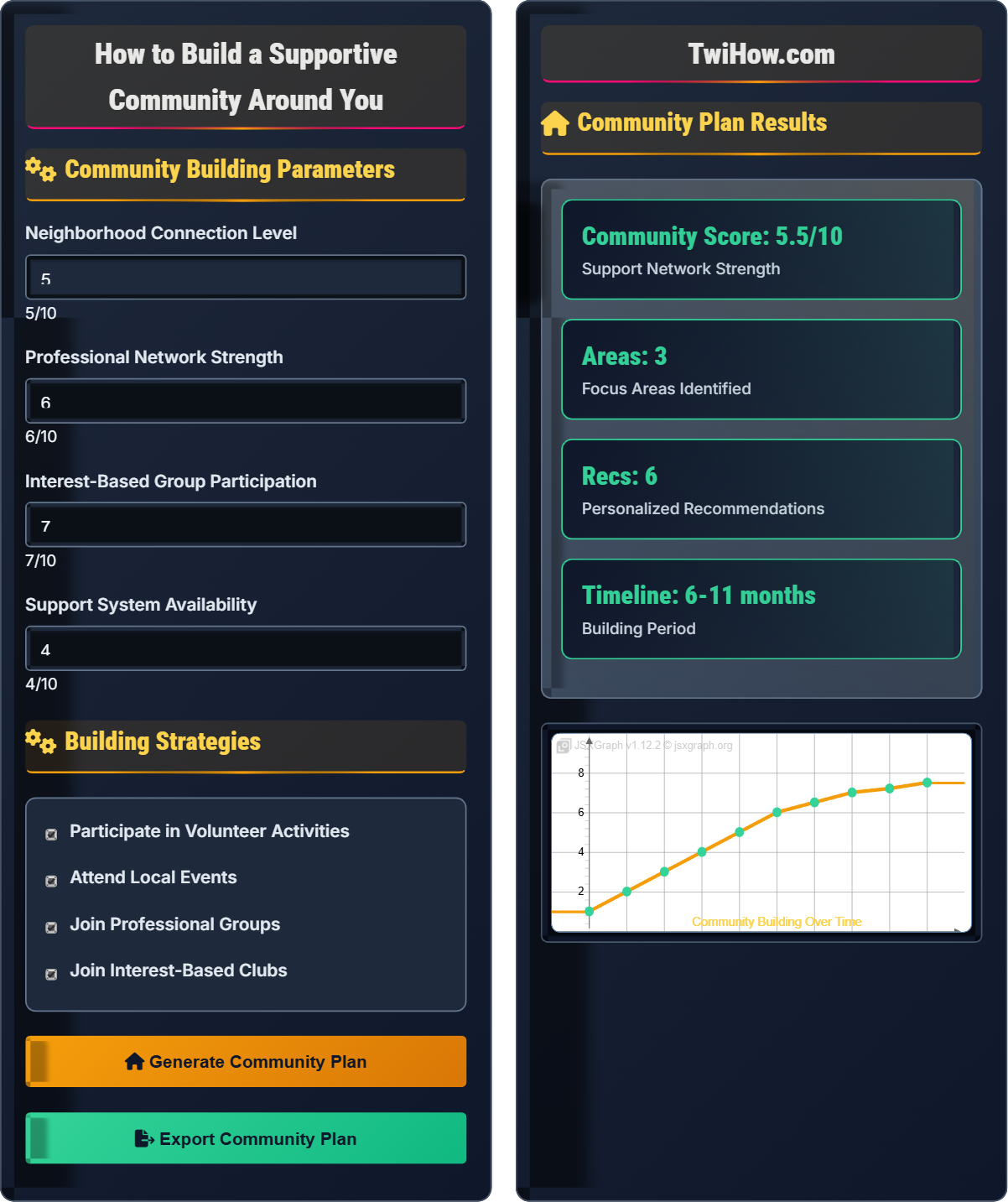
Community Plan Results
| Priority | Strategy | Timeline | Impact |
|---|---|---|---|
| 1 | Strengthen Neighborhood Connections | Month 1-2 | High |
| 2 | Expand Professional Network | Month 2-4 | Medium |
| 3 | Join Interest-Based Groups | Month 3-5 | High |
| 4 | Build Support Circles | Month 4-6 | High |
| 5 | Attend Local Events | Ongoing | Medium |
Join industry associations, attend conferences, and participate in online professional communities.
Introduce yourself to neighbors, participate in community meetings, and join neighborhood associations.
Find groups based on hobbies, causes, or shared interests to build meaningful connections.
Building Supportive Communities Explained
Community building involves intentionally creating and nurturing a network of relationships that provide mutual support, connection, and belonging. It encompasses various types of relationships—from close personal friendships to broader social networks—and includes both formal and informal connections. Effective community building creates a web of support that can provide emotional, practical, and social resources during different life circumstances.
Successful community building follows this equation:
Where:
- Initiative: Taking action to meet new people and create connections
- Consistency: Regular participation and follow-through
- Authenticity: Genuine interactions and self-expression
- Isolation: Degree of social withdrawal
- Reciprocity: Mutual support and giving/receiving
Key areas where community building strengthens life outcomes:
- Neighborhood Integration: Building local connections and civic engagement
- Professional Development: Career networking and mentorship opportunities
- Interest-Based Groups: Connecting with like-minded individuals
- Support Networks: Creating systems for mutual assistance
- Personal Growth: Learning from diverse perspectives and experiences
- Crisis Support: Having resources available during difficult times
- Start Small: Begin with one or two activities to avoid overwhelm
- Be Consistent: Regular participation builds trust and familiarity
- Offer Value: Bring skills, resources, or enthusiasm to groups
- Listen Actively: Show genuine interest in others' experiences
- Be Patient: Meaningful connections take time to develop
Community Building Fundamentals
Initiative, consistency, authenticity, reciprocity, and mutual support.
Community Strength = (Initiative × Consistency × Authenticity) / Isolation × Reciprocity
Where Initiative = taking action, Consistency = regular participation, Authenticity = genuine interactions.
- Building community requires intentional effort and time investment
- Reciprocity is essential for sustainable relationships
- Diversity in community provides different types of support
Community Circles
- Assessment: Evaluate current connections in each circle
- Identification: Find gaps where you need stronger connections
- Participation: Join activities that attract people in your target circles
- Initiation: Take steps to deepen relationships with promising connections
- Integration: Encourage connections between different circles when appropriate
- Each circle serves different needs and purposes
- Community building is a gradual, ongoing process
- Different life stages may require different types of connections
- Maintaining community requires effort from all participants
Building Strategies
Building relationships in your immediate area provides local support and convenience:
- Introduce Yourself: Go door-to-door or attend neighborhood association meetings
- Host Events: Organize potlucks, game nights, or seasonal celebrations
- Offer Help: Assist with yard work, pet sitting, or errands when needed
- Join Activities: Participate in community gardens, block parties, or cleanup events
- Use Apps: Try Nextdoor or similar platforms to connect with neighbors online
Developing career-related relationships supports professional growth:
- Industry Associations: Join professional organizations in your field
- Networking Events: Attend conferences, workshops, and industry meetups
- Online Platforms: Engage meaningfully on LinkedIn and professional forums
- Mentorship: Seek mentors and consider mentoring others
- Alumni Networks: Maintain connections from school or previous workplaces
Connecting with people who share your passions creates joyful relationships:
- Hobby Clubs: Join book clubs, sports teams, or crafting groups
- Volunteer Work: Participate in causes you care about
- Classes and Workshops: Take courses to learn new skills alongside others
- Religious/Spiritual Groups: Engage with faith-based communities
- Online Communities: Participate in forums and social media groups
Community Assessment Tool
Community Building Resources
- "Bowling Alone" by Robert Putnam - Classic analysis of community decline and rebuilding
- "The Art of Gathering" by Priya Parker - How to create meaningful community events
- "Together" by Vivek Murthy - On building connections in modern society
- "The Village Effect" by Susan Pinker - How face-to-face contact keeps us healthy
- Meetup - Find local groups with shared interests
- Nextdoor - Connect with neighbors in your area
- Eventbrite - Discover local events and activities
- Facebook Groups - Join local and interest-based communities
- Community Centers: Local gathering places for various activities
- Libraries: Host events, book clubs, and community programs
- Places of Worship: Religious and spiritual communities
- Sports Clubs: Team-based activities for building connections
- Volunteer Organizations: Opportunities to serve and connect
Community Building Quiz
What is the most important first step in building a supportive community around you?
Building a supportive community requires taking initiative and actively participating in activities where you can meet like-minded people. Passive waiting will not create connections. The most important step is to put yourself in situations where you can meet others and take the first step in initiating conversations and relationships.
The answer is B) Take initiative by participating in activities and introducing yourself.
Community building is an active process that requires putting yourself in social situations and making the first move. While it can feel vulnerable to initiate conversations or join groups, this is the only way to begin forming connections. The key is starting with activities that align with your interests, making it easier to connect with others who share your values or passions.
Community Building: Creating networks of supportive relationships
Initiative: Taking proactive steps to create connections
Social Participation: Actively engaging in group activities
• Building community requires active participation
• Start with activities that align with your interests
• Take the first step in making connections
• Begin with one or two activities to avoid overwhelm
• Prepare conversation starters about the activity
• Follow up with promising connections
• Expecting others to make the first move
• Joining too many groups at once
• Not following up after initial meetings
Explain the concept of reciprocity in community building and why it's essential for creating lasting, supportive relationships.
Definition: Reciprocity in community building refers to the mutual exchange of support, resources, and care between community members. It's the principle that relationships thrive when both parties contribute and receive support.
Importance: Reciprocity creates sustainable relationships because it ensures that support flows both ways. When you help others, they're more likely to help you in return, creating a foundation of trust and mutual care.
Examples: Offering to watch a neighbor's pets, sharing professional contacts, providing emotional support during difficult times, or sharing resources like tools or books.
Balance: Healthy reciprocity doesn't mean keeping exact score, but rather maintaining a general balance of giving and receiving over time.
Long-term Benefits: Reciprocal relationships create stronger, more resilient communities that can weather challenges and provide ongoing support.
Reciprocity is fundamental to human social bonds and has evolutionary roots in our survival as social creatures. When people feel that their contributions are valued and reciprocated, they're more likely to invest in relationships long-term. This creates a positive cycle where community members feel motivated to continue supporting each other, strengthening the entire network.
Reciprocity: Mutual exchange of support and resources
Mutual Care: Shared responsibility for each other's wellbeing
Sustainable Relationships: Connections that endure over time
• Give support freely without expecting immediate returns
• Be willing to accept help when offered
• Maintain a general balance of giving and receiving
• Look for ways to add value to others' lives
• Remember others' needs and follow up on them
• Express gratitude when others support you
• Keeping exact score of give and take
• Only helping when you expect something in return
• Feeling uncomfortable accepting help from others
Mark recently moved to a new city and wants to build relationships with his neighbors. He's introverted and feels nervous about approaching people. His apartment building has 20 units and a small community room. What specific steps should Mark take to build neighborhood connections while respecting his personality and comfort level?
Start Small: Mark should begin by simply greeting neighbors when he sees them in common areas, starting with friendly smiles and brief "hello" exchanges.
Observe Patterns: Notice which neighbors seem approachable and engaged with the community, perhaps those who walk dogs or take out trash regularly.
Use Common Spaces: Visit the community room during times when others might be there, like weekend mornings, and engage in light activities like reading.
Offer Practical Help: Provide assistance with small things like holding doors, collecting packages, or helping with minor issues.
Attend Building Events: Participate in any building-sponsored events or activities when they occur.
Gradual Escalation: As he becomes more comfortable, suggest or participate in low-pressure activities like informal coffee gatherings.
Online Option: Use building apps or online platforms to connect with neighbors virtually before meeting in person.
Community building should be tailored to individual personality types and comfort levels. Introverts can successfully build communities by starting with smaller, low-pressure interactions and gradually increasing engagement. The key is consistency and finding ways to contribute to the community that align with one's natural tendencies and preferences.
Introversion: Preference for smaller, more intimate social interactions
Gradual Integration: Slow, step-by-step community building approachPersonality-Appropriate Building: Tailoring strategies to individual comfort levels
• Community building should respect individual personality types
• Start with small, manageable interactions
• Consistency is more important than intensity
• Use common interests as conversation starters
• Offer practical help before seeking it
• Participate in low-pressure, activity-based interactions
• Expecting immediate, deep connections
• Forcing social interactions that feel unnatural
• Not giving relationships time to develop
Sarah is a freelance graphic designer who works from home and rarely interacts with other professionals in her field. She feels isolated and misses the collaboration and learning opportunities of a traditional workplace. How can she build a professional community while maintaining her independent work style?
Online Professional Groups: Join Slack channels, Facebook groups, or Discord servers for designers in her specialty.
Virtual Events: Attend webinars, online workshops, and virtual conferences in her field.
Co-working Spaces: Rent desk space in a co-working environment one or two days per week.
Professional Associations: Join design organizations that offer networking events and resources.
Local Meetups: Participate in design meetups or creative industry gatherings in her area.
Mentorship: Seek a mentor or consider mentoring junior designers to create meaningful connections.
Collaboration Projects: Partner with other freelancers on projects that require complementary skills.
Social Media Engagement: Actively participate in design discussions on Twitter, Instagram, or LinkedIn.
Professional community building in the digital age offers many options beyond traditional office environments. The key is finding the right mix of online and offline interactions that provide the benefits of professional relationships while respecting work style preferences. Virtual communities can be just as meaningful and supportive as in-person ones when approached thoughtfully.
Professional Community: Network of career-related relationships
Freelance Isolation: Lack of workplace social connections
Digital Networking: Building professional relationships online
• Professional communities can be built virtually
• Consistency in participation builds stronger connections
• Offer expertise to establish credibility and relationships
• Share your expertise to establish yourself as a resource
• Participate in online design challenges or critiques
• Join professional groups relevant to your specific niche
• Assuming professional community requires traditional employment
• Not participating consistently in professional groups
• Only consuming content without contributing to discussions
Why is diversity important in building a supportive community?
Diversity in community brings together people with different backgrounds, experiences, skills, and perspectives. This creates a rich support network where individuals can find various types of help and advice. A diverse community provides emotional support, practical assistance, professional guidance, and different viewpoints that enhance problem-solving and personal growth.
The answer is B) It provides different perspectives, skills, and types of support.
A diverse community is more resilient and comprehensive in its support capabilities. When community members come from different backgrounds, ages, professions, and life experiences, they can offer varied types of assistance and wisdom. This diversity ensures that when you face different challenges, there's likely someone in your community who has relevant experience or skills to help.
Community Diversity: Variety in backgrounds and experiences of members
Comprehensive Support: Multiple types of assistance available
Resilient Network: Community that can adapt to various needs
• Diverse communities provide more comprehensive support
• Different perspectives enhance problem-solving
• Variety in skills creates more resource options
• Seek out communities that include different age groups
• Join groups with people from various professions
• Participate in activities that attract diverse participants
• Limiting community to people exactly like yourself
• Avoiding communities that seem different from your background
• Not valuing perspectives that differ from your own
FAQ
Q: How many people should I aim to have in my core support community?
A: Research suggests that most people benefit from having 3-5 close friends in their core support network, plus 10-15 additional connections in their extended network. The Dunbar number suggests humans can maintain stable relationships with approximately 150 people total, but meaningful support typically comes from a smaller circle. The key factors are:
1. Quality over Quantity: A few reliable, trustworthy friends are more valuable than many superficial connections
2. Diversity of Support: Different friends may provide different types of support
3. Mutual Investment: Relationships require effort from both sides
4. Accessibility: You can actually reach out to them when needed
5. Variety of Needs: Different friends for different types of support
The exact number varies based on personality, lifestyle, and life circumstances.
Q: I'm shy and find it difficult to initiate conversations. How can I still build meaningful community connections?
A: Building community as an introvert or shy person is definitely possible with the right approach:
1. Start Small: Begin with low-pressure situations like book clubs or hobby groups
2. Prepare Conversation Starters: Think of questions about the activity or topic beforehand
3. Listen Actively: Focus on being a good listener rather than talking a lot
4. **Use Online Platforms:** Start with online communities before transitioning to in-person
5. Focus on Shared Interests: Let common activities provide natural conversation topics
6. Volunteer for Tasks: Working together creates natural opportunities for interaction
7. Bring a Friend: Having a familiar person can reduce anxiety
Remember, many people appreciate quieter, thoughtful individuals in their community.
Q: How do I maintain community relationships when I have a very busy schedule?
A: Maintaining community connections with a busy schedule requires strategic thinking:
1. Quality over Quantity: Focus on maintaining a few key relationships rather than many superficial ones
2. Efficient Activities: Choose community activities that provide maximum connection in minimal time
3. Combine Activities: Exercise with a friend, volunteer during lunch breaks, or attend events that combine socializing with other interests
4. Micro-Connections: Send quick texts, like social media posts, or make brief phone calls
5. Batch Interactions: Host or attend group activities that allow you to connect with multiple people at once
6. Strategic Scheduling: Block out specific times for community activities just like work meetings
7. Be Transparent: Let people know you're busy but value the relationship
Remember, consistency matters more than frequency.