How to Build Deeper, More Meaningful Friendships as an Adult
Complete friendship guide • Step-by-step explanations
Adult Friendship Building:
Show Friendship BuilderBuilding meaningful friendships as an adult requires intentional effort and strategic approaches that differ significantly from childhood or college connections. Adult friendships develop through shared interests, consistent interaction, and vulnerability over time. Unlike earlier stages of life, adult friendships require conscious cultivation as people have established routines, families, and professional commitments. Success comes from being genuinely interested in others, creating opportunities for connection, and maintaining consistent communication.
Essential elements for meaningful adult friendships:
- Consistency: Regular interaction to build familiarity and trust
- Vulnerability: Gradual sharing of personal experiences and feelings
- Shared Interests: Common activities or values that provide connection points
- Reciprocity: Mutual investment in the relationship's growth
Successful adult friendship building involves patience, persistence, and a willingness to step outside comfort zones to create meaningful connections that enrich life.
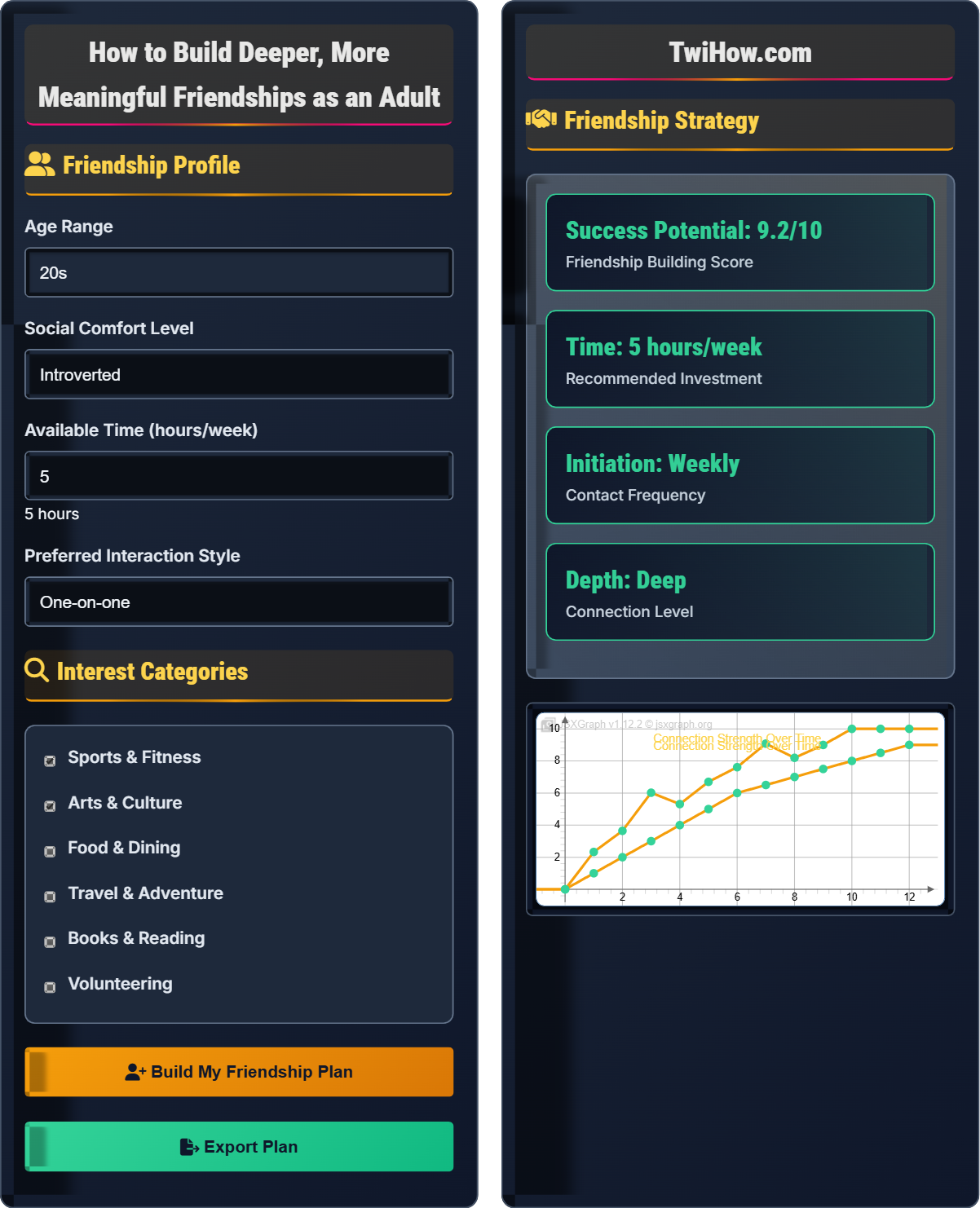
Friendship Profile
Interest Categories
Friendship Strategy
| Strategy | Priority | Effort | Impact |
|---|---|---|---|
| Join Groups | High | Medium | ⭐⭐⭐⭐⭐ |
| One-on-One | High | Medium | ⭐⭐⭐⭐⭐ |
| Shared Activities | Medium | Low | ⭐⭐⭐⭐ |
| Online Communities | Medium | Low | ⭐⭐⭐ |
| Workplace | Low | Low | ⭐⭐⭐ |
| Volunteering | Low | Medium | ⭐⭐⭐⭐ |
Building Meaningful Adult Friendships
Adult friendships differ significantly from childhood or college relationships. Adults have established life patterns, professional commitments, and family responsibilities that complicate social connections. Meaningful adult friendships require intentional effort, mutual investment, and time to develop trust and intimacy. The key is to approach friendship building with patience and consistency while respecting others' life circumstances.
Essential elements of meaningful adult friendships include:
- Mutual Respect: Valuing each other's time, boundaries, and perspectives
- Trust Building: Gradual sharing of personal information and experiences
- Reciprocity: Balanced give-and-take in the relationship
- Shared Values: Common interests, beliefs, or life goals
- Emotional Support: Availability during both good and challenging times
Different approaches offer unique advantages:
- Interest-Based Groups: Natural conversation starters and shared activities
- Professional Networks: Common career interests and potential for mutual support
- Community Service: Shared values and meaningful collaboration
- Online Communities: Access to diverse perspectives and flexible interaction
- Classes/Workshops: Learning environment that encourages interaction
- Be Consistent: Regular interaction builds trust and familiarity over time
- Listen Actively: Show genuine interest in others' experiences and perspectives
- Take Initiative: Don't wait for others to make plans; suggest activities
- Be Patient: Meaningful friendships take time to develop naturally
- Respect Boundaries: Understand that adults have complex schedules and responsibilities
Friendship Fundamentals
Trust building, reciprocity, vulnerability, consistency, mutual respect, emotional support.
Friendship Strength = (Consistency × Vulnerability × Reciprocity) / Time to Develop Trust
Where higher scores indicate stronger, more meaningful connections.
- Consistency builds trust over time
- Vulnerability must be mutual and gradual
- Respect others' time and boundaries
Practical Applications
New city moves, career changes, life transitions, social isolation.
- Join local groups aligned with interests
- Attend community events regularly
- Volunteer for causes you care about
- Take classes or workshops
- Adults have complex schedules and responsibilities
- Quality often matters more than quantity
- Be prepared for slower relationship development
- Respect professional and family boundaries
Adult Friendship Quiz
Which of the following is the MOST effective way to initiate contact with a potential friend as an adult?
Inviting someone for coffee or a shared activity is the most effective approach because it provides a structured opportunity for interaction around a common interest. This creates a natural context for conversation and allows both people to get to know each other in a low-pressure environment. It respects adult boundaries while showing genuine interest in building a connection.
The answer is B) Invite them for coffee or a shared activity.
Adult friendship initiation requires respecting boundaries while creating opportunities for connection. Direct invitations for shared activities provide a natural framework for interaction. This approach is more successful than digital-only contact or immediately requesting personal information, which can feel invasive. Taking initiative demonstrates genuine interest while providing structure for the interaction.
Initiating Contact: Taking the first step to connect with potential friends
Structured Interaction: Planned activities that provide natural conversation opportunities
Boundary Respect: Understanding and honoring others' comfort levels
• Provide context for interaction
• Respect personal boundaries
• Take appropriate initiative
• Suggest low-commitment activities
• Reference common interests
• Be specific about timing and location
• Being too pushy or intense initially
• Asking for personal information too soon
• Waiting for others to always initiate
Explain the process of building trust in adult friendships, including the timeline, appropriate vulnerability levels, and strategies for maintaining confidentiality.
Trust Timeline: Adult friendships typically take 3-6 months to develop significant trust, much longer than younger relationships. Trust builds through consistent, reliable interactions and demonstrated care.
Vulnerability Levels: Start with general experiences and preferences, gradually sharing more personal information as trust develops. Share struggles and challenges at a pace that matches the other person's openness.
Confidentiality: Never share others' personal information without permission. Demonstrate trustworthiness by keeping confidences and respecting privacy. Admit when you've made mistakes rather than hiding them.
Consistency: Follow through on commitments, respond to messages appropriately, and show up consistently to build reliability.
Trust in adult friendships develops gradually through consistent, reliable behavior. Adults are more cautious due to past experiences and life responsibilities. The key is to match vulnerability levels with the other person and demonstrate reliability over time. Trust is built through small, consistent actions rather than grand gestures.
Trust: Confidence in another person's reliability and integrity
Vulnerability: Willingness to share personal information and emotions
Confidentiality: Protecting others' personal information
• Match vulnerability levels appropriately
• Maintain confidentiality consistently
• Demonstrate reliability over time
• Share struggles before successes
• Ask for advice to show trust
• Follow through on small commitments
• Sharing too much too soon
• Breaking confidences
• Being inconsistent in behavior
You're a 35-year-old parent with a demanding career. You've recently met two people you'd like to develop friendships with: Person A is available on weekends but lives 30 minutes away, and Person B is available during lunch breaks but has a very busy schedule. Calculate how to balance these relationships while respecting your time constraints and determine which approach might be more sustainable long-term.
Person A Analysis: Weekend availability works well with family schedule, but 30-minute travel time reduces actual interaction time. Focus on monthly activities that include family or partner when possible.
Person B Analysis: Lunch breaks provide regular contact but limit depth of interaction. These connections are good for professional networking and quick emotional support.
Time Allocation: Dedicate 2 hours/week to Person A (every other weekend) and 1 hour/week to Person B (two lunch breaks). This totals 3 hours weekly, which is sustainable for busy parents.
Sustainable Approach: Person A relationship likely to develop deeper over time due to focused interaction, while Person B provides valuable daily connection. Both approaches are important for different friendship needs.
Adult friendship building requires realistic time management that acknowledges life constraints. The key is to maximize the quality of interactions within available time rather than focusing solely on quantity. Different types of friendships serve different needs - some provide deep emotional support while others offer daily connection and professional benefits.
Time Management: Efficiently allocating time to relationship maintenance
Life Constraints: External factors limiting available social time
Quality vs Quantity: Prioritizing meaningful interaction over frequency
• Be realistic about available time
• Maximize interaction quality
• Consider travel time in planning
• Combine activities with other responsibilities
• Plan regular check-ins even if brief
• Use technology for ongoing connection
• Overcommitting to multiple new friendships
• Not accounting for life responsibilities
• Expecting immediate deep connections
You want to develop a meaningful friendship with a colleague, but you're concerned about professional boundaries and potential complications. Develop a strategy that allows for friendship growth while maintaining appropriate workplace dynamics and avoiding conflicts of interest.
Boundary Setting: Keep initial interactions work-focused and gradually expand to personal topics during appropriate times like lunch breaks or after-work social events. Avoid discussing work politics or confidential information.
Professional Respect: Maintain professional behavior during work hours and avoid favoritism or special treatment. Keep personal conflicts separate from work interactions.
Outside Connection: Develop friendship primarily outside of work hours and locations. Suggest activities like weekend coffee, shared hobbies, or community events that occur away from the office.
Colleague Awareness: Be mindful that the friendship exists within a professional context. If workplace dynamics change (promotions, conflicts, etc.), be prepared to adjust the relationship accordingly.
Transparency: If asked by supervisors about close relationships with colleagues, be honest but professional about the nature of your connection.
Workplace friendships require careful boundary management to prevent professional complications. The key is to develop the friendship primarily outside of work while maintaining professional decorum during business hours. This approach allows for meaningful connection while protecting both careers and maintaining organizational harmony.
Professional Boundaries: Clear distinctions between work and personal relationships
Work-Life Integration: Managing relationships across different life domains
Conflict of Interest: Situations where personal relationships affect professional decisions
• Maintain professionalism during work hours
• Develop friendship outside of work context
• Avoid workplace gossip and confidential discussions
• Suggest after-hours activities
• Keep work discussions professional
• Be aware of company policies
• Blurring professional and personal boundaries
• Discussing workplace confidential information
• Showing favoritism to friends at work
Which of the following is the BEST strategy for maintaining long-term adult friendships?
Consistently checking in and showing interest in friends' lives is the foundation of lasting adult friendships. This reciprocal attention demonstrates care and investment in the relationship. Regular contact, whether through calls, texts, or social media, helps maintain connection during busy periods and shows that the friendship remains important to you.
The answer is B) Consistently check in and show interest in their lives.
Maintaining adult friendships requires ongoing effort from both parties. Unlike younger relationships that develop naturally through shared environments, adult friendships must be intentionally nurtured. Consistent contact, even if brief, maintains the connection and demonstrates value for the relationship. This approach helps friendships survive life changes and busy periods.
Reciprocal Attention: Mutual investment in maintaining the relationship
Relationship Maintenance: Ongoing actions to preserve friendship
Consistent Contact: Regular communication to maintain connection
• Invest time consistently
• Show genuine interest in their lives
• Take initiative in maintaining contact
• Remember important dates and events
• Share your own experiences periodically
• Use multiple communication methods
• Only reaching out when you need something
• Assuming friends will always initiate contact
• Not maintaining regular communication
FAQ
Q: I'm an introvert who finds it exhausting to meet new people. How can I build friendships without overwhelming myself?
A: As an introvert, focus on quality over quantity in friendship building:
Small Groups: Attend smaller gatherings where you can have meaningful one-on-one conversations rather than large social events.
Shared Activities: Join groups centered around your interests where conversation flows naturally around common topics.
Online Connections: Start with online communities related to your interests, which can be less overwhelming and allow you to connect at your own pace.
Home Environment: Invite people over for dinner or activities in your comfortable home environment where you feel most confident.
Energy Management: Schedule social activities after rest days and allow time to recharge afterward. It's better to have fewer, more meaningful interactions than to exhaust yourself with too many events.
Q: I have young children and a demanding job. How can I realistically make time for new friendships?
A: Busy parents need strategic approaches to friendship building:
Child-Friendly Activities: Join parent groups, playground activities, or school events where you can meet other parents facing similar challenges.
Efficient Time Use: Combine friendship with other activities - exercise with a friend, grocery shop together, or attend kids' activities in groups.
Technology: Use messaging apps to maintain connections during brief moments (naptime, commute, etc.)
Partner Support: Coordinate with your partner to alternate childcare duties, allowing time for individual social activities.
Realistic Expectations: Focus on maintaining 1-2 close friendships rather than having many acquaintances. Quality relationships are more sustainable with a busy schedule.