How to Build Resilience in Relationships During Stressful Times?
Complete relationship resilience guide • Step-by-step explanations
Relationship Resilience Fundamentals:
Show Resilience CalculatorBuilding resilience in relationships during stressful times involves strengthening communication, fostering mutual support, and developing adaptive coping strategies. Resilient relationships can weather challenges and even grow stronger through adversity. The key is maintaining connection while managing individual stress responses effectively.
Key components of relationship resilience:
- Effective Communication: Maintaining open, honest dialogue during stress
- Emotional Support: Providing and receiving mutual comfort and understanding
- Stress Management: Individual and joint coping strategies
- Flexibility: Adapting to changing circumstances and needs
- Trust Building: Maintaining security and reliability
- Shared Goals: Working together toward common objectives
Success requires both individual and collective commitment to maintaining connection and growth during difficult periods.
Resilience Assessment Parameters
Resilience Settings
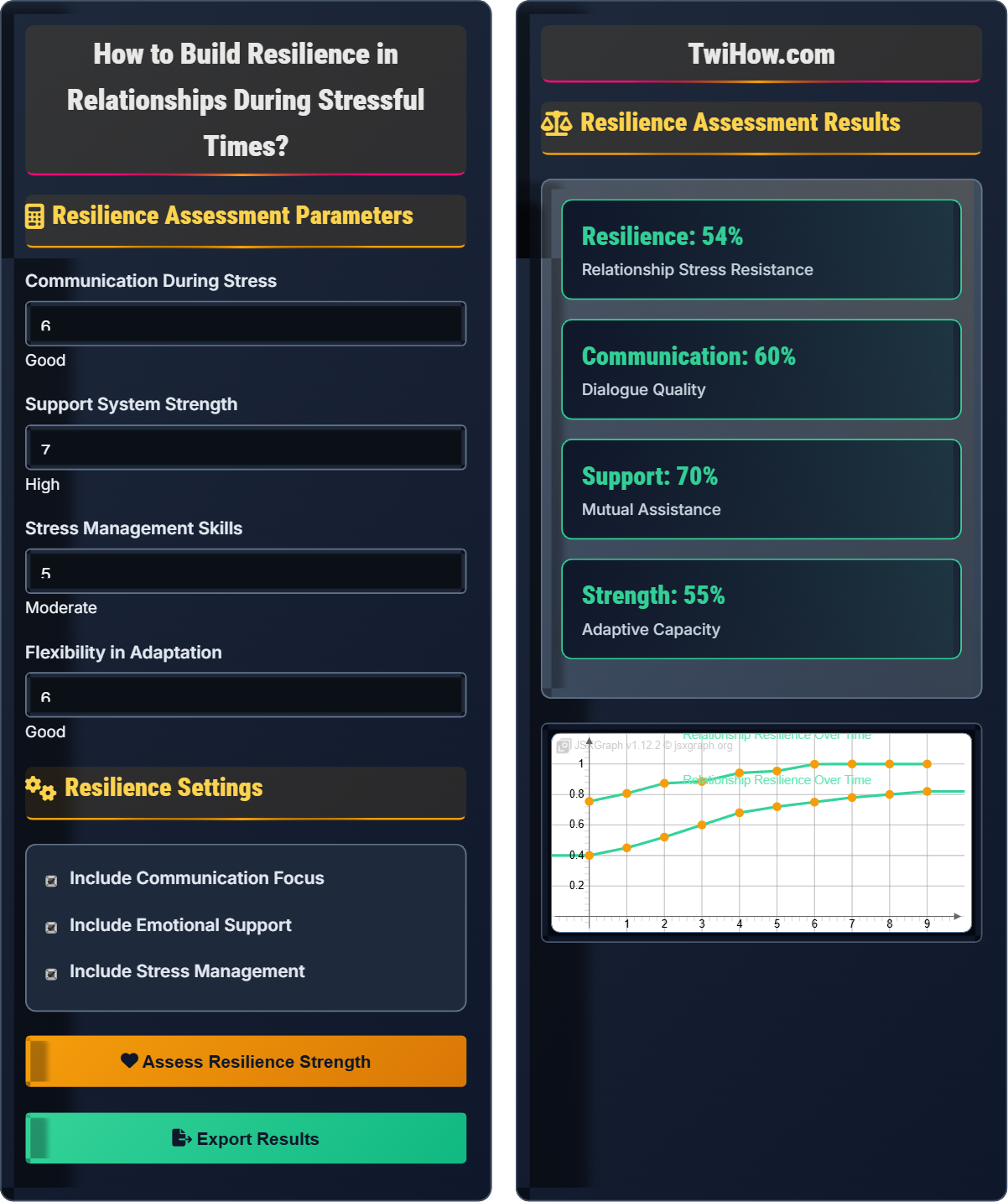
Resilience Assessment Results
| Area | Score | Development Level | Focus Area |
|---|---|---|---|
| Communication | 72% | Developing | Enhance stress communication skills. |
| Support | 75% | Developing | Maintain strong mutual support. |
| Stress Management | 55% | Emerging | Develop better individual coping. |
| Flexibility | 62% | Developing | Improve adaptation skills. |
Keep dialogue open and honest even during difficult times.
Be present and understanding for your partner's needs.
Take care of your own well-being to better support others.
Use challenges as opportunities for relationship growth.
Understanding Relationship Resilience During Stressful Times
Relationship resilience is the ability of a relationship to withstand, adapt to, and recover from stressful situations. The equation for relationship resilience can be expressed as:
Where:
- Communication: Open, honest dialogue during challenges
- Support: Mutual emotional and practical assistance
- Flexibility: Ability to adapt to changing circumstances
- Stress: External pressures affecting the relationship
- Conflict: Disagreements and tensions during stress
Building resilience follows a structured approach:
Where increasing communication, support, coping skills, and growth creates stronger relationship resilience.
Resilient relationships provide numerous benefits:
- Stress Reduction: Having support reduces individual stress levels
- Enhanced Communication: Stress periods can improve dialogue skills
- Deeper Connection: Overcoming challenges together strengthens bonds
- Personal Growth: Learning new coping strategies and skills
- Increased Trust: Demonstrating reliability during difficult times
- Future Preparedness: Building skills for future challenges
- During Crises: When facing major life challenges
- Before Stressful Events: Anticipating difficult periods
- Early Warning Signs: When noticing strain in the relationship
- Recovery Phases: After overcoming challenges
- Relationship Growth: Proactively building resilience
- Transition Periods: During major life changes
Resilience Strategies
Communication, emotional support, stress management, flexibility, trust building, shared goals.
Resilience = (Communication × Support × Flexibility) / (Stress + Conflict)
Where higher scores indicate stronger relationship resilience.
- Communication remains essential during stress
- Individual well-being supports relationship health
- Flexibility enables adaptation to challenges
Stress Techniques
Family crises, workplace stress, health challenges, financial difficulties, life transitions.
- Identify stress triggers and patterns
- Develop individual coping strategies
- Strengthen communication skills
- Build mutual support systems
- Practice flexibility and adaptation
- Maintain shared goals and values
- Everyone's stress tolerance varies
- Some challenges require professional help
- Recovery takes time and patience
- Relationships can both help and be challenged
Resilience Strategies
Maintaining open dialogue and expressing needs during stressful periods.
Providing and receiving comfort and understanding during challenges.
Developing individual and joint coping strategies for stress.
Stress Techniques
Adapting to changing circumstances and needs during stress.
Maintaining security and reliability during challenging times.
Working together toward common objectives despite stress.
Relationship Resilience During Stress Quiz
What is the most important factor for building relationship resilience during stressful times?
The most important factor is maintaining open communication. During stressful times, relationships need stronger communication, not less. Open dialogue helps both partners understand each other's needs, express concerns, and work together on solutions. Avoiding communication or reducing contact can lead to isolation and misunderstanding, weakening the relationship.
The answer is B) Maintaining open communication.
Communication serves as the foundation for all other resilience strategies. When stress hits, our natural tendency might be to withdraw or avoid difficult conversations, but this often creates more problems. Open communication allows both partners to share their stress, coordinate support, and maintain connection during challenging times. It's the key that enables all other resilience strategies to work effectively.
Open Communication: Honest, transparent dialogue during challenges
Relationship Foundation: Core element that enables other strategies
Stress Coordination: Sharing and managing stress together
• Communication becomes more important during stress
• Withdrawing can weaken relationships
• Dialogue enables other resilience strategies
• Schedule regular check-ins during stressful periods
• Use "I" statements to express feelings
• Listen actively without immediately offering solutions
• Assuming your partner knows what you're thinking
• Avoiding conversations to prevent conflict
• Not expressing your own stress and needs
Explain how to balance individual stress management with supporting your partner during stressful times. What are the key principles and approaches?
Self-Care First: Take care of your own stress needs so you can effectively support others.
Communication: Share your stress levels and needs with your partner honestly.
Coordination: Plan how to support each other during different stress periods.
Boundaries: Maintain healthy limits while providing support.
Flexibility: Adjust your support approach based on your partner's needs.
Professional Help: Seek external support when needed for both individuals.
The key is mutual support without complete role reversal during stress.
Relationship resilience requires both individual and collective stress management. You cannot pour from an empty cup - taking care of your own stress is not selfish, it's necessary for being able to support others. The goal is creating a system where both partners can manage their own stress while providing mutual support. This requires clear communication about individual needs and limits.
Individual Stress Management: Personal coping strategies and self-care
Mutual Support: Reciprocal assistance during challenging timesSelf-Care: Actions to maintain personal well-being
• Take care of yourself to better support others
• Communicate your own stress levels and needs
• Maintain healthy boundaries while being supportive
• Practice stress management techniques together
• Take turns providing primary support during stress
• Recognize when professional help is needed
• Completely neglecting your own needs while supporting others
• Expecting your partner to manage your stress completely
• Not communicating your own stress levels and limits
You and your partner are facing significant financial stress due to job loss and mounting bills. How do you maintain relationship resilience during this challenging time?
Open Communication: Discuss financial concerns honestly without blame or shame.
Joint Problem-Solving: Work together on budgeting, job searching, and financial planning.
Emotional Support: Acknowledge that financial stress affects both partners emotionally.
Stress Management: Practice stress-reduction techniques together and individually.
Focus on Control: Concentrate on what you can control rather than what you can't.
Strengthen Connection: Maintain emotional intimacy despite external pressures.
Financial stress is one of the most common relationship challenges and can test resilience significantly. The key is treating it as a joint problem to solve together rather than a source of blame or competition for resources. Maintaining emotional connection during financial stress requires intentional effort, as the pressure can create distance if not addressed directly.
Financial Stress: Pressure from monetary challenges and instability
Joint Problem-Solving: Collaborative approach to challenges
Emotional Connection: Maintaining intimacy despite external pressures
• Financial stress affects both partners equally
• Avoid blame and shame during financial difficulties
• Focus on solutions rather than problems
• Create a shared budget and financial goals
• Celebrate small wins during difficult times
• Find low-cost ways to maintain relationship activities
• Hiding financial information from your partner
• Blaming each other for financial circumstances
• Neglecting emotional needs during financial stress
Your partner has been diagnosed with a serious health condition. How do you build resilience in your relationship while managing the stress and uncertainty of this situation?
Information Sharing: Stay informed about the condition and treatment options together.
Emotional Support: Provide comfort and understanding while acknowledging your own fears.
Practical Assistance: Help with medical appointments, medications, and daily tasks.
Professional Support: Seek counseling for both individuals and the relationship.
Future Planning: Discuss hopes, fears, and plans for different scenarios.
Self-Care: Maintain your own health and well-being during caregiving.
Success requires balancing care for your partner with care for yourself.
Health crises test relationship resilience in unique ways, often creating caregiver roles that can strain relationships. The key is maintaining the relationship dynamic while providing care, not just focusing on the medical aspects. Both partners need support during health challenges, and professional help can be invaluable for navigating these complex situations.
Health Crisis: Serious medical condition affecting the relationship
Caregiver Role: Supporting partner during medical challenges
Professional Support: Counseling and medical guidance
• Both partners need emotional support during health crises
• Maintain relationship identity beyond medical roles
• Seek professional help when needed
• Join support groups for both patients and caregivers
• Maintain some normal relationship activities when possible
• Plan for different scenarios and outcomes
• Focusing only on medical aspects, not emotional needs
• Not taking care of your own health during caregiving
• Avoiding difficult conversations about prognosis and plans
Why is flexibility important for relationship resilience during stressful times?
Flexibility is important because it allows adaptation to changing circumstances. Stressful times often bring unexpected changes that require adjusting plans, expectations, and roles. Rigid approaches can break under pressure, while flexible relationships can bend without breaking. Flexibility enables couples to find new solutions and approaches when standard methods don't work.
The answer is B) It allows adaptation to changing circumstances.
Flexibility in relationships is like having a strong, bendable branch rather than a rigid stick. When stress hits, rigid relationships can break, but flexible ones can adapt and survive. This doesn't mean changing your core values, but rather being willing to adjust approaches, schedules, and expectations when circumstances require it. Flexibility allows for creative problem-solving and maintains relationship flow during disruptions.
Flexibility: Ability to adapt to changing circumstances
Adaptation: Modifying approaches when needed
Resilience: Bouncing back from challenges
• Flexibility enables creative problem-solving
• Adaptation prevents relationship rigidity
• Change is often necessary during stress
• Regularly review and adjust expectations
• Be open to new approaches and solutions
• Maintain core values while adjusting methods
• Clinging to rigid plans despite changing circumstances
• Not adjusting expectations during difficult times
• Resisting necessary changes in roles or responsibilities
FAQ
Q: What if my partner and I handle stress completely differently?
A: Different stress responses are common and can be managed:
1. Understand Differences: Learn about each other's stress responses
2. Respect Approaches: Acknowledge that different doesn't mean wrong
3. Complementary Support: Use different styles to support each other
4. Communication: Discuss how to support each other effectively
5. Flexibility: Adjust your support approach based on their needs
6. Professional Help: Consider counseling for significant differences
Different stress responses can actually strengthen relationships when understood and respected.
Q: How do I know if our relationship is resilient enough for future challenges?
A: Signs of relationship resilience include:
Communication: You can discuss difficult topics without destroying connection
Trust: You believe in each other's reliability during challenges
Support: You provide mutual assistance during tough times
Flexibility: You adapt to changing circumstances together
Recovery: You bounce back from conflicts and challenges
Growth: You learn and strengthen from difficult experiences
Resilience can be developed and strengthened over time.