How to Handle Jealousy or Insecurity Constructively?
Complete emotional management guide • Step-by-step explanations
Jealousy & Insecurity Management Fundamentals:
Show Emotional Management CalculatorHandling jealousy and insecurity constructively involves understanding the root causes, developing emotional regulation skills, and building self-confidence. These emotions are natural human responses, but when managed properly, they can lead to personal growth and stronger relationships. The key is transforming these feelings from destructive forces into opportunities for self-awareness and communication.
Key components of constructive management:
- Self-Awareness: Recognizing triggers and patterns of jealousy or insecurity
- Emotional Regulation: Managing intense emotions without acting destructively
- Communication: Expressing feelings constructively rather than reactively
- Self-Confidence: Building internal security and self-worth
- Trust Building: Developing confidence in relationships
- Personal Growth: Using emotions as catalysts for self-improvement
Successful management requires patience, self-compassion, and consistent practice of new emotional responses.
Emotional Management Assessment Parameters
Management Settings
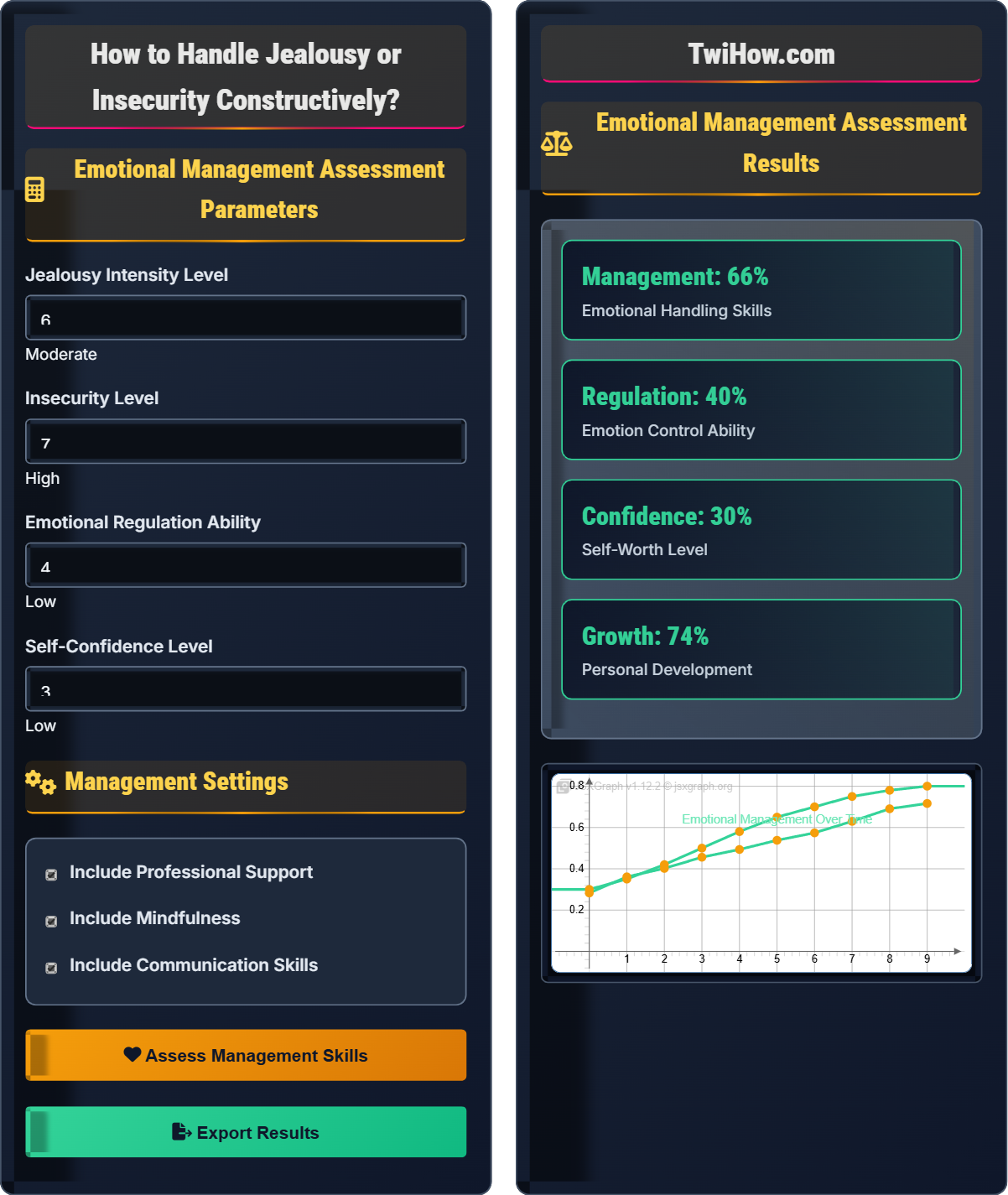
Emotional Management Assessment Results
| Area | Score | Development Level | Focus Area |
|---|---|---|---|
| Jealousy Management | 55% | Developing | Practice emotional regulation techniques. |
| Insecurity Handling | 48% | Emerging | Build self-confidence and self-worth. |
| Emotional Control | 45% | Beginning | Develop mindfulness and breathing techniques. |
| Self-Worth | 42% | Beginning | Focus on internal validation sources. |
Recognize triggers and patterns of jealousy or insecurity.
Manage intense emotions without acting destructively.
Express feelings constructively rather than reactively.
Build internal security and self-worth.
Understanding Jealousy and Insecurity Management
Jealousy is a complex emotion involving fear, suspicion, and anxiety about losing something valuable, especially in relationships. Insecurity involves feelings of inadequacy and doubt about one's worth or abilities. The equation for emotional management can be expressed as:
Where:
- Self-Awareness: Recognition of emotions and triggers
- Self-Confidence: Internal sense of worth and security
- Fear: Anxiety about potential losses or threats
- Insecurity: Doubt about one's worth or abilities
Constructive handling follows a structured approach:
Where increasing awareness, regulation, communication, and self-worth creates better emotional management.
Managing jealousy and insecurity constructively leads to:
- Healthier Relationships: Reduced conflict and increased trust
- Improved Self-Esteem: Greater internal security and confidence
- Better Communication: More honest and effective dialogue
- Emotional Stability: Better regulation of intense emotions
- Personal Growth: Opportunities for self-awareness and development
- Increased Resilience: Better ability to handle future challenges
- Intense Reactions: When emotions feel overwhelming or uncontrollable
- Relationship Damage: When jealousy or insecurity harms relationships
- Behavioral Changes: When emotions lead to destructive behaviors
- Persistent Patterns: When issues don't improve with self-work
- Self-Worth Issues: When insecurities significantly impact daily life
- Isolation: When emotions lead to social withdrawal
Emotional Patterns
Self-awareness, emotional regulation, constructive communication, self-confidence, trust building, personal growth.
Emotional Management = (Self-Awareness × Self-Confidence) / (Fear + Insecurity)
Where higher scores indicate better emotional management skills.
- These emotions are natural human responses
- Management takes time and practice
- Professional help can accelerate growth
Management Strategies
Personal relationships, romantic partnerships, family dynamics, workplace interactions.
- Identify triggers and patterns
- Practice emotional regulation
- Develop constructive communication
- Build self-confidence
- Establish trust in relationships
- Use emotions for personal growth
- Progress may be uneven
- Setbacks are normal parts of growth
- Self-compassion is essential
- Support systems are valuable
Emotional Patterns
Identifying situations, thoughts, or behaviors that activate jealousy or insecurity.
Understanding the mental narratives that fuel insecure or jealous feelings.
Recognizing bodily sensations associated with these emotions.
Management Strategies
Techniques for managing intense emotions without destructive reactions.
Expressing feelings in healthy, productive ways.
Developing internal security and self-worth.
Jealousy and Insecurity Management Quiz
When experiencing jealousy or insecurity, the most constructive first response is:
The most constructive response is to take a step back and examine your feelings. This allows for self-awareness and emotional regulation before reacting. Acting immediately (confrontation) or suppressing emotions entirely doesn't address the underlying issues. Taking time to understand your emotions helps you respond more constructively and identify the root causes of your feelings.
The answer is B) Take a step back and examine your feelings.
Emotional regulation begins with awareness. When we feel intense emotions like jealousy or insecurity, our initial impulse might be to act immediately. However, taking a moment to pause and examine what we're feeling allows us to respond thoughtfully rather than reactively. This pause creates space between the emotion and our response, giving us the opportunity to choose how to proceed in a way that aligns with our values and relationship goals.
Emotional Regulation: Managing and responding to emotional experiences in healthy ways
Self-Awareness: Recognition of one's emotions, thoughts, and behaviors
Reactive vs. Responsive: Acting impulsively vs. choosing thoughtful responses
• Feelings are natural, but reactions can be managed
• Pause before acting on intense emotions
• Examine emotions without judgment
• Practice the 5-4-3-2-1 grounding technique
• Take slow, deep breaths when emotions arise
• Ask yourself "What am I really afraid of?"
• Acting on emotions without reflection
• Suppressing emotions instead of processing them
• Assuming others' intentions based on feelings
Explain how to communicate feelings of jealousy or insecurity constructively in relationships. What are the key principles and techniques involved?
Key Principles: Use "I" statements rather than "you" statements to avoid blame. Focus on your own feelings and experiences rather than making accusations about the other person's behavior.
Timing: Choose a calm moment for conversation rather than addressing feelings during an emotional peak. Ensure privacy and adequate time for discussion.
Techniques: Start with your own feelings ("I felt insecure when..."), describe the specific situation without interpretation, and request what you need rather than demanding changes.
Approach: Frame the conversation as sharing your experience rather than fixing their behavior. Be open to their perspective and listen actively to their response.
Follow-up: Check in later to see how the conversation was received and if the situation has improved.
Effective communication transforms destructive emotions into opportunities for intimacy and understanding.
Communication during emotional states requires special care because emotions can cloud our ability to express ourselves clearly. The goal is to share your experience without making the other person feel attacked or defensive. This creates an environment where both parties can work together to address the underlying issues rather than becoming adversaries. Good communication also models the behavior you hope to receive in return.
I-Statements: Expressing feelings from your perspective without blame
Constructive Communication: Sharing experiences to improve understanding
Active Listening: Fully focusing on understanding the other person's perspective
• Focus on your feelings, not their behavior
• Choose appropriate timing for conversations
• Listen to their perspective with an open mind
• Practice your words before speaking
• Focus on the specific situation, not generalizations
• Ask for their perspective and feelings
• Using "you" statements that sound accusatory
• Bringing up multiple issues at once
• Demanding specific changes instead of expressing needs
You're feeling insecure about a new colleague who seems to be getting more recognition than you. You're worried about losing your position or status. How do you handle these feelings constructively without letting them affect your work performance?
Self-Assessment: Acknowledge your feelings without judgment. Recognize that insecurity is a natural response to change and competition.
Reality Check: Examine the facts vs. your fears. Are there actual threats to your position, or are you imagining potential scenarios?
Focus on Growth: Use the situation as motivation to improve your skills and performance rather than dwelling on comparisons.
Professional Communication: If appropriate, discuss your career goals with your supervisor to get clarity on expectations and opportunities.
Self-Confidence Building: Focus on your unique contributions and achievements rather than comparing yourself to others.
Boundary Setting: Limit rumination about the situation and redirect attention to controllable factors like your own performance.
Workplace insecurity often stems from comparing ourselves to others and fearing loss of status or security. The key is distinguishing between legitimate concerns and imagined threats. By focusing on your own growth and contributions rather than others' success, you can channel insecurity into motivation for improvement. Professional communication with supervisors can provide clarity and direction, reducing uncertainty that feeds insecurity.
Professional Comparison: Evaluating your performance relative to others
Reality Testing: Examining thoughts against actual evidence
Performance Focus: Concentrating on your own work quality
• Focus on what you can control
• Separate facts from fears
• Channel emotions into productive action
• Keep a record of your achievements
• Seek feedback from trusted colleagues
• Focus on your unique value proposition
• Constantly comparing yourself to others
• Assuming others' success means your failure
• Not seeking clarification when uncertain
You feel jealous when your partner spends time with friends of the opposite sex. You've noticed yourself monitoring their communications and feeling anxious about their interactions. How do you address these feelings constructively while maintaining the relationship?
Self-Reflection: Examine the root cause of your jealousy. Is it based on past experiences, low self-worth, or actual concerning behaviors?
Emotional Regulation: Practice calming techniques when jealousy arises rather than acting on impulses to monitor or confront.
Communication: Share your feelings with your partner using "I" statements, explaining your emotions without making demands or accusations.
Trust Building: Work on building confidence in the relationship and your own worth.
Boundary Setting: Discuss appropriate boundaries that make both parties comfortable without being controlling.
Self-Improvement: Address underlying insecurities through self-work or therapy if needed.
Success requires balancing honesty about feelings with respect for your partner's autonomy.
Jealousy in romantic relationships often stems from fears of loss and abandonment. The key is addressing these fears constructively rather than letting them drive controlling or suspicious behavior. Open communication about feelings can actually strengthen relationships when done with respect for both partners' needs. Building trust requires both partners to be responsive to each other's concerns while maintaining individual autonomy.
Healthy Boundaries: Limits that protect both partners' needs
Trust Building: Developing confidence in the relationship
Emotional Transparency: Sharing feelings without manipulation
• Address feelings without controlling behavior
• Respect partner's autonomy and friendships
• Focus on building trust rather than monitoring
• Focus on your own behavior and responses
• Ask for reassurance when needed appropriately
• Build your own social connections
• Monitoring partner's communications
• Demanding they cut off friendships
• Making accusations without evidence
Which of the following is the most effective way to build self-confidence and reduce insecurity?
Developing internal validation sources is the most effective way to build self-confidence and reduce insecurity. When we rely on our own self-assessment and values rather than external validation, we become less vulnerable to others' opinions and circumstances. This creates a stable foundation for self-worth that isn't dependent on external factors.
The answer is B) Developing internal validation sources.
External validation is inherently unstable because it depends on others' opinions and circumstances that we cannot control. Internal validation comes from knowing your own values, accomplishments, and worth regardless of external circumstances. This doesn't mean ignoring feedback from others, but rather having a strong internal foundation that isn't easily shaken by external events. Building internal validation involves self-reflection, recognizing your own achievements, and developing a clear sense of personal values.
Internal Validation: Self-worth based on personal values and self-assessment
External Validation: Self-worth dependent on others' opinions
Self-Worth: Intrinsic value of a person regardless of external achievements
• Your worth is not determined by others' opinions
• External validation is inherently unstable
• Internal validation provides emotional stability
• Keep a record of your accomplishments
• Practice self-compassion during setbacks
• Focus on your personal values and goals
• Equating worth with external achievements
• Seeking constant validation from others
• Avoiding challenges due to insecurity
FAQ
Q: Is it normal to feel jealous or insecure sometimes?
A: Yes, feeling jealous or insecure is completely normal:
1. Evolutionary Purpose: These emotions evolved to protect important relationships
2. Universal Experience: Most people experience these emotions at various times
3. Intensity Matters: Normal vs. problematic depends on frequency and intensity
4. Duration: Temporary feelings are normal, persistent patterns may need attention
5. Impact on Life: When emotions interfere with daily functioning, seek support
6. Response Patterns: How you handle these feelings matters more than having them
The key is learning to manage these natural emotions constructively rather than eliminating them entirely.
Q: How can I support my partner who struggles with jealousy or insecurity?
A: Supporting a partner with these struggles involves:
Empathetic Listening: Acknowledge their feelings without dismissing them
Reassurance: Provide appropriate comfort and validation of the relationship
Boundaries: Maintain your own autonomy while being supportive
Encouragement: Support their self-improvement efforts
Patience: Understand that change takes time and effort
Professional Support: Encourage therapy when appropriate
Remember that your partner's emotional growth is their journey, though you can provide loving support.