How to Handle Rejection or Breakups with Compassion
Complete guide • Step-by-step explanations
Compassionate Healing After Rejection:
Show Healing SimulatorHandling rejection and breakups with compassion involves treating yourself and others with kindness during difficult emotional transitions. It requires accepting the reality of the situation, processing emotions healthily, and moving forward with wisdom and self-compassion rather than anger or self-blame.
Key aspects of compassionate healing include:
- Self-Compassion: Treating yourself with the same kindness you'd offer a friend
- Emotional Processing: Allowing yourself to feel and work through difficult emotions
- Acceptance: Acknowledging the reality of the situation without resistance
- Growth Mindset: Learning from the experience and using it for personal development
Compassionate healing contributes significantly to emotional resilience and prevents long-term psychological damage from rejection or loss.
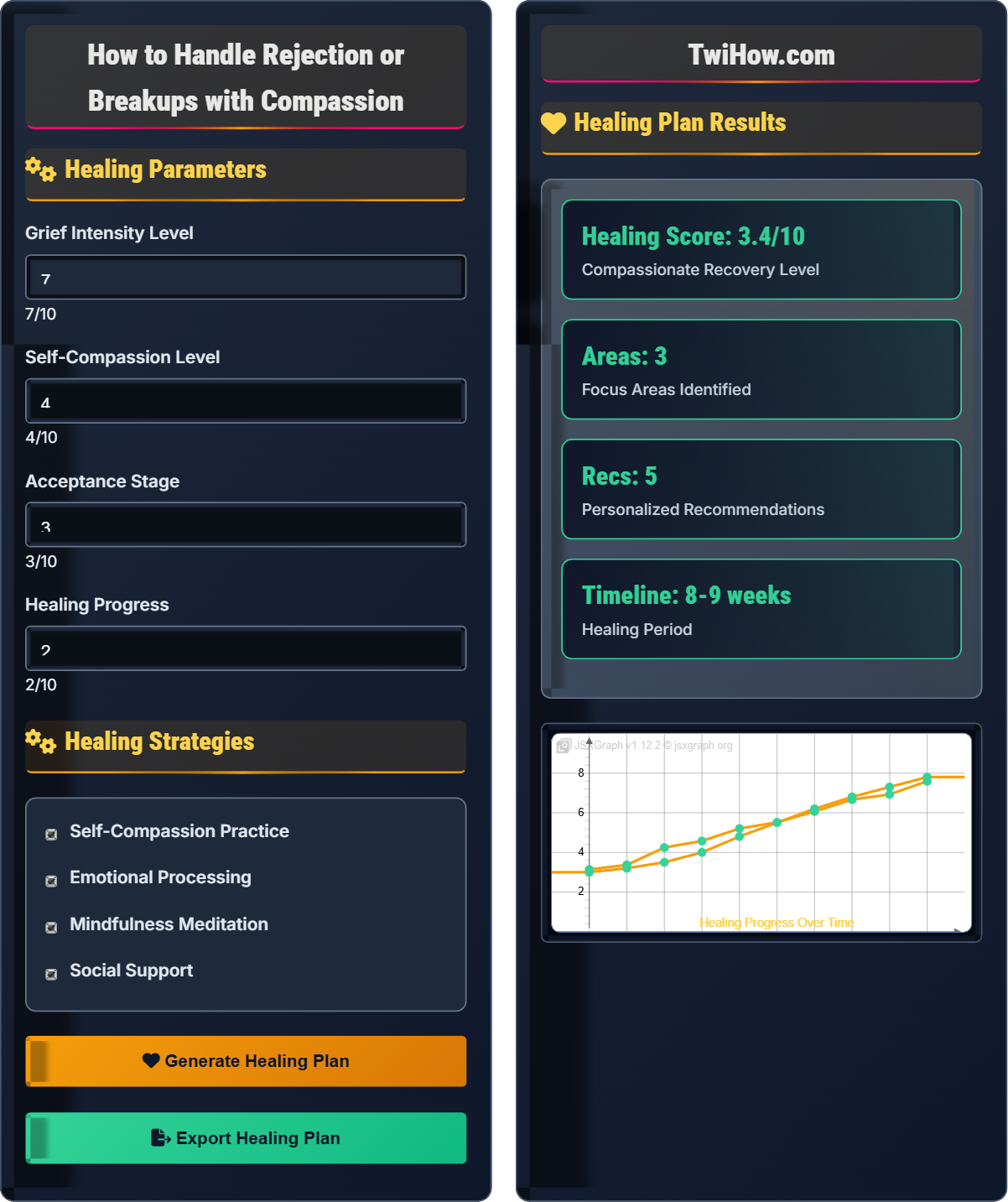
Healing Parameters
Healing Strategies
Healing Plan Results
| Priority | Strategy | Timeline | Impact |
|---|---|---|---|
| 1 | Self-Compassion Practice | Week 1-2 | High |
| 2 | Emotional Processing | Week 2-4 | High |
| 3 | Mindfulness Meditation | Week 3-5 | Medium |
| 4 | Social Support | Ongoing | High |
| 5 | Acceptance Work | Week 4-6 | High |
Treat yourself with kindness, recognize common humanity, and practice mindful awareness.
Allow yourself to experience and work through the natural stages of grief.
Accept the reality of the situation without resistance or self-blame.
Compassionate Healing After Rejection Explained
Compassionate healing after rejection or breakup involves treating yourself with kindness and understanding during difficult emotional transitions. Rather than engaging in self-criticism or dwelling on negative emotions, compassionate healing focuses on self-care, emotional processing, and growth through adversity. It recognizes that rejection and breakups are part of the human experience and can lead to valuable insights and personal development.
Effective healing follows this equation:
Where:
- Self-Compassion: Kindness toward yourself during difficult times
- Acceptance: Acknowledging reality without resistance
- Resistance: Fighting against what has happened
- Growth Mindset: Viewing the experience as an opportunity for development
Key areas where compassionate healing strengthens emotional well-being:
- Rejection Recovery: Moving past romantic or social rejection
- Breakup Healing: Processing the end of a romantic relationship
- Job Loss: Coping with professional rejection
- Friendship Endings: Dealing with lost friendships
- Family Dynamics: Handling rejection within family relationships
- Academic/Personal Goals: Coping with failure to achieve desired outcomes
- Mindfulness: Present-moment awareness without judgment
- Self-Kindness: Gentle, supportive self-talk
- Common Humanity: Recognizing that everyone experiences rejection
- Emotional Expression: Healthy outlets for processing feelings
- Gradual Exposure: Slowly returning to normal activities
Compassionate Healing Fundamentals
Self-compassion, emotional processing, acceptance, mindfulness, resilience building.
Healing Potential = (Self-Compassion + Acceptance) / Resistance × Growth Mindset
Where Self-Compassion = kindness to self, Acceptance = reality acknowledgment, Resistance = fighting reality.
- Allow yourself to grieve and feel emotions
- Practice self-kindness rather than self-criticism
- Recognize that rejection is a universal human experience
Grief and Healing Stages
- Self-Kindness: Being gentle with yourself during difficult times
- Common Humanity: Recognizing that everyone experiences rejection
- Mindful Awareness: Observing emotions without over-identifying with them
- Forgiveness: Letting go of self-blame and negative self-talk
- Everyone grieves differently and at their own pace
- It's okay to seek professional help if needed
- Healing is not linear - expect ups and downs
- Focus on self-care and maintaining your well-being
Healing Scenarios
Your romantic partner has ended the relationship. Here's how to approach healing with compassion:
- Allow Yourself to Grieve: It's normal to feel sad, angry, or confused. Don't suppress these emotions.
- Practice Self-Kindness: Speak to yourself as you would to a dear friend going through the same situation.
- Maintain Routines: Keep up with daily activities to maintain stability and purpose.
- Seek Support: Talk to trusted friends, family, or consider professional counseling.
- Reflect on Growth: Consider what you've learned about yourself and what you want in future relationships.
You were rejected for a job you really wanted. Here's how to handle it compassionately:
- Validate Your Disappointment: It's natural to feel disappointed when your hopes aren't met.
- Focus on What You Can Control: Improve your resume, interview skills, or expand your search criteria.
- Practice Self-Compassion: Remember that rejection doesn't define your worth or capabilities.
- Learn from Feedback: If provided, use feedback constructively to improve future applications.
- Keep Perspective: This rejection may redirect you toward a better opportunity.
A close friendship has ended due to growing apart or conflict:
- Process Your Feelings: Grief for the loss of the friendship is normal and valid.
- Take Responsibility: Acknowledge your role in the friendship's end if applicable, without excessive self-blame.
- Learn from the Experience: Consider what you've learned about friendship and your own needs.
- Give Time to Heal: Allow yourself space to process the loss before seeking new connections.
- Remain Open: Continue nurturing other relationships and remain open to new friendships.
Daily Healing Check-in
Healing Resources
- "Self-Compassion" by Kristin Neff - Scientific approach to treating yourself with kindness
- "The Gifts of Imperfection" by Brené Brown - Embracing vulnerability and self-worth
- "Option B" by Sheryl Sandberg and Adam Grant - Building resilience after hardship
- "The Power of Now" by Eckhart Tolle - Mindfulness and present-moment awareness
- Headspace - Guided meditation for emotional healing
- Calm - Relaxation and mindfulness practices
- Insight Timer - Free meditation community
- Daylio - Mood tracking and journaling
- Therapists: Licensed professionals specializing in grief and rejection
- Support Groups: Peer groups for those experiencing similar challenges
- Crisis Services: 24/7 support lines for severe emotional distress
- Coaches: Life coaches focusing on resilience and personal growth
Compassionate Healing Quiz
Which of the following best exemplifies self-compassion during a difficult time?
Self-compassion involves treating yourself with the same kindness, understanding, and support you would offer to a good friend facing the same situation. This approach acknowledges your pain without harsh self-judgment, promoting healing and emotional resilience. Self-compassion recognizes that suffering and imperfection are part of the shared human experience.
The answer is B) Treating yourself with the same kindness you'd show a friend.
Self-compassion is fundamentally different from self-esteem, which relies on positive self-evaluation. Self-compassion provides emotional stability regardless of external circumstances. It consists of three main components: self-kindness (being warm and understanding toward ourselves), common humanity (recognizing that suffering is universal), and mindfulness (balancing our emotions without over-identification).
Self-Compassion: Treating yourself with kindness during difficult times
Common Humanity: Recognizing that everyone experiences suffering
Mindfulness: Balanced awareness of emotions without over-identification
• Treat yourself as you would a good friend
• Acknowledge that suffering is part of life
• Balance emotions without suppressing them
• Use self-compassionate language when talking to yourself
• Practice the phrase "May I be kind to myself"
• Remember that imperfection is part of being human
• Equating self-compassion with self-indulgence
• Believing self-compassion means avoiding responsibility
• Thinking self-compassion is selfish
Explain the importance of allowing yourself to feel difficult emotions during the healing process. How can this help you recover more effectively?
Emotional Processing: Allowing yourself to feel difficult emotions is crucial because emotions serve as signals that help us understand our needs and values. Suppressing emotions can lead to prolonged suffering, physical symptoms, and delayed healing.
Benefits of Feeling: Processing emotions helps you integrate the experience, learn from it, and eventually move forward. It prevents emotional buildup that can manifest as anxiety, depression, or physical symptoms.
Healthy Expression: Find safe ways to express emotions through journaling, talking to trusted individuals, creative outlets, or physical activities.
Acceptance: Acknowledging emotions without judgment allows them to naturally subside over time, leading to genuine healing.
Emotions are adaptive responses that evolved to help us survive and thrive. When we suppress or ignore them, they don't disappear—they may resurface in unhealthy ways. Emotional processing involves acknowledging, understanding, and integrating difficult feelings in a safe environment. This approach leads to more complete healing than simply trying to think positively or distract from painful emotions.
Emotional Processing: Working through and integrating difficult emotions
Emotional Suppression: Consciously avoiding or hiding emotions
Emotional Integration: Accepting and learning from emotional experiences
• Emotions are temporary and will pass
• Feeling emotions doesn't mean you're weak
• Express emotions in safe, healthy ways
• Name your emotions specifically to better understand them
• Use the "RAIN" technique: Recognize, Allow, Investigate, Nurture
• Practice deep breathing when emotions feel overwhelming
• Trying to "think away" difficult emotions
• Using substances to numb emotional pain
• Avoiding all reminders of the painful experience
Sarah was rejected from her dream job after multiple rounds of interviews. She initially felt devastated and began questioning her abilities. After a few weeks, she started to view the rejection as an opportunity to discover a path that might be better suited to her strengths. How did Sarah shift from resistance to acceptance, and what benefits did this bring to her healing process?
Initial Resistance: Sarah's initial devastation represented resistance to the outcome, which is a natural part of the healing process. This allowed her to process the disappointment.
Shift to Acceptance: Through reflection and time, Sarah began to see the rejection as redirection rather than failure. She acknowledged that the outcome was beyond her control.
Opportunity Recognition: By viewing the rejection as a chance to find a better fit, Sarah transformed her mindset from victim to empowered individual.
Benefits: This shift reduced her emotional pain, allowed her to take constructive action, and opened her to new possibilities she hadn't previously considered.
Healing Impact: Acceptance accelerated her emotional recovery and led to a more positive future outlook.
The shift from resistance to acceptance is not about approving of painful events, but about acknowledging reality. Acceptance frees up mental and emotional energy that was being spent fighting what cannot be changed. This energy can then be redirected toward constructive action and personal growth. Sarah's example demonstrates how reframing can transform a negative experience into a catalyst for positive change.
Acceptance: Acknowledging reality without resistance
Reframing: Changing the way you view a situation
Resilience: Ability to bounce back from adversity• Acceptance takes time and practice
• Acceptance doesn't mean giving up
• Reframing can reveal hidden opportunities
• Practice the phrase "This is what happened"
• Look for lessons in difficult experiences
• Focus on what you can control moving forward
• Confusing acceptance with resignation
• Forcing acceptance before you're ready
• Ignoring the need to process emotions first
After a painful breakup, Michael finds that some friends are eager to listen and support him, while others seem uncomfortable with his emotions and try to quickly "fix" the situation. How should Michael approach seeking social support, and what types of support are most beneficial during the healing process?
Identify Supportive People: Michael should gravitate toward friends who listen without judgment, validate his feelings, and offer empathy rather than solutions.
Communicate Needs: He can politely let friends know what kind of support he needs (sometimes just listening, other times practical help).
Accept Different Styles: Understand that some people may be uncomfortable with emotions but can still offer other forms of support.
Expand Support Network: Consider joining support groups, online communities, or seeking professional help if needed.
Reciprocity: Maintain other relationships while healing, as isolation can slow recovery.
Effective social support during healing involves both emotional support (validation, empathy) and instrumental support (practical help). The most beneficial support involves being listened to without judgment, having your feelings validated, and receiving empathy rather than advice. Different people have different capacities for providing support, and it's important to recognize and appreciate their unique contributions.
Emotional Support: Empathy, validation, and understanding
Instrumental Support: Practical help and resources
Social Support: Assistance from others during difficult times
• Not everyone can provide the same type of support
• It's okay to ask for what you need
• Some people may need time to learn how to support you
• Be specific about what kind of support you need
• Express gratitude for the support you receive
• Consider professional support if friends aren't enough
• Expecting all friends to provide the same type of support
• Isolating yourself from social connections
• Becoming overly dependent on others for emotional regulation
Which of the following best demonstrates a growth mindset after experiencing rejection?
A growth mindset involves viewing challenges and setbacks as opportunities for learning and development. Instead of seeing rejection as evidence of personal inadequacy, people with a growth mindset recognize that experiences—both positive and negative—contribute to personal development and wisdom. This perspective promotes resilience and maintains motivation for future endeavors.
The answer is B) "This experience taught me something valuable about myself."
A growth mindset contrasts with a fixed mindset, which views abilities and characteristics as unchangeable. People with a growth mindset believe that effort, learning, and persistence can lead to improvement. In the context of rejection, this means seeing the experience as informative rather than defining. This perspective reduces the sting of rejection and maintains motivation for future attempts.
Growth Mindset: Belief that abilities can be developed through effort
Fixed Mindset: Belief that abilities are unchangeable
Resilience: Ability to bounce back from adversity
• Every experience offers learning opportunities
• Failure is part of the growth process
• Your worth isn't determined by external outcomes
• Ask "What can I learn from this?"
• Focus on effort and process, not just outcomes
• View rejection as redirection, not failure
• Taking rejection as personal proof of inadequacy
• Avoiding future attempts due to fear of rejection
• Believing that talent alone leads to success
FAQ
Q: How long should I expect to feel bad after a rejection or breakup?
A: There's no set timeline for healing from rejection or breakups, as everyone processes emotions differently. Generally, the most intense feelings may last 2-6 weeks, but the full healing process can take months. Key factors include:
1. Type of Rejection: Romantic breakups often take longer than job rejections
2. Duration of Relationship: Longer relationships typically require more healing time
3. Personal Resilience: Previous experience with rejection affects healing
4. Support System: Strong support can accelerate healing
5. Self-Care Practices: Healthy coping strategies help recovery
Remember, healing isn't linear—expect good and bad days throughout the process.
Q: Is it okay to contact my ex after a breakup to "check in" or maintain some connection?
A: Contacting an ex after a breakup depends on the situation:
1. Mutual Decision: If both parties agreed to stay friends, gradual transition may be appropriate
2. Unilateral Breakup: It's generally best to respect their decision and give space
3. Co-parenting: Necessary communication should be brief and child-focused
4. Emotional Readiness: Wait until you can interact without emotional intensity
5. Clear Boundaries: Establish what type of contact is acceptable
Often, a cooling-off period of several months allows both parties to heal and gain perspective before considering any contact.
Q: How do I deal with the fear of being rejected again in future relationships?
A: Fear of future rejection is natural after a painful experience:
1. Recognize the Fear: Acknowledge that fear is a normal protective mechanism
2. Challenge Catastrophic Thinking: Question worst-case scenarios
3. Focus on Growth: Use past experience to improve future relationships
4. Start Small: Gradually build trust in new connections
5. Self-Worth: Remember that your value isn't determined by others' choices
6. Professional Help: Consider therapy if fear significantly impacts your life
Remember, avoiding relationships to prevent rejection also prevents the possibility of meaningful connections.