How to Navigate Cultural or Religious Differences in Relationships?
Complete cultural bridge guide • Step-by-step explanations
Cultural Bridge Fundamentals:
Show Cultural Bridge SimulatorNavigating cultural and religious differences in relationships requires empathy, open communication, mutual respect, and a commitment to understanding. These differences, when approached constructively, can enrich relationships and provide opportunities for personal growth, but they require intentional effort to manage successfully.
Key aspects of managing cultural/religious differences:
- Open Communication: Honest discussions about beliefs and practices
- Respectful Curiosity: Learning about partner's background
- Compromise: Finding middle ground on important issues
- Support: Encouraging each other's traditions
- Flexibility: Adapting to new experiences and perspectives
Successful multicultural relationships embrace diversity as a strength while establishing shared values and practices that honor both backgrounds.
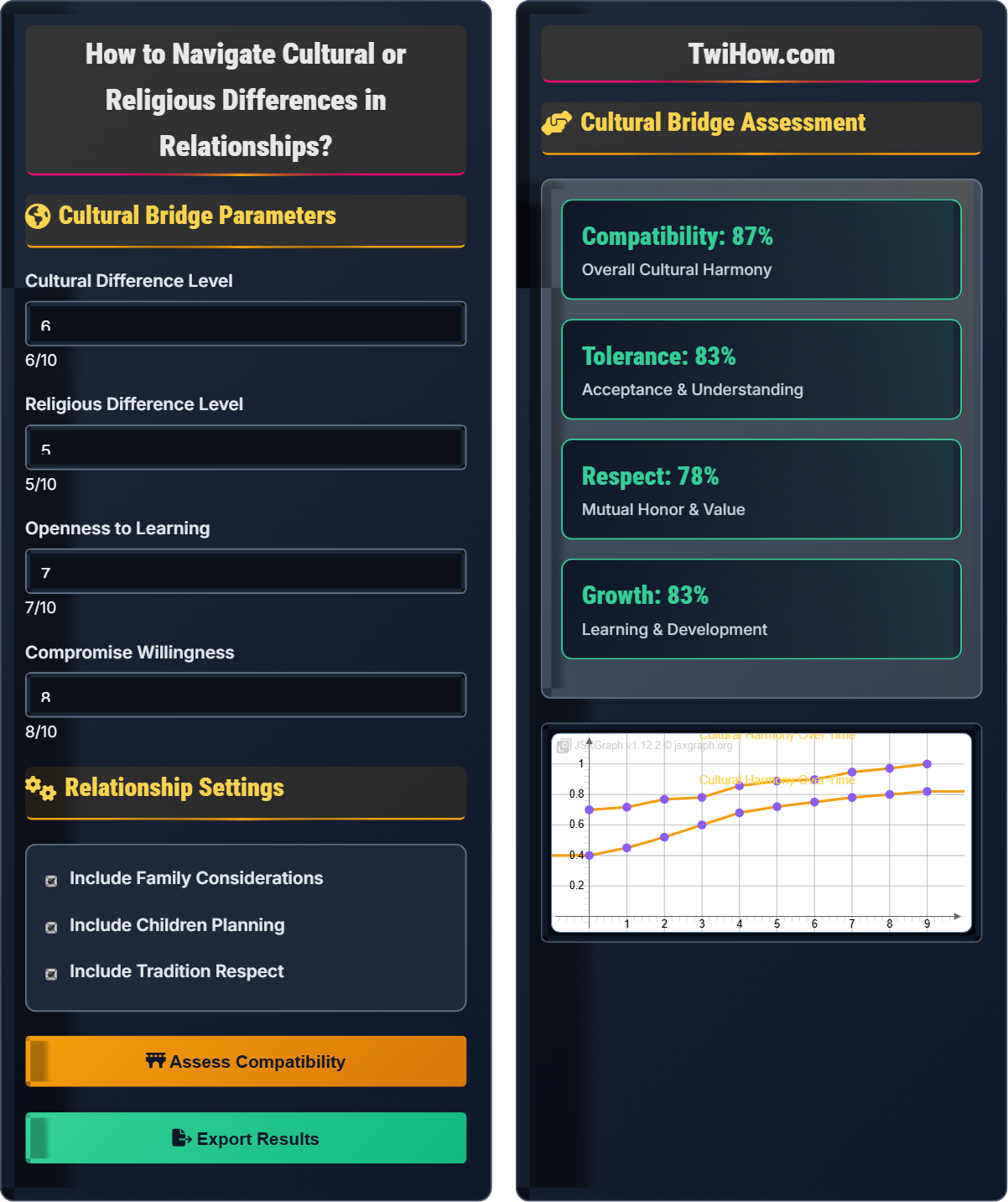
Cultural Bridge Parameters
Relationship Settings
Cultural Bridge Assessment
| Aspect | Score | Challenge Level | Recommendation |
|---|---|---|---|
| Cultural Understanding | 78% | Moderate | Continue learning about each other's backgrounds. |
| Religious Tolerance | 75% | Moderate | Establish clear boundaries and shared values. |
| Family Integration | 72% | High | Plan family meetings and cultural introductions. |
| Future Planning | 80% | Low | Good alignment on major life decisions. |
Understanding Cultural and Religious Differences in Relationships
Cultural differences encompass the variations in customs, traditions, values, communication styles, and lifestyle practices between partners from different cultural backgrounds. These differences can include language, food preferences, family structures, social norms, holidays, and life perspectives. Successfully navigating these differences requires awareness, respect, and a willingness to learn and adapt.
Religious differences involve varying beliefs about God, spiritual practices, moral values, worship methods, and life philosophies. The equation for managing religious differences can be expressed as:
Where:
- Respect: Valuing partner's beliefs
- Tolerance: Accepting differences without trying to change
- Communication: Open dialogue about faith practices
- Judgment: Negative evaluation of beliefs
- Inflexibility: Unwillingness to compromise
Key areas where cultural and religious differences commonly emerge:
- Family Roles: Gender expectations, family hierarchy, decision-making
- Holidays and Celebrations: Which holidays to observe, how to celebrate
- Food and Dietary Practices: Religious dietary restrictions, meal preferences
- Religious Observances: Prayer times, worship attendance, religious education
- Child Rearing: Discipline methods, education priorities, values teaching
- Communication Styles: Direct vs. indirect communication, emotional expression
- Early Discussions: Address differences before they become problems
- Respectful Learning: Approach differences with curiosity, not judgment
- Compromise Framework: Find middle ground on important issues
- Support Systems: Seek guidance from counselors or interfaith communities
- Family Integration: Gradually introduce families to each other
- Shared Values: Focus on common principles and goals
Cultural and Religious Fundamentals
Tolerance, respect, communication, compromise, empathy, cultural sensitivity, religious freedom.
Relationship Harmony = (Respect × Communication × Compromise) / (Judgment + Inflexibility)
Where Respect = honoring differences, Communication = open dialogue, Compromise = finding middle ground.
- Never try to convert or change your partner
- Respect boundaries around religious practices
- Communicate openly about differences
Practical Applications
Interracial relationships, interfaith marriages, multicultural families, cross-cultural communication.
- Learn about partner's culture/religion
- Attend cultural/religious events together
- Discuss future plans openly
- Involve families gradually
- Create blended traditions
- Seek support when needed
- Family acceptance may take time
- Children's upbringing requires planning
- Religious holidays need accommodation
- Communication styles may differ
Cultural Practices
Accommodating dietary restrictions, trying new cuisines, sharing traditional recipes.
Participating in each other's festivals, creating new traditions, respecting observances.
Understanding different family structures, hierarchies, and relationship expectations.
Religious Practices
Respecting prayer times, attending services together, creating spiritual space for both.
Deciding on children's religious education, teaching about both traditions.
Finding common ethical principles, discussing differences respectfully.
Cultural and Religious Navigation Quiz
When your partner practices a religion different from yours, the most respectful approach is:
The most respectful approach is to show respectful curiosity and participate when invited. This demonstrates genuine interest in your partner's spiritual life while maintaining your own beliefs. It allows for mutual understanding without pressure to change. Avoiding their practices entirely can feel dismissive, while trying to convert them is disrespectful and damaging to the relationship.
The answer is C) Show respectful curiosity and participate when invited.
Religious differences require delicate handling that respects both partners' spiritual journeys. The key is creating space for both belief systems without demanding conformity. This approach honors your partner's identity while preserving your own. It's possible to love someone deeply while holding different spiritual beliefs, as long as both partners feel respected in their convictions.
Religious Tolerance: Accepting different faiths without trying to change them
Spiritual Respect: Honoring partner's religious practices and beliefs
Interfaith Dialogue: Constructive conversation about religious differences
• Never pressure conversion
• Respect religious boundaries
• Support spiritual growth
• Ask thoughtful questions about their faith
• Attend services together occasionally
• Learn about religious holidays and practices
• Trying to prove one religion superior
• Dismissing partner's spiritual needs
• Assuming all followers believe identically
Describe the challenges and strategies for integrating families with different cultural backgrounds. How can couples navigate family expectations while maintaining their own values?
Challenges: Different family hierarchies, communication styles, expectations about roles, holiday traditions, and involvement in the relationship. Families may have concerns about cultural compatibility or fear losing their child to a different culture.
Strategies: Gradual introductions, education about each other's cultures, setting clear boundaries about involvement, creating new family traditions that honor both backgrounds, and presenting a united front as a couple.
Maintaining Values: Couples should discuss their core values early and agree on how to handle family pressures. They should communicate to families that while they respect traditions, they're creating their own family culture. Consistent messaging and mutual support help families adjust over time.
Family integration in multicultural relationships is often the longest-term challenge. Extended families may need time to adjust to cultural differences, and this process can't be rushed. The couple's unity is crucial—when both partners present a consistent message about boundaries and expectations, families are more likely to respect those decisions. Patience and persistence are essential as families gradually become more accepting.
Cultural Integration: Process of blending different cultural practices
Family Boundaries: Limits set regarding family involvement
Unified Front: Consistent approach taken by both partners
• Both partners must agree on family boundaries
• Respect both families equally
• Communicate expectations clearly
• Start with small gatherings
• Prepare families for cultural differences
• Create new traditions that honor both cultures
• Taking sides in family conflicts
• Not preparing families adequately
• Allowing one family to dominate
A Christian and Muslim couple needs to plan how to handle major religious holidays. The Christian partner celebrates Christmas and Easter, while the Muslim partner observes Ramadan and Eid. How can they create a meaningful celebration plan that honors both traditions while spending quality time together?
Christmas Planning: Partner can participate in celebrations while maintaining own traditions, exchange gifts on both occasions, incorporate elements from both cultures.
Ramadan Accommodation: Christian partner can show support by fasting part of the day, preparing meals for iftar, respecting dietary restrictions.
Eid Celebration: Participate in festivities, learn about significance, share in joyous traditions.
Flexible Scheduling: Alternate years for extended family visits, create new traditions that blend both cultures.
Children Consideration: If applicable, teach about both traditions, let them choose participation as they mature.
Communication: Discuss expectations annually, be flexible with plans as needed.
Holiday planning in interfaith relationships requires creativity and flexibility. The goal is not to merge traditions completely but to honor both while creating shared experiences. Support doesn't mean conversion—it means showing care and interest in what matters to your partner. The key is ensuring both partners feel their traditions are valued and respected.
Interfaith Celebration: Honoring multiple religious traditions
Cultural Accommodation: Adjusting practices to respect differences
Religious Support: Showing care for partner's spiritual practices
• Honor both traditions equally
• Respect religious obligations
• Plan ahead for major holidays
• Learn about the significance of each holiday
• Create new traditions that blend both cultures
• Be flexible with scheduling arrangements
• Ignoring partner's religious obligations
• Forcing participation in uncomfortable practices
• Not planning for recurring conflicts
An American partner who values direct communication and immediate feedback is in a relationship with a Japanese partner who values indirect communication and harmony. How can they bridge this communication gap while respecting both styles?
Understanding Phase: Learn about each other's communication styles and cultural reasons behind them. The American partner should understand that indirectness isn't dishonesty but a way to preserve harmony.
Adaptation Phase: Americans can soften directness with more context and gentler phrasing. Japanese partner can practice more direct communication for important issues.
Compromise Framework: Use direct communication for facts and logistics, indirect for sensitive emotional topics.
Feedback System: Regular check-ins about communication effectiveness and comfort levels.
Third Option: Written communication for complex or emotionally charged topics, allowing time for processing.
Success requires patience, practice, and mutual respect for different approaches.
Communication style differences often cause the most misunderstandings in multicultural relationships. What one person considers honest, another might perceive as harsh. Understanding the cultural roots of these differences helps partners appreciate rather than judge different approaches. The goal isn't to abandon one's natural style but to expand communication repertoire to include both approaches.
Direct Communication: Explicit expression of thoughts and feelings
Indirect Communication: Implicit expression through context and implication
High-Context Culture: Communication relies heavily on context
• Don't assume bad intentions behind communication style
• Ask for clarification instead of making assumptions
• Practice new communication approaches
• Learn about each other's cultural communication norms
• Use "I" statements to express needs
• Be patient during communication adjustments
• Judging communication style as right or wrong
• Not asking for clarification when confused
• Forcing one's own style on the partner
When raising children in an interfaith relationship, the most beneficial approach is:
Exposing children to both traditions and letting them choose as they mature is generally most beneficial. This approach respects both parents' beliefs while giving children the opportunity to make informed decisions about their own spirituality. It allows them to understand and appreciate both heritages without forcing premature choices.
The answer is B) Expose children to both traditions and let them choose.
Children in interfaith families benefit from exposure to multiple perspectives, which can create open-mindedness and cultural competency. The key is providing age-appropriate information about both traditions without pressuring choices. As children mature, they can explore which spiritual path resonates most with their developing identity. This approach requires both parents to commit to exposing children to both traditions respectfully.
Interfaith Upbringing: Exposing children to multiple religious traditions
Spiritual Exploration: Allowing children to discover their own beliefs
Religious Heritage: Family's cultural and spiritual background
• Present both traditions positively
• Allow children to explore freely
• Respect their eventual choices
• Teach children about both traditions' values
• Attend services together occasionally
• Answer questions honestly about differences
• Forcing early religious decisions
• Speaking negatively about either tradition
• Withholding information about heritage
FAQ
Q: How do we handle disapproval from our families about our interfaith relationship?
A: Handling family disapproval requires patience, consistency, and clear boundaries:
1. Present a United Front: Both partners must consistently show commitment to each other
2. Gradual Introduction: Allow families to get to know each other slowly and positively
3. Education: Share information about your partner's faith and culture to reduce fears
4. Set Boundaries: Be clear about what behavior toward your relationship is acceptable
5. Seek Support: Connect with other interfaith couples for encouragement
6. Show Success: Demonstrate that your relationship is healthy and loving
Remember that acceptance often takes time, and some family members may never fully approve. Focus on building your relationship while maintaining respectful contact with families.
Q: I'm interested in someone from a very different cultural background. How do I prepare for potential challenges?
A: Preparation for cross-cultural dating involves several key steps:
Education Phase: Learn about your potential partner's culture, history, values, and traditions. Read books, watch documentaries, and speak with others from that culture.
Self-Reflection: Examine your own cultural biases and assumptions. Consider how your background influences your expectations.
Communication Skills: Develop patience and active listening skills. Practice asking open-ended questions about their experiences.
Family Preparation: Think about how your families might react and how you'll handle those conversations.
Flexibility Mindset: Be prepared to adapt your habits, routines, and perspectives when appropriate.
Support Network: Identify resources and other multicultural couples who can offer guidance.
The most important preparation is cultivating genuine curiosity and respect for differences.