How to Support a Loved One with Mental Health Challenges?
Complete mental health support guide • Step-by-step explanations
Mental Health Support Fundamentals:
Show Support AssessmentSupporting a loved one with mental health challenges requires empathy, understanding, and practical assistance. Effective support involves listening without judgment, offering practical help, and encouraging professional treatment while maintaining your own well-being. The goal is to provide consistent, compassionate support that empowers your loved one to manage their mental health journey.
Key components of mental health support:
- Education: Learning about specific mental health conditions
- Communication: Using empathetic, non-judgmental dialogue
- Boundaries: Maintaining healthy limits while providing support
- Resources: Connecting to professional help and community resources
- Self-Care: Taking care of your own mental health
- Consistency: Providing reliable, ongoing support
Successful support requires patience, self-awareness, and recognition that you cannot "fix" someone else's mental health.
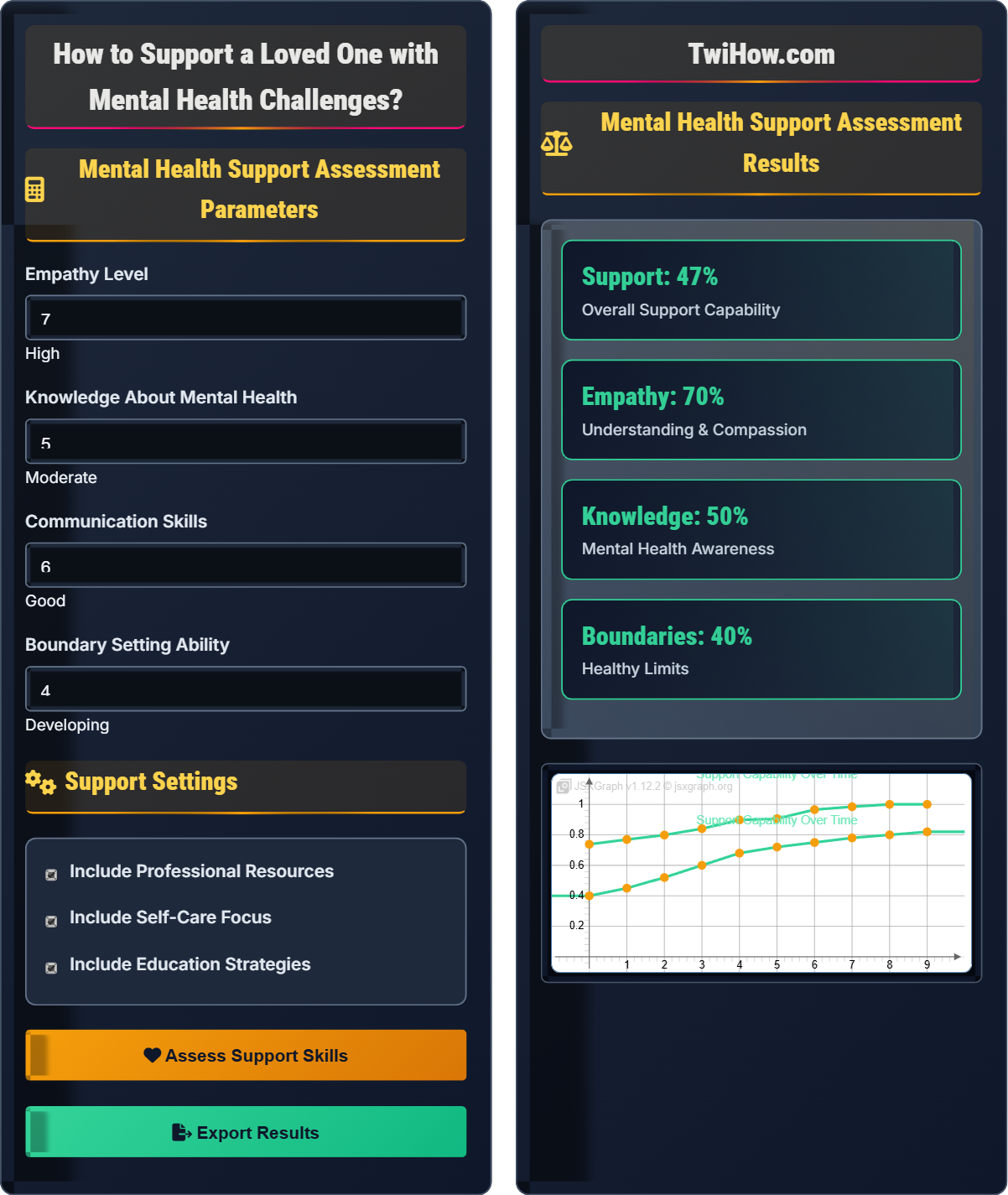
Mental Health Support Assessment Parameters
Support Settings
Mental Health Support Assessment Results
| Area | Score | Development Level | Focus Area |
|---|---|---|---|
| Empathy | 72% | Strong | Maintain current compassion levels. |
| Knowledge | 55% | Developing | Learn more about specific conditions. |
| Communication | 62% | Developing | Enhance dialogue techniques. |
| Boundaries | 48% | Emerging | Strengthen personal limits. |
Learn about the specific mental health condition your loved one is facing.
Provide a safe space for open, honest communication.
Support seeking therapy, medication, or other treatments.
Take care of your own mental health while supporting others.
Understanding Mental Health Support for Loved Ones
Mental health support involves providing emotional, practical, and informational assistance to someone dealing with mental health challenges. The equation for effective support can be expressed as:
Where:
- Empathy: Ability to understand and share feelings
- Knowledge: Understanding of mental health conditions
- Communication: Effective dialogue and listening skills
- Judgment: Critical or condemning attitudes
- Burnout: Personal exhaustion from over-giving
Successful mental health support follows a structured approach:
Where increasing understanding, empathy, resource provision, and self-care creates better support outcomes.
Providing effective mental health support offers numerous benefits:
- Improved Treatment Outcomes: Better engagement with professional help
- Reduced Isolation: Decreased feelings of loneliness and stigma
- Enhanced Recovery: Faster and more sustainable healing
- Stronger Relationships: Deeper bonds and trust
- Increased Hope: Renewed optimism about recovery
- Prevention: Reduced risk of crisis situations
- Open Communication: When they reach out or seem ready to talk
- Signs of Distress: When you notice changes in behavior or mood
- During Treatment: Supporting therapy, medication, or other interventions
- Crises: During acute mental health episodes
- Recovery: During healing and rebuilding phases
- Anniversaries: During potentially triggering dates or events
Support Strategies
Education, active listening, encouragement, practical assistance, boundary setting, self-care.
Support Effectiveness = (Empathy × Knowledge × Communication) / (Judgment + Burnout)
Where higher scores indicate better support capabilities.
- You cannot "fix" someone else's mental health
- Professional help is often necessary
- Self-care is essential for sustainable support
Wellness Techniques
Family support, friendship assistance, workplace accommodations, community resources.
- Learn about the specific condition
- Practice active listening skills
- Encourage professional treatment
- Offer practical assistance
- Set healthy boundaries
- Maintain your own well-being
- Everyone's needs are different
- Support may be rejected initially
- Recovery is not linear
- Professional help may be needed
Support Strategies
Learning about specific mental health conditions and treatment options.
Providing undivided attention without judgment or advice-giving.
Motivating professional help-seeking and treatment compliance.
Wellness Techniques
Offering concrete help with daily tasks or appointments.
Maintaining healthy limits while providing support.
Taking care of your own mental health during the process.
Mental Health Support Strategies Quiz
When supporting a loved one with mental health challenges, the most important approach is:
The most important approach is listening without judgment and offering empathy. Mental health challenges require understanding and compassion, not immediate problem-solving or avoidance. Active listening creates a safe space for your loved one to express their feelings and shows that you care about their experience.
The answer is B) Listening without judgment and offering empathy.
When someone is struggling with mental health, they often need to feel heard and understood rather than fixed. Our instinct might be to solve their problems, but mental health challenges are complex and often require professional intervention. The most powerful thing you can offer is your presence, attention, and validation of their experience. This creates trust and opens the door for them to seek professional help.
Active Listening: Fully focusing on understanding the speaker
Empathy: Understanding and sharing another's feelings
Validation: Acknowledging the legitimacy of someone's experience
• Listen to understand, not to respond
• Avoid giving unsolicited advice
• Validate feelings without judgment
• Use open-ended questions like "How are you feeling?"
• Reflect back what you hear to confirm understanding
• Ask "What would be helpful right now?"
• Trying to solve problems instead of listening
• Minimizing their experience with "at least" statements
• Avoiding the conversation altogether
Explain how to encourage a loved one to seek professional help for mental health challenges. What are the key principles and approaches?
Normalize Help-Seeking: Emphasize that therapy and treatment are normal and healthy responses to mental health challenges.
Share Information: Provide factual information about different treatment options without being pushy.
Offer Practical Support: Help with logistics like finding providers, scheduling appointments, or transportation.
Lead by Example: If appropriate, share your own positive experiences with mental health support.
Be Patient: Understand that they may not be ready to seek help immediately.
Focus on Benefits: Highlight how professional support could improve their quality of life.
Remember that you cannot force someone to seek help, but you can provide support and resources.
Encouraging professional help requires a delicate balance between being supportive and respecting autonomy. Many people resist therapy due to stigma, fear, or denial. The key is to remove barriers to seeking help while respecting their right to make their own decisions. This involves education, normalization, and practical assistance rather than pressure or ultimatums.
Normalization: Making mental health support seem ordinary and acceptable
Autonomy: Respecting someone's right to make their own decisions
Logistical Support: Practical assistance with accessing services
• You cannot force someone to seek help
• Respect their autonomy and decisions
• Provide support regardless of their choices
• Research providers together if they're open to it
• Offer to accompany them to appointments
• Share positive stories about mental health treatment
• Making ultimatums about seeking help
• Being pushy or judgmental about their resistance
• Taking their refusal personally
Your colleague has been open about struggling with anxiety and depression. They've mentioned feeling overwhelmed at work. How do you support them while maintaining professional boundaries?
Listen Supportively: Offer a brief, private conversation if they initiate it, but don't probe further.
Respect Privacy: Keep their disclosures confidential and don't share with others.
Encourage Professional Help: Gently suggest they speak with Employee Assistance Program if available.
Offer Practical Support: Help with immediate work tasks if appropriate, but don't take over their responsibilities.
Set Boundaries: Maintain professional relationship and avoid becoming their primary support system.
Know Your Limits: Refer them to appropriate resources when needed.
Workplace support requires balancing compassion with professional boundaries. The goal is to provide appropriate support while maintaining the professional relationship. This means being empathetic and helpful without taking on the role of therapist or primary support person. It's important to encourage professional resources and maintain appropriate boundaries for both parties.
Employee Assistance Program: Workplace mental health support services
Professional Boundaries: Limits that maintain appropriate workplace relationships
Confidentiality: Keeping sensitive information private
• Maintain confidentiality about their disclosures
• Don't take on therapeutic role
• Encourage professional resources
• Offer brief check-ins rather than lengthy conversations
• Know your company's mental health resources
• Focus on work-related support rather than personal therapy
• Becoming their primary emotional support at work
• Sharing their disclosures with others
• Taking on their work responsibilities indefinitely
Your family member is experiencing a mental health crisis and is resistant to professional help. They're becoming increasingly isolated and their condition is deteriorating. How do you approach this situation while maintaining your own well-being?
Ensure Safety: Assess if there are immediate safety concerns that require emergency intervention.
Seek Guidance: Contact mental health professionals for advice on how to proceed.
Involve Others: Reach out to other family members or friends who can help.
Set Limits: Establish boundaries about what support you can provide.
Take Care of Yourself: Maintain your own mental health and well-being.
Professional Resources: Connect with crisis hotlines, mental health organizations, or intervention specialists.
Remember that you cannot control someone else's choices, but you can control your responses.
Crisis situations require immediate action but also careful consideration of safety and boundaries. When someone is in crisis and resistant to help, it's important to involve professionals who have experience with such situations. The key is balancing compassion with practical safety measures while protecting your own mental health. You cannot save someone who doesn't want to be saved, but you can provide support and resources.
Mental Health Crisis: Acute episode requiring immediate intervention
Intervention: Structured approach to encourage treatment
Safety Assessment: Evaluating risk of harm to self or others
• Safety is the primary concern in crisis situations
• You cannot control someone else's choices
• Professional guidance is essential in crisis
• Contact National Suicide Prevention Lifeline for guidance
• Document concerning behaviors for professional reference
• Connect with support groups for families
• Trying to handle crisis alone without professional help
• Ignoring signs of immediate danger
• Sacrificing your own well-being in the process
Why is self-care important when supporting someone with mental health challenges?
Self-care is important to avoid burnout and maintain sustainable support. Supporting someone with mental health challenges can be emotionally and physically draining. Taking care of your own needs ensures that you can continue providing support over the long term without becoming overwhelmed or resentful.
The answer is B) To avoid burnout and maintain sustainable support.
Supporting someone with mental health challenges is like being on an airplane - you need to put on your own oxygen mask first. This isn't selfish; it's practical. If you become depleted, burned out, or overwhelmed, you won't be able to provide effective support. Self-care ensures that you maintain your own emotional and physical health, which ultimately benefits both you and your loved one. Sustainable support requires balance.
Burnout: Emotional and physical exhaustion from over-giving
Sustainable Support: Long-term assistance without depletion
Self-Care: Actions to maintain personal well-being
• You cannot pour from an empty cup
• Self-care enables better support
• Maintaining your health is not selfish
• Schedule regular breaks from caregiving duties
• Maintain your own social connections
• Practice stress-reduction techniques
• Neglecting your own needs completely
• Feeling guilty about taking care of yourself
• Not setting boundaries to protect your well-being
FAQ
Q: What if my loved one doesn't want my support or pushes me away?
A: When a loved one pushes you away:
1. Respect Their Space: Don't force interaction if they need distance
2. Stay Available: Let them know you're there when they're ready
3. Be Consistent: Continue to offer support without pressure
4. Focus on Self-Care: Take care of your own emotional needs
5. Encourage Other Supports: Help them connect with other resources
6. Stay Connected: Send occasional messages showing you care
Remember that resistance often comes from shame, fear, or feeling overwhelmed.
Q: How do I know if I'm doing enough to support my loved one?
A: Signs you're providing good support:
Consistency: You're reliably available and supportive
Boundaries: You're maintaining your own well-being
Communication: You're listening without judgment
Encouragement: You're supporting professional treatment
Respect: You're honoring their autonomy and decisions
Self-Care: You're maintaining your own health and relationships
Remember that you're supporting, not curing their mental health challenges.