How to Support Mental Health in Relationships
Complete guide • Step-by-step explanations
Mental Health in Relationships:
Show Support SimulatorSupporting mental health in relationships involves creating a safe, understanding, and supportive environment where both partners can thrive emotionally. It requires effective communication, setting healthy boundaries, practicing self-care, and knowing when to seek professional help.
Key aspects of mental health support in relationships include:
- Active Listening: Giving full attention and validating your partner's feelings
- Emotional Boundaries: Respecting limits and maintaining your own well-being
- Self-Care Practices: Taking care of your own mental health to better support your partner
- Professional Resources: Knowing when and how to access mental health services
Healthy relationships contribute significantly to mental wellness by providing emotional support, reducing stress, and fostering a sense of belonging and security.
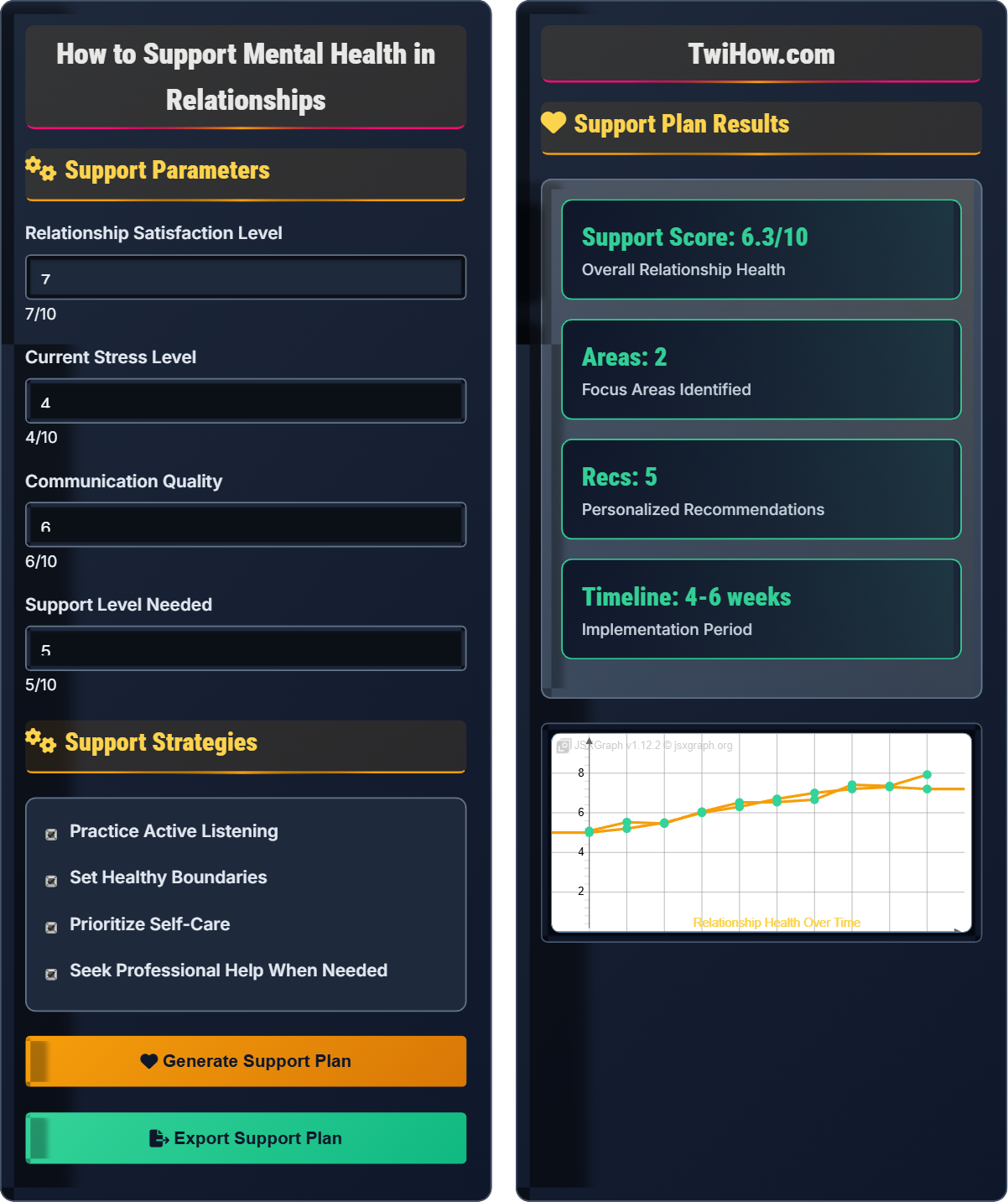
Support Parameters
Support Strategies
Support Plan Results
| Priority | Strategy | Timeline | Impact |
|---|---|---|---|
| 1 | Improve Communication | Week 1-2 | High |
| 2 | Set Boundaries | Week 2-3 | Medium |
| 3 | Practice Self-Care | Ongoing | High |
| 4 | Reduce Stress | Week 3-4 | Medium |
| 5 | Seek Support | As Needed | High |
Practice active listening, validate feelings, and express needs clearly.
Establish clear limits and respect each other's emotional and physical space.
Prioritize individual well-being to maintain capacity for supporting your partner.
Supporting Mental Health in Relationships Explained
Mental health support in relationships involves creating an environment where both partners feel safe, understood, and valued. It encompasses emotional validation, practical assistance, and encouragement for seeking professional help when needed. Effective support requires balance between helping your partner and maintaining your own mental well-being.
Mental health support in relationships can be understood through this formula:
Where:
- Communication: Quality of emotional exchange and understanding
- Boundaries: Respectful limits that protect both individuals
- Self-Care: Individual practices that maintain personal well-being
- Stress Factors: External pressures affecting the relationship
- Support: Mutual assistance and emotional availability
Key areas where mental health support strengthens relationships:
- Depression Support: Encouraging professional treatment, providing companionship
- Anxiety Management: Creating calm environments, practicing grounding techniques together
- Stress Reduction: Shared relaxation activities, problem-solving approaches
- Conflict Resolution: Healthy communication during disagreements
- Life Transitions: Supporting each other through major changes
- Crisis Management: Emergency support and professional intervention
- Active Listening: Fully attending to your partner's concerns without judgment
- Validation: Acknowledging feelings as real and important
- Practical Help: Assisting with daily tasks during difficult periods
- Encouragement: Motivating positive steps toward mental wellness
- Patience: Understanding that recovery and growth take time
Mental Health Fundamentals
Active listening, validation, boundaries, self-care, professional resources.
Relationship Health = (Communication + Boundaries + Self-Care) / Stress × Support
Where Communication = emotional exchange quality, Boundaries = respectful limits, Self-Care = personal well-being maintenance.
- You cannot support others if you neglect your own mental health
- Professional help is sometimes necessary and beneficial
- Boundaries protect both partners' well-being
Application Scenarios
Depression support, anxiety management, stress reduction, crisis intervention.
- Daily check-ins and emotional validation
- Creating safe spaces for expression
- Developing coping strategies together
- Connecting with professional resources
- Know your limits as a supporter
- Recognize when professional help is needed
- Balance giving and receiving support
- Maintain your own identity and interests
Support Scenarios
Your partner has been experiencing low mood, decreased energy, and withdrawal from activities they once enjoyed. Here's how to provide support:
- Listen Without Judgment: Allow them to express their feelings without trying to immediately fix everything
- Encourage Professional Help: Gently suggest therapy or counseling if they haven't already sought help
- Provide Structure: Help with daily routines and gentle encouragement to maintain basic self-care
- Be Patient: Recovery takes time and setbacks are normal
- Maintain Your Own Health: Don't neglect your own needs while supporting your partner
Your partner experiences panic attacks and social anxiety. Here's how to help:
- Learn About Anxiety: Understand symptoms and triggers to provide better support
- Practice Grounding Techniques: Learn breathing exercises and grounding methods together
- Create Safe Spaces: Make home environments calming and supportive
- Respect Boundaries: Don't force exposure to anxiety-provoking situations
- Stay Calm: Remain composed during panic episodes to provide stability
Both partners are feeling overwhelmed due to work stress and family responsibilities:
- Open Communication: Regular check-ins about stress levels and needs
- Shared Responsibilities: Distribute household and emotional labor fairly
- Quality Time: Schedule regular connection time despite busy schedules
- Individual Space: Allow time for separate interests and self-care
- Seek Support: Consider couples therapy if stress becomes overwhelming
Daily Check-in Tool
Mental Health Resources
- National Suicide Prevention Lifeline: 988 or 1-800-273-8255
- Crisis Text Line: Text HOME to 741741
- National Domestic Violence Hotline: 1-800-799-7233
- SAMHSA National Helpline: 1-800-662-4357
- Headspace: Meditation and mindfulness
- Calm: Relaxation and sleep support
- Talkspace: Online therapy platform
- BetterHelp: Counseling services
- Sanvello: Mood tracking and CBT tools
Mental Health Support Quiz
Which of the following is the MOST effective way to support a partner experiencing a mental health crisis?
Effective support during a mental health crisis begins with active listening and validation. This means acknowledging your partner's feelings as real and important without trying to immediately solve the problem or minimize their experience. Active listening helps your partner feel heard and understood, which can be calming and reassuring during distressing moments.
The answer is B) Listen without judgment and validate their feelings.
During mental health crises, people often feel isolated and misunderstood. The primary goal of support is to provide emotional safety and connection. Validation doesn't mean agreeing with everything your partner says, but rather acknowledging that their emotions are real and valid. This approach builds trust and creates space for more productive problem-solving later.
Active Listening: Fully focusing on and responding to your partner's communication
Validation: Acknowledging that someone's feelings are real and understandable
Mental Health Crisis: A situation where someone's mental state puts them at risk of harm
• Listen first, offer solutions later
• Avoid minimizing their experience
• Stay calm and present
• Use phrases like "That sounds really difficult"
• Ask "How can I best support you right now?"
• Focus on presence rather than problem-solving
• Trying to "fix" everything immediately
• Comparing their experience to others
• Dismissing their feelings as irrational
Explain the importance of setting healthy boundaries when supporting a partner's mental health. Why is it crucial to maintain your own well-being while providing support?
Boundary Importance: Healthy boundaries protect both partners' mental health by establishing clear expectations, limits, and responsibilities. They prevent codependency and ensure that support doesn't become overwhelming or detrimental to either person.
Self-Care Necessity: Maintaining your own well-being is essential because you cannot pour from an empty cup. When you neglect your own mental health, you become less effective as a support person and may experience burnout, resentment, or your own mental health decline.
Balance: Boundaries allow for mutual support while preserving individual identity and autonomy. They ensure that helping behaviors remain healthy rather than enabling or overwhelming.
The concept of boundaries in mental health support is often misunderstood as being uncaring or distant. In reality, boundaries are acts of care for both people involved. They create sustainable support systems that can endure over time. Without boundaries, supporters may become exhausted or develop their own mental health issues, ultimately reducing their ability to help their partner.
Boundaries: Limits that define acceptable behavior and responsibilities
Codependency: Excessive emotional reliance on another person
Burnout: Physical and emotional exhaustion from prolonged stress
• You are not responsible for fixing your partner's mental health
• Your well-being matters equally
• Boundaries can be adjusted as needed
• Communicate boundaries clearly and compassionately
• Practice saying no when necessary
• Schedule regular self-care time
• Believing that good partners sacrifice everything
• Feeling guilty for having needs
• Blurring the line between helping and fixing
Sarah's partner Alex has been diagnosed with depression and anxiety. Alex often cancels plans and isolates during difficult periods. Sarah feels frustrated because she wants to help but doesn't know how to support Alex without becoming overwhelmed herself. Describe a balanced approach Sarah could take to support Alex while maintaining her own mental health.
For Alex: Sarah should acknowledge that depression and anxiety cause real symptoms that affect Alex's ability to participate in activities. She should offer gentle encouragement without pressure and provide reassurance that their relationship isn't dependent on constant activity.
For Sarah: She should set boundaries around her availability for support, maintain her own social connections, and schedule regular self-care activities. She should communicate her needs clearly and ask for what she needs in return.
Together: They should establish regular check-ins, explore professional treatment options for Alex, and create a support plan that includes both individual and couple-focused strategies.
This scenario illustrates the complexity of supporting a partner with mental illness while maintaining your own well-being. The key is finding a middle ground between being supportive and avoiding burnout. Both partners have valid needs that deserve attention, and the relationship benefits when both people are functioning at their best.
Depression Symptoms: Low energy, motivation problems, isolation tendencies
Support Balance: Helping without enabling or becoming overwhelmed
Professional Treatment: Therapy, medication, or other clinical interventions
• Mental illness symptoms are not character flaws
• Both partners' needs matter
• Professional help is often necessary
• Offer flexible support options
• Maintain your own identity and interests
• Plan low-pressure activities
• Taking canceled plans personally
• Becoming the sole source of support
• Ignoring warning signs of your own stress
Your partner has been showing signs of increased anxiety, sleeping difficulties, and expressing hopelessness about the future. They recently mentioned that life feels "too much" and that "things won't get better." How should you respond, and what resources should you access?
Immediate Response: Take these statements seriously as potential warning signs of suicidal ideation. Ask directly about suicide thoughts in a non-judgmental way: "Are you having thoughts of harming yourself?"
Support Actions: Stay with your partner, remove access to means of self-harm, and connect with professional help immediately. Do not leave them alone if there's active risk.
Resources: Call 988 (Suicide & Crisis Lifeline), contact their therapist, or take them to the emergency room. Have crisis numbers readily available.
Follow-up: Ensure ongoing professional support and continue to monitor for warning signs.
Recognizing crisis warning signs is crucial for preventing tragic outcomes. Many people worry that asking about suicide will put the idea in someone's head, but research shows this is not true. Direct, compassionate questioning can actually provide relief and open the door to help. Immediate action is essential when safety is at risk.
Suicidal Ideation: Thoughts about ending one's life
Crisis Warning Signs: Behaviors indicating immediate riskMeans Restriction: Removing access to lethal methods
• Take all threats seriously
• Ask directly about suicidal thoughts
• Seek immediate professional help
• Keep crisis hotlines accessible
• Develop a safety plan together
• Connect with mental health professionals
• Dismissing concerning statements
• Promising to keep suicidal thoughts secret
• Waiting to see if things improve
Which of the following is the BEST example of maintaining self-care while supporting a partner's mental health?
Effective support requires maintaining your own well-being so you can be present and helpful for your partner. Scheduling regular personal time demonstrates healthy boundary-setting and self-respect, while still prioritizing your partner's needs. This approach creates sustainable support that benefits both partners.
The answer is B) Scheduling regular personal time while remaining available for support.
Self-care in the context of supporting others is not selfish—it's essential. When you maintain your own physical, emotional, and mental health, you're better equipped to provide consistent, effective support. This approach prevents resentment, burnout, and the deterioration of your own mental health, which would ultimately harm both you and your partner.
Self-Care: Activities that maintain your physical and mental health
Sustainable Support: Support that can be maintained over time
Burnout Prevention: Maintaining energy and effectiveness
• Your well-being enables better support
• Boundaries benefit both partners
• Self-care is not selfish
• Schedule self-care activities regularly
• Communicate your needs clearly
• Maintain outside relationships
• Believing you must sacrifice everything
• Feeling guilty about personal needs
• Neglecting your own mental health
FAQ
Q: How do I know when my partner needs professional help versus when I can support them myself?
A: While you can provide emotional support, companionship, and encouragement, professional help is needed when:
1. Safety Concerns: Any mention of self-harm or suicidal thoughts
2. Impairment: Difficulty with daily functioning, work, or relationships
3. Duration: Symptoms persist for weeks or months without improvement
4. Severity: Symptoms are intense and overwhelming
5. Resistance: Your partner is unwilling to engage in support efforts
Your role is to encourage professional help, not replace it. You can support by researching therapists, offering to attend appointments, or helping with practical barriers to treatment.
Q: My partner has anxiety and sometimes has panic attacks. What should I do when this happens?
A: During a panic attack, remember the 4 A's approach:
Accept: Acknowledge that this is happening and it's temporary
Assure: Reassure your partner that they're safe and the feelings will pass
Assist: Help them with grounding techniques like deep breathing or focusing on objects around them
Allow: Let them handle the attack in their preferred way
Stay calm, speak in a gentle tone, and avoid saying "calm down." Instead, try phrases like "You're safe" or "This will pass." Don't leave them alone unless they request space.
Q: How can I support my partner while also taking care of my own mental health?
A: Think of the airplane oxygen mask principle: put on your own mask first. To support your partner while maintaining your well-being:
1. Set Clear Boundaries: Define your availability and capacity for support
2. Maintain Your Own Support Network: Keep friends, family, or your own therapist
3. Practice Self-Care: Schedule regular activities that recharge you
4. Monitor Your Stress Levels: Notice when you're becoming overwhelmed
5. Communicate Your Needs: Let your partner know when you need space or support
Remember, a healthy relationship involves mutual support, not one-sided caregiving.