Benefits of Friendship Across Different Life Stages
Complete guide • Step-by-step explanations
Friendship Benefits Across Life Stages:
Show Friendship SimulatorFriendships provide essential benefits throughout our lives, adapting to meet our changing needs at each developmental stage. From early childhood socialization to elderly support systems, friendships contribute to emotional well-being, personal growth, and overall life satisfaction. Understanding how these relationships evolve and adapt helps us nurture meaningful connections across our lifespan.
Key aspects of friendship benefits include:
- Childhood Development: Learning social skills, empathy, and cooperation
- Adolescent Growth: Identity formation, peer support, and emotional development
- Adult Support: Career networking, emotional stability, and life partnerships
- Elderly Well-being: Cognitive stimulation, social engagement, and emotional support
Strong friendships across life stages contribute significantly to mental health, longevity, and overall quality of life.
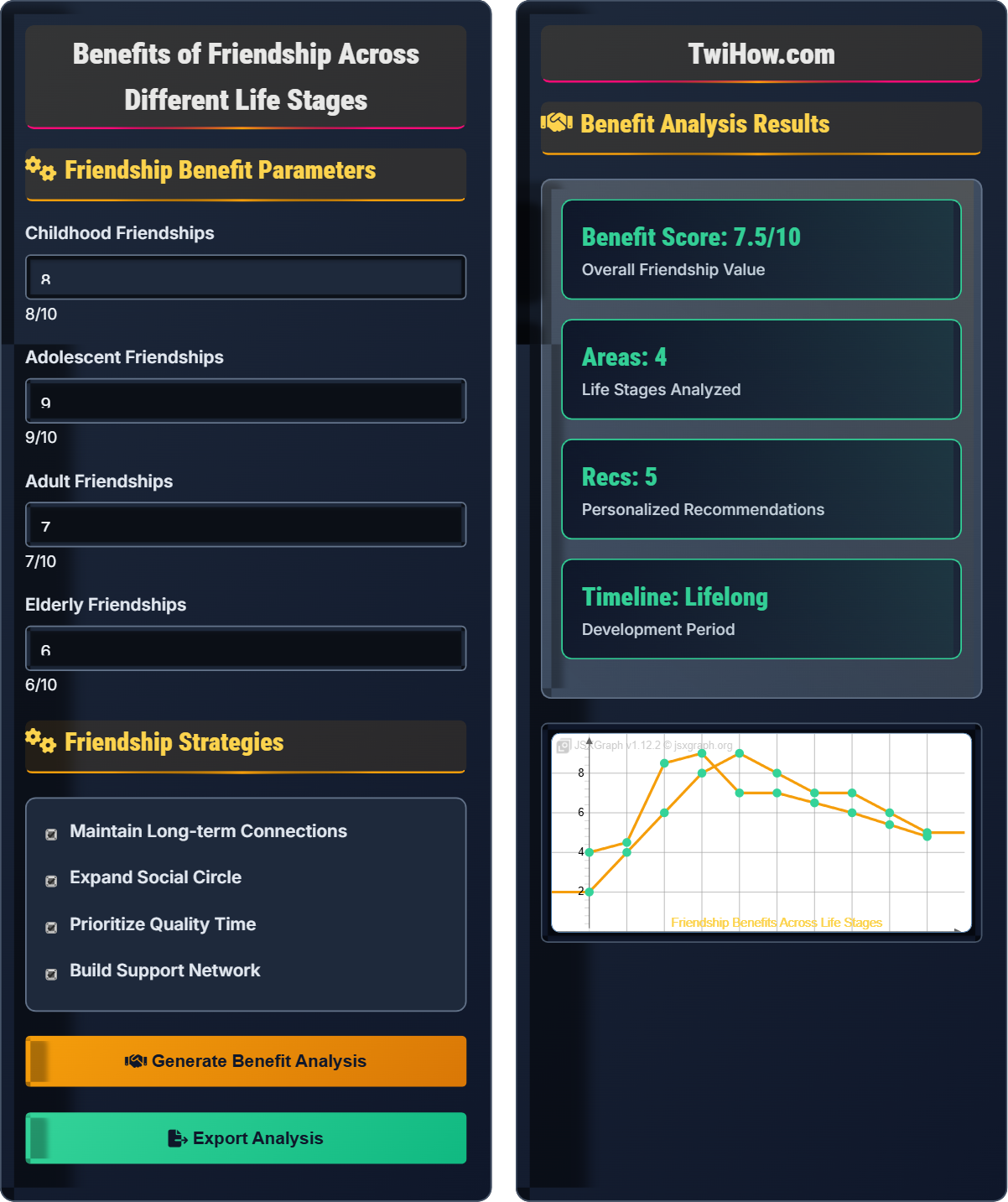
Friendship Benefit Parameters
Friendship Strategies
Benefit Analysis Results
| Stage | Primary Benefits | Impact Level | Development Focus |
|---|---|---|---|
| Childhood | Social Skills | High | Cooperation |
| Adolescence | Identity Support | High | Peer Bonding |
| Young Adult | Networking | Medium | Career Growth |
| Adult | Emotional Support | High | Lifelong Bonds |
| Elderly | Well-being | High | Mental Health |
Encourage play-based friendships and teach social skills through interaction.
Support identity exploration and provide guidance for healthy peer relationships.
Benefits of Friendship Across Life Stages Explained
Friendship benefits encompass the positive impacts that social connections have on our physical, emotional, and psychological well-being throughout different life stages. These benefits evolve as our needs change, providing essential support for development, growth, and resilience at each phase of life. Research consistently shows that strong friendships contribute to better health outcomes, increased longevity, and improved quality of life.
Friendship benefits follow this equation:
Where:
- Quality: Meaningful and deep connections
- Quantity: Number of social connections
- Consistency: Regular contact and engagement
- Isolation: Degree of social isolation
- Support: Mutual assistance and emotional backing
Key areas where friendship benefits strengthen life outcomes:
- Childhood Development: Social skill acquisition and emotional regulation
- Adolescent Growth: Identity formation and peer support
- Adult Success: Career networking and emotional stability
- Health Outcomes: Reduced stress and improved longevity
- Resilience Building: Coping with life challenges
- Wisdom Transmission: Sharing knowledge across generations
- Quality Over Quantity: Deep, meaningful relationships
- Consistency: Regular contact and engagement
- Mutuality: Reciprocal support and care
- Adaptability: Evolving with changing life circumstances
- Investment: Time and energy in maintaining connections
Friendship Benefits Fundamentals
Emotional support, social development, cognitive stimulation, physical health, resilience building.
Life Satisfaction = (Quality × Quantity × Consistency) / Isolation × Support
Where Quality = meaningful connections, Quantity = number of friends, Consistency = regular contact.
- Friendships require ongoing investment and maintenance
- Benefits evolve as life circumstances change
- Quality friendships provide greater benefits than numerous superficial ones
Life Stage Timeline
- Friendship needs change with life circumstances
- Quality matters more than quantity at all ages
- Friendships require adaptation as people grow
- Maintaining connections takes intentional effort
Life Stage Scenarios
Friendships during childhood provide essential social and emotional development opportunities:
- Social Skills: Learning to share, take turns, and cooperate with others
- Emotional Regulation: Practicing empathy and understanding others' feelings
- Self-Confidence: Building self-esteem through positive peer interactions
- Problem-Solving: Working through conflicts and finding compromises
- Language Development: Expanding vocabulary and communication skills
Teenage friendships become crucial for identity formation and emotional support:
- Identity Exploration: Discovering who they are through peer relationships
- Emotional Support: Sharing concerns and receiving validation
- Independence: Developing autonomy away from family
- Belonging: Finding their place in peer groups
- Values Formation: Exploring beliefs and moral reasoning
Adult friendships provide professional networking and emotional stability:
- Career Support: Professional networking and career advice
- Life Transitions: Support during marriage, parenthood, and career changes
- Emotional Stability: Maintaining mental health through life challenges
- Work-Life Balance: Providing perspective and stress relief
- Long-term Commitment: Building lasting bonds that span decades
Senior friendships contribute to cognitive health and life satisfaction:
- Cognitive Stimulation: Engaging in conversations and activities that maintain mental sharpness
- Emotional Support: Providing comfort during health challenges and losses
- Legacy Sharing: Passing wisdom and life experiences to younger generations
- Social Engagement: Preventing isolation and loneliness
- Continued Growth: Opportunities for new experiences and learning
Friendship Assessment Tool
Friendship Resources
- "The Art of Friendship" by Tom Rath - Scientific approach to building meaningful connections
- "Friendship: An Exposition" by C.S. Lewis - Philosophical exploration of friendship
- "The Social Animal" by David Brooks - How relationships shape our development
- "The Friendship Formula" by Kate Leaver - Modern approach to maintaining friendships
- Meetup - Find local groups with shared interests
- Bumble BFF - App specifically for making friends
- Nextdoor - Connect with neighbors
- Eventbrite - Attend local events and activities
- Community Centers: Local gathering places for various activities
- Volunteer Organizations: Opportunities to meet like-minded people
- Sports Clubs: Team-based activities for building connections
- Book Clubs: Intellectual engagement and social interaction
Friendship Across Life Stages Quiz
Which of the following is the most important benefit of friendships during childhood?
During childhood, friendships provide crucial opportunities for developing essential social skills such as sharing, cooperation, empathy, and emotional regulation. These foundational skills learned through peer interactions become the basis for all future relationships. While academic achievement and physical activity are important, the primary benefit of childhood friendships is the development of social competence and emotional intelligence.
The answer is B) Social skill development and emotional regulation.
Childhood friendships serve as laboratories for social learning. Through interactions with peers, children practice essential life skills in a relatively safe environment. They learn to navigate conflicts, understand different perspectives, and regulate their emotions. These experiences are critical for developing the social competency needed for success in adolescence and adulthood.
Social Skills: Abilities to interact effectively with others
Emotional Regulation: Managing emotional responses appropriately
Social Competence: Effectiveness in social interactions
• Childhood friendships lay the foundation for all future relationships
• Social skills are best learned through peer interaction
• Emotional regulation develops through practice
• Encourage play-based social interactions
• Teach conflict resolution skills early
• Model healthy friendship behaviors
• Underestimating the importance of childhood friendships
• Prioritizing academic achievement over social development
• Not providing enough opportunities for peer interaction
Explain the critical role of friendships during adolescence in identity formation and emotional development. Why are peer relationships particularly important during this stage?
Identity Formation: Adolescents use friendships as mirrors to explore different aspects of their personality, values, and beliefs. Peers provide feedback and validation as teens experiment with different identities.
Emotional Support: Teenagers often turn to friends rather than family for emotional support during this tumultuous period of physical and psychological changes.
Independence: Friendships provide a space for adolescents to practice independence and decision-making away from parental supervision.
Belonging: Peer acceptance and group membership fulfill the fundamental human need for belonging during a time of significant change.
Values Clarification: Through peer discussions and debates, adolescents refine their personal values and moral reasoning.
Adolescence is characterized by the dual developmental tasks of identity formation and individuation from parents. Friendships provide a unique context where teens can explore their emerging identity while maintaining connection. Peer relationships during this stage are particularly influential because they offer a sense of equality and mutual understanding that may not be available in family relationships.
Identity Formation: Developing a coherent sense of self
Individuation: Becoming psychologically independent from parents
Peer Influence: Impact of friends on behavior and attitudes
• Peer relationships become more important than family during adolescence
• Identity exploration is a normal part of teenage development
• Peer support is crucial for emotional well-being
• Support your teen's positive friendships
• Encourage diverse social connections
• Maintain open communication about peer influences
• Dismissing the importance of teenage friendships
• Being overly restrictive about peer relationships
• Not understanding the developmental importance of peer acceptance
Sarah is a 35-year-old mother of two who works full-time. She finds it increasingly difficult to maintain her college friendships as everyone has moved to different cities and has different life priorities. She feels lonely and wonders if she's missing out on important social connections. How should Sarah approach maintaining friendships during this life stage?
Quality Focus: Sarah should prioritize maintaining a few key friendships rather than trying to keep up with everyone. Deep, meaningful connections are more valuable than numerous superficial ones.
Technology Use: Regular video calls, group chats, and virtual activities can help maintain long-distance friendships with college friends.
Local Connections: Joining parent groups, professional organizations, or hobby clubs can help Sarah build new friendships in her current location.
Flexible Scheduling: Organizing shorter, more frequent interactions that work with busy schedules, like coffee dates or park visits.
Family Integration: Including children in social activities can help blend family time with friendship time.
Realistic Expectations: Accepting that friendships will naturally evolve as life circumstances change.
Adult life stages bring unique challenges to maintaining friendships due to career demands, family responsibilities, and geographic mobility. Successful friendship maintenance during this stage requires intentional effort and adaptation. The key is recognizing that friendship needs may change but the importance of social connections remains constant.
Adult Friendships: Relationships formed or maintained during adulthood
Life Stage Adaptation: Adjusting friendships to match changing circumstances
Quality vs. Quantity: Prioritizing deep relationships over numerous connections
• Friendships require ongoing investment and adaptation
• New friendships can be as meaningful as old ones
• Technology can bridge geographical distances
• Schedule regular check-ins with important friends
• Join groups that align with your interests and values
• Be open to making new friends at any age
• Believing that making new friends is impossible as an adult
• Expecting friendships to remain unchanged despite life circumstances
• Not making time for social connections due to busy schedules
Robert, 72, has noticed that many of his longtime friends have passed away or moved to assisted living facilities. He's experiencing loneliness and wondering how to build new friendships at his age. What strategies would be most effective for Robert to develop meaningful connections?
Community Centers: Participate in senior center activities, classes, and social events designed for older adults.
Religious Organizations: If applicable, join religious community activities and volunteer opportunities.
Hobbies and Interests: Pursue long-held interests or try new activities like book clubs, gardening groups, or art classes.
Technology: Use video calls to maintain connections with remaining friends and join online communities.
Intergenerational Programs: Volunteer with programs that connect seniors with younger people.
Exercise Classes: Join gentle exercise classes like tai chi, yoga, or walking groups.
Neighborhood Engagement: Get involved in neighborhood associations or community gardens.
Building friendships in later life requires overcoming unique challenges such as health limitations, transportation issues, and the loss of peers. However, research shows that maintaining social connections is crucial for cognitive health and longevity in older adults. The key is finding activities that match physical capabilities and interests while providing regular social interaction.
Senior Friendships: Social connections formed or maintained in later life
Social Isolation: Lack of social connections and interactions
Cognitive Health: Mental sharpness and memory maintenance
• It's never too late to make new friends
• Social connections are vital for health at any age
• Adapt activities to physical capabilities
• Start with small group activities to reduce intimidation
• Consider transportation options for social activities
• Use technology to stay connected with existing friends
• Assuming that making friends is only for young people
• Not seeking out age-appropriate social opportunities
• Letting health concerns prevent social engagement
Research consistently shows that strong friendships throughout life contribute most significantly to:
Extensive research demonstrates that strong social connections, including friendships, are among the strongest predictors of longevity and overall health. Studies show that people with strong friendships have lower rates of depression, anxiety, heart disease, and other health problems. Social connections provide emotional support, reduce stress, encourage healthy behaviors, and provide a sense of purpose and belonging.
The answer is B) Longevity and overall health.
Research spanning decades has consistently shown that social relationships are as important to health as diet, exercise, and smoking cessation. The mechanisms include stress reduction, immune system support, behavioral modeling of healthy habits, and provision of practical support during times of need. This research underscores the fundamental human need for connection and belonging.
Longevity: Extended lifespan and healthy aging
Social Connections: Network of relationships and interactions
Health Outcomes: Physical and mental well-being measures
• Social relationships are fundamental to health
• Quality friendships have measurable health benefits
• Isolation increases health risks significantly
• Prioritize social connections as part of health routine
• Invest time in maintaining meaningful friendships
• Seek social activities that promote health
• Undervaluing social connections compared to other health factors
• Believing that social needs decrease with age
• Not recognizing the health consequences of social isolation
FAQ
Q: How many close friends does a person need to maintain optimal well-being?
A: Research suggests that the quality of friendships matters more than quantity. Most studies indicate that having 3-5 close, supportive friendships is sufficient for optimal well-being. However, the number can vary based on personality, cultural background, and life circumstances. The key factors are:
1. Reciprocity: Mutual support and care
2. Trust: Ability to confide and share personal concerns
3. Availability: Friends who are accessible during times of need
4. Similarity: Shared values, interests, or life stages
5. Complementary Skills: Friends who offer different types of support
Some people thrive with fewer, deeper friendships, while others benefit from larger, more diverse social networks.
Q: Is it normal for friendship patterns to change significantly during different life stages?
A: Yes, it's completely normal and expected for friendship patterns to evolve throughout life:
1. Childhood: Play-based friendships focused on shared activities
2. Adolescence: Intimate friendships centered on identity exploration
3. Young Adulthood: Networking friendships supporting career and relationship goals
4. Adulthood: Support-based friendships helping navigate life transitions
5. Later Life: Companionship-based friendships providing emotional support
These changes reflect evolving needs, interests, and life circumstances. The key is adapting to these changes while maintaining meaningful connections that serve current needs.
Q: How can I help my teenager maintain healthy friendships while setting appropriate boundaries?
A: Supporting healthy teenage friendships requires balance:
1. Get to Know Their Friends: Meet their friends and their families when possible
2. Set Clear Expectations: Establish reasonable curfews and rules about activities
3. Respect Privacy: Allow private conversations while maintaining general awareness
4. Teach Evaluation Skills: Help them recognize healthy vs. unhealthy friendship dynamics
5. Model Healthy Relationships: Demonstrate positive relationship behaviors
6. Stay Connected: Maintain open communication so they feel comfortable coming to you with concerns
The goal is to provide support while allowing your teen to develop their own relationship skills.