How to Discuss Finances with Your Partner
Complete guide • Step-by-step explanations
Financial Communication in Relationships:
Show Finance SimulatorDiscussing finances with your partner is crucial for building trust, transparency, and shared goals in your relationship. Effective financial communication involves honest disclosure of debts, income, spending habits, and future financial aspirations, along with collaborative planning for joint expenses and savings.
Key aspects of financial communication include:
- Honest Disclosure: Sharing complete financial information including debts, assets, and spending patterns
- Budget Planning: Collaboratively creating and managing household budgets
- Goal Setting: Aligning financial objectives and timelines for major purchases
- Decision Making: Establishing processes for financial choices and responsibilities
Open financial communication contributes significantly to relationship stability by reducing conflicts, building trust, and ensuring both partners are working toward shared objectives.
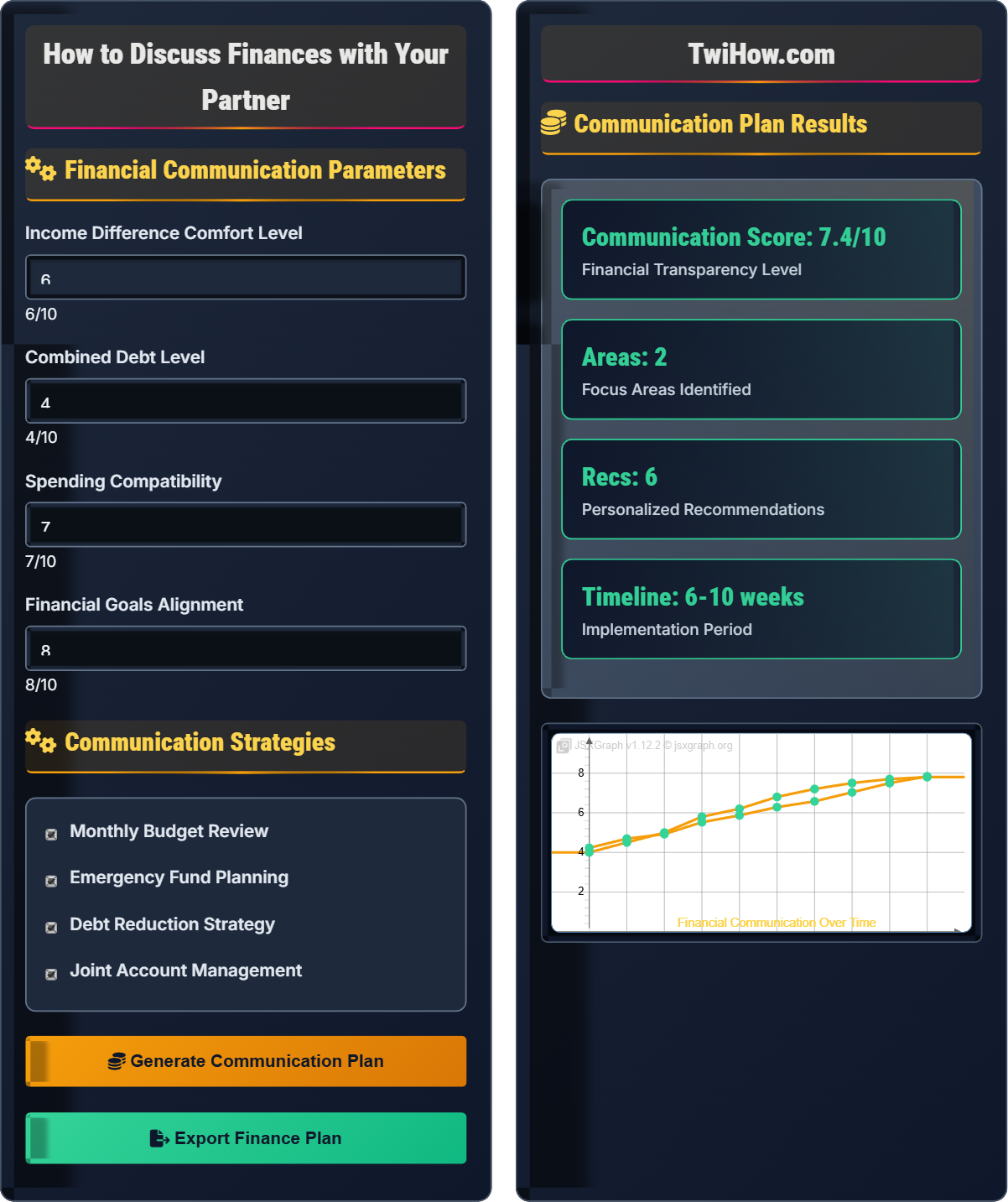
Financial Communication Parameters
Communication Strategies
Communication Plan Results
| Priority | Strategy | Timeline | Impact |
|---|---|---|---|
| 1 | Open Financial Discussion | Week 1 | High |
| 2 | Joint Budget Creation | Week 2-3 | High |
| 3 | Debt Management Plan | Week 4-5 | Medium |
| 4 | Goal Setting Session | Week 6-7 | High |
| 5 | Regular Check-ins | Ongoing | Medium |
Set SMART financial goals together and track progress regularly.
Create a joint budget that respects both partners' spending preferences.
Develop a plan to tackle combined debt while maintaining financial stability.
Financial Communication in Relationships Explained
Financial communication in relationships involves honest, ongoing discussions about money matters between partners. It encompasses sharing financial information, making joint decisions about spending and saving, and aligning financial goals. Effective financial communication builds trust and prevents conflicts that can damage relationships.
Successful financial communication follows this equation:
Where:
- Transparency: Open sharing of financial information
- Trust: Confidence in each other's financial decisions
- Conflicts: Number of unresolved financial disputes
- Collaboration: Working together on financial goals
Key areas where financial communication strengthens relationships:
- Major Purchases: Deciding together on homes, cars, or other significant investments
- Emergency Planning: Building reserves for unexpected expenses
- Retirement Planning: Coordinating long-term financial security
- Children Expenses: Planning for education and childcare costs
- Travel and Leisure: Budgeting for vacations and recreational activities
- Investment Decisions: Making joint investment choices
- Regular Meetings: Scheduled discussions about financial matters
- Transparency: Full disclosure of financial information
- Respect: Honoring different financial backgrounds and perspectives
- Compromise: Finding middle ground on financial decisions
- Patience: Understanding that financial harmony takes time to achieve
Financial Communication Fundamentals
Transparency, respect, regular meetings, goal alignment, accountability.
Financial Harmony = (Transparency × Trust) / Conflicts × Collaboration
Where Transparency = open financial sharing, Trust = confidence in decisions, Conflicts = unresolved disputes.
- Always be honest about your financial situation
- Respect different money values and backgrounds
- Make financial decisions together when possible
Application Scenarios
Debt consolidation, budget planning, major purchases, emergency funds, retirement planning.
- Monthly budget reviews and adjustments
- Joint account management strategies
- Debt repayment coordination
- Long-term investment planning
- Consider both partners' earning disparities
- Plan for individual spending freedom
- Address different spending priorities
- Maintain financial independence balance
Financial Conversation Scenarios
One partner earns significantly more than the other. Here's how to approach the conversation:
- Focus on Contributions: Emphasize that financial contribution is just one aspect of partnership
- Proportional Contributions: Consider contributing to joint expenses based on percentage of income rather than equal amounts
- Individual Spending: Allow each partner to maintain personal spending freedom
- Shared Goals: Focus on common financial objectives rather than individual contributions
- Respect Backgrounds: Acknowledge that earning differences may reflect different career paths or opportunities
Both partners have existing debts when entering the relationship:
- Full Disclosure: Share complete details of all debts, including amounts, interest rates, and payment schedules
- Joint Strategy: Decide whether to tackle debts individually or together
- Prioritization: Focus on highest interest rate debts first (avalanche method) or smallest balances first (snowball method)
- Separate vs. Joint: Determine which debts remain individual responsibility versus shared responsibility
- Prevention: Establish agreements to prevent accumulating new joint debt without discussion
Deciding whether to buy a house, car, or other significant item:
- Financial Assessment: Evaluate whether you can afford the purchase without compromising other goals
- Timeline Discussion: Consider whether to accelerate or delay other financial objectives
- Responsibility Division: Clarify who handles payments, maintenance, and related decisions
- Emergency Preparedness: Ensure you have adequate reserves for unexpected expenses
- Future Flexibility: Consider how the purchase might affect your ability to adapt to changing circumstances
Financial Breakdown Tool
Financial Communication Resources
- "The Financially Intelligent Couple" by Michael M. Thomas - Practical advice for managing money together
- "Smart Couples Finish Rich" by David Bach - Strategies for financial success as a team
- "The Total Money Makeover" by Dave Ramsey - Debt elimination and wealth-building plan
- "Happy Money" by Elizabeth Dunn and Michael Norton - Psychology of spending and happiness
- Mint - Free budgeting and expense tracking
- YNAB (You Need A Budget) - Zero-based budgeting approach
- EveryDollar - Simple budgeting tool
- Personal Capital - Comprehensive financial dashboard
- Financial Planners: Certified Financial Planners (CFPs) for comprehensive planning
- Marriage Counselors: Professionals specializing in financial communication
- Credit Counselors: For debt management and credit improvement
- Tax Professionals: For optimizing tax strategies as a couple
Financial Communication Quiz
What is the most important element of financial transparency in a relationship?
Financial transparency is about open communication regarding money matters, including goals, concerns, debts, and spending patterns. While revealing account balances is part of transparency, the broader concept encompasses sharing financial objectives and concerns. This creates a foundation for collaborative financial planning and prevents surprises that could strain the relationship.
The answer is B) Sharing financial goals and concerns openly.
Financial transparency is not about surveillance or control, but about building trust and enabling collaborative decision-making. When partners share their financial perspectives, they can work together to achieve common goals and navigate challenges. The key is creating an environment where both partners feel comfortable discussing money without judgment or shame.
Financial Transparency: Open communication about money matters
Collaborative Planning: Making financial decisions together
Financial Goals: Shared objectives for money management
• Share information gradually to build trust
• Respect different comfort levels with disclosure
• Focus on understanding, not judgment
• Start with general financial habits before specifics
• Create a safe space for financial discussions
• Schedule regular financial check-ins
• Withholding important financial information
• Judging partner's past financial decisions
• Avoiding difficult financial conversations
Explain the best approach for creating a joint budget when partners have significantly different spending habits and priorities. How can they ensure both people's needs are met?
Assessment: Begin by honestly discussing each person's spending patterns, values, and financial goals. Use categories like necessities, wants, and savings to organize expenses.
Allocation Method: Consider proportional contributions based on income percentage rather than equal dollar amounts. For example, if one person earns 60% of the combined income, they contribute 60% to joint expenses.
Individual Accounts: Maintain separate accounts for personal spending to preserve financial independence and accommodate different spending preferences.
Joint Account: Create a joint account for shared expenses like rent, utilities, groceries, and savings goals.
Regular Reviews: Schedule monthly budget meetings to assess progress and make adjustments as needed.
Creating a successful joint budget requires balancing fairness with flexibility. The goal is to ensure both partners feel their financial needs and values are respected while working toward common objectives. Different approaches may work better for different couples, so experimentation and regular reassessment are key to finding the right balance.
Proportional Contribution: Contributing based on income percentage
Financial Independence: Maintaining personal spending freedom
Joint Expenses: Costs shared by both partners
• Both partners must contribute to the budget process
• Individual spending freedom should be preserved
• Budgets should be reviewed and adjusted regularly
• Start with a trial period to test budget arrangements
• Use budgeting apps to track spending easily
• Celebrate small victories in reaching financial goals
• Forcing identical spending patterns on both partners
• Ignoring different financial backgrounds and values
• Failing to adjust the budget when circumstances change
John and Sarah are getting married next year. John has $15,000 in student loans and $5,000 in credit card debt. Sarah has no debt but $10,000 in savings. They're concerned about how to handle John's debt. How should they approach this situation to ensure it doesn't strain their relationship?
Full Disclosure: John should provide complete details about his debts, including interest rates, minimum payments, and repayment terms. Sarah should share her perspective on debt and financial security.
Debt Classification: Determine which debts John will manage individually and whether any will become shared responsibility after marriage.
Repayment Strategy: Create a plan for paying down John's debt while protecting Sarah's savings. Consider using the debt snowball or avalanche method.
Future Protection: Establish agreements about taking on new debt jointly without prior discussion.
Support System: Sarah can provide emotional support while John works to eliminate his debt, but should not feel obligated to pay it off directly.
Pre-marital debt discussions are crucial for relationship success. The key is finding a balance between supporting each other and maintaining financial responsibility. Each person should take ownership of their pre-marital debt while working together to build a secure financial future. Clear agreements about debt responsibilities prevent misunderstandings later.
Pre-marital Debt: Financial obligations existing before marriage
Debt Snowball: Paying smallest debts first for psychological wins
Debt Avalanche: Paying highest interest debts first for savings
• Discuss debt before making major commitments
• Each person should take responsibility for their own debt
• Create clear agreements about future debt decisions
• Consider a pre-marital financial consultation
• Set up automatic payments for debt reduction
• Celebrate debt reduction milestones together
• Hiding debt from your partner
• Expecting one partner to pay off the other's debt
• Not addressing debt before marriage
Mike wants to save $50,000 for a down payment on a house in 3 years, while Lisa wants to travel internationally every year. They earn $120,000 combined annually and currently spend $90,000 per year. How can they balance these competing goals while maintaining their relationship?
Goal Prioritization: Determine which goal is more urgent (house down payment) and which can be modified (travel frequency).
Financial Analysis: Calculate that they have $30,000 in annual surplus. To save $50,000 in 3 years, they need to save about $1,389 per month.
Compromise Solution: Reduce travel budget to $5,000 per year ($417/month) and allocate the rest to the house fund. This allows some travel while progressing toward homeownership.
Timeline Adjustment: Consider extending the timeline slightly to allow for more travel, or finding ways to increase income.
Alternative Options: Look for affordable domestic travel options or travel during off-seasons to stretch the travel budget further.
Financial goal alignment requires creative problem-solving and compromise. The key is identifying which goals are non-negotiable and which can be modified. Often, there are solutions that partially satisfy both partners. The process of working together to find these solutions can strengthen the relationship and build teamwork skills.
Financial Surplus: Income remaining after expenses
Goal Prioritization: Ranking objectives by importance
Compromise Solution: Partial satisfaction of multiple objectives
• Both partners' goals deserve consideration
• Some goals may need to be delayed or modified
• Creative solutions often exist between extremes
• Use the 50/30/20 rule as a starting point
• Consider increasing income to accommodate multiple goals
• Find cost-effective alternatives for expensive goals
• Viewing financial goals as zero-sum competitions
• Refusing to compromise on any financial decisions
• Not considering creative solutions to financial challenges
What is the recommended frequency for couples to review their financial situation and budget?
Monthly financial reviews are ideal for maintaining awareness of spending patterns, tracking progress toward goals, and making necessary adjustments. This frequency allows couples to catch problems early and stay aligned on their financial objectives without the burden of daily check-ins. Regular communication prevents small issues from becoming major conflicts.
The answer is B) Monthly to track spending and adjust goals.
Regular financial communication prevents the accumulation of financial stress and misunderstandings. Monthly reviews provide enough frequency to stay on track with goals while allowing for flexibility in monthly variations. The key is consistency and creating a routine that feels manageable rather than burdensome for both partners.
Financial Review: Regular assessment of spending and progress
Goal Tracking: Monitoring progress toward financial objectives
Spending Patterns: Consistent ways of allocating money
• Consistency is more important than perfection
• Reviews should be collaborative, not accusatory
• Adjust frequency based on comfort level
• Choose a consistent day each month for reviews
• Make reviews positive by celebrating successes
• Keep reviews focused and time-efficient
• Avoiding financial discussions until problems escalate
• Making financial reviews feel like interrogations
• Only discussing problems, not successes
FAQ
Q: Should we combine all our finances or keep them completely separate?
A: There's no one-size-fits-all answer, but many successful couples use a hybrid approach:
1. Joint Account: For shared expenses like rent, utilities, groceries, and savings goals
2. Individual Accounts: For personal spending, hobbies, and gifts to maintain financial independence
3. Contribution Method: Either equal contributions or proportional based on income
The key is transparency and agreement on how money flows between accounts. Discuss what makes both partners comfortable and adjust as needed.
Q: My partner is very secretive about money and gets defensive when I bring it up. How do I encourage openness?
A: Financial secrecy often stems from shame, fear, or past negative experiences:
1. Start Small: Begin with general money values rather than specific amounts
2. Share First: Model transparency by sharing your own financial information first
3. Focus on Future: Frame discussions around shared goals rather than past mistakes
4. Non-Judgmental Approach: Emphasize understanding rather than criticism
5. Professional Help: Consider couples counseling if financial secrecy is part of larger trust issues
Remember, building financial trust takes time and patience.
Q: How do we handle different attitudes toward risk in investing and financial decisions?
A: Different risk tolerances are common and manageable:
1. Assessment: Take risk tolerance questionnaires together to understand each other's comfort levels
2. Portfolio Split: Allocate investments based on individual risk preferences
3. Education: Learn about investment basics together to make informed decisions
4. Hybrid Approach: Create a portfolio that reflects a compromise between both risk profiles
5. Regular Reassessment: Risk tolerance can change over time, so revisit periodically
The goal is finding an allocation that both partners can feel comfortable with.