What is the Impact of Past Trauma on Current Relationships?
Complete trauma & relationships guide • Step-by-step explanations
Trauma & Relationships Fundamentals:
Show Trauma Impact AssessmentPast trauma significantly impacts current relationships through triggered emotional responses, altered attachment patterns, trust difficulties, and communication challenges. Understanding these impacts is crucial for healing and developing healthier relationship dynamics. Trauma can manifest in various ways, from hypervigilance to emotional numbing, affecting intimacy and connection.
Key impacts of trauma on relationships:
- Attachment Disruption: Difficulty forming secure emotional bonds
- Trigger Responses: Intense emotional reactions to seemingly minor events
- Trust Issues: Challenges believing in others' reliability and safety
- Communication Barriers: Difficulty expressing needs and emotions
- Intimacy Challenges: Fear of vulnerability and closeness
- Emotional Regulation: Difficulty managing intense emotions in relationships
Healing from trauma's relational impacts requires awareness, professional support, and patience with the gradual process of recovery.
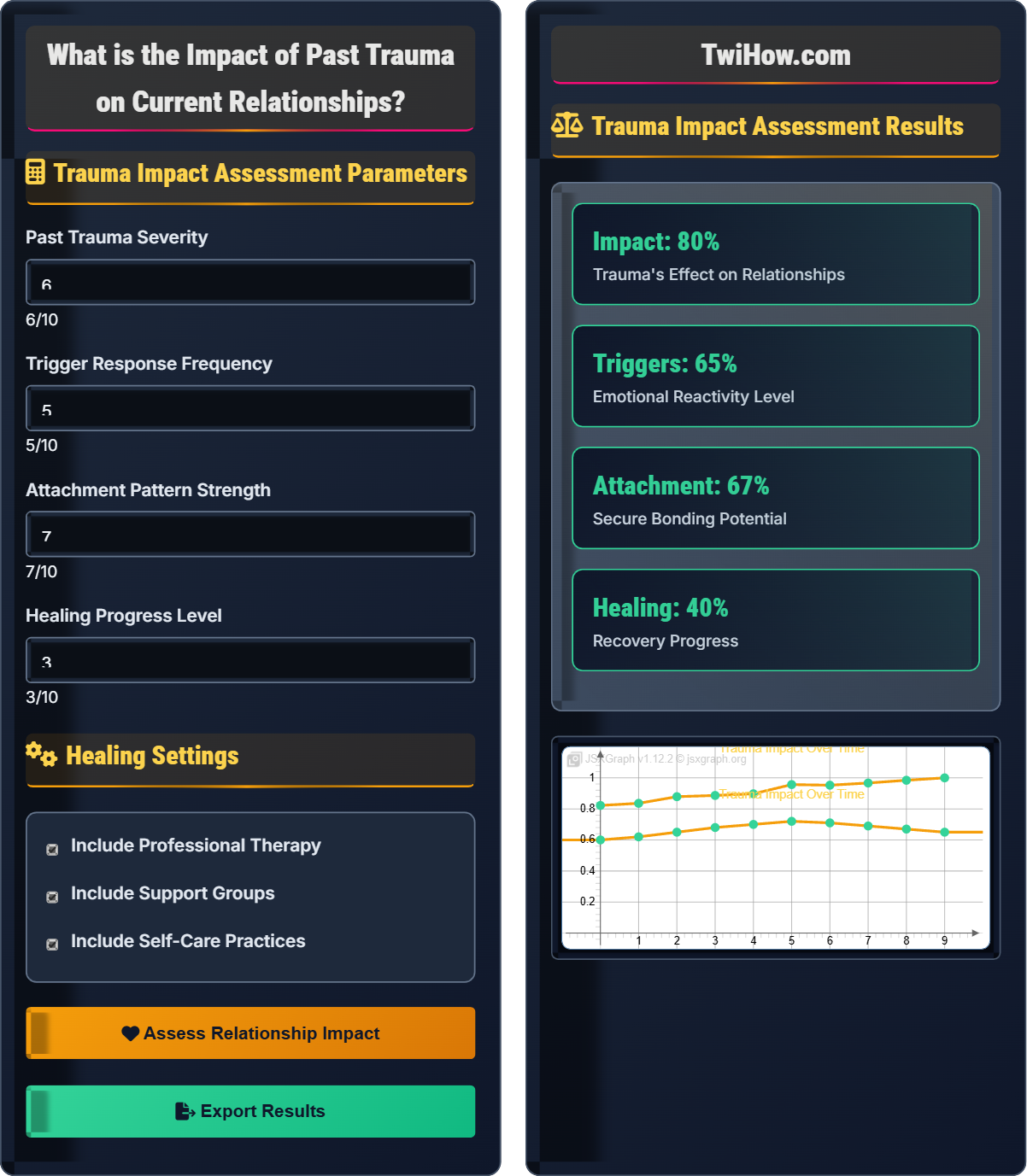
Trauma Impact Assessment Parameters
Healing Settings
Trauma Impact Assessment Results
| Impact Area | Score | Severity Level | Focus Area |
|---|---|---|---|
| Trust Issues | 68% | Moderate | Work on building safety in relationships. |
| Emotional Triggers | 75% | High | Develop trigger management strategies. |
| Attachment Patterns | 70% | High | Explore secure attachment development. |
| Communication | 62% | Moderate | Improve emotional expression skills. |
Establish emotional and physical safety in your environment and relationships.
Work with a therapist to process traumatic experiences safely.
Develop emotional regulation and communication skills.
Apply healing skills to current relationships gradually.
Understanding Trauma's Impact on Relationships
Trauma significantly affects relationships through various psychological and emotional pathways. The equation for trauma's relational impact can be expressed as:
Where:
- Trauma Severity: The intensity and duration of past traumatic experiences
- Trigger Sensitivity: How easily past trauma responses are activated
- Attachment Disruption: The degree to which trauma disrupted healthy attachment patterns
- Healing Progress: The amount of therapeutic work and recovery achieved
- Support Systems: Available emotional and professional support
Recovery from trauma's relational impacts follows a structured approach:
Where establishing safety, processing trauma, building skills, and integrating healing into relationships creates a foundation for recovery.
Effective healing from trauma's relational impacts involves:
- Therapy: Trauma-focused therapy to process experiences safely
- Support Groups: Connecting with others who understand trauma
- Safety Building: Creating secure environments and relationships
- Skill Development: Learning emotional regulation and communication skills
- Gradual Exposure: Slowly building trust and intimacy
- Self-Compassion: Practicing kindness toward yourself during healing
- Intense Reactions: Extreme emotional responses to minor relationship events
- Trust Difficulties: Consistent inability to trust even reliable partners
- Isolation: Avoiding relationships due to fear of harm
- Repetition: Attracting similar unhealthy relationship patterns
- Emotional Numbing: Inability to feel emotions in relationships
- Hyperarousal: Constant anxiety or hypervigilance in relationships
Trauma Impacts
Emotional triggers, attachment disruption, trust issues, hypervigilance, emotional numbing, flashbacks.
Relational Impact = (Trauma Severity × Trigger Sensitivity × Attachment Disruption) / (Healing Progress + Support Systems)
Where higher scores indicate stronger trauma-related relationship challenges.
- Healing takes time and patience
- Professional support is often necessary
- Self-compassion is essential
Healing Strategies
Personal relationships, family dynamics, workplace interactions, community connections.
- Establish safety and stability
- Process traumatic experiences
- Develop coping skills
- Build healthy relationships
- Practice self-compassion
- Integrate healing into daily life
- Healing is not linear
- Triggers may persist during healing
- Support systems are crucial
- Progress varies by individual
Trauma Impact Areas
Difficulty believing in others' reliability and safety due to past betrayal or harm.
Intense emotional reactions to situations that remind the brain of past trauma.
Difficulty forming secure emotional bonds due to disrupted early attachment patterns.
Healing Approaches
Creating secure environments and relationships where healing can occur.
Working with a therapist to process traumatic experiences safely.
Learning emotional regulation and communication skills for healthy relationships.
Trauma Impact on Relationships Quiz
Which of the following is the most common way trauma manifests in relationships?
Intense emotional reactions to minor events is the most common manifestation of trauma in relationships. This occurs because trauma can sensitize the nervous system, causing disproportionate responses to situations that remind the brain of past threats. The brain may perceive minor relationship events as dangerous, triggering fight, flight, or freeze responses that seem excessive to the situation.
The answer is B) Intense emotional reactions to minor events.
Trauma fundamentally alters how the brain processes safety and threat. The amygdala becomes hyperactive, leading to quick emotional responses, while the prefrontal cortex (responsible for rational thinking) becomes less active during stress. This neurological change means that situations that wouldn't normally trigger strong emotions may activate trauma responses, creating confusion for both the person with trauma history and their partner.
Emotional Triggers: Stimuli that activate trauma-related emotional responses
Hyperarousal: Heightened state of alertness and reactivity
Fight-Flight-Freeze: Automatic survival responses to perceived threats
• These reactions are not conscious choices
• Understanding helps, but doesn't eliminate reactions
• Professional help is often necessary
• Identify specific triggers
• Develop grounding techniques
• Communicate about reactions when calm
• Judging reactions as intentional
• Expecting immediate control over responses
• Minimizing the intensity of reactions
Explain how past trauma affects attachment patterns in relationships. What are the different attachment styles that can develop and how do they manifest?
Attachment Formation: Early trauma disrupts the formation of secure attachment bonds, which serve as templates for all future relationships. The brain learns to expect danger in close relationships, affecting how trust and safety are perceived.
Anxious Attachment: Characterized by fear of abandonment, constant seeking of reassurance, and intense emotional reactions to perceived rejection. Often develops when caregivers were inconsistent in their availability.
Avoidant Attachment: Marked by emotional distance, difficulty with intimacy, and self-reliance. Develops when caregivers were unavailable or rejecting of emotional needs.
Disorganized Attachment: Shows mixed behaviors of approach and avoidance, confusion in relationships, and unpredictable responses. Often results from trauma with caregivers who were simultaneously frightening and protective.
Manifestation: These patterns affect communication, conflict resolution, emotional expression, and relationship expectations, often creating self-fulfilling prophecies that reinforce original trauma-based beliefs.
Attachment theory explains how early relationships with caregivers create internal working models of how relationships function. Trauma interrupts this process, leading to insecure attachment patterns that persist into adulthood. Understanding your attachment style helps explain relationship patterns and provides a roadmap for developing more secure connections.
Secure Attachment: Healthy emotional bond with trust and safety
Internal Working Model: Mental representations of relationships
Self-Fulfilling Prophecy: Expectations that influence behavior to create predicted outcomes
• Attachment styles can be modified with awareness and work
• Understanding patterns helps break cycles
• Secure relationships can promote healing
• Learn about your attachment style
• Choose partners with secure attachment
• Practice vulnerability gradually
• Believing attachment style is fixed forever
• Choosing partners with similar insecure patterns
• Not seeking professional help for attachment issues
You experienced childhood trauma and now struggle with authority figures at work. You become anxious around your boss, avoid meetings, and interpret neutral comments as criticism. This is affecting your career and workplace relationships. How do you address this trauma-related pattern?
Recognition: Acknowledge that your reactions may be trauma-related rather than based on current reality. The authority figure dynamic may be triggering childhood patterns.
Professional Support: Seek therapy to process the original trauma and develop coping strategies for workplace triggers.
Grounding Techniques: Practice mindfulness and grounding exercises before and during meetings to stay present in the current environment.
Reality Checking: Keep a journal of workplace interactions to objectively assess whether your interpretations match actual events.
Gradual Exposure: Start with smaller interactions and gradually increase engagement with your boss as you build confidence.
Communication: If appropriate, discuss your needs with trusted colleagues or HR while maintaining professional boundaries.
Trauma responses often generalize to similar relationship dynamics, even in different contexts. Workplace authority relationships can activate childhood trauma patterns, creating professional challenges. The key is recognizing the connection between past trauma and present reactions while developing strategies to function effectively in the current environment.
Generalization: Extending trauma responses to similar situations
Grounding Techniques: Methods to stay present in the moment
Reality Checking: Comparing perceptions with objective facts
• Past trauma responses don't reflect current reality
• Professional help can accelerate healing
• Workplace accommodations may be available
• Practice breathing techniques before meetings
• Keep notes about actual interactions
• Seek support from trusted colleagues
• Assuming all authority figures are dangerous
• Avoiding all workplace interactions
• Not seeking professional support
Your romantic partner sometimes cancels plans last minute, which triggers intense abandonment fears from childhood trauma. You respond with extreme distress, accusations, and emotional withdrawal. Your partner feels overwhelmed by your reactions. How do you address this pattern?
Self-Awareness: Recognize that your reaction is trauma-related rather than a reflection of your partner's intentions. The cancellation may be triggering childhood abandonment fears.
Pause Before Reacting: Develop a brief pause between the trigger and your response to allow your rational brain to engage.
Communicate Needs: When calm, explain your trauma history and how cancellations affect you, without making your partner responsible for your reactions.
Develop Coping Skills: Practice self-soothing techniques and remind yourself that adult relationships are different from childhood experiences.
Therapy Work: Process the original abandonment trauma to reduce the intensity of current reactions.
Compromise Solutions: Work together to find ways to manage unexpected changes that feel safer for you.
Success requires both personal healing and relationship communication.
Relationship triggers often connect past trauma to present situations in ways that feel overwhelming. The key is developing the ability to separate past experiences from current realities while communicating your needs without expecting your partner to be responsible for your trauma responses. This requires both individual healing work and collaborative relationship skills.
Separation of Past and Present: Distinguishing current safety from past danger
Collaborative Healing: Working together on relationship challenges
Individual Responsibility: Managing your own trauma responses
• Your partner is not responsible for your trauma responses
• Communication should be about your needs, not their faults
• Healing requires both individual and relational work
• Practice self-soothing techniques
• Keep a trigger journal
• Explain patterns when calm, not reactive
• Expecting your partner to prevent all triggers
• Blaming your partner for your reactions
• Not doing individual healing work
Regarding healing from trauma's impact on relationships, which statement is most accurate?
Healing is a gradual process that varies by individual. Trauma recovery is not linear and depends on factors like trauma severity, support systems, therapeutic approach, and personal resilience. Some people may see significant improvements in months, while others may need years of consistent work. The process involves learning to live with trauma rather than forgetting it, while reducing its impact on daily functioning and relationships.
The answer is B) Healing is a gradual process that varies by individual.
Trauma healing involves neuroplasticity - the brain's ability to form new neural pathways. This process takes time and repetition. Healing doesn't mean erasing trauma memories but rather changing how the brain responds to them. The nervous system needs time to recalibrate from hypervigilance to appropriate alertness. Healing timelines vary based on trauma complexity, available support, individual resilience, and consistency of therapeutic work.
Neuroplasticity: Brain's ability to form new neural pathways
Non-linear Healing: Recovery with ups and downs rather than steady progress
Hypervigilance: Constant state of heightened alertness
• Healing is not linear
• Setbacks are normal parts of the process
• Consistency is more important than speed
• Celebrate small victories along the way
• Focus on progress, not perfection
• Build a strong support network
• Expecting rapid healing
• Getting discouraged by setbacks
• Comparing your healing to others
FAQ
Q: My trauma reactions are pushing my partner away. How do I explain this to them without overwhelming them?
A: Approach the conversation strategically:
1. Choose the Right Time: Talk when both of you are calm and have privacy
2. Focus on Facts: Explain that your reactions are trauma-related, not about them
3. Share Your Efforts: Let them know you're working on healing
4. Request Specific Support: Ask for what would be helpful, not what to do
5. Validate Their Feelings: Acknowledge that your reactions affect them too
6. Offer Hope: Share that healing is possible with time and work
Keep the conversation focused on your needs and healing rather than placing responsibility on your partner.
Q: How can I support my partner's healing without taking on their trauma?
A: Supporting without absorbing trauma involves clear boundaries:
Listen Without Fixing: Offer presence rather than solutions
Encourage Professional Help: Support therapy and other professional interventions
Take Care of Yourself: Maintain your own well-being and interests
Set Limits: Be clear about what you can and cannot provide
Stay Connected: Continue building your relationship beyond trauma
Get Your Own Support: Consider therapy or support groups for partners of trauma survivors
Remember that your partner's healing is their journey, though you can walk alongside them.