What is the Role of Humor and Play in Healthy Relationships?
Complete relationship guide • Step-by-step explanations
Relationship Fundamentals:
Show Humor & Play SimulatorHumor and play are essential elements that strengthen bonds, reduce stress, and create positive emotional connections in relationships. They serve as natural stress relievers, communication enhancers, and intimacy builders that contribute significantly to relationship satisfaction and longevity.
Key benefits of humor and play in relationships:
- Stress Relief: Laughter reduces cortisol and promotes oxytocin release
- Bonding: Shared laughter creates emotional connections
- Communication: Playful interaction opens dialogue
- Conflict Resolution: Light-hearted approach diffuses tension
- Creativity: Play stimulates imagination and innovation
Healthy relationships incorporate humor and play at every stage, from initial attraction to long-term commitment, adapting playful behaviors to suit the relationship's evolving needs.
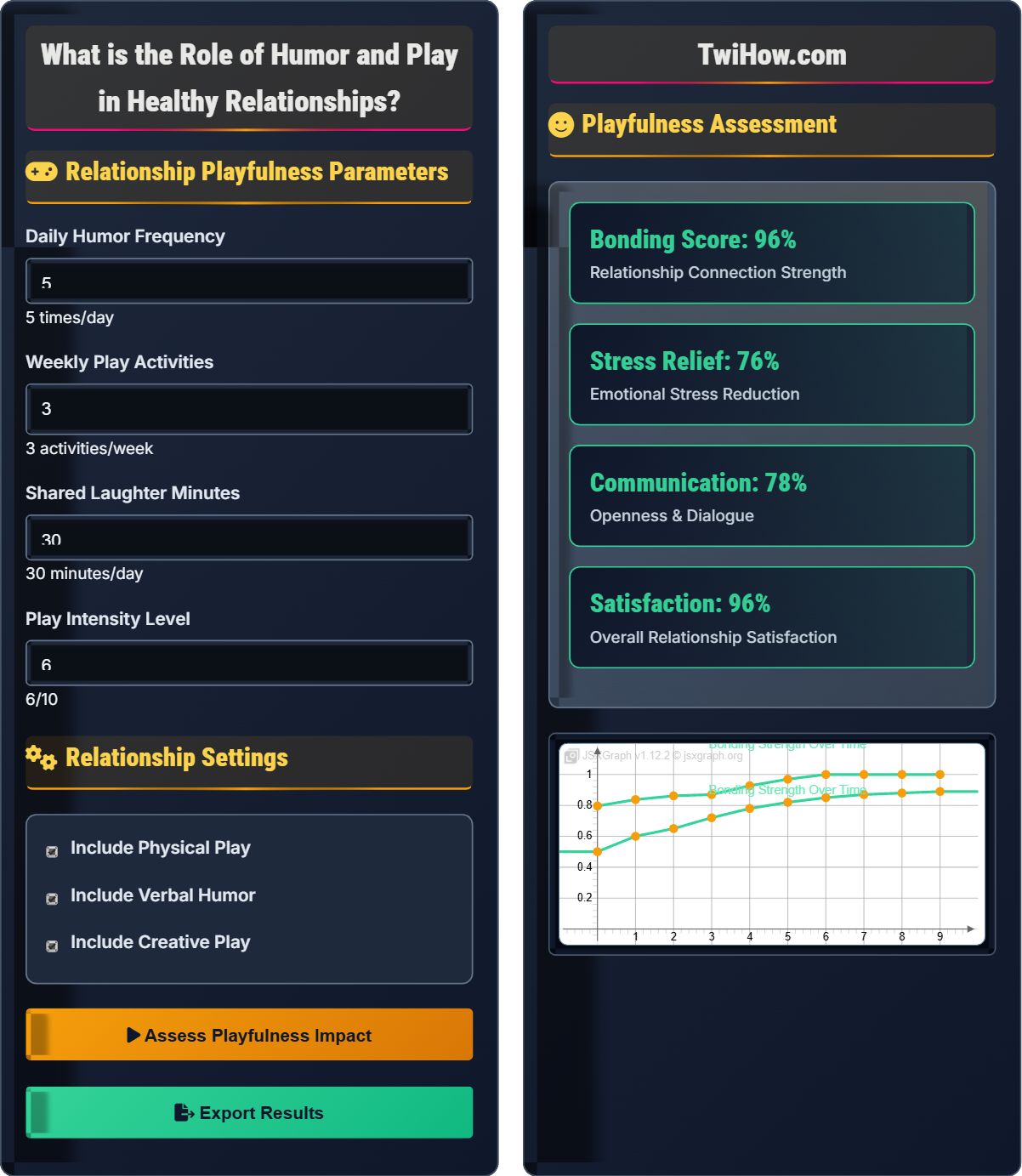
Relationship Playfulness Parameters
Relationship Settings
Playfulness Assessment
| Metric | Score | Impact | Recommendation |
|---|---|---|---|
| Laughter Frequency | 85% | High | Excellent! Maintain this level. |
| Play Engagement | 78% | Medium | Increase physical play activities. |
| Stress Relief | 72% | Medium | Add more playful moments during stress. |
| Connection Quality | 88% | High | Strong bond maintained. |
The Science Behind Humor and Play in Relationships
Humor in relationships serves multiple psychological functions. It acts as a social lubricant that reduces anxiety and tension, making communication easier. Neurologically, laughter triggers the release of endorphins and oxytocin, creating feelings of happiness and bonding. Shared laughter also signals safety and trust, indicating that partners feel comfortable enough to be vulnerable together.
Play in adult relationships maintains the childlike wonder and spontaneity that often gets lost in daily routines. The equation for relationship playfulness can be expressed as:
Where:
- Frequency: How often playful interactions occur
- Quality: The meaningfulness of the interaction
- Reciprocity: Mutual participation and enjoyment
- Stress Level: Background stress that may inhibit play
Effective relationship humor and play take various forms:
- Self-Deprecating Humor: Gentle humor about oneself, showing humility
- Inside Jokes: Shared references that strengthen exclusivity
- Playful Teasing: Light, affectionate banter between partners
- Physical Play: Tickling, dancing, playful wrestling
- Creative Play: Art projects, games, imaginative scenarios
- Intellectual Play: Puzzles, word games, friendly debates
- Daily Interactions: To maintain connection and joy
- During Stress: To provide relief and perspective
- Conflict Resolution: To de-escalate tension (appropriately)
- Special Occasions: To enhance celebrations
- New Experiences: To share adventures and discoveries
- Routine Times: To inject novelty and excitement
Humor and Play Fundamentals
Emotional regulation, stress relief, bonding, communication enhancement, intimacy building.
Relationship Playfulness = (Frequency × Quality × Reciprocity) / Stress Level
Where Frequency = regularity of play, Quality = meaningfulness, Reciprocity = mutual enjoyment.
- Humor should never hurt or belittle
- Play should be consensual and enjoyable for both
- Context matters - appropriate timing is crucial
Practical Applications
Daily bonding, stress management, conflict resolution, intimacy enhancement, creativity stimulation.
- Create regular playtime
- Develop inside jokes and references
- Use humor to address light issues
- Engage in shared recreational activities
- Individual humor preferences vary
- Cultural differences in humor
- Timing and appropriateness matter
- Balance with serious communication
Play Activities
Board games, puzzles, cooking together, dance parties, storytelling, charades.
Walking, hiking, playground visits, sports, picnics, nature exploration.
Arts and crafts, music making, theater games, improvisation, creative writing.
Humor and Play Learning Quiz
Which type of humor is most beneficial for strengthening romantic relationships?
Research consistently shows that affiliative humor (jokes that bring people together, shared laughter, inside jokes) is most beneficial for relationships. This type of humor strengthens bonds, reduces tension, and creates positive emotional associations. While self-deprecating humor can show humility, and self-enhancing humor can demonstrate resilience, affiliative humor specifically targets relationship building.
The answer is B) Affiliative humor.
Understanding different types of humor helps partners choose the most relationship-enhancing approaches. Affiliative humor creates shared positive experiences that strengthen emotional bonds. It's distinct from aggressive humor (which can harm relationships) or self-defeating humor (which might indicate low self-esteem). The key is to use humor that brings partners closer rather than creating distance or discomfort.
Affiliative Humor: Humor used to enhance relationships and amuse others
Aggressive Humor: Humor used to criticize, ridicule, or manipulate others
Self-Enhancing Humor: Humor used to maintain a humorous outlook in adverse situations
• Humor should strengthen, not weaken bonds
• Consider partner's sensitivity and preferences
• Avoid humor that targets insecurities
• Develop private jokes that strengthen exclusivity
• Use humor to navigate difficult topics gently
• Notice what makes your partner laugh genuinely
• Using sarcasm during conflicts
• Making fun of partner's insecurities
• Ignoring partner's discomfort with certain humor
Explain how play and humor serve as emotional regulation tools in relationships. Describe the physiological and psychological mechanisms involved.
Physiological Mechanisms: Laughter triggers the release of endorphins (natural mood elevators), reduces cortisol (stress hormone), and increases oxytocin (bonding hormone). Play activates the parasympathetic nervous system, promoting relaxation and counteracting stress responses.
Psychological Mechanisms: Play provides a safe space for emotional expression, shifts perspectives during stressful times, and creates positive emotional memories. Humor offers cognitive reframing opportunities, helping partners view challenges differently.
Relationship Benefits: Shared positive emotions strengthen attachment bonds, create resilience during difficult periods, and establish healthy coping patterns that partners can rely on during future stressors.
The mind-body connection in emotional regulation through play and humor is profound. When partners engage in playful activities together, they're not just having fun—they're actively supporting each other's emotional health. The neurochemical changes create a positive feedback loop that reinforces the desire to spend time together and seek out joyful experiences.
Emotional Regulation: The ability to manage and respond to emotional experiences
Oxytocin: Hormone associated with bonding and trust
Endorphins: Natural painkillers and mood elevators
• Use play to complement, not replace, serious communication
• Recognize when partner needs comfort over humor
• Balance playful and supportive responses
• Establish playful rituals for stress relief
• Notice emotional states that benefit from lightness
• Practice active listening before offering humor
• Using humor when partner is genuinely upset
• Dismissing serious concerns with jokes
• Forcing playfulness when it's not welcome
A couple has been together for 3 years and notices their relationship has become routine-focused with little playfulness. They work full-time jobs and have young children. Design a practical weekly plan to incorporate humor and play that fits their schedule and family situation.
Daily Micro-Moments: 5-minute morning jokes, funny voices during household tasks, playful goodbyes.
Evening Routines: Silly bedtime stories with kids, 10-minute dance breaks after dinner, sharing funny daily moments.
Weekly Activities: Saturday morning pancake art competitions, Sunday evening board game sessions with family, Wednesday "fun fact" sharing during dinner.
Monthly Special: Playdate exchanges with other families, trying new restaurants with playful themes, weekend "adventure" walks.
Seasonal Traditions: Holiday costume creation, seasonal scavenger hunts, family talent shows.
This approach integrates play into existing routines rather than requiring major schedule changes.
Successful integration of humor and play in busy relationships requires strategic planning that works with existing schedules rather than against them. The key is finding small, consistent opportunities for playfulness that accumulate over time to create significant relationship benefits. Quality matters more than quantity—meaningful micro-moments of play can be more impactful than occasional elaborate activities.
Micro-Moments: Brief interactions that create connection
Integration Strategy: Incorporating activities into existing routinesConsistency: Regular practice for lasting benefits
• Start small and build gradually
• Involve family members when appropriate
• Adapt to changing schedules
• Use transition times for playful moments
• Create visual reminders for planned activities
• Track what activities work best for your family
• Planning elaborate activities that don't fit reality
• Forgetting to involve other family members
• Abandoning plans after initial setbacks
An intercultural couple faces challenges with different humor styles—one partner comes from a culture that values direct, sometimes self-deprecating humor, while the other comes from a culture that values gentle, indirect humor. How can they navigate these differences while maintaining respect and connection?
Education Phase: Learn about each other's cultural humor traditions, including acceptable topics, delivery styles, and social contexts.
Experimentation Phase: Try each other's humor styles in safe, low-stakes situations to understand the underlying intentions.
Compromise Framework: Create agreed-upon guidelines for when to use different humor styles, with respect for both cultural backgrounds.
New Tradition Creation: Develop unique humor styles that blend both cultural approaches, creating something that belongs to their relationship.
Feedback Mechanism: Regular check-ins about humor comfort levels and adjustments as needed.
Success requires patience, cultural sensitivity, and a willingness to adapt communication styles.
Cultural differences in humor represent deeper values about communication, respect, and social interaction. What one person finds amusing, another might find offensive—not due to personal failings, but because of different cultural conditioning. Successful intercultural couples learn to appreciate these differences as opportunities for growth and expanded perspectives.
Cultural Humor: Humor styles influenced by cultural norms and values
Intercultural Communication: Communication between individuals from different cultures
Sensitivity: Awareness of how cultural differences affect communication
• Assume positive intentions behind different humor styles
• Educate yourself about partner's cultural background
• Create safe spaces for expressing concerns
• Ask questions instead of making assumptions
• Share childhood humor memories to understand roots
• Find universal humor elements (physical comedy, absurdity)
• Taking cultural humor differences personally
• Forcing one's own cultural humor style
• Avoiding the topic due to discomfort
When is humor most appropriately used during relationship conflicts?
Humor is most effective in relationships after emotional intensity has decreased but before complete resolution. At this stage, partners are receptive to connection and perspective shifts, but still need to address the underlying issues. Using humor during peak emotion can seem dismissive, while waiting until resolution eliminates the opportunity to use humor for healing and connection.
The answer is B) After emotions have cooled but before resolution.
Timing is crucial when using humor in conflict situations. During high-intensity moments, humor can feel invalidating or dismissive of genuine emotions. After emotions settle, humor can help reestablish connection and provide perspective on the situation. The goal is to use humor to facilitate healing and understanding, not to avoid addressing real issues.
Emotional Intensity: Peak level of emotional arousal during conflict
De-escalation: Process of reducing emotional tension
Conflict Resolution: Process of addressing and solving disagreements
• Wait for emotional readiness
• Focus on the situation, not the person
• Ensure both partners are receptive
• Look for signs of emotional cooling
• Start with gentle, self-directed humor
• Gauge partner's receptiveness before proceeding
• Using humor to avoid addressing real issues
• Making partner the target of jokes during conflict
• Forcing humor when partner isn't ready
FAQ
Q: How do we maintain playfulness in our relationship after having children?
A: Maintaining playfulness with children requires creative integration and strategic timing:
1. Family Play Integration: Include children in playful activities that everyone enjoys (games, outdoor adventures, silly dances)
2. Micro-Moments: Find brief opportunities for connection during daily routines (playful voices while cooking, funny faces during diaper changes)
3. Couple Time Protection: Schedule regular adult-only play time, even if brief (weekly date nights, morning coffee rituals)
4. Modeling Behavior: Demonstrate playfulness so children see its value and eventually give you space to continue it
5. Evolution of Play: Accept that play styles will change but can remain meaningful and connecting
The key is adapting your play style to fit your new reality rather than abandoning play entirely.
Q: I'm not naturally funny—can I still develop humor skills for relationships?
A: Absolutely! Humor skills can be developed and don't require being a comedian:
Observational Humor: Notice funny things in daily life and share them with your partner
Timing Development: Practice recognizing appropriate moments for lightness
Storytelling: Share amusing personal experiences with good timing
Appreciation Skills: Be a good audience for your partner's humor
Playful Attitude: Approach life with curiosity and lightheartedness
Shared Activities: Engage in fun activities together that naturally lead to laughter
Remember, your partner's laughter is more about feeling connected to you than your comedic skill. Authentic enjoyment and a willingness to be silly together matter more than perfect timing.