How to Choose Destinations Aligned with Your Interests and Values
Travel guide • Step-by-step destination selection
Destination Alignment:
Find My Ideal DestinationChoosing travel destinations that align with your personal interests and values creates more meaningful and fulfilling travel experiences. This guide helps you identify what matters most to you and find destinations that match your priorities.
Key factors for destination alignment:
- Personal Interests: Cultural activities, outdoor adventures, culinary experiences, etc.
- Core Values: Sustainability, social responsibility, authenticity, etc.
- Travel Style: Luxury vs. budget, group vs. solo, relaxation vs. adventure
- Life Goals: Personal growth, learning, connecting with nature, etc.
By systematically evaluating destinations against your personal criteria, you can discover places that resonate with your deepest interests and values, leading to more transformative travel experiences.
Interest & Values Assessment
Additional Preferences
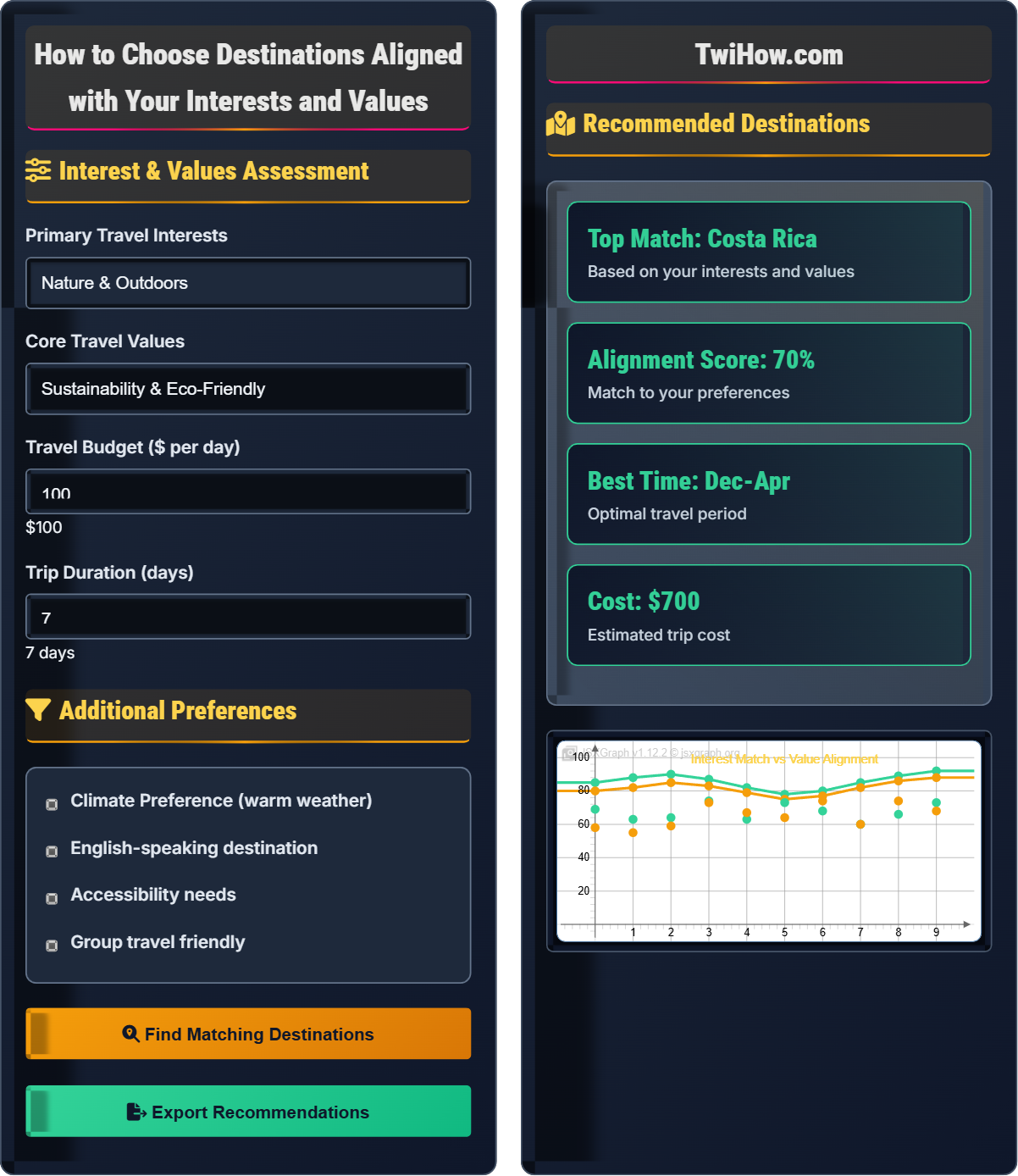
Recommended Destinations
| Destination | Interest Match | Value Alignment | Overall Score |
|---|---|---|---|
| Costa Rica | 90% | 85% | 87% |
| New Zealand | 88% | 82% | 85% |
| Japan | 92% | 78% | 85% |
| Switzerland | 75% | 90% | 82% |
| Thailand | 85% | 70% | 77% |
Your Travel Profile
Primary Interest: Nature & Outdoors
Core Value: Sustainability & Eco-Friendly
Budget Range: $100/day
Preferred Climate: Warm Weather
Destination Highlights
Costa Rica: Rich biodiversity, eco-lodges, sustainable tourism initiatives
New Zealand: Pristine landscapes, Maori culture, conservation efforts
Japan: Harmony with nature, traditional practices, innovation
How to Align Destinations with Your Interests and Values
Your travel identity is formed by your personal interests, values, and life goals. It's the foundation for choosing destinations that feel meaningful and authentic to you. When your travel choices align with your inner self, you're more likely to have transformative experiences that enrich your life.
The destination alignment score can be calculated as:
Where:
- Interest Match: How well the destination matches your interests
- Value Alignment: How well the destination reflects your values
- Practical Feasibility: Budget, accessibility, timing, etc.
Popular travel interests that people align with:
- Nature & Wildlife: National parks, wildlife viewing, hiking trails
- Culture & Heritage: Museums, historical sites, local traditions
- Adventure: Extreme sports, outdoor challenges, exploration
- Culinary: Local food, cooking classes, restaurant experiences
- Spirituality: Meditation retreats, sacred sites, wellness
- Arts & Entertainment: Music, theater, festivals, galleries
- Sustainability: Environmental protection, eco-tourism, carbon footprint
- Authenticity: Genuine local experiences, avoiding tourist traps
- Respect: Cultural sensitivity, supporting local communities
- Safety: Personal security, health considerations
- Learning: Educational opportunities, skill development
- Connection: Building relationships, community engagement
Interest & Values Assessment
Travel interests, personal values, destination alignment, meaningful travel, authentic experiences.
Alignment Score = (Interest Match + Value Alignment + Practical Feasibility) / 3
Where Score ranges from 0-100% indicating how well a destination matches your profile.
- Know yourself before choosing destinations
- Consider both interests and values
- Balance idealism with practical constraints
Practical Applications
Personalized travel planning, sustainable tourism, cultural immersion, adventure travel, wellness retreats.
- Define your travel identity
- Research potential destinations
- Calculate alignment scores
- Compare and rank options
- Create value-aligned itinerary
- Budget constraints and reality
- Seasonal and climate factors
- Political and safety considerations
- Environmental impact
Travel Alignment Quiz
Which of the following is the most effective way to identify your primary travel interests?
Reflecting on activities you enjoy at home provides insight into what you'll likely enjoy while traveling. Your interests at home often translate to travel preferences. For example, if you enjoy hiking and nature photography at home, you'll likely appreciate destinations with natural beauty and outdoor activities.
The answer is B) Reflect on activities you enjoy at home and want to explore abroad.
Understanding your interests is fundamental to choosing destinations that align with your values. This approach connects your daily life preferences with travel choices, creating a bridge between familiar comfort zones and new experiences. By identifying consistent patterns in what energizes you, you can predict which travel experiences will be fulfilling.
Travel Interests: Activities and experiences that bring you joy and satisfaction while traveling
Interest Mapping: Connecting home preferences to travel opportunities
Value Alignment: Matching destinations to personal priorities and beliefs
• Interests are consistent across contexts
• Self-reflection leads to better matches
• Popular destinations don't guarantee personal satisfaction
• Keep a travel journal of past trips
• Note what activities made you happiest
• Consider why certain experiences were memorable
• Following trends instead of personal preferences
• Choosing destinations based on others' experiences without self-assessment
Explain how to determine if a destination aligns with your core values. Provide specific examples of values and matching destinations.
Determining Value Alignment: Research destinations for evidence of your core values in action. Look for environmental policies, social initiatives, cultural preservation efforts, and ethical tourism practices.
Examples of Values and Destinations:
Environmental Sustainability: Costa Rica (eco-lodges, renewable energy, protected areas)
Cultural Authenticity: Bhutan (preservation of traditions, happiness-focused economy)
Community Support: Peru (community-based tourism in Cusco region)
Peace and Harmony: New Zealand (Maori cultural integration, low crime rates)
Check government policies, read reviews from like-minded travelers, and look for certifications like eco-tourism badges.
Value alignment goes beyond personal enjoyment to encompass ethical and moral considerations. When destinations reflect your values, travel becomes a way to support causes you believe in. This creates a deeper sense of purpose and meaning in your travels.
Value Alignment: Congruence between destination characteristics and personal beliefs
Ethical Tourism: Travel that supports local communities and environments
Cultural Preservation: Maintaining traditional practices and heritage
• Research destination policies and practices
• Look for third-party certifications
• Read reviews from values-conscious travelers
• Check for sustainability certifications
• Look for community-based tourism options
• Research local social and environmental initiatives
• Assuming all destinations are equally ethical
• Not researching beyond surface attractions
• Prioritizing convenience over values
You value sustainable travel and environmental conservation, but your budget is limited. How would you balance these competing priorities when choosing a destination? Provide a specific strategy that addresses both concerns.
Strategy for Balancing Budget and Values: Focus on destinations that offer affordable eco-tourism options and emphasize sustainable practices that don't require premium pricing.
Specific Approach: Consider countries like Costa Rica or Ecuador where eco-tourism is developed but costs remain reasonable. Choose locally-owned accommodations, use public transportation, participate in free nature walks, and visit national parks with minimal entrance fees.
Additional Tactics: Travel during shoulder seasons for lower prices, volunteer with conservation projects (sometimes offering free accommodation), or choose destinations where your currency has greater purchasing power.
This approach allows you to support sustainable tourism while staying within budget constraints.
Real-world travel planning often requires balancing multiple priorities. The key is finding destinations where your values and budget intersect. Many countries with strong environmental policies also offer budget-friendly options, especially those promoting eco-tourism as a national priority.
Eco-Tourism: Responsible travel to natural areas that conserves the environment
Budget Consciousness: Making travel decisions with financial constraints in mind
Value Integration: Incorporating personal beliefs into travel choices
• Sustainable doesn't always mean expensive
• Research budget-friendly eco-options
• Consider currency exchange rates
• Look for government-sponsored eco-programs
• Choose destinations with strong conservation policies
• Consider volunteering opportunities
• Assuming sustainable travel always costs more
• Not researching budget-friendly eco-destinations
• Compromising values for low cost
You're interested in nightlife and partying, but you value respect for local customs and cultures. How would you navigate this apparent contradiction when visiting conservative destinations? Propose solutions that honor both your interests and your values.
Approach to Reconciling Interests and Values: Research destinations that align with both your social interests and cultural values. If visiting a conservative area, adapt your behavior respectfully while seeking appropriate outlets.
Strategies:
1. Destination Selection: Choose destinations known for vibrant night scenes that still respect local customs (e.g., Barcelona, Berlin, or Bangkok)
2. Respectful Behavior: If in conservative areas, limit nightlife activities to designated areas and respect local laws
3. Cultural Integration: Explore local versions of social activities (e.g., traditional music venues, cultural festivals)
4. Timing: Visit during festivals or events when social activities are culturally accepted
The key is finding destinations where your interests naturally align with cultural values.
Successful travel requires flexibility and cultural sensitivity. When interests seem to conflict with values, creative solutions often emerge. The best approach is usually selecting destinations where your interests naturally align with local values, eliminating the need for compromise.
Cultural Sensitivity: Awareness and respect for local customs and values
Appropriate Behavior: Conducting oneself in accordance with local norms
Destination Fit: Alignment between personal interests and local culture
• Always research local customs beforehand
• Respect local laws and social norms
• Adapt behavior to fit cultural expectations
• Research destinations that match your interests
• Learn basic cultural etiquette
• Ask locals for appropriate venues
• Ignoring local customs in favor of personal preferences
• Not researching cultural expectations
• Assuming all destinations welcome all behaviors
Which of the following best describes the long-term benefit of choosing destinations aligned with your interests and values?
When destinations align with your interests and values, you experience deeper engagement and satisfaction. These experiences tend to be more memorable and personally transformative, contributing to personal growth and a stronger sense of fulfillment. While aligned travel may require more planning, the resulting experiences are richer and more meaningful.
The answer is B) More meaningful and fulfilling travel experiences.
The primary benefit of values-aligned travel is psychological and emotional enrichment. When our travel experiences reflect who we are and what we care about, they become integrated into our identity and contribute to our personal narrative. This creates lasting memories and personal growth that extends far beyond the trip itself.
Meaningful Travel: Experiences that connect with personal identity and values
Personal Fulfillment: Satisfaction derived from authentic experiences
Transformative Travel: Journeys that lead to personal growth
• Authentic experiences create lasting memories
• Values alignment increases satisfaction
• Meaningful travel contributes to personal growth
• Document personal reflections during travel
• Choose experiences that resonate with you
• Prioritize quality over quantity of experiences
• Prioritizing convenience over authenticity
• Chasing Instagram-worthy moments over meaningful ones
• Ignoring personal values for trending destinations
FAQ
Q: How do I know if I'm choosing destinations based on my true interests versus what I think I should be interested in?
A: To identify your true interests, reflect on what energizes you versus what exhausts you. True interests create excitement and anticipation, while imposed interests feel like obligations. Consider:
1. Energy Level: Which activities make you feel alive and engaged?
2. Time Perception: When do you lose track of time because you're so absorbed?
3. Emotional Response: What activities bring genuine joy versus social satisfaction?
4. Consistency: Do you consistently gravitate toward certain types of experiences?
Also, remember that interests can evolve. Pay attention to changes in what appeals to you over time, and don't feel pressured to stick with outdated interests.
Q: How can I balance my personal travel interests with family members who have different values and preferences?
A: Family travel requires compromise and creative planning. Try these strategies:
Find Common Ground: Identify overlapping interests between family members. For example, if one person loves history and another loves nature, choose destinations with historic sites in beautiful natural settings.
Flexible Itineraries: Plan days with different focus areas, allowing each person to enjoy their preferred activities.
Multi-Generational Destinations: Some destinations naturally appeal to different age groups (e.g., Disney World, national parks).
Value Integration: Emphasize shared values like family bonding, learning, or creating memories together.
Individual Time: Include some independent activities for adults while children participate in age-appropriate programs.