How to Plan Multi-Destination Trips Efficiently
Complete planning guide • Step-by-step explanations
Multi-Destination Planning:
Show Route OptimizerPlanning multi-destination trips efficiently requires strategic thinking, careful organization, and systematic planning. The key is to optimize routes geographically, manage time effectively, allocate budgets wisely, and coordinate logistics seamlessly. Efficient multi-destination travel maximizes experiences while minimizing travel time, costs, and stress. Success depends on thorough research, proper timing, and flexible planning that accommodates both must-see attractions and unexpected opportunities.
Essential planning principles:
- Geographic Clustering: Group nearby destinations together to minimize travel
- Time Management: Allocate appropriate time for each location based on activities
- Logistics Coordination: Plan transportation, accommodation, and transfers efficiently
- Budget Optimization: Distribute funds across destinations for maximum value
Successful multi-destination trips balance ambitious itineraries with realistic expectations, allowing for both productive sightseeing and necessary rest periods.
Trip Configuration
Destination Preferences
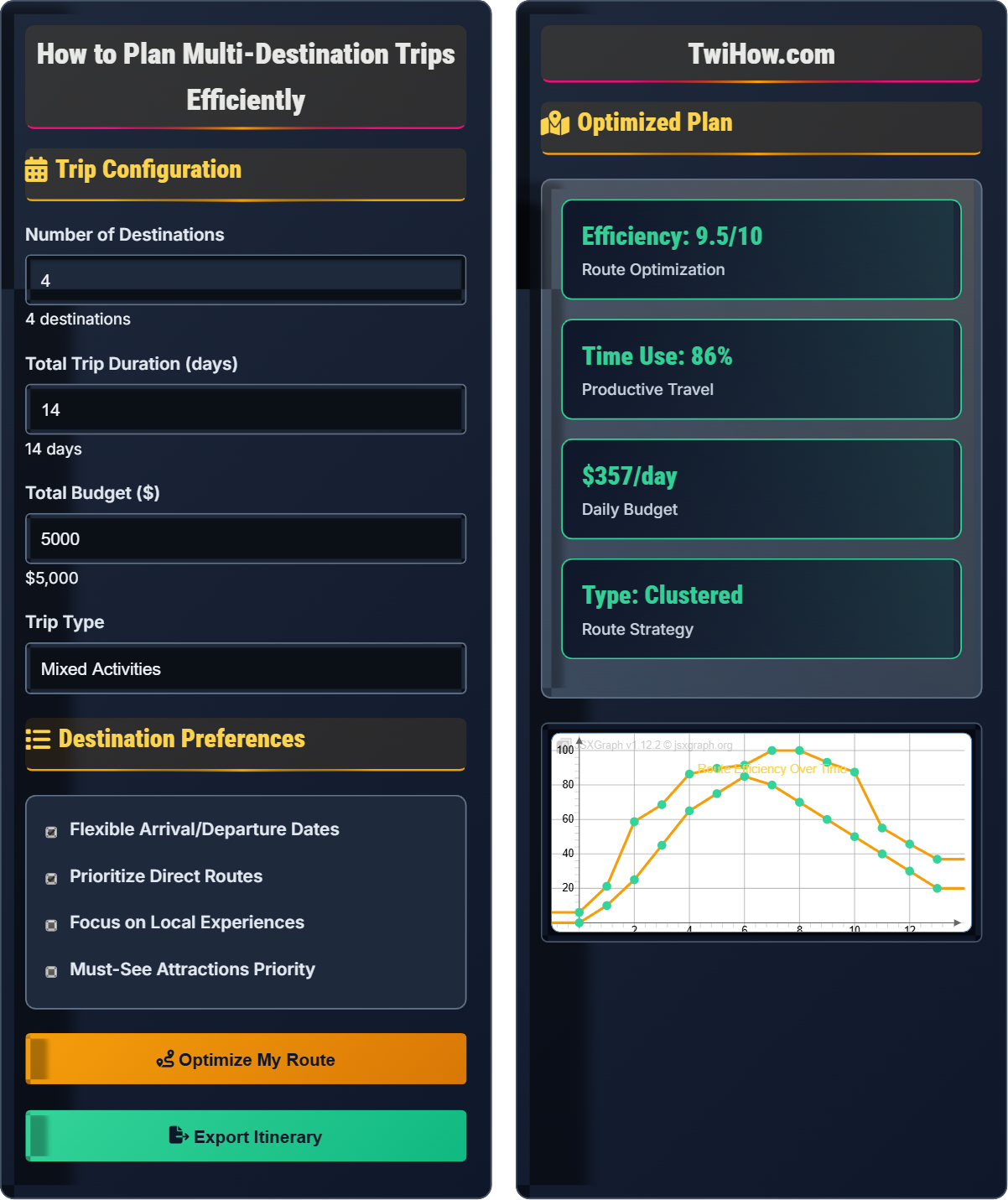
Optimized Plan
| Day | Location | Activities | Cost |
|---|---|---|---|
| Days 1-4 | New York | Statue of Liberty, Central Park, Broadway | $1,200 |
| Days 5-7 | Boston | Freedom Trail, Harvard, Fenway Park | $900 |
| Days 8-10 | Washington DC | Smithsonian, National Mall, Monuments | $1,000 |
| Days 11-14 | Philadelphia | Independence Hall, Liberty Bell, Food Tour | $900 |
Multi-Destination Trip Planning
Efficient multi-destination trip planning involves optimizing multiple variables simultaneously: geographic proximity, time allocation, budget distribution, and activity scheduling. The goal is to create a seamless experience that maximizes value while minimizing travel friction. This requires balancing ambitious itineraries with realistic timeframes and coordinating logistics across multiple locations.
Key factors that influence multi-destination efficiency:
- Geographic Proximity: Distances between destinations affect travel time and costs
- Time Allocation: Balancing exploration time with travel time
- Budget Distribution: Allocating funds across destinations for maximum value
- Seasonal Considerations: Weather, crowds, and seasonal activities
- Transportation Options: Available modes and their efficiency
Different route strategies offer unique advantages:
- Linear Route: Visit destinations in sequence, no backtracking
- Hub-and-Spoke: Return to central location between destinations
- Clustered: Group nearby destinations together
- Circular: Return to starting point after visiting all destinations
- Start with Geography: Plan routes based on location proximity
- Allow Buffer Time: Add 10-15% extra time for unexpected delays
- Minimize Luggage Movement: Pack light or ship luggage between locations
- Use Efficient Transport: Choose fastest, most reliable transportation
- Group Similar Activities: Schedule similar attractions together
Planning Fundamentals
Route optimization, geographic clustering, time management, budget allocation, logistics coordination.
Route Efficiency = (Total Productive Time / Total Trip Duration) × (Budget Optimization Factor) / Geographic Distance Factor
Where higher scores indicate more efficient trip planning.
- Cluster nearby destinations together
- Allow buffer time for transitions
- Research transportation options thoroughly
Practical Applications
European tours, US road trips, Asian city hopping, business travel circuits.
- Research transportation networks
- Identify geographic clusters
- Allocate time proportionally
- Book accommodations strategically
- Consider seasonal weather patterns
- Factor in travel time between destinations
- Plan for rest days between intense periods
- Have backup plans for disruptions
Multi-Destination Planning Quiz
Which of the following is the BEST example of effective geographic clustering for a multi-destination trip?
Option B represents effective geographic clustering as all destinations are located along the East Coast of the United States, allowing for efficient travel between locations. The destinations are positioned in a logical sequence that minimizes backtracking and optimizes travel time. This clustering strategy reduces transportation costs and maximizes time spent exploring rather than traveling.
The answer is B) New York → Philadelphia → Washington DC → Boston.
Geographic clustering is the foundation of efficient multi-destination travel. It involves grouping nearby destinations together to minimize travel time and costs between locations. When destinations are geographically close, transportation options are often more frequent and affordable, and travel time is reduced, allowing more time for actual exploration and activities.
Geographic Clustering: Grouping nearby destinations to minimize travel
Route Optimization: Sequencing destinations for maximum efficiency
Travel Efficiency: Minimizing travel time relative to exploration time
• Group nearby destinations together
• Consider transportation networks
• Minimize backtracking between locations
• Use maps to visualize destination locations
• Research transportation options between destinations
• Consider regional travel passes for efficiency
• Spreading destinations too widely apart
• Not considering transportation options
• Failing to group nearby locations
Explain how to allocate time effectively when planning a 10-day trip with 4 destinations. Include considerations for travel time, exploration time, and buffer periods.
Time Allocation Strategy: For a 10-day trip with 4 destinations, allocate time as follows:
Exploration Time: 6-7 days (1.5-2 days per destination for meaningful exploration)
Travel Time: 2-3 days (including transfers, potential delays, and travel between destinations)
Buffer Time: 1-2 days (for unexpected delays, weather, or extended activities)
Recommendation: Spend 2-3 days in each destination with 1-2 travel days distributed throughout. This allows for meaningful exploration while accounting for travel and unexpected circumstances. Consider the complexity of each destination - more complex destinations may require more time.
Effective time management in multi-destination travel requires balancing exploration with travel and flexibility. The key is to avoid overly packed itineraries that leave no room for unexpected delays or spontaneous discoveries. Time allocation should consider the complexity of each destination, transportation requirements, and the need for rest between intense travel periods.
Time Allocation: Distributing available time across different activities
Buffer Time: Extra time reserved for unexpected events
Travel Time: Time spent moving between destinations
• Allocate 20-30% of time for travel
• Include buffer time for delays
• Consider destination complexity in time allocation
• Plan longer stays in complex destinations
• Include rest days between travel periods
• Allow flexibility for extended activities
• Packing too many activities into short stays
• Not accounting for travel time between destinations
• Failing to include buffer time for delays
You're planning a 12-day trip with 3 destinations: New York ($200/day), Paris ($180/day), and Barcelona ($150/day). Your total budget is $3,000. Calculate how to distribute your time and budget across these destinations to maximize your experience while staying within budget. Consider that flights between destinations cost $800 total.
Flight Costs: $800 (leaving $2,200 for daily expenses)
Remaining Budget: $2,200 for 12 days = $183/day average
Recommended Allocation:
New York: 4 days × $200 = $800
Paris: 4 days × $180 = $720
Barcelona: 4 days × $150 = $600
Total: $2,120 + $800 = $2,920 (within $3,000 budget)
Alternative: Spend 5 days in Barcelona ($750), 4 days in Paris ($720), and 3 days in New York ($600), leaving $130 for emergencies.
Budget optimization requires balancing cost per day with time allocation. In this case, the most expensive destination (New York) gets moderate time allocation, while the least expensive (Barcelona) could receive more time. The key is to find a balance that allows meaningful experiences while staying within budget. Consider that some destinations may offer better value for longer stays.
Budget Allocation: Distributing funds across different destinations
Cost Per Day: Daily expenses including accommodation, food, and activities
Value Optimization: Maximizing experience per dollar spent
• Include all destination costs in budget
• Consider value per day in each location
• Leave contingency funds for emergencies
• Research cost differences between destinations
• Consider longer stays in cheaper destinations
• Plan for currency exchange rate differences
• Not accounting for all destination costs
• Ignoring currency differences
• Failing to include transportation between destinations
You're planning a trip through Western Europe visiting London, Paris, Amsterdam, and Brussels. You have 10 days and want to minimize travel time while managing costs. Compare the efficiency of flying versus taking trains between these cities, and recommend the optimal transportation strategy.
Flying: Total flight time ~4 hours, but with airport travel, security, and waiting, actual time is 8-12 hours per flight. Cost ~$300-600 total.
Train Travel: London-Paris (2.5hr), Paris-Amsterdam (3.5hr), Amsterdam-Brussels (2hr). Total ~8 hours of travel, but with city-center to city-center convenience. Cost ~$200-400 total.
Recommendation: Train travel is more efficient for this itinerary. Despite slightly longer travel time, trains offer door-to-door convenience, no security delays, and scenic views. The total travel time is comparable when factoring in airport procedures, and trains provide more flexibility with shorter notice changes.
Optimal Strategy: Use Eurostar for London-Paris, Thalys for Paris-Amsterdam, and regional trains for Amsterdam-Brussels. Book in advance for better prices.
Transportation strategy for multi-destination travel must consider total door-to-door time, not just travel time. For short distances in well-connected regions like Western Europe, trains often outperform flights when accounting for airport procedures. The key is to evaluate total time investment including access, waiting, and egress time for each transportation mode.
Door-to-Door Time: Total time from origin to destination including access
Transportation Efficiency: Time and cost effectiveness of travel options
Regional Connectivity: Quality and frequency of transportation links
• Consider total travel time including procedures
• Research transportation networks in region
• Book advance tickets for savings
• Compare door-to-door times for all options
• Research regional rail passes for savings
• Consider overnight trains for time efficiency
• Only considering travel time without procedures
• Not researching regional transportation options
• Failing to book advance tickets for savings
Which of the following is the BEST strategy for optimizing a multi-destination trip route?
Grouping geographically close destinations together and traveling in sequence is the most efficient strategy. This approach minimizes travel time and costs between locations, maximizes time spent exploring rather than traveling, and reduces the complexity of logistics. Geographic clustering is the foundation of efficient multi-destination travel.
The answer is C) Group geographically close destinations together and travel in sequence.
Route optimization prioritizes geographic efficiency over other factors. While personal preferences and budget considerations are important, the fundamental principle of efficient multi-destination travel is to minimize travel friction by clustering nearby locations. This strategy allows for more meaningful experiences while reducing time spent in transit.
Route Optimization: Sequencing destinations for maximum efficiency
Geographic Clustering: Grouping nearby destinations together
Travel Efficiency: Minimizing travel time relative to exploration time
• Prioritize geographic proximity in planning
• Minimize backtracking between destinations
• Consider transportation networks in region
• Use mapping tools to visualize routes
• Research transportation options between destinations
• Consider circular routes to minimize return travel
• Planning routes based on preferences rather than geography
• Not considering transportation networks
• Creating inefficient backtracking patterns
FAQ
Q: How do I pack efficiently for a multi-destination trip with different climates?
A: Efficient packing for diverse climates requires strategic layering and versatile pieces:
Layering System: Pack lightweight base layers that can be mixed and matched. A warm jacket can work in cold climates and as a windbreaker in milder weather.
Versatile Clothing: Choose items that work in multiple settings (e.g., convertible pants, moisture-wicking shirts that work for hiking and casual wear).
Climate Zones: Research weather patterns and pack for the most extreme conditions you'll encounter. Consider shipping clothes between destinations for longer trips.
Quick-Dry Items: Pack clothes that dry quickly for washing and reuse during long trips.
Digital Solutions: Store important documents digitally and use lightweight accessories that serve multiple purposes.
Q: What tools and apps are most helpful for coordinating multi-destination travel?
A: Essential tools for multi-destination travel coordination:
Route Planning: Google Maps for route optimization, Rome2rio for transportation options between cities, and Roadtrippers for US road trips.
Accommodation: Booking.com, Airbnb, and Hostelworld for various lodging options. Consider location-based filters.
Transportation: Airlines' apps for flight management, train apps like DB Navigator (Germany) or SNCF Connect (France), and ride-sharing apps for local transport.
Organization: TripIt for consolidating all bookings, Evernote for notes and documents, and XE Currency for exchange rates.
Communication: WhatsApp for messaging and Google Translate for language barriers.
Backup: Store important documents in multiple locations and have offline versions of maps and itineraries.