What Are Effective Strategies for Traveling During Peak Seasons?
Complete peak season travel guide • Step-by-step explanations
Peak Season Travel:
Show Peak Season PlannerTraveling during peak seasons presents unique challenges and opportunities. Peak seasons typically occur during summer months, holidays, and school breaks when destinations experience maximum visitor volumes. Successful peak season travel requires strategic planning, flexibility, and understanding of seasonal dynamics. The key is to balance cost, crowds, and experience quality through careful preparation and smart decision-making.
Essential peak season travel strategies:
- Early Booking: Secure accommodations and flights well in advance Flexible Dates: Consider shoulder season travel for better deals
- Alternative Destinations: Explore less popular locations during peak times
- Advance Planning: Reserve popular attractions and activities ahead of time
Peak season travel can be rewarding when approached with the right strategies, offering access to optimal weather, special events, and vibrant cultural experiences while managing increased costs and crowds.
Travel Preferences
Travel Goals
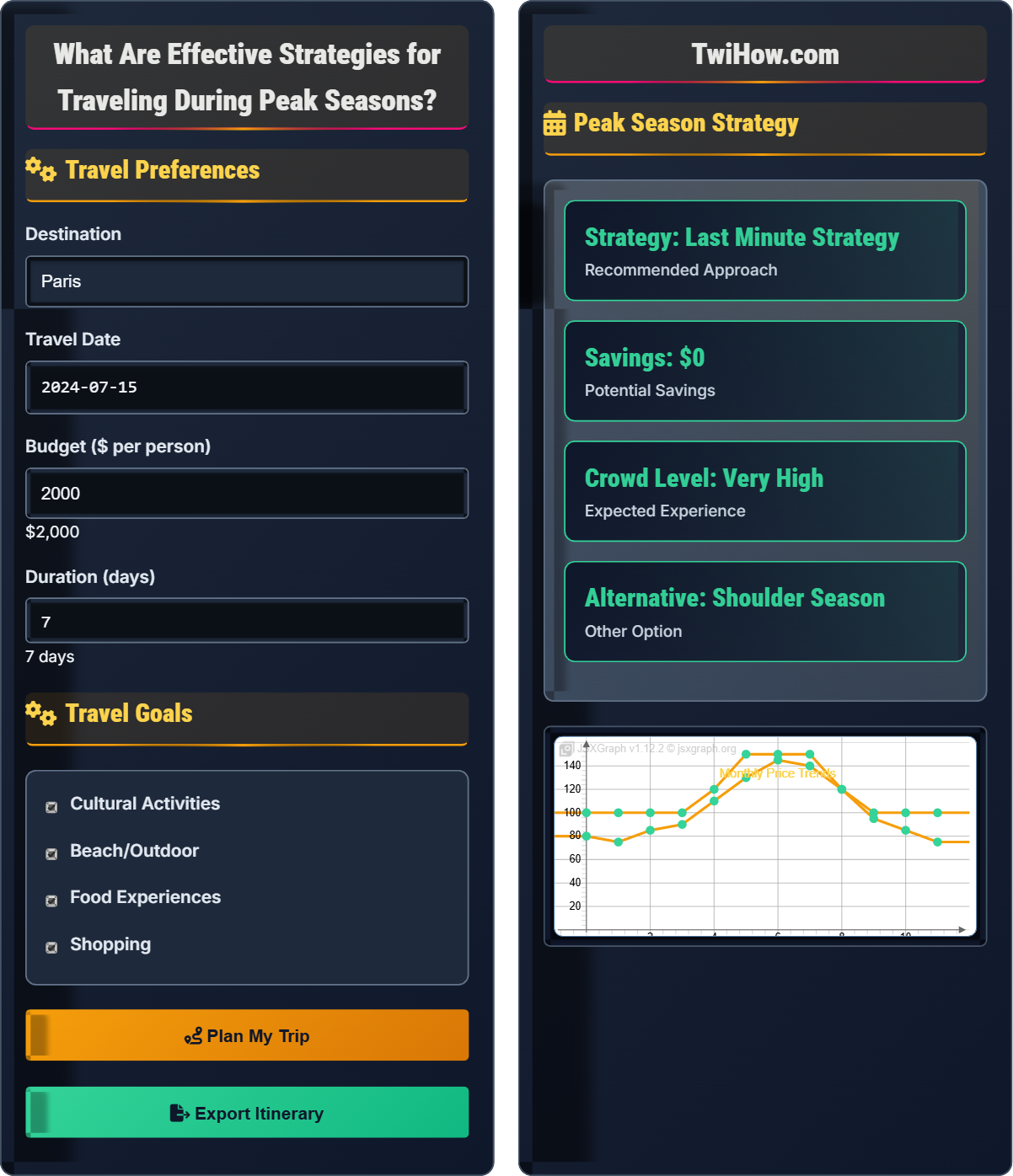
Peak Season Strategy
| Strategy | Impact | Difficulty | Value |
|---|---|---|---|
| Book Early | High Savings | Easy | ⭐⭐⭐⭐⭐ |
| Flexible Dates | Medium Savings | Medium | ⭐⭐⭐⭐ |
| Off-Peak Activities | Reduced Crowds | Easy | ⭐⭐⭐⭐ |
| Alternative Locations | New Experience | Hard | ⭐⭐⭐ |
Peak Season Travel Strategies
Peak seasons vary by destination but generally occur during summer months, major holidays, and school vacation periods. During these times, destinations experience maximum visitor volumes, higher prices, and increased demand for accommodations and attractions. Understanding peak season patterns helps travelers make informed decisions about timing, costs, and experiences.
Global peak season patterns include:
- Summer Peak: June-August in Northern Hemisphere, December-February in Southern Hemisphere
- Holiday Peaks: Christmas, New Year, Easter, Thanksgiving, and local festivals
- School Breaks: Spring break, summer vacation, and winter holidays
- Shoulder Seasons: Periods just before/after peak season with moderate crowds and prices
Different strategies offer unique advantages:
- Early Booking: Guaranteed availability, potential savings, peace of mind
- Flexible Dates: Better pricing, fewer crowds, alternative experiences
- Alternative Destinations: Unique experiences, lower costs, less crowding
- Off-Peak Activities: Shorter lines, better photos, more authentic interactions
- Start Early: Visit popular attractions in the morning before crowds arrive
- Book Fast Passes: Reserve entry times for major attractions in advance
- Explore Local Areas: Discover neighborhoods away from main tourist zones
- Plan Rest Days: Balance intensive sightseeing with relaxation
- Stay Connected: Monitor real-time crowd levels and weather conditions
Peak Season Fundamentals
Peak seasons, shoulder seasons, crowd management, advance booking, flexible dates.
Peak Season Cost = Base Price × (1 + Peak Season Premium) - Early Booking Discount
Where Peak Season Premium typically ranges from 20-100% above base price.
- Book accommodations 6-12 months in advance
- Reserve popular attractions before arrival
- Expect higher prices during peak periods
Practical Applications
Summer vacation planning, holiday travel, special events, family reunions.
- Research destination-specific peak periods
- Compare peak vs. shoulder season costs
- Identify alternative accommodations
- Plan activities around crowd schedules
- Factor in 20-50% price increase during peaks
- Consider shoulder season for better value
- Look for package deals and early bird discounts
- Plan for additional costs (parking, dining)
Peak Season Travel Quiz
Which of the following is typically NOT considered a peak travel season?
October in Paris is typically considered a shoulder season, which falls between peak and off-season. Shoulder seasons usually offer milder weather, fewer crowds, and better prices compared to peak season. Peak seasons are characterized by maximum tourist volumes, higher prices, and maximum activity availability.
The answer is D) October in Paris (shoulder season).
Understanding the difference between peak, shoulder, and off-seasons is crucial for travel planning. Peak seasons occur when destinations experience maximum visitor volumes, usually during summer months, major holidays, and school breaks. Shoulder seasons offer a middle ground with moderate crowds and prices, while off-seasons have minimal tourism activity.
Peak Season: Period with maximum tourist activity and highest prices
Shoulder Season: Transition period between peak and off-season
Off-Season: Period with minimal tourist activity and lowest prices
• Peak seasons vary by destination
• Shoulder seasons offer good value
• Off-seasons may have limited services
• Research destination-specific peak periods
• Consider shoulder season for better value
• Book early for peak season travel
• Assuming all summer months are peak season
• Not considering shoulder seasons
• Booking last minute during peak periods
Explain how peak season travel affects your budget and describe three strategies to manage increased costs while still enjoying a quality experience during peak periods.
Budget Impact: Peak season travel typically increases costs by 20-100% compared to off-season. Accommodations, flights, dining, and attraction fees are all higher during peak periods due to increased demand. Popular restaurants and activities may also require reservations and deposits.
Management Strategies:
1. Early Booking Discounts: Book accommodations and flights 6-12 months in advance to secure early bird rates and avoid last-minute price surges.
2. Alternative Accommodations: Consider vacation rentals, hostels, or hotels outside prime tourist areas to reduce lodging costs.
3. Free Activities: Plan visits to free museums, parks, beaches, and walking tours to balance paid experiences with budget-friendly options.
Budget management during peak seasons requires strategic thinking and advance planning. The key is to allocate resources wisely, taking advantage of early booking opportunities while finding creative ways to enjoy experiences without overspending. Successful peak season budgeting balances cost-conscious decisions with the desire for quality experiences.
Early Bird Rates: Discounts offered for advance bookings
Peak Season Premium: Additional cost charged during high-demand periods
Cost-Benefit Analysis: Evaluating expenses versus experience quality
• Expect 20-100% price increases during peaks
• Book early to secure better rates
• Balance paid and free experiences
• Set aside extra budget for unexpected costs
• Look for package deals and promotions
• Consider group discounts and memberships
• Not accounting for peak season premiums
• Booking too late and paying premium prices
• Focusing only on expensive activities
You want to visit Rome during the summer peak season (July) with a budget of $3,000 for a 7-day trip. You estimate that peak season flights cost $800 (vs. $500 off-season), hotels cost $150/night (vs. $90 off-season), and daily expenses will be 30% higher than off-season averages of $80/day. Calculate whether your budget will cover the trip and suggest adjustments if needed.
Peak Season Costs:
Flights: $800 (vs. $500 off-season)
Hotels: $150 × 7 nights = $1,050 (vs. $630 off-season)
Daily Expenses: $80 × 1.30 × 7 days = $728 (vs. $560 off-season)
Total Peak Season Cost: $800 + $1,050 + $728 = $2,578
Off-Season Cost: $500 + $630 + $560 = $1,690
Conclusion: Your $3,000 budget will cover the trip with $422 remaining. Peak season costs you $888 more than off-season travel.
Adjustments: With the remaining budget, you could upgrade accommodations, add day trips, or increase daily spending for premium experiences.
Peak season budget calculations require understanding the percentage increases for different expense categories. Accommodations typically see the largest increases, followed by flights and daily expenses. The example shows that while peak season costs are significantly higher, a well-planned budget can still accommodate the trip with room for adjustments.
Peak Season Premium: Additional cost during high-demand periods
Budget Allocation: Distribution of funds across different expense categories
Cost Differential: Difference between peak and off-season expenses
• Calculate all expense categories
• Account for percentage increases
• Include buffer for unexpected costs
• Compare peak vs. off-season costs
• Factor in percentage increases for all expenses
• Build in contingency funds
• Only calculating accommodation increases
• Forgetting daily expense inflation
• Not accounting for all expense categories
You're visiting the Colosseum in Rome during peak season. Lines are typically 2-3 hours long, and the site opens at 8:30 AM. You've reserved skip-the-line tickets for 10 AM. However, you want to avoid crowds for photography and meaningful exploration. Develop a strategy for maximizing your experience given these constraints.
Arrival Strategy: Arrive 30 minutes before your ticket time (9:30 AM) to ensure you enter promptly at 10 AM, avoiding the worst of the morning crowds that typically arrive after 10:30 AM.
Photography Timing: Focus on capturing the most iconic shots during your first 30 minutes when lighting is optimal and crowds haven't fully arrived. Use the reserved time slot to access popular viewpoints before they become congested.
Exploration Approach: Start with the main arena floor and upper levels during your reserved time, then explore the underground areas when crowds thin out slightly later in the morning. Consider returning for the evening tour if available, as late afternoon light provides excellent photo opportunities with fewer visitors.
Alternative Activities: Plan other crowded attractions (like Vatican Museums) for afternoon hours when Colosseum crowds have dispersed, then return to Colosseum area in late afternoon for different perspectives.
Crowd management during peak season requires strategic timing and understanding of visitor flow patterns. Skip-the-line tickets provide access during busy periods, but optimal experiences often require additional planning around crowd behavior. The key is to leverage your reserved access while understanding when and where crowds form throughout the day.
Skip-the-Line Tickets: Reserved entry times to bypass general admission queues
Crowd Flow Patterns: Predictable visitor movement throughout the day
Photography Windows: Optimal times for crowd-free shots
• Arrive before reserved time
• Understand peak crowd hours
• Maximize reserved access period
• Research attraction-specific crowd patterns
• Use early morning light for photography
• Plan return visits for different lighting
• Arriving exactly at reserved time
• Not planning beyond skip-the-line access
• Missing optimal photography windows
Which of the following is the BEST alternative strategy for peak season travel?
Choosing less popular destinations during peak season is the best alternative strategy. This approach allows you to travel during favorable weather and school breaks while avoiding the crowds and inflated prices of major tourist destinations. You can still enjoy quality experiences in emerging destinations that may offer unique cultural experiences and better value during peak season.
The answer is B) Choose less popular destinations during peak season.
Alternative destination strategy during peak season represents smart resource allocation. Instead of fighting crowds and paying premium prices at popular destinations, travelers can discover emerging locations that offer similar experiences at better value. This approach requires research but often results in more authentic and enjoyable experiences.
Alternative Destinations: Less popular locations offering similar experiences
Emerging Tourism: Growing destinations with developing infrastructure
Resource Allocation: Strategic distribution of travel resources
• Research alternative destinations thoroughly
• Verify infrastructure and services
• Consider accessibility and safety
• Look for "next hot destinations" lists
• Check recent travel blogs and reviews
• Verify transportation options
• Choosing destinations without adequate infrastructure
• Not researching safety and accessibility
• Assuming all alternatives are equally developed
FAQ
Q: What are the best strategies for booking flights during peak season to get the best prices?
A: Booking flights during peak season requires strategic planning:
Timing: Book domestic flights 3-6 months in advance and international flights 6-11 months ahead. The sweet spot is typically 6-8 weeks before departure for peak season flights.
Search Techniques: Use incognito browsing to avoid price tracking, search across multiple devices, and check prices on different days of the week. Tuesdays and Wednesdays often show better deals.
Flexibility: Consider flying mid-week instead of weekends, look at nearby airports, and be willing to connect instead of non-stop flights. Set up price alerts to monitor fluctuations.
Alternative Options: Consider package deals, airline alliances, and credit card partnerships that might offer discounts or upgrades during peak periods.
Q: How can families manage the challenges of peak season travel while keeping costs reasonable?
A: Family peak season travel requires special considerations:
Accommodation: Vacation rentals or family suites often provide better value than multiple hotel rooms. Look for places with kitchens to save on meal costs.
Activities: Many attractions offer family packages or free admission for children under certain ages. Research these deals in advance.
Timing: Plan activities around nap times and meal schedules. Visit popular attractions early morning or late afternoon to avoid peak crowds.
Budgeting: Factor in children's needs and activities when budgeting. Consider that some costs decrease (free meals, reduced attraction prices) while others increase (accommodation size).
Flexibility: Build extra time into your schedule for rest and unexpected delays. Peak season can be exhausting for children.