Learning About Destination History and Context
Travel guide • Step-by-step cultural education
Historical Learning:
Create Learning PlanUnderstanding a destination's history and cultural context enriches travel experiences and fosters deeper appreciation. This comprehensive guide provides strategies for learning about destinations through multiple sources and approaches.
Key aspects of destination learning:
- Pre-trip Research: Books, documentaries, and online resources
- Local Engagement: Interacting with residents and guides
- Site Visits: Museums, monuments, and historical locations
- Academic Sources: Scholarly articles and historical documents
- Technology Tools: Apps, virtual tours, and digital archives
Effective destination learning combines multiple approaches for comprehensive understanding.
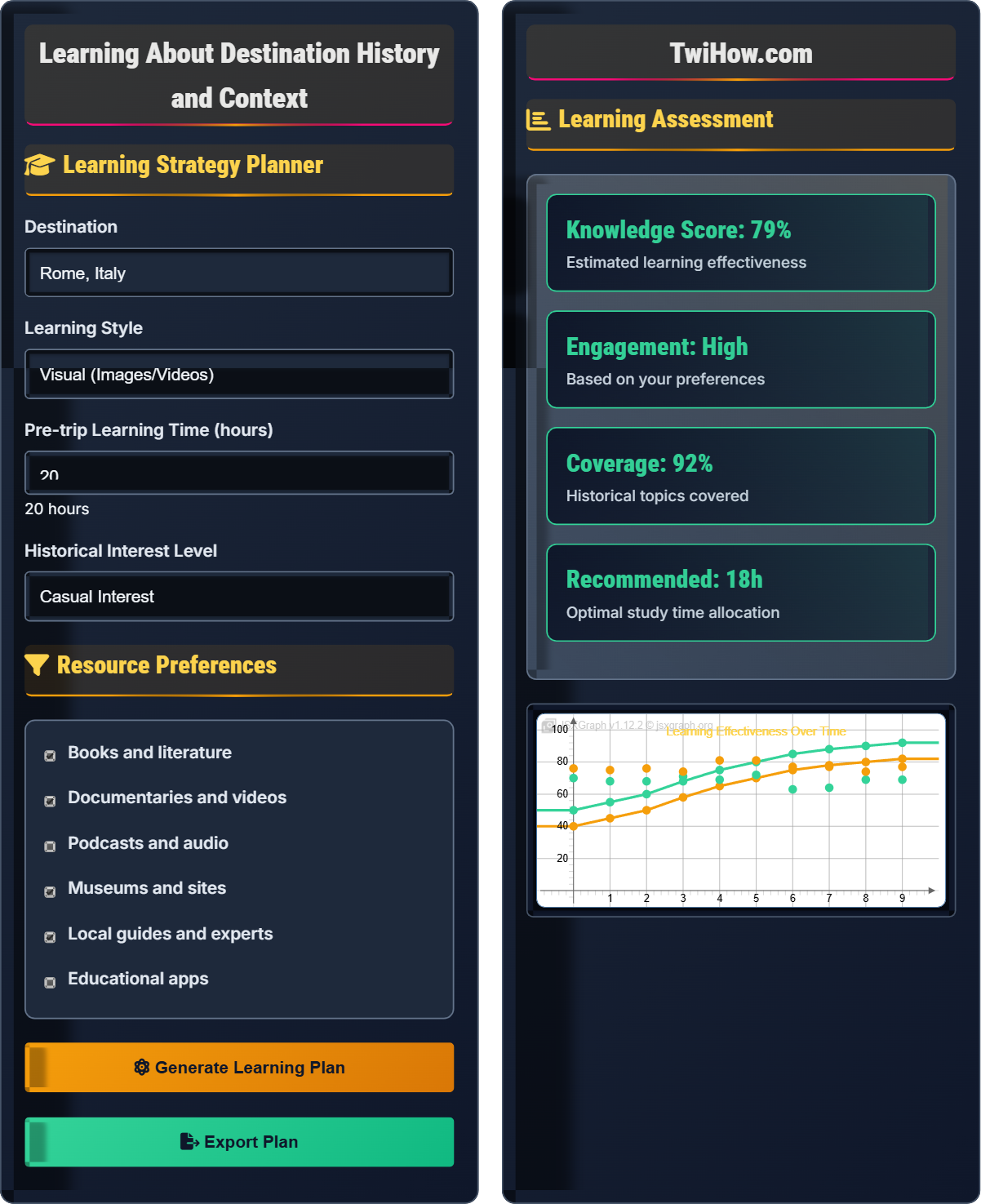
Learning Strategy Planner
Resource Preferences
Learning Assessment
| Resource Type | Time Allocation | Topics Covered | Priority |
|---|---|---|---|
| Books | 6 hours | Roman Empire, Architecture | High |
| Documentaries | 4 hours | Historical Events | High |
| Guides | 3 hours | Local Perspectives | Medium |
| Museums | 4 hours | Artifacts & Art | High |
| Apps | 1 hour | Quick Facts | Low |
Recommended Books
Rome: "SPQR" by Mary Beard, "The Decline and Fall" by Gibbon
General: "A History of the World" by Andrew Marr
Documentary Series
Historical: "Ancient Civilizations", "Rome: Engineering an Empire"
Cultural: "Civilisation" by Kenneth Clark
Learning About Destination History and Context
Learning about a destination's history and context requires multiple approaches to build comprehensive understanding. Effective historical learning combines academic research with experiential engagement, creating a rich foundation for meaningful travel experiences.
The learning effectiveness can be calculated as:
Where:
- Engagement: Active participation and interest level
- Diversity: Number of different resource types used
- Depth: Thoroughness of exploration
- Time Invested: Hours spent on learning activities
Books, articles, and scholarly sources
Documentaries and virtual tours
Guides, locals, and experts
Museums, monuments, and sites
- Academic Sources: Scholarly books, journals, and historical documents
- Visual Media: Documentaries, films, and virtual tours
- Audio Resources: Podcasts, audiobooks, and interviews
- Interactive Tools: Educational apps, virtual reality experiences
- Local Experts: Tour guides, historians, and community members
- Primary Sources: Original documents, artifacts, and testimonies
Learning Strategy
Historical learning, cultural context, destination research, educational travel, cultural literacy, historical awareness.
Learning Effectiveness = (Engagement × Diversity × Depth) / Time Invested × 100%
Where higher scores indicate more effective learning.
- Diversify learning sources for comprehensive understanding
- Combine academic and experiential learning approaches
- Engage with local perspectives and narratives
Practical Applications
Pre-trip preparation, cultural immersion, historical appreciation, educational travel, meaningful experiences, personal growth.
- Identify learning objectives and interests
- Research destination historical timeline
- Select appropriate learning resources
- Allocate time for different learning methods
- Apply knowledge during travel
- Balance academic and experiential learning
- Consider multiple perspectives and narratives
- Allow for serendipitous discoveries
- Adapt learning to your style and pace
Historical Learning Quiz
Which combination of learning approaches is most effective for understanding destination history?
Diverse learning approaches provide multiple perspectives and reinforce understanding. Combining academic sources (books), visual media (documentaries), and experiential learning (local engagement) creates a comprehensive foundation for understanding destination history. Each approach complements the others and addresses different learning styles.
The answer is B) Diverse sources including books, documentaries, and local engagement.
Effective learning about history requires multiple modalities because historical events are complex and multifaceted. Academic sources provide factual foundation, visual media offers contextual understanding, and local engagement provides human perspective. This multi-modal approach accommodates different learning preferences and creates deeper comprehension.
Multi-Modal Learning: Using multiple approaches to acquire knowledge
Historical Context: Background circumstances surrounding events
Primary Sources: Original documents and artifacts from the time period
• Diversify learning sources for comprehensive understanding
• Combine academic and experiential approaches
• Engage with multiple perspectives
• Start with general overviews before specializing
• Use visual aids to remember historical timelines
• Connect historical events to current observations
• Relying on a single source or perspective
• Not connecting historical context to present day
• Focusing only on famous events, ignoring daily life
Explain the importance of primary sources in understanding destination history and how to access them while traveling.
Importance of Primary Sources:
Primary sources provide firsthand accounts and authentic perspectives from the time period. They offer insights into daily life, attitudes, and experiences that secondary sources might miss. These sources include diaries, letters, newspaper articles, photographs, artifacts, and oral histories.
Accessing Primary Sources:
Archives and Libraries: Many destinations have local archives with historical documents. Major cities often have national libraries with historical collections.
Museums: Often house primary sources and provide context. Many allow photography of documents and artifacts.
Local Institutions: Universities, historical societies, and religious institutions may have unique collections.
Digital Archives: Many primary sources are digitized and accessible online before travel.
Oral Histories: Speaking with elderly residents or descendants of historical figures provides living primary source material.
Historical Sites: Physical locations provide context and authenticity that cannot be replicated in secondary sources.
Primary sources help distinguish between historical fact and later interpretations.
Primary sources are essential because they provide authentic voices from the past. They help learners understand historical events from the perspective of people who lived through them, rather than filtered through later interpretations. This creates more nuanced and accurate understanding of historical contexts.
Primary Source: Original document or artifact from the time period
Secondary Source: Analysis or interpretation of primary sources
Historical Context: Circumstances surrounding historical events
• Verify authenticity of primary sources
• Consider the creator's perspective and bias
• Use primary sources to supplement, not replace, broader context
• Research archives before travel
• Contact institutions in advance
• Take detailed notes and photos when permitted
• Not verifying authenticity of sources
• Taking primary sources at face value without context
• Failing to consider the creator's perspective
You're traveling to Kyoto and want to understand the cultural significance of temples and gardens. How would you approach learning about the spiritual and aesthetic principles behind these sites?
Learning Approach:
1. Historical Foundation: Read about Buddhism's arrival in Japan, the development of Zen philosophy, and the tea ceremony's influence on garden design.
2. Philosophical Understanding: Study concepts like wabi-sabi (finding beauty in imperfection), mono no aware (transience), and ma (negative space).
3. Artistic Context: Learn about traditional Japanese aesthetics, the influence of Chinese philosophy, and how political changes affected temple construction.
4. Practical Engagement: Attend meditation sessions, tea ceremonies, or calligraphy workshops to experience these principles firsthand.
5. Site-Specific Learning: Research the history of each specific temple and garden, including their founding, patronage, and architectural features.
6. Local Perspective: Engage with monks, gardeners, or cultural practitioners who can explain spiritual significance.
Resources: Books by authors like Donald Keene, D.T. Suzuki, and Pico Iyer provide cultural context. Documentaries on Japanese aesthetics and spiritual practices offer visual understanding.
This approach connects intellectual understanding with experiential appreciation.
Cultural sites require understanding both historical context and philosophical principles. Simply knowing when a temple was built is insufficient; understanding the spiritual and aesthetic concepts behind it transforms a sightseeing visit into meaningful cultural engagement.
Cultural Context: Social, spiritual, and aesthetic background of practices
Wabi-Sabi: Japanese aesthetic focusing on imperfection and impermanence
Zen Buddhism: School emphasizing meditation and direct experience
• Understand philosophical foundations
• Connect historical context to present significance
• Engage with both intellectual and experiential learning
• Study basic philosophical concepts before travel
• Participate in cultural activities when possible
• Ask about spiritual significance, not just history
• Focusing only on historical facts, missing spiritual context
• Treating cultural sites as mere photo opportunities
• Not understanding the relationship between philosophy and architecture
You're visiting a former colonial destination. How do you learn about both the colonizer's and the colonized's perspectives on historical events?
Balanced Historical Learning:
1. Colonizer's Perspective: Examine official records, administrative documents, and colonial literature. These sources reveal the imperial mindset and policies implemented.
2. Colonized Perspective: Seek indigenous historical accounts, resistance movements, oral histories, and post-colonial scholarly works. These provide insights into lived experiences and impacts.
3. Contemporary Voices: Read works by local historians, novelists, and activists who interpret colonial history from indigenous perspectives.
4. Comparative Analysis: Contrast different accounts of the same events to understand how perspectives differ.
5. Site Interpretation: Compare how historical sites present colonial history. Some may reflect dominant narratives while others emphasize local perspectives.
6. Local Engagement: Discuss historical events with local residents, particularly elders who may have heard family stories about the colonial period.
Resources: Academic works by post-colonial scholars, local historical societies, indigenous museums, and contemporary local authors provide balanced perspectives.
Understanding multiple viewpoints creates more nuanced historical understanding.
Colonial history is complex because it involves multiple, often conflicting, narratives. Effective learning requires examining both official records and local perspectives to understand the full impact of colonialism on different populations.
Post-Colonial Studies: Academic field examining colonial impacts
Multiple Narratives: Different perspectives on the same historical events
Decolonizing History: Reexamining history from indigenous perspectives
• Seek multiple perspectives on historical events
• Recognize power imbalances in historical narratives
• Understand ongoing impacts of colonialism
• Read works by local historians and authors
• Visit indigenous cultural centers and museums
• Listen to local perspectives during discussions
• Accepting only official historical narratives
• Not seeking indigenous perspectives
• Failing to understand ongoing colonial impacts
Which technology tool is most valuable for learning about destination history while traveling?
Audio guide apps with historical content provide detailed, site-specific information that enhances understanding while viewing historical locations. These apps often include expert commentary, primary source readings, and contextual explanations that connect what visitors see with historical significance. They allow for self-paced learning and can be paused for reflection and observation.
The answer is B) Audio guide apps with historical content.
Audio guides combine visual and auditory learning while providing immediate context for what visitors are seeing. This multimodal approach reinforces learning and creates stronger connections between historical knowledge and physical sites. The portability and self-paced nature make them ideal for experiential learning.
Audio Guide: Technology providing narration at historical sites
Experiential Learning: Learning through direct experience
Site-Specific Information: Contextual details relevant to location
• Use technology to enhance, not replace, observation
• Verify information from multiple sources
• Balance digital and direct experience
• Download content before arrival
• Use headphones for better focus
• Take notes during audio presentations
• Following audio guides without looking around
• Not pausing to absorb information
• Assuming all digital content is accurate
FAQ
Q: I have limited time to prepare before my trip. What are the most efficient ways to learn about a destination's history?
A: For efficient historical learning with limited time:
Quick Start Strategy:
1. Watch a quality documentary: 2-3 hour documentary can cover centuries of history
2. Read a concise overview book: "A Short History of [Destination]" provides essential timeline
3. Focus on major periods: Identify 3-4 key historical eras and learn their significance
4. Download audio guides: Learn while visiting sites rather than beforehand
5. Research 5-7 important figures: People often embody historical themes
Time-Saving Tips:
• Use Wikipedia's "History of..." pages for quick overviews
• Focus on events that shaped current culture and landmarks
• Prioritize understanding over memorizing dates
• Ask locals for "must-know" historical facts
Key Principle: Depth over breadth - understand a few major themes thoroughly rather than skimming many topics.
Q: How do I balance learning about history with enjoying my travel experience?
A: Historical learning should enhance, not overshadow, travel enjoyment:
Integration Techniques:
• Learn enough background to appreciate what you're seeing, but don't over-study
• Use historical knowledge as conversation starters with locals
• Focus on stories and human elements rather than just dates and facts
• Allow for spontaneous discoveries that complement your learning
Practical Balance:
• Dedicate 20-30% of travel time to structured learning activities
• Spend 70-80% on experiential activities that apply your knowledge
• Take breaks from intensive learning to enjoy sensory experiences
• Use learning as a lens to enhance, not dominate, your experiences
Pro Tips:
• Schedule learning activities during less active parts of the day
• Use audio guides while walking to combine movement with learning
• Join guided tours that blend history with exploration
• Keep a travel journal connecting historical knowledge to personal observations
The goal is enriched appreciation, not academic overload.