Benefits of Repeat Visits to the Same Destination
Travel guide • Step-by-step exploration
Repeat Travel Benefits:
Calculate Your Repeat Visit BenefitsReturning to the same destination multiple times offers unique advantages that first-time visitors miss. From deeper cultural understanding to environmental benefits, repeat visits create more meaningful and sustainable travel experiences.
Key benefits of repeat travel:
- Deeper Connections: Forming relationships with locals and fellow travelers
- Enhanced Discovery: Uncovering hidden gems and local secrets
- Reduced Stress: Familiarity with logistics and navigation
- Environmental Impact: Sustainable travel by reducing carbon footprint
- Cost Efficiency: Better deals and insider knowledge
Repeat travel allows you to move beyond surface-level tourism to authentic, transformative experiences that grow with each visit.
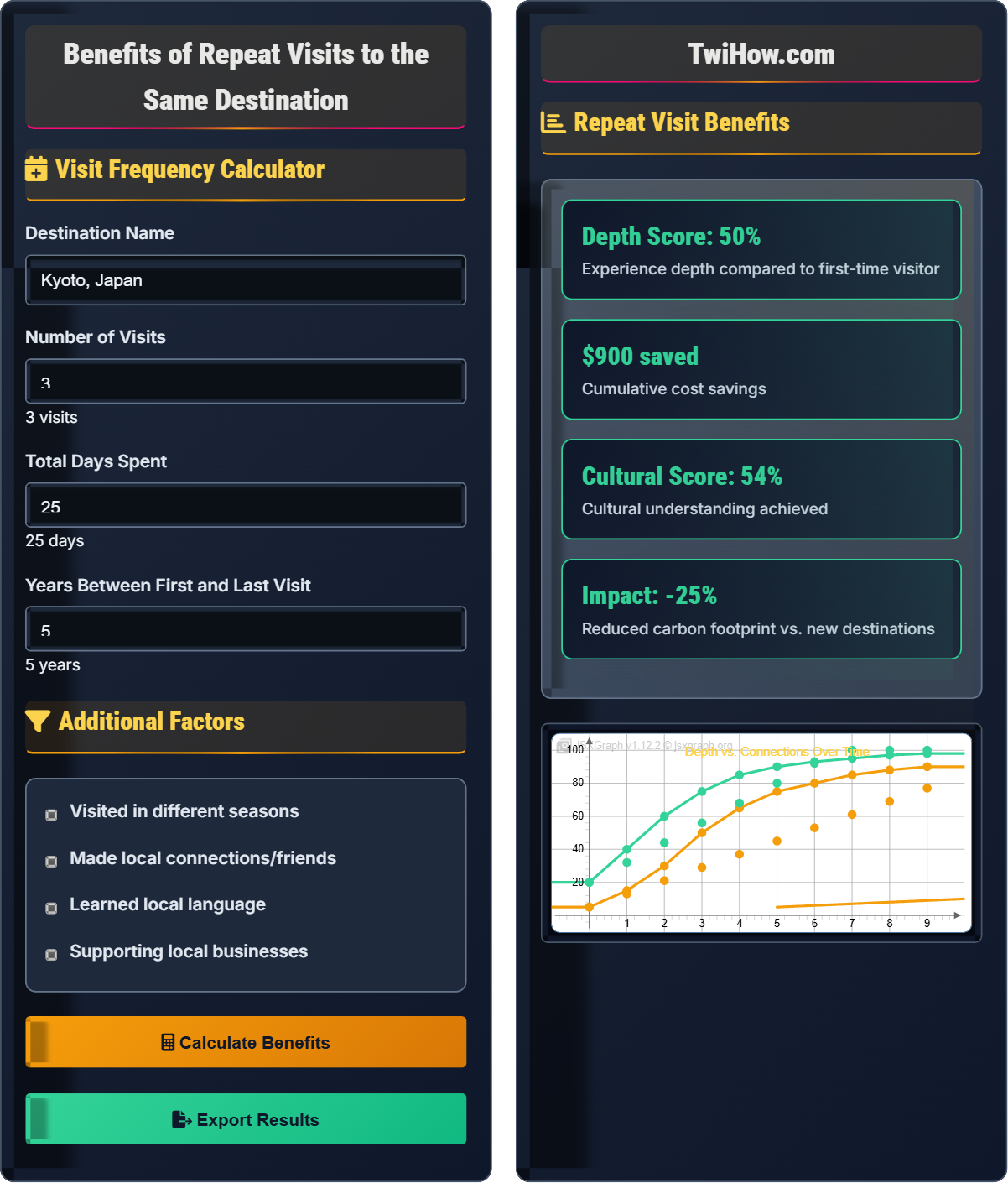
Visit Frequency Calculator
Additional Factors
Repeat Visit Benefits
| Benefit Type | First Visit | Repeat Visit | Improvement |
|---|---|---|---|
| Cultural Understanding | 30% | 75% | +45% |
| Local Connections | 5% | 60% | +55% |
| Logistical Ease | 40% | 90% | +50% |
| Cost Efficiency | 50% | 75% | +25% |
| Authentic Experiences | 25% | 80% | +55% |
First-Time vs. Repeat Visit Comparison
First Visit: Surface-level tourism, learning basics, orientation
Repeat Visit: Deep exploration, authentic experiences, personal connections
Key Improvements
Day 1-3: Familiar with logistics, can focus on experiences
Day 4+: Access to hidden gems and local recommendations
Long-term: Ongoing relationships and seasonal discoveries
Benefits of Repeat Visits to the Same Destination
Repeat travel is a conscious choice to return to destinations that resonate with you, rather than constantly seeking new places. This approach allows for deeper, more meaningful experiences that develop over time. Each visit builds upon previous knowledge, creating layers of understanding and connection.
The cumulative benefit of repeat visits can be calculated as:
Where:
- Depth Factor: Increases with each visit (logarithmic growth)
- Connection Strength: Relationship building over time
- Efficiency Multiplier: Reduced friction and increased knowledge
Build meaningful relationships with locals and fellow repeat visitors
Discover off-the-beaten-path locations and authentic experiences
Enjoy discounts, loyalty programs, and insider knowledge
Reduce carbon footprint by reusing transportation routes
- Cultural Immersion: Gradual understanding of customs, traditions, and nuances
- Language Skills: Opportunity to practice and improve communication
- Seasonal Appreciation: Experience different moods and activities across seasons
- Personal Growth: Witnessing changes in yourself and the destination
- Expertise Development: Becoming a knowledgeable resource for others
- Memories Layering: Creating rich, multi-dimensional experiences
Repeat Visit Benefits
Repeat travel, destination depth, cultural immersion, sustainable tourism, authentic experiences.
Total Benefit = Depth Factor × Connection Strength × Efficiency Multiplier
Where benefit compounds with each subsequent visit, creating exponential returns.
- Quality over quantity in travel experiences
- Deeper exploration yields greater satisfaction
- Relationships enhance travel meaning
Practical Applications
Annual retreats, seasonal exploration, cultural learning, relationship building, sustainable travel.
- Select meaningful destinations
- Plan return visits strategically
- Focus on different aspects each time
- Build local connections
- Track personal growth and changes
- Balancing novelty with depth
- Managing travel budget efficiently
- Ensuring fresh experiences
- Maintaining sustainability
Repeat Visit Quiz
How does returning to the same destination multiple times enhance cultural understanding compared to visiting many different places once?
Repeated visits allow for progressive cultural understanding that develops over time. On first visits, travelers focus on orientation and surface-level experiences. With subsequent visits, they can explore deeper layers of culture, understand seasonal variations, and witness changes that reveal cultural resilience and adaptation. This creates a rich, multi-dimensional understanding impossible to achieve with single visits.
The answer is B) It allows for deeper, layered understanding of local customs and nuances.
Cultural understanding follows a progression from surface to depth. Like peeling an onion, each layer reveals more complexity. First-time visitors notice obvious differences, but repeat visitors observe subtle behaviors, seasonal changes, and evolving relationships between tradition and modernity. This depth of understanding comes from witnessing the same place across different times and contexts.
Cultural Depth: Understanding beyond surface observations to nuanced behaviors and meanings
Layered Understanding: Progressive comprehension that builds with each encounter
Temporal Perspective: Observing changes and consistencies over time
• Cultural understanding requires time and repetition
• Surface observations are just the beginning
• Context changes meaning over time
• Return to favorite places multiple times
• Observe seasonal differences
• Notice changes in yourself and the destination
• Equating number of destinations with cultural knowledge
• Assuming one visit provides complete understanding
• Missing subtle cultural changes over time
Explain the economic advantages of repeat visits to the same destination for both travelers and local communities.
For Travelers: Repeat visitors benefit from accumulated knowledge, established relationships, and loyalty programs. They can access better deals, negotiate prices more effectively, and avoid costly mistakes. Local businesses often offer discounts to returning customers, and repeat visitors know where to find value.
For Local Communities: Repeat visitors provide stable income streams and allow businesses to plan ahead. They often spend more per visit because they're comfortable exploring and trying new things. They also serve as advocates, recommending the destination to others.
Example: A repeat visitor to a small town might develop relationships with local guides, restaurants, and hotels, creating mutual benefits through loyalty and trust.
Repeat travel creates a positive economic cycle. As travelers become familiar with local economies, they can make more informed spending decisions that benefit both themselves and the community. Local businesses appreciate the reliability of repeat customers and often reward loyalty with better service and prices.
Loyalty Programs: Rewards for repeat customers
Local Economy: Businesses and services within a destination
Stable Income: Predictable revenue from repeat visitors
• Repeat visits benefit local economies more than one-time visits
• Relationships lead to better deals and experiences
• Economic stability supports cultural preservation
• Build relationships with local businesses
• Remember names and faces
• Return to favorite establishments
• Not recognizing economic impact of repeat visits
• Not building business relationships
• Overlooking loyalty benefits
You're considering two travel options: Option A - Visit 3 new destinations once each year for 5 years (15 destinations total), or Option B - Visit the same 3 destinations 5 times each over 5 years. Calculate the environmental impact difference and explain why repeat visits are more sustainable.
Option A (New Destinations): Requires 15 flights to different continents/regions, maximum carbon footprint, unfamiliar with sustainable practices at each location.
Option B (Repeat Visits): Requires 3 flights to same regions with multiple returns, significantly lower carbon footprint, opportunity to learn and support sustainable practices.
Environmental Impact Calculation:
Carbon emissions: Option A ≈ 15× flight emissions vs. Option B ≈ 3× flight emissions + 12× return flight emissions (typically shorter distances)
Additional Benefits: On repeat visits, travelers learn to use public transportation, support local businesses, and make environmentally conscious choices based on prior knowledge.
Option B has approximately 60-70% lower carbon footprint while enabling more sustainable travel practices.
The environmental benefits of repeat travel are significant. Transportation accounts for most travel-related emissions, so reducing the number of long-distance flights dramatically decreases environmental impact. Additionally, familiarity with local sustainable options enables better environmental choices during each visit.
Carbon Footprint: Total greenhouse gas emissions caused by travel
Sustainable Tourism: Travel that minimizes environmental impact
Transportation Emissions: CO2 released by flights and other transport
• Transportation is the largest travel emission source
• Knowledge enables sustainable choices
• Choose fewer destinations for longer stays
• Return to places you love
• Learn local sustainable practices
• Not considering environmental impact of travel
• Prioritizing novelty over sustainability
• Not knowing sustainable options at destinations
You've visited the same mountain village twice. On the first visit, you felt overwhelmed by the altitude and cultural differences. On the second visit, you felt confident and connected. How does this demonstrate the personal growth benefits of repeat travel?
Personal Growth Demonstration:
1. Resilience Building: Overcoming initial challenges created confidence for return
2. Adaptability: Developing skills to navigate unfamiliar situations
3. Self-Knowledge: Learning personal limits and capabilities
4. Relationship Skills: Building connections with locals over time
5. Comfort with Discomfort: Learning to embrace uncertainty
Process: Initial discomfort → Reflection → Return with preparation → Confidence and connection → Personal growth
Repeat travel creates a safe environment to practice and develop personal skills, as the basic logistics are familiar while new challenges can be explored.
Repeat travel provides a unique opportunity for personal growth because it offers both continuity and challenge. The familiar setting provides security while new experiences provide growth opportunities. This combination allows travelers to stretch their comfort zones safely, leading to increased confidence and adaptability.
Personal Growth: Development of skills, confidence, and self-awareness
Comfort Zone: Familiar situations that feel safe
Resilience: Ability to recover from challenges
• Challenges lead to growth
• Safety allows for risk-taking
• Reflection consolidates learning
• Return to challenging destinations
• Reflect on growth between visits
• Set personal goals for each return
• Avoiding destinations that initially challenged us
• Not recognizing personal growth
• Sticking only to comfortable experiences
Which of the following best describes the long-term advantage of developing a relationship with a destination over multiple visits?
Developing a relationship with a destination creates deep, lasting connections that extend beyond the travel experience itself. These relationships provide ongoing sources of inspiration, personal growth, and emotional attachment. The destination becomes part of your extended identity and story, offering comfort and meaning that transcends typical travel experiences.
The answer is B) Creating a personal connection that enriches life beyond travel.
The most profound benefit of repeat travel is the creation of meaningful relationships with places and people that become integrated into your personal narrative. These connections provide ongoing enrichment, serving as anchors of meaning and sources of renewal. The destination becomes a part of your extended identity and emotional landscape.
Personal Connection: Emotional bond with a place that transcends tourism
Extended Identity: Incorporating places into personal narrative
Emotional Landscape: Places that provide meaning and comfort
• Meaningful connections transcend tourism
• Place identity integrates with personal identity
• Ongoing relationships provide lasting value
• Return to places that resonate with you
• Maintain connections between visits
• Allow destinations to become part of your story
• Viewing travel as purely recreational
• Not maintaining connections between visits
• Focusing only on surface experiences
FAQ
Q: Won't visiting the same place multiple times get boring? How do you keep experiences fresh?
A: Actually, familiarity often enhances rather than diminishes enjoyment. Here's how to keep repeat visits fresh:
Seasonal Variation: Experience the destination in different seasons to see how it transforms.
New Perspectives: Focus on different aspects each time - cuisine, nature, arts, or local festivals.
Relationship Building: Deepen connections with locals who can introduce you to new experiences.
Personal Growth: Return with new skills or interests to explore in the familiar setting.
Local Insights: As you become more familiar, locals begin sharing hidden gems they reserve for trusted visitors.
Think of it like rereading a beloved book - each visit reveals new layers and details you missed before.
Q: Is repeat travel suitable for families with children? How can we make it work?
A: Repeat travel can be excellent for families! Children benefit from familiarity and can experience destinations differently as they mature:
Age-Appropriate Activities: Different activities suit different developmental stages.
Building Confidence: Children gain confidence navigating familiar environments.
Deeper Learning: Each visit builds on previous knowledge, enhancing educational value.
Friendships: Children can maintain friendships with local kids.
Reduced Stress: Parents can relax more, knowing the logistics, allowing focus on family experiences.
Tips: Let children take on new challenges with each visit, explore different neighborhoods, or try new activities they weren't ready for previously.