Memory Capture Without Device Distraction
Travel guide • Step-by-step mindful documentation
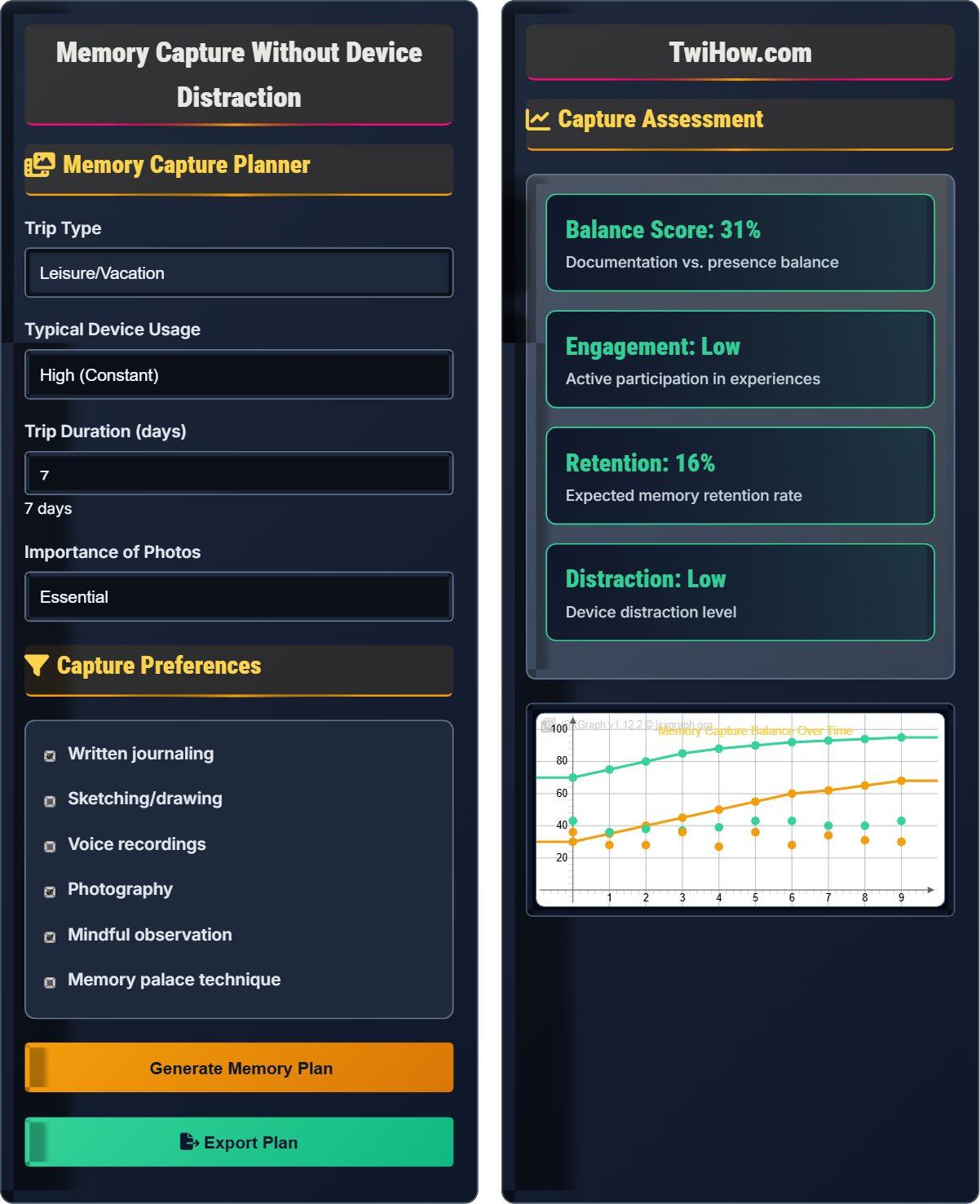
Memory Capture:
Create Memory PlanCapturing memories without being distracted by devices requires intentional balance between documentation and mindful presence. This guide provides strategies for meaningful memory capture that enhances rather than detracts from experiences.
Key aspects of mindful memory capture:
- Intentional Moments: Selective capture of truly meaningful experiences
- Present Awareness: Full engagement in the moment being documented
- Quality Over Quantity: Meaningful captures rather than endless photos
- Alternative Methods: Sketching, journaling, and mental note-taking
- Post-Experience Reflection: Processing and organizing memories thoughtfully
Successful memory capture preserves experiences while maximizing present-moment awareness and enjoyment.
Memory Capture Planner
Capture Preferences
Capture Assessment
| Method | Frequency | Best Times | Priority |
|---|---|---|---|
| Journaling | Daily | Evening reflection | High |
| Photography | 3-5 per day | Morning, sunset | Medium |
| Sketching | 2-3 per day | Scenic stops | Low |
| Mindful Moments | Continuous | All day | High |
| Voice Recording | 1-2 per day | Special moments | Medium |
Recommended Strategies
Leisure: 5-minute mindful observation before any photos
Adventure: Capture key moments, not continuous filming
Cultural: Document experiences through local interactions
Time Management
Photo Sessions: 10-15 minutes max, 2-3 times per day
Reflection Time: 20-30 minutes evening journaling
Mindful Breaks: 5 minutes every hour of experience
Memory Capture Without Device Distraction
Memory capture without device distraction involves creating a balance between preserving experiences and fully experiencing them. This requires intentional strategies that allow for documentation while maintaining present-moment awareness. The goal is to create lasting memories that are both preserved externally and internalized through mindful experience.
The optimal memory capture balance can be calculated as:
Where:
- Presence Time: Minutes fully engaged in experience
- Quality Capture: Meaningful documentation moments
- Total Experience Time: Total duration of experience
- Distraction Factor: Time spent managing devices
Experience fully before capturing
Connect emotionally to the moment
Document meaningfully and efficiently
Preserve memories in multiple formats
- 5-4-3-2-1 Method: Notice 5 things you see, 4 you hear, 3 you touch, 2 you smell, 1 you taste
- Memory Palace: Create mental locations to store experiences
- Snapshot Moments: Take mental pictures by closing eyes and observing
- Alternative Documentation: Sketching, journaling, voice notes
- Time Blocking: Designated capture vs. pure experience periods
- Intention Setting: Define specific moments worth capturing
Capture Strategy
Memory capture, mindful documentation, present awareness, intentional photography, digital detox, mindful travel, experience over photos.
Balance Score = (Presence Time + Quality Capture) / (Total Experience Time + Distraction Factor) × 100%
Where higher scores indicate better balance between documentation and presence.
- Experience first, document second
- Limit capture to meaningful moments
- Use multiple documentation methods
Practical Applications
Travel photography, family gatherings, scenic observation, cultural experiences, personal reflection, memory preservation.
- Set device usage limits before experiences
- Practice mindful observation techniques
- Choose meaningful moments to capture
- Use efficient documentation methods
- Reflect on experiences while present
- Balance documentation with experience
- Respect others' privacy and preferences
- Consider impact on group dynamics
- Plan for post-experience organization
Memory Capture Quiz
What is the most effective technique for experiencing a moment fully before capturing it?
Closing your eyes and mentally noting sensory details forces you to be fully present in the moment. This technique engages multiple senses and creates a rich internal memory before any external documentation occurs. It ensures you experience the moment with full attention before attempting to preserve it.
The answer is B) Close your eyes and mentally note 5 sensory details.
Mindful observation techniques train attention to be present rather than focused on capturing. By engaging multiple senses consciously, you create stronger internal memories that complement external documentation. This approach ensures the experience itself is valued over the documentation.
Mindful Observation: Conscious attention to present moment experience
Sensory Details: Information received through five senses
Internal Memory: Mental recording of experiences
• Experience before documenting
• Engage multiple senses
• Create internal memories first
• Use the 5-4-3-2-1 sensory technique
• Take brief mental snapshots
• Practice mindful breathing during observation
• Starting with documentation instead of experience
• Not engaging all senses
• Missing the moment while preparing to capture
Explain the difference between quality and quantity approaches to memory capture and why quality is more effective for meaningful experiences.
Quantity Approach:
• Take hundreds of photos/videos of the same scene
• Document every moment without discrimination
• Focus on having something to show later
• Constant device usage throughout experience
Quality Approach:
• Selectively capture only the most meaningful moments
• Fully experience before deciding to document
• Focus on preserving emotional essence
• Use devices efficiently and briefly
Why Quality is More Effective:
• Creates stronger emotional connections to memories
• Reduces distraction from the experience
• Makes post-trip review more meaningful
• Preserves the feeling, not just appearance
• Allows for deeper engagement with the moment
Quality captures are more likely to evoke vivid memories and emotions later.
Quality-focused memory capture prioritizes the experience itself over documentation. This approach recognizes that memories are formed through deep engagement, not through external recording. Quality captures become meaningful triggers for reliving experiences.
Quality Capture: Meaningful documentation of significant moments
Quantity Capture: Extensive documentation of all moments
Emotional Essence: Feelings and significance of experiences
• Select moments thoughtfully
• Focus on emotional significance
• Prioritize experience over documentation
• Set a daily photo limit
• Wait 10 seconds before capturing
• Ask yourself "why is this meaningful?"
• Taking photos without purpose
• Not experiencing moments before capturing
• Focusing on quantity over meaning
You have 8 hours of travel experiences planned for the day. How should you allocate time between experiencing and documenting to maintain optimal balance?
Recommended Time Allocation:
• Full Experience Time: 6 hours (75%) - Pure engagement with activities
• Documentation Time: 45 minutes (9%) - Efficient photo/video capture
• Reflection Time: 45 minutes (9%) - Journaling, mental processing
• Transition Time: 30 minutes (6%) - Moving between activities
Documentation Strategy:
• Morning: 10-15 minute capture session at sunrise
• Midday: 10-15 minute session during lunch break
• Evening: 15-20 minute session during sunset
• Throughout: 3-5 mental snapshots of key moments
Techniques:
• Use time-blocking to separate experience from documentation
• Set specific capture windows to avoid constant interruption
• Practice mindful observation between capture sessions
• Focus on experiences that can't be replicated elsewhere
This approach maximizes both experience quality and documentation effectiveness.
Time allocation for memory capture requires recognizing that experiences and documentation are different activities requiring different mindsets. Separating these activities allows for full engagement in each. The key is to schedule documentation rather than letting it interrupt experiences.
Time Blocking: Scheduling specific time periods for different activities
Mental Snapshots: Brief conscious observation techniques
Transition Time: Time between activities for adjustment• Allocate 70-80% of time to pure experience
• Limit documentation to specific time blocks
• Include reflection time for processing
• Use a timer for documentation sessions
• Set phone to "Do Not Disturb" during experiences
• Plan capture times in advance
• Allowing documentation to interrupt experiences
• Not allocating specific capture time
• Spending too much time reviewing captures
You're traveling with a group where some members are constantly taking photos while others want to experience moments without interruption. How do you balance everyone's needs?
Group Communication Strategy:
1. Discuss Expectations: Talk about everyone's preferences before the trip
2. Set Group Agreements: Establish "photo-free" and "capture" times
3. Rotate Roles: Have different people take group photos
4. Respect Boundaries: Honor when others want to be in the moment
Compromise Solutions:
• Designate specific "photo stops" during activities
• Allow 2-3 minutes for photos before resuming experience
• Create group rules about photo etiquette
• Encourage non-photographer members to take turns
Individual Strategies:
• Practice "mental photography" alongside physical photos
• Focus on capturing moments meaningful to the whole group
• Share responsibility for group documentation
• Respect others' preferences for photo-free moments
Benefits:
• Everyone gets to experience moments fully
• Photos are taken efficiently without disrupting flow
• Group harmony is maintained
• Memories are preserved while being experienced
Communication and mutual respect are key to group memory capture success.
Group travel requires balancing individual preferences with collective experience. Successful group memory capture involves negotiation and compromise. The goal is to ensure everyone can experience moments meaningfully while still creating shared documentation.
Group Dynamics: Interactions and relationships within travel group
Photo Etiquette: Respectful behavior around documentation
Collective Experience: Shared moments that involve all group members
• Communicate expectations in advance
• Respect others' preferences
• Set boundaries for photo sessions
• Plan photo stops during natural breaks
• Use timers to limit photo sessions
• Assign different people to document different days
• Not discussing preferences before travel
• Allowing constant photo interruptions
• Not respecting others' need for photo-free time
Which alternative documentation method is most effective for creating lasting memories while maintaining presence?
Evening journaling with sketches combines multiple memory consolidation techniques while not interfering with real-time experience. Writing engages different cognitive processes that strengthen memory formation, while sketches capture visual elements without requiring device manipulation during experiences. This method allows for full presence during the moment and thoughtful reflection afterward.
The answer is B) Evening journaling with sketches.
Alternative documentation methods that occur after experiences allow for full presence during the moment. Evening reflection provides time for processing and consolidating memories. The combination of writing and sketching engages multiple cognitive pathways, creating stronger and more durable memories.
Memory Consolidation: Process of strengthening and storing memories
Cognitive Pathways: Mental processes involved in memory formation
Post-Experience Reflection: Processing memories after the fact
• Separate experience from documentation
• Use multiple memory techniques
• Reflect on experiences thoughtfully
• Keep a small notebook handy
• Sketch simple symbols or shapes
• Write about emotions and feelings, not just facts
• Trying to document everything in real-time
• Not processing experiences afterward
• Focusing only on visual elements
FAQ
Q: I'm passionate about photography and want to capture everything. How can I maintain my passion while not missing the experiences?
A: Passionate photographers can maintain their craft while being present:
Technical Excellence:
• Master your camera so you can operate it without thinking
• Use muscle memory for common settings adjustments
• Practice composition techniques until they become instinctive
Mindful Photography:
• Choose shots that truly matter rather than shooting everything
• Take time to really see the light, composition, and moment
• Practice the "see, feel, shoot" approach
Experience Integration:
• Use photography as a tool for deeper observation
• Notice details you might otherwise miss
• Let the camera be an extension of your attention
Quality Over Quantity:
• Aim for 1 perfect shot instead of 10 average ones
• Focus on capturing the essence of the moment
• Trust your instincts and don't second-guess
Post-Processing:
• Review and select images thoughtfully
• Use editing to enhance rather than fix
• Create meaningful sequences and stories
True photography enhances presence rather than diminishing it.
Q: How do I balance capturing family memories while actually enjoying time with my children?
A: Family memory capture requires special strategies:
Pre-Planning:
• Decide on 2-3 key moments to capture per day
• Involve children in choosing which moments are important
• Set up shots in advance rather than capturing spontaneously
Delegation:
• Rotate photography duties with your partner
• Give older children simple cameras for their perspective
• Hire local photographers for important events
Efficient Techniques:
• Use burst mode for action shots
• Set up group photos quickly
• Focus on candid moments during natural pauses
Alternative Documentation:
• Record audio of children's voices and laughter
• Have children draw their favorite moments
• Create a family journal with everyone contributing
Being Present:
• Put the camera away during special bonding moments
• Focus on experiencing the joy rather than preserving it
• Remember that imperfect memories are still precious
Post-Trip Organization:
• Involve children in selecting and organizing photos
• Create physical albums together
• Share memories through storytelling
Children's natural joy often creates the best memories without documentation.