How to Handle Homesickness or Travel Burnout
Complete wellness guide • Step-by-step explanations
Travel Wellness:
Show Wellness TrackerHandling homesickness and travel burnout is crucial for maintaining mental wellness during extended travel. These emotional challenges are normal experiences that can affect anyone, regardless of travel experience. Homesickness involves longing for familiar environments and loved ones, while travel burnout results from overstimulation, exhaustion, and accumulated stress from constant travel. Understanding these conditions and implementing appropriate coping strategies ensures a more sustainable and enjoyable travel experience.
Essential approaches to managing homesickness and travel burnout:
- Self-Awareness: Recognize early signs of emotional distress and acknowledge feelings without judgment
- Connection Strategies: Maintain meaningful connections with home while building temporary connections abroad
- Rest and Recovery: Incorporate rest periods and self-care into travel schedules
- Grounding Techniques: Use mindfulness and sensory grounding to stay present in the moment
Successful management of homesickness and travel burnout requires a proactive approach that combines emotional awareness, practical coping strategies, and self-compassion during challenging moments.
Wellness Assessment
Current Symptoms
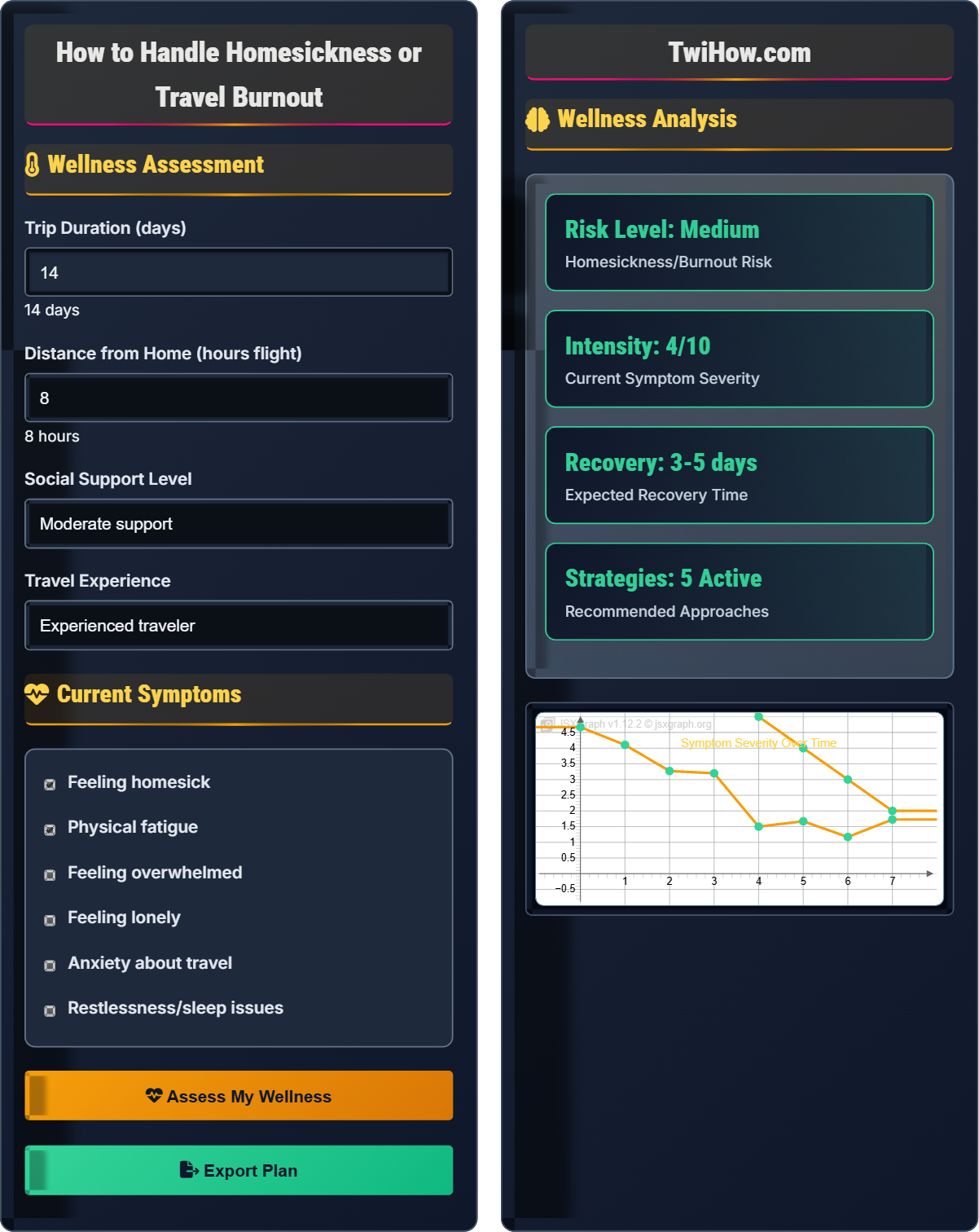
Wellness Analysis
| Strategy | Urgency | Difficulty | Effectiveness |
|---|---|---|---|
| Contact Home | High | Easy | ⭐⭐⭐⭐⭐ |
| Rest & Sleep | High | Medium | ⭐⭐⭐⭐⭐ |
| Local Connection | Medium | Medium | ⭐⭐⭐⭐ |
| Self-Care | Medium | Easy | ⭐⭐⭐⭐ |
| Activity Reduction | Low | Easy | ⭐⭐⭐ |
| Professional Help | Low | Hard | ⭐⭐⭐⭐⭐ |
Homesickness and Travel Burnout Management
Homesickness and travel burnout are common emotional challenges that can affect travelers of all experience levels. Homesickness involves feelings of longing for familiar environments, people, and routines, while travel burnout results from accumulated stress, overstimulation, and physical/emotional exhaustion from constant travel. Both conditions are normal responses to significant environmental and routine changes.
Factors that increase susceptibility to homesickness and travel burnout include:
- Duration of Travel: Extended trips increase exposure to stressors
- Distance from Home: Greater distance may intensify feelings of isolation
- Lack of Social Support: Limited connection with others
- Insufficient Rest: Overpacked schedules without recovery time
- Major Life Transitions: Recent changes in personal circumstances
Effective strategies fall into several categories:
- Connection Strategies: Maintaining contact with home while building local connections
- Rest and Recovery: Prioritizing sleep, rest, and reduced activity levels
- Mindfulness Techniques: Grounding exercises, meditation, and present-moment awareness
- Physical Care: Proper nutrition, hydration, and gentle exercise
- Environmental Comfort: Creating familiar spaces and routines abroad
- Preparation: Research your destination and plan for emotional challenges
- Communication: Stay connected with loved ones through regular check-ins
- Balance: Alternate intensive travel days with rest days
- Self-Care: Maintain familiar comforting routines even while traveling
- Flexibility: Adjust plans when feeling overwhelmed or homesick
Wellness Fundamentals
Homesickness, travel burnout, emotional wellness, coping strategies, self-care.
Wellness Index = (Rest Score + Connection Score + Activity Balance) / 3 - Stress Factors
Where scores are rated 1-10, with higher numbers indicating better wellness.
- Feelings of homesickness are normal and temporary
- Rest and recovery are essential for mental wellness
- Seek professional help if symptoms persist or worsen
Practical Applications
Study abroad, extended business travel, solo travel, backpacking adventures.
- Establish daily check-ins with yourself
- Create portable comfort items and rituals
- Build local social connections
- Maintain physical health routines
- Listen to your body and emotions
- Don't push through severe symptoms
- Have backup plans for rest days
- Know when to seek professional help
Travel Wellness Quiz
Which of the following is the BEST indicator that someone is experiencing homesickness rather than general travel fatigue?
Homesickness is specifically characterized by emotional longing for familiar people, places, and routines associated with home. While missing familiar foods (B) and having sleep issues (D) can be related, they can also occur due to other travel-related factors. Feeling sad and longing for family and familiar routines is the core emotional signature of homesickness.
The answer is C) Feeling sad and longing for family and familiar routines.
Homesickness is distinguished from general travel fatigue by its emotional component - specifically the intense longing for home, family, and familiar environments. While physical symptoms like fatigue and sleep issues may accompany homesickness, the key diagnostic feature is the emotional yearning for home. This understanding helps travelers identify the specific nature of their discomfort and apply targeted coping strategies.
Homesickness: Emotional distress caused by separation from familiar environments
Travel Fatigue: Physical and mental exhaustion from travel activities
Longing: Intense desire for something absent or unattainable
• Homesickness involves emotional longing for home
• Physical symptoms alone don't indicate homesickness
• Recognition is the first step to addressing the condition
• Notice emotional patterns, not just physical symptoms
• Journal about feelings to identify homesickness triggers
• Accept that homesickness is a normal experience
• Confusing general fatigue with homesickness
• Ignoring emotional components of distress
• Not acknowledging homesickness as legitimate
Explain how to prevent travel burnout during a 3-week backpacking trip through Southeast Asia. Include specific strategies for pacing, self-care, and recognizing early warning signs.
Pacing Strategies: Plan for rest days every 4-5 days of activity. Instead of visiting multiple countries weekly, focus on 1-2 countries with deeper exploration. Build buffer time between major activities to account for unexpected delays or needed rest.
Self-Care Practices: Maintain consistent sleep schedule (even if time zones change), drink plenty of water, eat balanced meals, take brief naps when needed, and engage in light exercise like stretching or walking. Bring familiar comfort items like a favorite pillowcase or music playlist.
Early Warning Signs: Persistent fatigue that doesn't improve with sleep, irritability, decreased enjoyment of activities, difficulty concentrating, physical symptoms like headaches, and feeling overwhelmed by simple tasks. When these appear, implement rest days immediately rather than pushing through.
Prevention of travel burnout requires proactive planning and self-awareness. The key is to build recovery time into the schedule before burnout occurs. Pacing prevents accumulation of fatigue, while self-care maintains physical and emotional resources. Recognizing early warning signs allows for timely intervention before severe burnout develops.
Travel Burnout: Mental and physical exhaustion from excessive travel
Pacing: Distributing activities to prevent overexertion
Self-Care: Actions taken to maintain physical and emotional well-being
• Schedule rest days proactively
• Maintain basic health routines
• Act on early warning signs immediately
• Book accommodations with kitchenettes for comfort food
• Limit new experiences to 2-3 per day
• Keep a daily wellness check-in journal
• Overpacking the itinerary
• Ignoring early signs of fatigue
• Not bringing comfort items from home
You're studying abroad in Germany for a semester. After 6 weeks, you're experiencing severe homesickness: crying frequently, having trouble sleeping, losing interest in activities, and constantly comparing your experience to home. Your grades are declining, and you're considering ending the program early. Calculate the severity score (1-10) and recommend an intervention plan that balances staying in the program with addressing your emotional needs.
Severity Assessment: Based on symptoms (crying, sleep issues, declining academic performance, persistent negative mood), this is a severity level 8/10 - severe homesickness requiring immediate intervention.
Intervention Plan: 1. Contact campus counseling services for professional support 2. Increase communication with family/friends at home (daily check-ins) 3. Join study groups or clubs to build local connections 4. Take 2-3 consecutive rest days to recover emotionally 5. Create a "comfort corner" in your dorm with familiar items 6. Speak with academic advisor about workload adjustments 7. Consider a weekend trip to a nearby city to shift perspective
Timeline: Implement interventions immediately, reassess after one week. If no improvement, consider temporary leave or program modification.
Severe homesickness requires multi-faceted intervention addressing emotional, social, and practical needs. The example shows how to systematically assess severity and develop a comprehensive plan that addresses root causes while maintaining goals. Professional support is crucial for severe cases, and flexibility in goals may be necessary while preserving core objectives.
Severity Assessment: Rating system to determine intervention intensity needed
Multi-Faceted Intervention: Approach addressing multiple contributing factors
Professional Support: Help from counselors or mental health professionals
• Seek professional help for severe symptoms
• Address multiple contributing factors
• Reassess interventions regularly
• Don't wait for symptoms to resolve on their own
• Use multiple support channels simultaneously
• Keep detailed records of mood and interventions
• Trying to "tough it out" with severe symptoms
• Only addressing one aspect of homesickness
• Not seeking professional help when needed
You're on a 3-month volunteer assignment in rural Kenya. After 2 months, you're experiencing culture shock, homesickness, and beginning to show signs of travel burnout. The local community is welcoming but you feel isolated due to language barriers. You're questioning whether you can complete the assignment. Develop a comprehensive strategy that addresses cultural adaptation, homesickness, and burnout while respecting your commitment to the community.
Cultural Adaptation: Engage with a local mentor who speaks English to help bridge communication gaps. Participate in local traditions and celebrations to build genuine connections. Learn key phrases in the local language to show respect and effort.
Homesickness Management: Establish regular video calls with family, create a photo wall of home memories, and maintain a gratitude journal focusing on positive experiences. Share your culture with locals to create mutual exchange.
Burnout Recovery: Negotiate with program coordinators for 1-2 rest days per week. Reduce working hours temporarily while maintaining core commitments. Practice meditation or yoga in natural settings.
Community Commitment: Communicate honestly with supervisors about your challenges - most communities appreciate transparency and want volunteers to succeed. Ask for modified responsibilities rather than abandoning the project entirely.
Complex situations like extended international assignments require balancing personal wellness with external commitments. The key is to view challenges as temporary obstacles rather than insurmountable problems. Honest communication with local partners often leads to mutually beneficial solutions that preserve relationships while supporting personal well-being.
Culture Shock: Disorientation experienced in unfamiliar cultural environment
Volunteer Commitment: Obligation to fulfill agreed-upon service responsibilities
Mutual Exchange: Reciprocal sharing of cultures and experiences
• Maintain open communication with hosts
• Adapt responsibilities rather than abandoning commitments
• Focus on gradual cultural integration
• Find local activities that remind you of home
• Connect with other expats or volunteers for support
• Document your growth and adaptation journey
• Viewing local community as source of problems
• Abandoning commitments without communication
• Not adapting approach to changing needs
Which of the following scenarios indicates the need for immediate professional mental health support while traveling?
Persistent thoughts of self-harm or inability to cope represent a serious mental health crisis that requires immediate professional intervention. While missing pets, feeling tired, and wanting to call family are normal experiences during travel, thoughts of self-harm indicate a level of distress that exceeds normal homesickness or travel burnout and requires professional support.
The answer is C) Having persistent thoughts of self-harm or inability to cope.
It's important to distinguish between normal travel-related emotional challenges and serious mental health concerns. Normal homesickness and travel burnout, while uncomfortable, are temporary and manageable with appropriate strategies. However, persistent thoughts of self-harm or inability to function represent a psychiatric emergency requiring immediate professional intervention, regardless of travel context.
Self-Harm Thoughts: Ideas about causing harm to oneself
Psychiatric Emergency: Situation requiring immediate mental health intervention
Functioning: Ability to perform basic life activities
• Seek immediate help for self-harm thoughts
• Normal homesickness doesn't require emergency care
• Know the difference between discomfort and crisis
• Research mental health resources before travel
• Keep emergency contact information accessible
• Don't hesitate to seek help for serious symptoms
• Minimizing serious mental health symptoms
• Not having emergency mental health resources
• Confusing normal discomfort with crisis
FAQ
Q: I'm going on my first solo trip abroad and I'm worried about getting homesick. How can I prepare mentally for this possibility?
A: First-time solo travelers often experience homesickness, so preparation is wise:
Pre-Trip Preparation: Pack comfort items from home (photos, favorite snacks, small keepsake). Set up regular check-ins with loved ones. Practice independent activities at home to build confidence.
Mental Preparation: Normalize homesickness as a common, temporary experience. Create a "wellness toolkit" with coping strategies you know work for you (journaling, meditation, music).
During Travel: Start with familiar activities in new places to create bridges between home and abroad. Gradually increase novelty as you adjust. Remember that homesickness typically peaks around days 3-7 and then begins to subside.
Emergency Plan: Know how to contact support people and have a plan for the worst-case scenario (early return if absolutely necessary).
Q: I travel frequently for work and often feel burned out. What are practical strategies I can use during short layovers and hotel stays?
A: Frequent business travelers need efficient wellness strategies:
Micro-Rest Techniques: 10-minute breathing exercises during layovers, progressive muscle relaxation in hotel rooms, or brief walks around the terminal.
Consistent Routines: Same bedtime routine regardless of location, consistent morning habits, and maintaining basic hygiene practices.
Portable Wellness: Travel-size aromatherapy, noise-canceling headphones, eye mask, and a few comfort items that fit in carry-on.
Technology Boundaries: Set specific times to disconnect from work communications and establish "do not disturb" hours.
Local Connection: Brief interaction with hotel staff or locals, trying one local food item, or taking a quick walk to orient yourself to the location.