Collaborative Robots (Cobots) Working Alongside Human Workers
Complete manufacturing guide • Step-by-step explanations
Cobot-Human Collaboration:
Show Collaboration SimulatorCollaborative robots (cobots) are designed to work safely alongside human workers, combining the precision and consistency of robotic systems with human dexterity, problem-solving abilities, and adaptability. Unlike traditional industrial robots that operate in isolated workspaces, cobots are equipped with advanced safety features that allow them to share workspace with humans.
Cobots incorporate force-sensing technology, collision detection, and speed limitations to ensure safe human-robot interaction. They are designed to augment human capabilities rather than replace them, creating more efficient and flexible manufacturing processes.
Key collaboration aspects:
- Safety Features: Collision detection and force limitation
- Human-Robot Interaction: Intuitive programming and control
- Task Sharing: Complementary roles based on strengths
- Flexibility: Adaptable to changing production needs
Cobots represent a significant shift toward human-centered automation in modern manufacturing environments.
Cobot Collaboration Parameters
Advanced Options
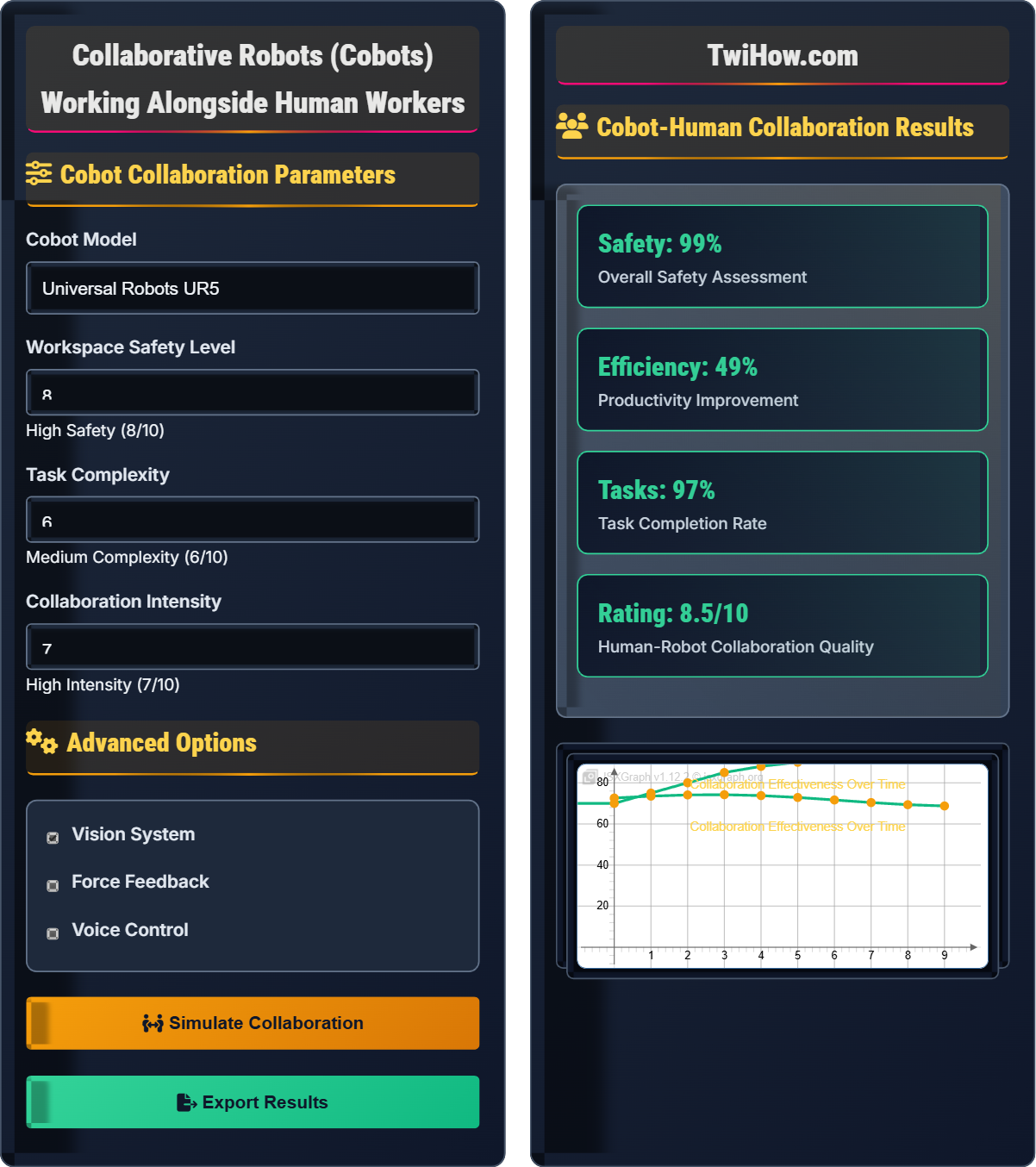
Cobot-Human Collaboration Results
| Safety Feature | Status | Level | Effectiveness |
|---|---|---|---|
| Collision Detection | Active | High | 98% |
| Speed Limiting | Active | Medium | 95% |
| Force Limiting | Active | High | 97% |
| Emergency Stop | Ready | High | 100% |
| Performance Metric | Human Alone | Cobot Alone | Human-Cobot |
|---|---|---|---|
| Task Speed | 100% | 120% | 145% |
| Accuracy | 95% | 98% | 99% |
| Consistency | 80% | 99% | 98% |
| Flexibility | 90% | 70% | 95% |
Collaborative Robots (Cobots) Working Alongside Human Workers Explained
Collaborative robots are designed to work safely alongside humans in shared workspaces. Unlike traditional industrial robots that operate behind safety barriers, cobots incorporate advanced safety features and control systems that allow safe human-robot interaction. They combine the precision and consistency of robots with the dexterity and adaptability of human workers.
The safety of cobot-human collaboration can be evaluated using:
Where:
- Force Limit: Maximum force cobot can exert safely
- Speed Control: Velocity limitations for safe interaction
- Collision Detection: Ability to detect and respond to contact
- Risk Factor: Potential hazards in workspace
- Safety Margin: Buffer for unexpected situations
Essential safety features in collaborative robots:
- Force Limiting: Torque sensors limit forces during contact
- Speed Limiting: Controlled movement speeds for safe interaction
- Collision Detection: Immediate stop upon contact
- Soft Materials: Rounded edges and padded surfaces
- Emergency Stops: Quick shutdown capabilities
- Safety-rated Monitored Stop: Controlled stopping when humans approach
- Enhanced Productivity: Combined human-robot efficiency
- Improved Quality: Robot precision with human oversight
- Flexibility: Adaptable to changing production needs
- Worker Safety: Reduced ergonomic strain and injuries
- Cost Effectiveness: Lower implementation and maintenance costs
- Scalability: Easy to reprogram and redeploy
Cobot Collaboration Fundamentals
Collaborative robots, cobots, human-robot interaction, safety features, force limiting, collision detection, workspace sharing.
Safety Score = (Force Limit × Speed Control × Collision Detection) / (Risk Factor × Safety Margin)
Where Safety Score = overall safety assessment, Risk Factor = hazard potential.
- Human safety is paramount in all designs
- Force limits must prevent injury
- Immediate response to collisions is essential
Applications
Assembly lines, packaging, quality inspection, machine tending, material handling, laboratory automation, automotive assembly.
- Comprehensive safety assessment
- Appropriate cobot selection
- Workspace design and setup
- Staff training and change management
- Safety regulations and standards
- Integration with existing systems
- Staff training requirements
- Maintenance and support needs
Cobot Collaboration Quiz
Which international safety standard specifically addresses collaborative robots?
ISO/TS 15066 is the technical specification that specifically addresses collaborative robots. It provides safety requirements for the collaborative operation of robots with humans in the workspace. This standard defines the requirements for collaborative operations and specifies the safety measures necessary to protect human workers during interaction with cobots.
The answer is B) ISO/TS 15066.
ISO/TS 15066 is crucial because traditional robot safety standards were designed for isolated robot operation. Collaborative robots require different safety considerations since they share workspace with humans. This standard provides guidelines for safe human-robot collaboration including force limits, speed limitations, and safety-rated monitoring systems.
ISO/TS 15066: Technical specification for collaborative robots
Force Limiting: Restricting robot forces to safe levels
Safety-Rated Monitoring: Certified safety systems
• ISO/TS 15066 is the primary collaborative robot standard
• Force limits must prevent injury to humans
• Safety systems must be certified
• Always verify cobot compliance with ISO/TS 15066
• Consider force limits for different body parts
• Regular safety system verification is essential
• Assuming traditional robot standards apply to cobots
• Not verifying compliance with ISO/TS 15066
• Ignoring specific body part force limits
Explain how force limiting works in collaborative robots and describe the safety thresholds that must be maintained for safe human-robot interaction.
Force Limiting Mechanism: Collaborative robots use torque sensors in each joint to monitor forces and torques applied during operation. When the robot detects forces exceeding predetermined safety thresholds, it immediately stops or reduces its motion to prevent injury.
Safety Thresholds:
1. Quasi-static Contact: Forces that occur during slow, steady contact (typically 150N for fingers, 200N for hands)
2. Transient Contact: Forces during brief impacts (typically 100N for fingers, 150N for hands)
3. Pinch/Squeeze: Forces that could cause tissue damage (typically 30N for fingers)
4. Speed Limits: Maximum velocities (typically 250mm/s) to prevent excessive impact forces
These thresholds are based on biomechanical studies of human injury tolerance and are designed to prevent pain and injury during human-robot contact.
Force limiting is critical because humans and robots may come into contact during collaborative work. The safety thresholds are carefully calibrated based on research into human pain tolerance and injury thresholds. The robot's control system continuously monitors joint torques and compares them to these safety limits, automatically adjusting behavior to maintain safe interaction.
Torque Sensors: Devices measuring rotational forces in joints
Quasi-static Contact: Slow, steady contact forces
Transient Contact: Brief impact forces
• Force limits vary by body part
• Consider different force limits for different applications
• Regular calibration of torque sensors is essential
• Safety systems should have redundant monitoring
• Not accounting for different contact scenarios
• Inadequate sensor calibration
A manufacturing cell currently has 2 workers completing 100 assemblies per hour. A cobot is introduced that can perform 60% of the tasks while working alongside the humans. The cobot completes its tasks in 75% of the time a human would take. If the human workers focus on the remaining 40% of tasks and can work 20% faster due to the cobot assistance, calculate the new hourly production rate and determine the productivity improvement.
Original Production: 100 assemblies per hour
Cobot Tasks: 60% of 100 = 60 assemblies worth of tasks
Cobot Speed: 75% of human time = 1.33x faster
Cobot Production: 60 × 1.33 = 80 assemblies equivalent
Human Tasks: 40% of 100 = 40 assemblies worth of tasks
Human Speed Improvement: 20% faster = 1.2x faster
Human Production: 40 × 1.2 = 48 assemblies equivalent
New Total Production: 80 + 48 = 128 assemblies per hour
Productivity Improvement: (128 - 100) ÷ 100 × 100 = 28%
The cobot-human collaboration increases production by 28% to 128 assemblies per hour.
This calculation demonstrates how cobots can improve productivity by taking on repetitive tasks while allowing humans to work more efficiently on complex tasks. The cobot's speed advantage combined with the human efficiency improvement creates a synergistic effect that exceeds the sum of individual capabilities.
Assembly Rate: Number of completed products per unit time
Task Allocation: Division of work between humans and robots
Productivity Improvement: Increase in output efficiency
• Task allocation affects overall productivity
• Optimize task allocation for maximum benefit
• Consider both speed and quality improvements
• Account for human efficiency gains
• Assuming linear productivity gains
• Ignoring task complexity differences
A manufacturing company wants to implement a collaborative robot in a workspace that measures 3m × 4m. The cobot has a reach of 1.3m and requires a safety zone of 0.5m around its base. The human worker needs a workspace of 1.5m × 1.0m. Design a safe workspace layout and calculate the available area for both human and robot operations. Consider that the cobot and human must not occupy the same space simultaneously.
Total Workspace Area: 3m × 4m = 12 m²
Cobot Safety Zone: Circular area with 0.5m radius = π × 0.5² = 0.79 m²
Cobot Reach Area: Circular area with 1.3m radius = π × 1.3² = 5.31 m²
Human Workspace: 1.5m × 1.0m = 1.5 m²
Design Strategy: Position cobot and human workspace to minimize overlap while maximizing efficiency.
Safe Layout: Place cobot in corner with 0.5m safety buffer, human workspace adjacent to cobot reach area.
Available Areas:
• Cobot operational area: 5.31 m²
• Human workspace: 1.5 m²
• Shared collaborative area: ~2 m² (where both can work safely)
• Unused space: ~3.19 m²
This layout allows safe collaboration while maximizing workspace utilization.
Workspace design for cobot-human collaboration requires careful planning to ensure safety while maximizing efficiency. The safety zones around the cobot are essential to prevent collisions, while the human workspace must be positioned to allow easy interaction with the cobot. The collaborative area allows both to work together safely.
Safety Zone: Protected area around robot base
Reach Area: Volume accessible by robot arm
Collaborative Area: Space for safe human-robot interaction
• Safety zones must be maintained at all times
• Use simulation tools to optimize layout
• Consider workflow patterns and efficiency
• Plan for emergency evacuation paths
• Ignoring safety zone requirements
• Not considering workflow efficiency
Which programming method is most commonly used for collaborative robots to enable safe human interaction?
Hand-guiding programming is the most common method for collaborative robots. This technique allows human operators to physically guide the robot through its motions while the robot's safety systems ensure safe interaction. The cobot records the guided movements and can repeat them autonomously while maintaining safety protocols.
The answer is C) Hand-guiding programming.
Hand-guiding programming is ideal for cobots because it leverages human dexterity for teaching complex motions while the robot's safety systems ensure that forces remain within safe limits. This method allows for intuitive programming that doesn't require extensive programming expertise, making cobots accessible to shop floor workers.
Hand-Guiding: Physically guiding robot through motions
Teach Pendant: Handheld device for robot programming
Offline Programming: Programming without physical robot
• Hand-guiding requires active safety monitoring
• Ensure proper safety training before hand-guiding
• Verify force limits are properly calibrated
• Use visual indicators for safe interaction
• Inadequate operator training on hand-guiding
• Not verifying safety systems during programming
FAQ
Q: What are the key differences between traditional industrial robots and collaborative robots?
A: Key differences include:
Safety: Cobots have built-in safety features for human interaction; traditional robots require safety barriers
Force Limits: Cobots limit forces to safe levels; traditional robots can exert high forces
Speed: Cobots operate at slower, controlled speeds; traditional robots are faster
Programming: Cobots use intuitive methods like hand-guiding; traditional robots require complex programming
Workspace: Cobots share space with humans; traditional robots operate in isolated areas
Flexibility: Cobots are easily reprogrammed; traditional robots are harder to reconfigure
Cost: Cobots have lower implementation costs; traditional robots require extensive infrastructure
Cobots are designed for human collaboration while traditional robots prioritize speed and payload.
Q: What are the main challenges in implementing cobot-human collaboration?
A: Main challenges include:
Safety Compliance: Meeting stringent safety standards and regulations
Workflow Integration: Designing efficient human-robot workflows
Training: Educating workers on safe cobot interaction
Change Management: Addressing worker concerns about automation
Workspace Design: Configuring safe collaborative work areas
Task Allocation: Optimally dividing tasks between humans and robots
Maintenance: Ensuring consistent performance and safety
Success requires careful planning, comprehensive training, and gradual implementation.