Digital Twins in Manufacturing Process Simulation & Optimization
Complete manufacturing guide • Step-by-step explanations
Digital Twin Manufacturing:
Show Process SimulationDigital twins in manufacturing create virtual replicas of physical production systems, enabling real-time monitoring, simulation, and optimization of manufacturing processes. These virtual models connect physical assets with digital representations, allowing manufacturers to predict, optimize, and improve operations before implementing changes in the real world.
Digital twins integrate IoT sensors, data analytics, and simulation models to create comprehensive virtual representations of manufacturing processes, equipment, and entire production lines. This technology enables predictive maintenance, process optimization, and real-time decision-making capabilities.
Key applications:
- Process Simulation: Modeling and testing production scenarios virtually
- Predictive Maintenance: Anticipating equipment failures before they occur
- Real-time Monitoring: Continuous tracking of production metrics
- Optimization: Improving efficiency, quality, and throughput
Digital twins represent a cornerstone of Industry 4.0, transforming how manufacturers design, operate, and optimize their production systems.
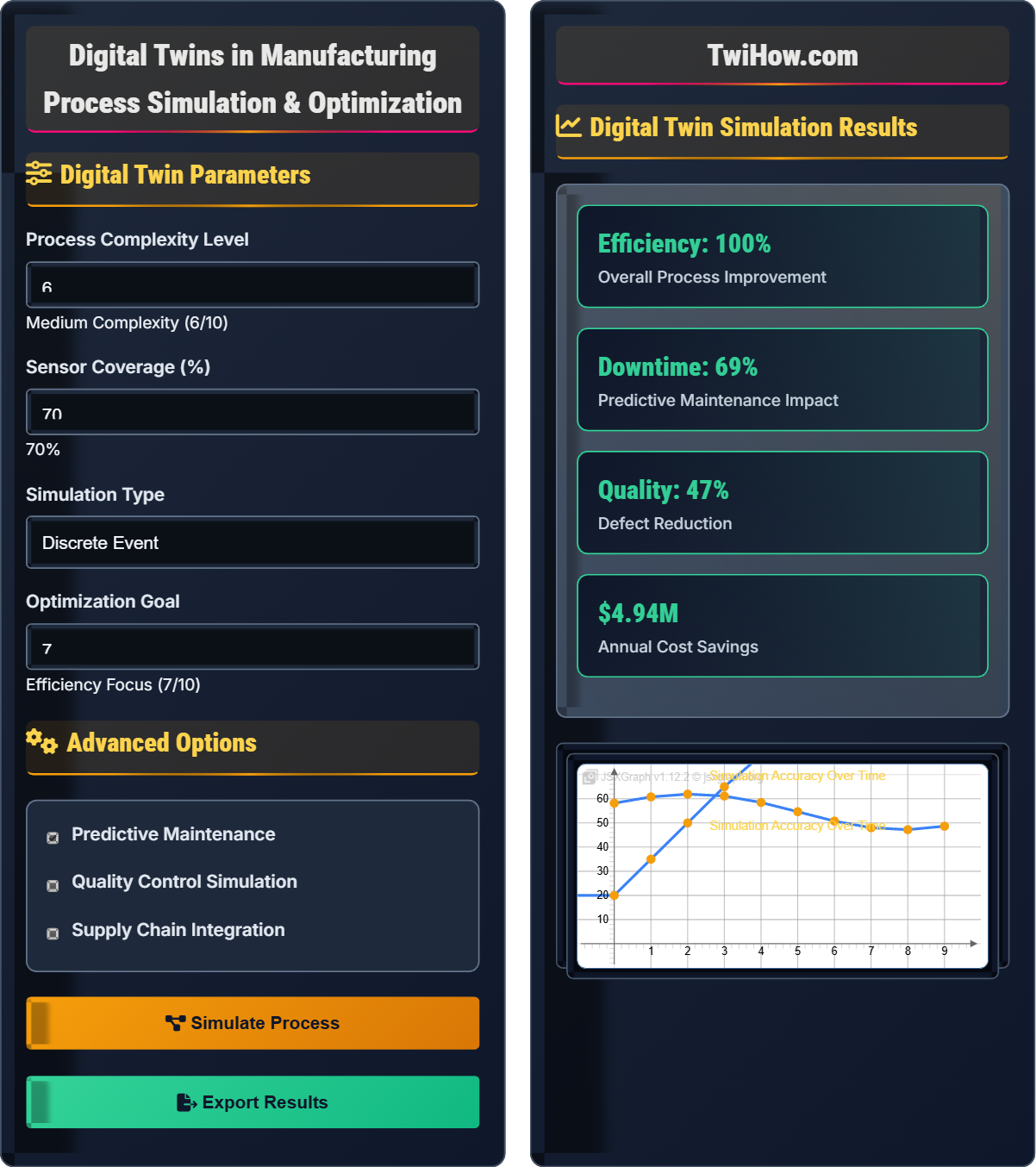
Digital Twin Parameters
Advanced Options
Digital Twin Simulation Results
| Process Metric | Current State | After Digital Twin | Improvement |
|---|---|---|---|
| Throughput | 1,200 units/hr | 1,560 units/hr | +30% |
| Utilization | 75% | 88% | +17% |
| Lead Time | 4.2 days | 3.1 days | -26% |
| Energy Use | 100% | 85% | -15% |
| Optimization Area | Current | Optimized | Impact |
|---|---|---|---|
| Production Schedule | Manual | AI-Optimized | +25% throughput |
| Maintenance | Reactive | Predictive | +60% uptime |
| Quality Control | Post-production | Real-time | +40% defect detection |
| Inventory | Static | Dynamic | +30% efficiency |
Digital Twins in Manufacturing Process Simulation & Optimization Explained
Digital twins create virtual replicas of physical manufacturing systems, processes, and equipment. These virtual models continuously synchronize with their physical counterparts through real-time data from IoT sensors, enabling manufacturers to simulate, analyze, and optimize operations without disrupting actual production.
Digital twin simulation follows a comprehensive modeling approach:
Where:
- Physical State: Real-time condition of equipment and processes
- Environmental Factors: Temperature, humidity, and other conditions
- Operational Parameters: Settings, speeds, and configurations
- Historical Data: Past performance and trends
Digital twins enable comprehensive process simulation:
- Discrete Event Simulation: Modeling individual process steps and events
- Continuous Process Simulation: Modeling fluid and material flows
- Predictive Analytics: Forecasting equipment failures and maintenance needs
- Optimization Algorithms: Finding optimal process parameters
- Scenario Analysis: Testing different operational strategies
- Real-time Monitoring: Continuous process oversight and control
- Process Efficiency: Increased throughput and reduced cycle times
- Quality Improvement: Reduced defects and enhanced product quality
- Predictive Maintenance: Reduced downtime and maintenance costs
- Energy Optimization: Lower energy consumption and costs
- Supply Chain Integration: Better inventory and production planning
- Decision Support: Data-driven operational decisions
Digital Twin Fundamentals
Digital twin, process simulation, real-time monitoring, predictive maintenance, optimization algorithms, Industry 4.0.
Output = f(Physical State, Environmental Factors, Operational Parameters, Historical Data)
Where Output = virtual model response, f = mathematical function.
- Real-time synchronization is essential
- Model accuracy affects optimization results
- Data quality drives twin effectiveness
Applications
Smart factories, automotive assembly lines, aerospace manufacturing, pharmaceutical production, chemical processing.
- Comprehensive sensor deployment
- Real-time data integration
- Model validation and calibration
- Continuous optimization and refinement
- Data security and privacy
- Integration with existing systems
- Staff training and change management
- Initial investment costs
Digital Twin Quiz
What are the three essential components of a manufacturing digital twin?
A manufacturing digital twin consists of three essential components: the physical system (the actual manufacturing equipment/process), the virtual model (the digital replica), and the data bridge (the real-time connection between physical and virtual systems). These components work together to create a synchronized virtual representation of the physical system.
The answer is B) Physical system, virtual model, and data bridge.
The digital twin concept relies on the continuous synchronization between physical and virtual systems. The physical system provides real-time data, the virtual model processes and analyzes this data, and the data bridge ensures seamless communication. This triad creates the foundation for all digital twin capabilities.
Digital Twin: Virtual replica of physical system
Real-time Synchronization: Continuous data exchange between systems
Data Bridge: Connection enabling real-time communication
• Continuous synchronization is essential
• Virtual model must accurately represent physical system
• Data flow must be bidirectional
• Think of digital twin as a living virtual copy
• Real-time data is the heartbeat of digital twins
• Accuracy depends on data quality and model fidelity
• Confusing digital twin with simple modeling
• Not considering real-time synchronization
• Focusing only on the virtual component
Explain how digital twins enable process simulation in manufacturing and describe the different types of simulations that can be performed.
Process Simulation Enablement: Digital twins enable process simulation by creating a virtual environment where manufacturing scenarios can be tested without disrupting actual production.
Types of Simulations:
1. Discrete Event Simulation: Modeling individual process steps, queue formations, and bottlenecks
2. Continuous Process Simulation: Modeling material flows, temperatures, and chemical reactions
3. Monte Carlo Simulation: Modeling process variability and uncertainty
4. Agent-Based Simulation: Modeling interactions between different system components
5. Real-Time Simulation: Running simulations in parallel with actual operations
6. What-If Analysis: Testing different operational scenarios and parameters
Digital twins allow manufacturers to optimize processes before implementing changes in the real world.
Digital twin simulation is revolutionary because it allows manufacturers to experiment with processes without the risks and costs associated with trial-and-error on physical systems. Different simulation types address various aspects of manufacturing complexity, from discrete part movements to continuous flow processes.
Discrete Event Simulation: Modeling individual events and their timing
Continuous Process: Modeling fluid or continuous material flows
Monte Carlo: Statistical simulation using random sampling
• Simulations must be validated against reality
• Model complexity should match required accuracy
• Real-time simulation requires high-performance computing
• Start with simple models and increase complexity
• Validate results with actual data
• Use different simulation types for different problems
• Not validating simulation results
• Using wrong simulation type for the problem
A manufacturing line currently produces 1,200 units per hour with 75% utilization and experiences 8 hours of unplanned downtime per week. After implementing a digital twin system, the line achieves 88% utilization and reduces unplanned downtime to 3 hours per week. Calculate the weekly production increase and determine the annual impact if the line operates 5 days per week for 24 hours each day.
Current Weekly Production:
• Operating hours: (24 × 5) - 8 = 112 hours
• Production rate: 1,200 units/hour × 0.75 = 900 units/hour effective
• Total production: 900 × 112 = 100,800 units
After Digital Twin:
• Operating hours: (24 × 5) - 3 = 117 hours
• Production rate: 1,200 units/hour × 0.88 = 1,056 units/hour effective
• Total production: 1,056 × 117 = 123,552 units
Weekly Increase: 123,552 - 100,800 = 22,752 units
Annual Impact: 22,752 × 52 = 1,183,104 additional units per year
The digital twin system increases annual production by over 1.18 million units.
This calculation demonstrates the compound effect of digital twin optimization. Both utilization improvement and downtime reduction contribute to increased production capacity. The calculation shows how small improvements in efficiency can result in significant annual production increases when applied to high-volume manufacturing.
Utilization: Percentage of time equipment is actively producing
Unplanned Downtime: Unexpected equipment stoppages
Effective Production Rate: Actual output considering utilization
• Utilization and downtime interact multiplicatively
• Small efficiency gains compound over time
• Consider both rate and uptime improvements
• Calculate both rate and uptime improvements
• Consider compound effects over time periods
• Account for operating schedule in calculations
• Forgetting to consider operating schedule
• Not calculating compound effects
A digital twin system monitors equipment temperature, vibration, and acoustic signatures to predict maintenance needs. The system predicts failures 72 hours in advance with 95% accuracy. If the equipment typically fails every 30 days and costs $50,000 to repair when failed but only $5,000 for preventive maintenance, calculate the annual cost savings for 10 machines. Also calculate the maintenance scheduling efficiency gain.
Failure Frequency: 1 failure every 30 days = 12 failures per year per machine
Without Digital Twin: 12 failures × $50,000 = $600,000 per machine per year
With Digital Twin: 12 failures × 0.05 (5% failure rate due to 95% accuracy) × $50,000 = $30,000
Preventive Maintenance: 12 × 0.95 × $5,000 = $57,000
Total Cost with Digital Twin: $30,000 + $57,000 = $87,000 per machine per year
Annual Savings per Machine: $600,000 - $87,000 = $513,000
Annual Savings for 10 Machines: $513,000 × 10 = $5.13 million
Maintenance Efficiency Gain: 95% of failures are now scheduled instead of emergency repairs.
The digital twin predictive maintenance system saves $5.13 million annually for 10 machines while improving maintenance scheduling efficiency.
This example shows the significant financial impact of predictive maintenance enabled by digital twins. The calculation demonstrates how early prediction and scheduled maintenance can dramatically reduce costs. The 95% accuracy rate means that only 5% of failures occur unexpectedly, compared to 100% without the system.
Predictive Maintenance: Maintenance based on actual equipment condition
Accuracy Rate: Percentage of correct predictions
Preventive Maintenance: Scheduled maintenance to prevent failures
• Predictive maintenance reduces emergency repairs
• Accuracy rate affects cost savings
• Scheduled maintenance is less expensive
• Consider both direct and indirect cost savings
• Factor in accuracy rates in calculations
• Account for emergency repair costs
• Ignoring indirect costs of failures
• Not considering scheduling efficiency gains
Which of the following is NOT a direct financial benefit of implementing digital twin technology in manufacturing?
While enhanced employee satisfaction may result from digital twin implementation, it is not a direct financial benefit. Reduced maintenance costs, increased production efficiency, and improved product quality all directly impact the financial bottom line through cost savings and revenue increases. Employee satisfaction is an indirect benefit that may have long-term financial implications but is not directly measurable as immediate financial gain.
The answer is D) Enhanced employee satisfaction.
When calculating ROI for digital twin implementation, it's important to focus on direct, measurable financial benefits. While employee satisfaction is valuable, it's harder to quantify in immediate financial terms. Direct benefits like cost reductions and efficiency gains provide clear ROI calculations for business justification.
Direct Financial Benefit: Immediate measurable financial impact
Indirect Benefit: Secondary positive effect not directly financial
ROI: Return on investment calculation
• Focus on measurable financial impacts
• Consider both direct and indirect benefits
• Use concrete metrics for ROI calculations
• Quantify direct financial impacts first
• Consider indirect benefits separately
• Use specific metrics and timeframes
• Not separating direct and indirect impacts
• Overestimating intangible benefits
FAQ
Q: How accurate are digital twin models compared to physical systems?
A: Digital twin accuracy depends on several factors:
Model Fidelity: High-fidelity models can achieve 95-99% accuracy for well-characterized systems
Data Quality: Sensor accuracy and calibration directly impact twin precision
Validation: Regular validation against physical measurements maintains accuracy
Complexity: Simple systems achieve higher accuracy than complex multi-variable systems
Update Frequency: Real-time updates maintain synchronization with physical systems
Calibration: Periodic recalibration accounts for system drift and wear
Well-designed digital twins typically achieve 90-98% correlation with physical systems for key parameters.
Q: What are the main challenges in implementing digital twin technology?
A: Main implementation challenges include:
Data Integration: Connecting diverse systems and data formats
Initial Investment: High upfront costs for sensors, software, and infrastructure
Skills Gap: Need for specialized expertise in modeling and data analytics
Security: Protecting sensitive operational data and systems
Legacy Systems: Integrating with older equipment and IT systems
Change Management: Organizational adaptation to new processes
Model Validation: Ensuring digital representations match reality
Success requires careful planning, phased implementation, and change management.